SOUTHEAST ARCHEOLOGICAL CENTER (SEAC) WISH/NEEDS LIST Archeological Field Program Support/Museum and Curatorial Support High efficiency, high capacity field vehicles --- SEAC needs two high-capacity (6+ passenger), high efficiency (25+mpg), flexible-configuration field vehicles for transporting medium to large crews to and from the field. Ideally, these vehicles could be standard-sized vans, SUVs, or crew-cab trucks. Our best option would be capable of running on alternative fuels (biodiesel, E-85 Ethanol, or Natural Gas). Specific models that meet our criteria include the hybrid Toyota Highlander and the Dodge Sprinter Passenger Van (diesel). High efficiency passenger vehicles --- SEAC needs two smaller (2-5 passenger), high efficiency (40+mpg), flexible-configuration field vehicles for transporting small crews, museum collections, and other NPS equipment to and from the field. Ideally, this vehicle could be a small sedan, station wagon, or SUV that can run on alternative fuels (biodiesel, E-85 Ethanol, or Natural Gas). SEAC established a no-cost lease with Volkswagen of American between 2003 and 2006 for a 2004 Jetta station wagon, which met our requirements. Current models that meet our requirements include the Toyota Prius, Honda Civic Sedan, Volkswagen Jetta Diesel Sedan and Station Wagon, and the Passat Diesel Sedan. Tablet computers for field-based data entry (Windows-based) --- These five computers will be used by SEAC staff members to take notes in the field, enter site-based data (GPS positions, Total Station data, Ground Penetrating Radar data, photographs), and prepare reports. Autolevel --- This instrument assists archeologists in maintaining site provenience across large archeological sites by allowing field crew members know immediately how far they are below a set datum in the excavation unit in which they are working. This instrument usually comes with a transmitting head and several receivers that can be used in excavation units. Total Station --- This instrument will assist archeologists in precisely locating artifacts on sites, and mapping the physical features and topography of sites. While this instrument is usually used by surveyors and in the building industry, it is well-adapted for archeological use. A total station that incorporates GPS positioning would be the best choice due to the remote locations in which some projects are conducted. GPS equipment --- SEAC is in need of a second backpack-mounted GPS unit that is compatible with the existing SEAC Trimble GPS unit. The current unit is Trimble model Pro XRS. The compatible unit, software, and accessories are listed below:
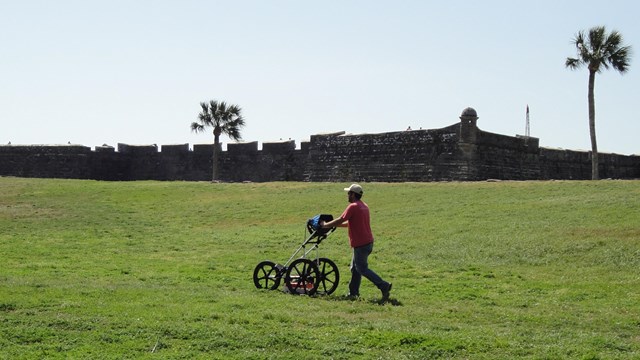
Geoscan Research Resistivity Meter --- SEAC archeologists need the following equipment to improve our capability to non-destructively explore and document archeological sites. This meter measures differences in the resistance of soil to an induced electrical charge. The goal of non-destructive research is consistent with NPS Management Policy (2006), as well as the Secretary of Interior standards. Both the items bulleted below and the following item will assist in reaching this identified goal.
Geonics EM-38 Model MK2-2 conductivity meter --- This meter measures how well soil conducts an induced electrical field. Differenced in the conductivity of soil can direct archeologists to buried structures and other site features. Contact: Brinnen Carter, SEAC Authorization: DO 21, Section 5.1 |