National Park Service, U.S. Department of the Interior
Southeast
Archeological
Center
 
Tallahassee, Florida
Large banner image of SEAC archeologists conducting fieldwork.
Text Size:  Icon to change text size to small. Icon to change text size to medium. Icon to change text size to large.
Featured Project

The Salt Springs Site: An Ancient Shoreline Revealed (Cont'd)

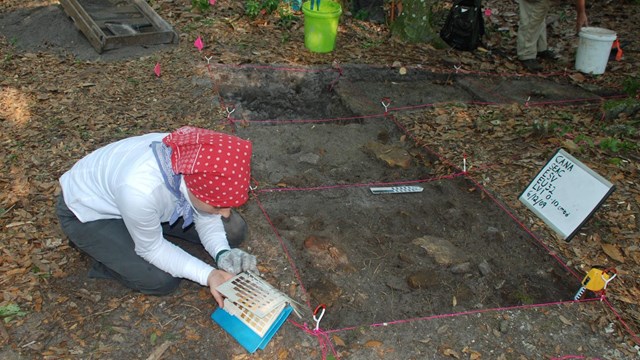
Figure 3. Archeologists from the NPS and USFS excavating in the footprint of the retaining wall.

Figure 3. Archeologists from the NPS
and USFS excavating in the footprint
of the retaining wall.
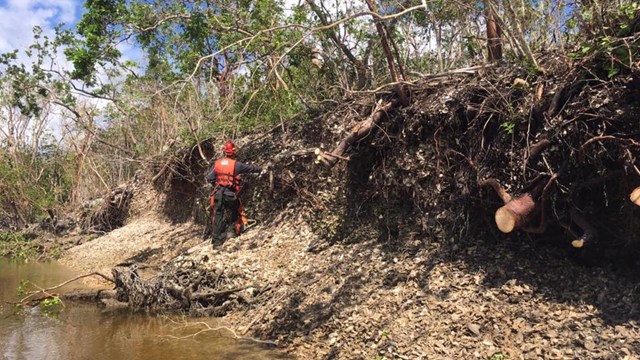
In all, thirty-four excavation units were placed in the foot print of the retaining wall (Figure 3). Excavations revealed a spring/river run shoreline marked by 50 to 100 cm of botanical materials commonly found along the shores of freshwater marshes. Preliminary analysis identified plant species including marsh grasses, leaves of shoreline trees such as oak, hickory and palm, with abundant hickory nuts, acorns and other seeds present.

These data have the potential to inform us about the changing environmental conditions that were occurring during a rapid rise in sea level 6.000 years ago. As sea levels rose, the pressure on the Floridian aquifer increased and Salt Springs began flowing more profoundly. Formerly a minor seep spring, Salt Springs became the headwaters of a major river tributary. Marsh lands developed along its run, creating a more welcoming environment for Native Americans seeking the wetlands' edible plants, fish, and shellfish.

Figure 4. Gourd seeds and rind fragments.
Figure 4. Gourd seeds and rind
fragments.

Included in the botanical remains were well-preserved gourds (Figure 4). The discovery of gourds in such an excellent state of preservation is important to archeologists because the gourd is thought to be one of the earliest crops domesticated in the New World. Examinations of the gourds' shapes and genetic make-up have the potential to tell us what stage the process of domestication had achieved by 6,000 years ago. Since ceramics were not developed until 4000 years ago, gourds would have been used as light-weight containers for storage, as well as easily transpotable dippers and dishes.

Figure 5. Carved wooden object.

Figure 5. Carved wooden object.

Also present in the shoreline deposits were numerous wooden logs with axed marks as well as carved pieces of wood (figure 5). Analyses of these and all the botanical remains from Salt Springs are currently being undertaken by Dr. Lee Newsom and her students, including Johanna Talcott of Penn State University who participated in the fieldwork at Salt Springs.


Next. . .
Back


National Park Service arrowhead logo Seac Home