The
Fort Pulaski Cemetery
The most studied area of Fort Pulaski National Monument
with regards to archeology is the cemetery located across the moat from
the northwest side of the demilune (Click here for a Map
with the Cemetery's Location). The earliest burial at the site is
that of Lieutenant
Robert Rowan, an officer stationed at Fort Greene, who died in 1800.
Based on archeological and archival research concerning the cemetery,
it is generally felt that Rowan's burial was moved from somewhere else.
This is due to the simple fact that the land the fort's cemetery resides
on was built during the construction phase of Fort Pulaski somewhere
between 1829 and 1847. The grave of Lieutenant Rowan is 1 of only 2
burials marked by any type of grave marker (Click for a picture of Rowan's
Headstone - 56 KB). The other marked burial in the cemetery belongs
to the infant son of Lieutenant Charles and Marion Sellmer, who died
at the Quarantine Station on Cockspur Island in 1872. The 37 other identified
burials in the cemetery belong to Confederate or Union troops, or post-Civil
War civilian and military personnel. There is also the possibility that
some of the laborers who helped build the fort are buried here, but
so far there is no archeological or archival evidence to support this.
To view a map showing the locations of all the burials in the Fort Pulaski
cemetery, click here. Click on each
section of the map for more information.
1998
investigations in the area of the cemetery helped to reveal the construction
of the land that slopes away from the fortification, or glacis.
This is the land on which the cemetery is located. A 1 meter wide by
10 meters long by 2 meters deep trench was dug perpendicular to the
northwest side of the moat (Click here for a Map
of the Trench Profile - 63 KB). The glacis, created during the fort's
construction period, utilized soil taken from the adjacent moat. Its
layering is an exact opposite of what would have been seen originally,
with the top layer of soil in the moat area being on the bottom of the
glacis. Because of this reverse stratigraphy, it is relatively
easy to discover the boundaries of the glacis and figure out what areas
were disturbed by burials or reconstruction activities.
The Search for the Immortal 600
The
520 Confederate prisoners, who later came to be known as the "Immortal
600", arrived at Fort Pulaski near the end of October 1864 (Click
here for More
Information on the Immortal 600). When they left on March 5, 1865,
9 of their members were buried outside the walls of Fort Pulaski and
4 more would soon join them. The location of the burials of those belonging
to the Immortal 600 has been an important focus of much of the research
done at the cemetery of Fort Pulaski.
1994 Remote Sensing Investigations
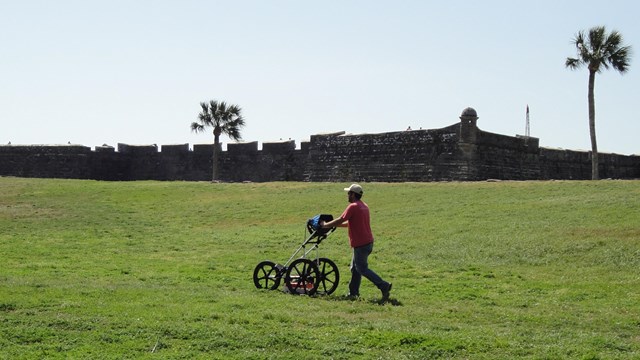
A 1994 remote sensing survey of the cemetery area
was undertaken by Southeast Archeological Center archeologists for the
purpose of locating the section containing the Immortal 600 burials.
Remote sensing is a way of locating underground features without actually
digging. In this particular case, their instrument relied on variations
in magnetic properties between different types of soils to show possible
locations of features. Once an area is identified as containing a possible
feature, a relatively small hole is then dug to see if any materials
are located in the area. This process is known as ground truthing.
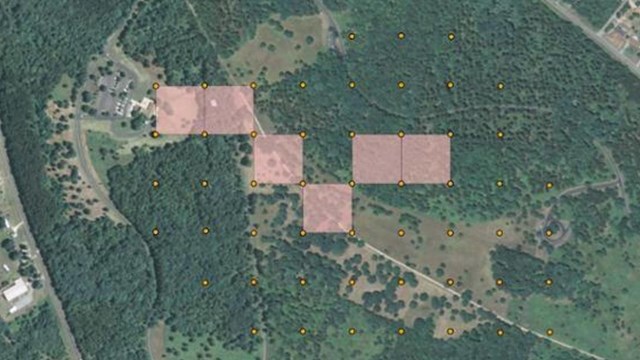
The 1994 survey was conducted at the eastern end of the cemetery area
(Click for a Map of the Survey Area).
It was unable to locate the area of the Confederate graves, although
it did identify an area of 1930s related disturbance in the southeast
portion of the cemetery. Various levels of disturbance in the area of
the cemetery would make remote sensing investigations very unreliable
due to the introduction and mixing of multiple soil types.
Archival Research and the 1998
Investigations
Research performed at the National Archives by Mauriel
Joslyn and John Jameson (Jameson 1997) located some pertinent information
dealing with the Fort Pulaski cemetery. While initially focused on materials
related to the Immortal 600, they also showed that most, if not all
of the Union soldiers buried at Fort Pulaski were exhumed following
the war. Joslyn's research pointed specifically to the removal of burials
from the Rhode Island section of the cemetery. In addition, she compiled
a list of the 13 members of the Immortal 600 who were known to have
died at Fort Pulaski (see table below). Jameson recovered a list of
burials in the Fort Pulaski cemetery initially dated to 1873, but containing
two additions from 1879 (Click here for the 1873/1879
List). The 8 members of the Immortal 600 that showed up on the 1873
list are indicated below with a corresponding number.
|
List
of "Immortal 600" Confederate Dead Buried at Fort Pulaski
Click on a name for more information about their death. This information
comes from Mauriel Joslyn's 1996 book entitled, Immortal
Captives.
|
|
Name
|
Grave # in Joslyn
|
1873 Burial List #
|
Roster Date
|
|
Burney,
I.L.
|
-
|
11
|
Nov. 12, 1864
|
|
Fitzgerald,
George
|
5
|
-
|
Nov. 13, 1864
|
|
Lane, C.C.
|
-
|
13
|
Dec. 08, 1864
|
|
Burgin,
John M.
|
-
|
-
|
Jan. 28, 1864
|
|
Legg,
Russell W.
|
5
|
-
|
Feb. 07, 1865
|
|
Bradford,
Moses J.
|
6
|
12
|
Feb. 13, 1865
|
|
King,
Alex M.
|
7
|
-
|
Feb. 15, 1865
|
|
Rosenbalm, E.A.
|
-
|
10
|
Feb. 18, 1865
|
|
Goodloe, T.J.
|
-
|
8
|
Feb. 27, 1865
|
|
Brumley, O.R.
|
-
|
6
|
Mar. 4, 1865
|
|
Eastham,
C.B.
|
-
|
7
|
Mar. 6, 1865
|
|
Gannoway, J.T.
|
-
|
9
|
Mar. 10, 1865
|
|
Tolbert, John H.
|
-
|
-
|
Mar. 14, 1865
|
Table
taken from Lou Groh's 1999 report entitled, Archeological
Investigations
at Fort Pulaski National Monument, Chatham County, Georgia.
A July 16, 1874, newspaper article from the Savannah
Morning News reported the names on 8 Confederate grave markers
as well, but the names appear to be derived from the 1873 burial list
because of the spelling inconsistencies seen in both (Click for the
Newspaper Article). These inconsistencies
could have occurred due to the fact that the Confederate troops imprisoned
at Fort Pulaski were not allowed to place grave markers at the burials
of their deceased comrades. When markers were finally placed years
later, the exact information and spelling was sometimes lost (Click
here for the location of the Grave
Marker Locations Uncovered During Archeological Investigations).
As can be seen on the "Grave Marker Location" map, there
are eight grave markers in the Confederate section of the graveyard.
These markers probably coincide with the 8 names in both the 1873
Cemetery List and the 1874 newspaper article. Whether these 8 names
actually correspond with those buried in these locations may never
be known.
With the available archival and remote sensing information,
the 1998 field season sought to pinpoint the cemetery location and
the location of the Immortal 600 burials. Specifically,
the archeologists' main goals were to locate the unmarked graves of
the Confederate officers imprisoned at Fort Pulaski and to define
the boundaries of the cemetery. Based on an 1863 sketch map done by
Reverend Frederic Denison, Chaplain for the 3rd Rhode Island Heavy
Artillery, much of the search for the Confederate graves was confined
to the eastern half of the cemetery (Click here for Denison's
Map). As can be seen on his map, the eastern section of the cemetery
was reserved for Confederate burials, of which there were 4 dating
to the time before the arrival of the Immortal 600. The lowercase
"c" on the map indicates the position of a memorial cannon
buried muzzle down marking the location of the cemetery. This cannon
was removed by National Park Service staff in the 1970s and conserved,
and now sits atop the walls of Fort Pulaski.
During the excavations, a number of burials oriented
perpendicular to the previously discovered east-west burials were
located and mapped. The north-south graves were likely coffin burials
used by post Civil War military personnel and their families (Click
here for a Map of the North-South
Burials and a Photograph of 2 North-South
Burials). Due to unfavorable excavation conditions, further research
was postponed until the following field season.
The 1999 Investigations
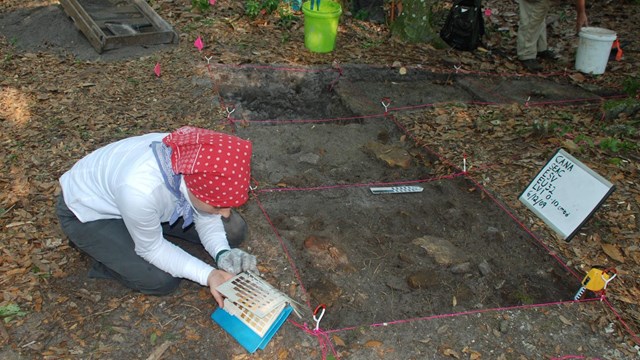
Extensive excavations were conducted in 1999, leading
to the complete delineation of the cemetery's boundaries (Click here
for the Cemetery Map - 40 KB). 37
separate burials were identified, including the ones recorded during
the 1998 field season. Of these, 19-21 lie in the general area of the
Confederate section and were, therefore, thought to be related to burials
of Confederate prisoners at Fort Pulaski. So far, only 17 Confederate
dead can be accounted for in the archives. Based on archival research
and the 1999 excavations, it is felt that most of the Union troops who
died during the Civil War were exhumed, and their cemetery plots were
reused by civilians and post-Civil War military personnel. This is based
mainly on the non-standard orientation of burials going north-south
as opposed to east-west.
In addition to the 37 burials, 5 areas of graveyard disturbance
were also identified during the 1999 investigations. These included:
-
the removal of the memorial cannon mentioned in the
above section
-
the 1950 placement and 1994 removal of the Fort Screven
monument
-
digging from the addition and removal of a walkway
around Rowan's grave
-
the 1930s addition of fill dirt on the northern part
of the cemetery
-
and the 1930s addition of fill dirt on the entire
moat side of the cemetery.
The disturbances that occurred in the middle of the cemetery,
such as the cannon removal and the addition/removal of the Fort Screven
monument, probably impacted the surrounding burials somewhat. Both of
these areas can be seen in green on the cemetery
map (40 KB). In addition to these 5 disturbances, the following
was written in the 1874 newspaper article mentioned in the above section:
|
A few days since, while on an excursion with
some up-country friends to Fort Pulaski, our attention was attracted
by a neat enclosure containing several graves marked with head-boards,
marking the graves of deceased soldiers. Upon enquiry of Colonel
Howard, Commandant of the Fort, we learned that the graves
were those of Confederate officers, whose remains had been gathered
and buried there by his direction. (emphasis added)
|
The above quotation from the newspaper article implies
that United States troops stationed at Fort Pulaski after the Civil
War possibly moved some of the burials and placed grave markers showing
their locations. Furthermore, the presence of an enclosure indicates
that there may have been some additional disturbance caused by its construction.
These are just two more examples illustrating why our understanding
of the Fort Pulaski cemetery is still so cloudy.
The cemetery at Fort Pulaski is an area of incredibly
complex archeological and historical context. Only through the combined
efforts of archeology and archival research will the many and varied
uses of it be more fully comprehended. As part of the above-mentioned
investigations, the extent of the cemetery was defined so that future
maintenance and restoration work at the fort would not disturb the cemetery
area. This helps to ensure that the information contained within this
area will be there for further study.
Needs
for Additional Research
The majority of the known cultural resources located with
the monument are related to the construction and function of the Civil
War fortification of Fort Pulaski. Former Park Superintendent Ralston
B. Lattimore and Historian Rogers W. Young have provided excellent documentation
regarding the construction history and events relating to the fort.
However, outside these areas, very little is known regarding the Civil
War era archeological resources. Therefore, it is recommended that systematic
subsurface testing be conducted on all of Cockspur Island to identify
and determine intra site boundaries. Archeological investigations that
focus on identifying construction methods and materials, site boundaries,
structure function, and structure associations would greatly aid current
site interpretations. The resulting data recovered from the investigations
would also aid in evaluating the national, state, and local significance
of archeological resources associated with the Civil War era at Fort
Pulaski National Monument.*
*Paragraph excerpted from Lou Groh's
2000 report, Fort Pulaski National Monument: Archeological Overview
and Assessment, from "Chapter 7: Recommendations for Future
Archeological Research", page 97. Published by the Southeast Archeological
Center of the National Park Service, Tallahassee, Florida.
Archeology
of the Post Civil War Era
Table
of Contents
|