STEWARDS OF THE PAST: PRESERVING ARIZONA'S ARCHAEOLOGICAL RESOURCES THROUGH POSITIVE PUBLIC INVOLVEMENT
Teresa L. Hoffman
Introduction In the face of increasing pressures upon the global environment, it comes as no surprise that the archaeological remains of our cultural heritage are at greater risk. This is particularly true in the United States where the tangible evidence of our nation's collective ancestry is not always afforded protection on private land as it is in other nations, and where sites on public land are increasingly vulnerable to impacts from the growing numbers of citizens seeking recreation in the great outdoors. How we choose to respond to these changing conditions, and to influence the manner in which people relate to the prehistory and history of our nation, will have a major impact on the future survival of those resources. Recognizing that people generally do not respond favorably to negative messages couched in legal terms, Arizona archaeologists have taken a positive approach to the issue of site looting and vandalism. Encounters with archaeological sites are seen as opportunities for offering information and positive messages about the value of these resources. There is also a growing ethic that it is a duty to provide access to these resources, rather than taking steps to keep the public away. This is particularly evident for the Federal Government as reflected in the 1988 amendments to the Archaeological Resources Protection Act (PL 96-95) which calls for each federal land manager to "...establish a program to increase public awareness of the significance of the archaeological resources located on public lands and Indian lands and the need to protect such resources." Also, it is clear that resource avoidance is not always possible, or desirable. In some cases, increasing site access provides a measure of protection by enhancing visibility and providing a sense of "presence," although the degree of access must be considered. In northern Arizona, the Coconino National Forest has had success in curbing looting and vandalism by placing interpretive signs and guest registers at several sites experiencing increasing pressures (Pilles 1989). The interpretive sign provides information on the site and requests cooperation in its preservation. The guest register also provides some interpretive material, and indicates that the "patrolling ranger" can be contacted for more information. Although there may actually be no regular patrol by a ranger, the implied presence of a site monitor has a beneficial effect.
Arizona's Site Steward Program
The Arizona Site Steward Program, an organization of volunteers, developed as a statewide, cooperative response to curb site destruction, gather information, and provide positive opportunities for public involvement. These objectives are met by placing Stewards in the field at specially selected resources. The public land managers of Arizona and a Native American tribal government sponsor the Steward Program. Stewards are selected, trained and certified by the State Historic Preservation Officer (SHPO) and the Archaeology Advisory Commission and, in general, most Stewards are not professional archaeologists. They are interested and concerned citizens who share an appreciation and respect for our rich cultural heritage and choose this avenue to contribute to its preservation. It is no coincidence that many Stewards are members of the two avocational archaeology organizations in the state, the Arizona Archaeological Society (AAS) and the Arizona Archaeological and Historical Society (AAHS). The following "Statement of Purpose" outlines the basic program tenets from the Arizona Site Steward Program Handbook for Volunteers (Bashaw 1990:1).
Statement of Purpose
In recognition of the fact that prehistoric and historic archaeological materials are irreplaceable national cultural resources, the Arizona Site Steward Program works toward the following goals:
The current focus of the program is primarily on items 1-3, and 6 at this relatively early stage of operation.
Program Development
The Site Steward program is strongly rooted in the history of the growth of public archaeology in Arizona, and tied to the Arizona Archaeology Advisory Commission. A brief synopsis of this history is provided here, while a detailed explanation can be found elsewhere (Hoffman 1988, Hoffman and Lerner 1986, 1988, 1989; Rogge 1989; also see Lerner, Rogge this volume). The Commission was created in 1985 by the Arizona Legislature to act as an advisory body to the SHPO. Early in its development, the Commission adopted the position that deterring looting and vandalism through informational and educational activities should be a high priority, and many proposals for programs that would accomplish these goals were considered. However, the most fruitful approach appeared to be a statewide program of volunteer Site Stewards who would monitor the condition of archaeological sites. There had been increasing interest in establishing a volunteer program of this type. In 1982, two short-lived efforts involving avocational archaeologists from the AAS and the AAHS were tried in southern Arizona for specific sites on State land. In addition, the U.S. Forest Service and Bureau of Land Management have used volunteers to patrol sites on their lands. However, until the recent efforts of the Commission, no attempt had been made to coordinate such activities, or to determine needs and priorities for site patrols, on a statewide basis. At the Commission's first meeting on December 6, 1985, then-Governor Bruce Babbitt indicated his interest in the Texas Archaeological Stewardship Network, and suggested that the Commission investigate the feasibility of a similar program to protect Arizona's resources. The Commission made the Steward Program a top priority and formed the Law Enforcement Committee to pursue this. At its first meeting on January 25, 1986, the Law Enforcement Committee began its efforts, and soon discovered that volunteer initiatives to identify and protect cultural resources were rare. Only six formal programs could be identified. In 1972, British Columbia had formed a similar program, and Saskatchewan, Ontario, Australia, and South Carolina had apparently attempted such programs, as well as Texas. Currently, active programs are in place only in British Columbia, Australia, and Texas. The State of Texas and the Province of British Columbia were approached to obtain information on their programs. During the spring of 1986, the Committee prepared a proposal to develop a steward program in Arizona. The Commission formally approved this proposal on June 5, and press releases immediately were distributed statewide to recruit volunteers. By August 7, a Statewide Coordinator and thirteen Region Coordinators had been selected from twenty-two applicants, and on October 1 a general meeting of the Stewards and Commission was held to organize the program. Throughout the next year and a half, a draft handbook and initial training program were developed, and the program was given a trial test on the Coconino and Tonto National Forests. Issues of liability and insurance were resolved through federal and state volunteer agreements (Pilles 1989: 42). In addition, an Intergovernmental Agreement (IGA) defining and formally creating the program was developed and signed by the SHPO, Arizona State Parks; the Bureau of Land Management; the State Land Department; the USDA Forest Service, Southwestern Region; and the Hopi Tribe. The IGA served to define the purpose and organization of the program, and assigned responsibilities for program administration, operation, and support to each of the participating parties. The final IGA was filed in March 1988 with the Arizona Secretary of State, and by midyear the program was functioning on a statewide basis.
Program Organization
As a result of signing the IGA, the program was formalized and the stage was set for defining the roles of everyone involved. As currently organized, the main players in the Site Steward Program are (1) the signators of the IGA; (2) the Archaeology Advisory Commission and the Site Steward Committee; (3) the Statewide Coordinator; (4) the Region Coordinators; and (5) the Site Stewards. The role of each of these and how they integrate is discussed below. The SHPO provides administrative support for the program from its offices, including a computerized system to track progress in terms of personnel training, volunteer hours, and site monitoring results.
Role of the SHPO
With oversight responsibility for the entire program, the SHPO selects and trains volunteer coordinators, formulates procedures for administration and training, creates and oversees the conduct of a training program, and oversees public information statewide. In addition, the SHPO reports annually on the activities and accomplishments of the Site Steward Program to the participating parties and the public. The majority of these activities are done in coordination with the Statewide Coordinator who works out of the SHPO offices.
Role of Land Managers
Each of the land managers develops a list of prioritized sites for monitoring, and executes volunteer agreements with Site Stewards working on their respective lands. Law enforcement contacts are identified and the reporting procedures to be followed are outlined. Ideally, each agency has a coordinator or coordinators for Site Steward activities on its lands. This coordinator as well as other archaeologists within the agency participate in both field and classroom training for Stewards, and usually takes Stewards and/or Region Coordinators out on the initial site visits. The coordinator is the land manager's representative and often nominates sites for monitoring and works closely with the Region Coordinator and Stewards to develop local procedures for scheduling monitoring, establishing priorities, site recording, protection and maintenance, and local program support.
Each agency works together to monitor program activities. This is done primarily under the auspices of the Site Steward Committee which contains at least one representative of each signatory of the IGA. At least annually, the signatories of the IGA are to evaluate the effectiveness of the Site Steward Program, make recommendations, and acknowledge superior performances.
Role of the Commission
As an advisory body to the SHPO set in Arizona statute, the Commission initiated the Steward Program and reviews the recommendations of the Statewide Coordinator for Region Coordinators, receives reports on current program activities at each meeting, delegates one member to sit on the Site Steward Committee, and reports on the Site Steward Program to the Governor, Legislature, and others as part of its annual report. Commission members are appointed by the Governor. They receive no compensation for their services, nor do they have a budget so support of the program is limited.
Role of the Site Steward Committee
This committee is composed of representatives of each signatory to the IGA as well as a member of the Commission, and the Statewide Coordinator. These meetings are open to all Stewards and the public as well. The Committee reviews program procedures, standards and overall operations; makes recommendations to the SHPO; is directed to report annually to the signatories on the efficiency and effectiveness of the program; and recognizes outstanding performances by program participants. In practice, the Committee has met infrequently on an as-needed basis.
Role of the Statewide Coordinator
The Statewide Coordinator is responsible for coordinating and implementing the statewide Steward Program through periodic program monitoring; scheduling of regular meetings with region coordinators, Stewards and land managers; volunteer recruiting and program promotion; scheduling of training; processing certification requests; publication of a quarterly newsletter; maintenance/update of appropriate computer and paper files; updating of the Handbook for Volunteers; and communication of policies and procedures to participants. As part of the data gathering part of the program, the Statewide Coordinator works with Stewards in producing annual and quarterly reports on the status of the statewide program, based on information gathered from regions throughout the state, and on ongoing collection of program data. The result is a well coordinated and integrated program that meets the needs of program participants and sponsors. Over the past several years, this voluntary role has been ably filled by Jack Bashaw, a retired physician, whose endless energy and commitment have been instrumental in the implementation of the program. His hard work and dedication to the program clearly indicates that this position required a greater commitment of support from the program participants than a volunteer could be reasonably expected to provide. Although the SHPO has provided a "home" and administrative support for the program, and the Bureau of Land Management has donated $3,000 to assist in program management, obtaining sufficient funding to support a paid position has proven to be difficult. The SHPO has requested a full time Statewide Coordinator position, entitled "Resource Protection Specialist," and funding in its state budget for the past two years. The position was recently approved for the 1990/91 fiscal year and the SHPO expects to fill the position by Fall 1990.
Roles of Region Coordinators and Stewards
Recognizing that most site monitoring would be done on a regional basis, the program was designed to operate at the local level. Initially, 12 regions were identified, but as the program grew it soon became apparent that smaller, autonomous areas were needed to maintain effective communications and dissemination of materials for site patrols. By the spring of 1990, 28 regions covering most of the state had been created. Each Region Coordinator serves as the local contact for Steward Activities in his/her region, serving as the liaison between the Statewide Coordinator, land manager and individual Stewards. Region Coordinators work closely with land managers to determine site monitoring priorities, establish patrol routes, recruit volunteers to serve as Site Stewards, often conduct the 8-hour training programs, ensure that site patrols are conducted by qualified Stewards, and assume overall responsibility for operation of the program at the regional level. As mentioned above, this person is approved for the position by the Commission and appointed by the SHPO on an annual basis. Initial and subsequent nominations are made by the Statewide Coordinator with input from local land managers and Stewards. Stewards are volunteers certified by the Commission and appointed by the SHPO. The initial appointment is probationary for one year, with subsequent appointments at the recommendation of the Region Coordinator for two years. The basic duties of the Stewards include monitoring historic and prehistoric archaeological sites, recording site condition, and reporting evidence of looting, vandalism, or other damage to the responsible land manager. Stewards may also get involved with other, related activities as defined in the volunteer agreements they sign with each land managing agency.
Training Requirements for Stewards
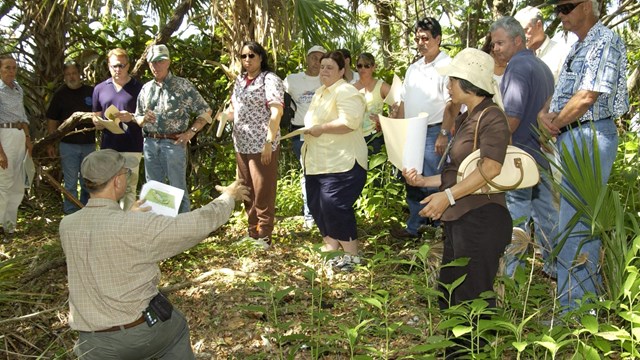
The sponsors of the Steward Program have been consistent in their desire that the program be a flexible one that meets the needs of both land managers and Stewards, and this wish has carried over into the training and other components of the program. The training is designed to provide candidates with (1) introductions to the program purpose and sponsors, (2) basic outdoor skills for their own safety, (3) sufficient information to allow them to identify and evaluate site conditions, and (4) a sense of ownership in the accomplishments of the program in preserving and protecting the cultural resources of the state. This latter point is particularly important and is a constant challenge to maintain. Because Stewards are volunteers, they can be expected to stay in the program only as long as it is interesting and rewarding for them. Part of maintaining that interest is to keep training time and paperwork to a minimum. The training course that a candidate must pass to be a certified Steward consists of roughly three hours in the classroom, and five hours in the field with an archaeologist. The core program includes the following topics:
Throughout their training and introduction to the program, it is strongly emphasized that law enforcement is not a focus of the program. The role of the Steward is to deter looting and vandalism through monitoring and education, not law enforcement activities.
Program Accomplishments and Directions for the Future
The Site Steward program is a dynamic initiative that is still growing and adapting to changing needs and conditions. It has proven effective in assisting land managers to protect archaeological resources on public lands, in gathering baseline information on site condition and the extent of looting and vandalism, and in offering meaningful opportunities to the interested public for participation in archaeology. By mid-1990, at least 354 Stewards had been trained and certified, over 7,200 hours of Steward service had been logged, and at least 205 archaeological sites were being monitored. The program has strengthened relations between avocational and professional archaeologists, and forged new ties between archaeologists and the public. As volunteers, Stewards have credibility in convincing people about the importance of archaeological resources. The results of this, and other public archaeology programs in Arizona, has been heightened public sensitivity to cultural resources which has been expressed in a variety of ways. For instance, an increase in citizen activism and advocacy for archaeological resources has been noted. The most recent example occurred in north central Arizona where a private developer, who owned property containing a significant Sinagua pueblo and associated burials, had leased the land to a pothunter prior to construction of a housing development. Over 200 citizens, including members of local Native American tribes, turned out in protest and blocked the path of the bulldozer. This display of public outrage received state and national attention and has subsequently convinced the landowner to reconsider his approach and establish a dialogue with the interested parties. Another benefit of this demonstration of public concern was that it drew the attention of State legislators, leading to revival of burial protection bills which had previously languished. Site Stewards also played a role in the recent conviction of a site looter/vandal in northern Arizona on a State Park. Steward monitoring of sites on the park had created a set of baseline maps and site condition information which proved valuable in making a case for site damage against several individuals caught red-handed in the act of looting/vandalism at one particularly important archaeological site. Although the outcome was only a single misdemeanor conviction, without the work of the Stewards this case might never have been brought to trial. The Steward Program continues to achieve recognition, and was recently awarded one of the highest honors for historic preservation in the state of Arizona. In May of 1990, Arizona Governor Rose Mofford presented the Governor's Award for Historic Preservation to Jack Bashaw and the Arizona Site Stewards in the organization category. The award recognized the role of the Site Stewards in preserving and protecting the State's cultural heritage. The program was also recognized in Governor Mofford's 1990 State of the State address as an example of volunteerism in protecting our cultural resources. As we look to the future, it is essential that a fulltime Statewide Coordinator be in place to serve as the program advocate. With increasing program growth and the collection of a higher level of site looting/vandalism data, it should be possible to evaluate this site information and direct site protection efforts more effectively. The Steward Program also provides a firm basis for establishing a wider network of partnerships with other agencies and organizations in the public and private sector. A broader base of support should allow expansion of program efforts to include more of the goals outlined in the "Statement of Purpose" at the beginning of this article.
Conclusion
The Site Steward Program is only one component of a broad-based public archaeology initiative in Arizona, and the key to its success has been cooperation between the many organizations who are concerned over the future survival of our cultural heritage. By working together on this, we have significantly increased our chances of accomplishing our shared objectives.
References Cited
Bashaw, J. (1990) Arizona Site Steward Program Handbook for Volunteers. State Historic Preservation Office, Arizona State Parks, Phoenix.
Hoffman, T. L. (1988) Arizona Archaeology Week: Expanding Public Awareness Through a Federal and State Partnership. Cultural Resources Management Bulletin 11.
Hoffman, T. L. and S. Lerner (1986) The Use and Abuse of Archaeological Sites: Educating the Public. Paper presented at the 1986 Society for American Archaeology Symposium "The Carrot, Not the Stick," sponsored by the National Association of State Archaeologists.
Hoffman, T. L. and S. Lerner (1988) Arizona Archaeology Week: Promoting the Past to the Public. National Park Service Technical Bulletin 2.
Hoffman, T. L. and S. Lerner (1989) Arizona Archaeology Week: Promoting the Past to the Public, pp. 31-37. In Fighting Indiana Jones in Arizona: Proceedings of the 1988 American Society for Conservation Archaeology, Ed. A.E. Rogge, Portales, New Mexico.
Pilles, P. J., Jr. (1989) The Arizona Archaeology Advisory Commission and the Site Stewards Program, pp. 39-44. In Fighting Indiana Jones in Arizona: Proceedings of the 1988 American Society for Conservation Archaeology, Ed. A.E. Rogge, Portales, New Mexico.
Rogge, A. E., Editor (1989) Fighting Indiana Jones in Arizona: Proceedings of the 1988 American Society for Conservation Archaeology, Papers from the Symposium held at the 53rd Annual Meeting of the Society for American Archaeology, Phoenix. Portales, New Mexico.
P.L. 96-95 (1988). Return to the Table of Contents Open the Microsoft Word Version of this Article
|