|
THE ARCHAEOLOGIST AS GLOBAL EDUCATOR
Phyllis Mauch Messenger and Walter W. Enloe
Introduction
Archaeology is the stuff of our childhood fantasies about exotic peoples, places, and times. The subject matter of archaeological exploration seems almost limitless, with discovery, intrigue, and foreign locations often thrown in. To many, archaeology would seem to be the perfect career. Yet archaeologists often are not succeeding in communicating what they do, why and how they do it, and why it might be important. And, it can be argued, they "do not take enough notice of the perceptions of the past held by the public" (Stone 1989: 195). The current focus on cultural heritage resource preservation is a key factor motivating archaeologists to look for opportunities to improve their performance in the area of public education, especially in the schools. This article will attempt to offer paths of thought along which those interested in studying the nature of humankind in a variety of times and places--which certainly includes archaeologists and educators--might meet. Archaeologists and educators share common areas of interest and have much to offer one another. The archaeologist seeks to create interest in the study and support of archaeology, including the preservation of cultural heritage resources. The archaeologist realizes a need to reach students in K-12 classrooms, ideally offering more than a "dog and pony" show. The educator wants to help students gain an understanding of who we are and how we fit in the world (a "global perspective"), in part by studying human responses to change over time. The educator seeks to help students understand the commonalities of being human and to respect the rich diversity of human culture. The educator seeks to gain access to community resources, integrating enrichment activities into the curriculum in a meaningful way. In order to understand and integrate these goals, let us look at the growing field of global education and at anthropologists' analysis of the role of anthropology/archaeology in it. We will build a profile of "archaeologist as global educator," and a parallel profile of "archaeologist and child as active learner and explorer," with examples of activities and approaches that illustrate the possibilities of using global education as a framework for archaeology in the schools, and archaeology and cultural heritage education as powerful tools for global education.
Global, International, and Multicultural Studies
There is a growing movement in United States elementary and secondary education to address, appreciate, and understand the multicultural nature of our population. In many areas this is a mandated addition to the curriculum. Multicultural education addresses the reality that countries such as the United States are a plurality of peoples, that, in fact, "we are the world," and that we must help our children respect the commonalities of being citizens of one country while respecting the varieties of cultural differences within it. We are not so much a melting pot as a multi-ingredient salad or a cultural mosaic. The movement toward globalizing or internationalizing curricula recognizes our increasing global interdependence and the need to understand the world and our place in it. For many educators, "global" is synonymous with "international" and encompasses a variety of diverse educational goals and strategies: area studies and foreign languages; multicultural and intercultural education; international relations and foreign policy studies; international development studies; and single issue perspectives on a global scale, such as environmental or war-and-peace issues. Global education also has been defined as either world issue and problem studies or world-centered approaches to education (i.e., the world as an interdependent system). A more integrating (as well as historic) definition of global is "interactive and systemic," suggesting spherical completeness and comprehensiveness. An interactive whole understood synchronically and diachronically--that is, historically or developmentally and presently or in process--may refer to the world, humanity, a particular culture or village, or the local community or classroom. More specifically we use the term global to convey the concept of the planet as an interactive whole (Gaia or spaceship earth) and the human species as an interactive whole (human family, global village). We recognize that the last half century has brought rapid and sweeping changes, uniting humanity through technological breakthroughs in transportation and communication, causing it to become, in Martin Luther King's terms, more of "a neighborhood," linked by technology as well as by global problems such as global warming, pollution, and uneven distribution of resources. On numerous occasions, Dr. King argued that unless we learn to see ourselves as a "brotherhood" ("humanhood" or humanity) and resolve our global problems, "we will perish together as fools" (Washington 1986: 117-122). Similarly, human scientist and psychoanalyst Erik Erikson contends that human beings are the only living species that tend toward "pseudo-speciation." Through gender, race, or cultural background, we tend to segregate, we tend to rate as superior or inferior, we tend to differentiate our single, organic whole--the human species (Erikson 1968: 41-2). A global perspective in education, then, will be informed by the concepts of interactive system, whole world, the whole of organic life (including humanity), and the whole of human culture. A number of educators have elaborated the basic characteristics of a school curriculum that is global, addressing the need to understand the world and its cultures and our relationship to them. Archaeologists should find it useful to reflect on how their perspectives on a particular culture illustrate or encompass the components of these conceptions, as well as how an understanding of anthropological concepts and processes could enrich the global classroom. In current thinking about social studies in general and global education in particular, we find an increasing emphasis on an historical perspective to current issues, evaluating human responses to change and seeing patterns and systems in particular geographic contexts, rather than looking at isolated events. The goal is to provide a context or foundation for social participation. It is possible to envision the eventual formulation of a new interdisciplinary area of human studies. Recent academic developments have established human science as a recognized rubric, within which the traditional social sciences, including archaeology, interface with biology (Piaget 1972). With the interdependency of the human sciences and the humanities, a more complete approach to the study of human beings can be formulated which will foster human attitudes and skills that transcend the school house and are essential capacities that aid the lived experience of students as a whole. Global educator Lee Anderson delineates a set of global citizenship competencies in terms of self-perspective and self-awareness. Archaeologists will recognize these as issues and questions they deal with in their research and teaching, particularly the fourth point. Anderson's themes are: 1) A capacity to perceive oneself and all other individuals as members of a single species of life whose numbers share a common biological status, a common way of adapting to their natural environments, a common history, a common set of biological and psychological needs, common existential concerns, and common social problems; 2) A capacity to perceive oneself, the groups to which one belongs, and the human species as a whole as a part of the earth's ecosystem; 3) A capacity to perceive oneself and the group one belongs to as participants in the transnational social order; 4) A capacity to perceive oneself, one's community, one's nation, and one's civilization as both "cultural borrowers" and "cultural depositors" who both draw from and contribute to a "global band of human culture" that has been and continues to be fed by contributions by all peoples, in all geographical regions, and in all periods of history; and 5) A self-conscious capacity to perceive that the world system and its component elements are objects of perception, beliefs, attitudes, opinions, values, and assumptions on our part as well as the part of others (Anderson 1979). Educator Willard Kniep, of the American Forum--Global Perspectives in Education, sees the need for holistic strands across subject areas and through grade levels in order for a curriculum to be global (Kniep 1988). These strands are addressed through broad school-community collaboration, inquiry, and consensus on these two essential questions: What is the nature of the contemporary world? What skills, attitudes, and knowledge do students need to be responsible and reasonable participants for the future in a world we know to be increasingly complex, changing, and interdependent? This growing orientation toward educating for local and global citizenship and, correspondingly, the need to reevaluate the changing role for education in a changing multi-boundary, transnational world, is no better formulated than through the perspective of the United States' foremost educational reformer, John Goodlad. He has proposed that the total system worldview of economist Kenneth Boulding (1985) is a novel paradigm approximating "the way things are" and providing a guidepost for school renewal and curriculum restructuring. Goodlad has adapted Boulding's world model to provide an appropriate systems model for global studies. Goodlad categorizes various methods of study and subject matter through which students expand their localized view of the world into the wider context of global systems (Goodlad 1988, also see 1984). His systems (and some of the methods and subjects he lists) are: 1) the world as a physical system (the physical sciences, technology), 2) the world as a biological system (e.g., zoology, ecology), 3) evaluative and belief systems (studies in the bases of choice and decision making, e.g., religion, economics), 4) communicative and expressive systems (the means and ways of human communication and expression), 5) the human species (studies in the traits and characteristics of human beings, e.g., history, the arts, religion, archaeology), and 6) the global village--social, political and economic systems (how humans collectively manage their lives, e.g., anthropology, economics, ecology, archaeology). While archaeology is central to the last two, methods and subject matter related to archaeology are found in all areas of Goodlad's vision of the scope of school-based curricula for expanding students' worldviews. Global educators have developed the framework for preparing young people for life in a world increasingly characterized by pluralism, interdependence, and change. As political leaders and citizens add to the voice calling for global education, its attainment becomes more of a reality. And those, including archaeologists/anthropologists, who can make an informed contribution to our understanding of the human species and the global village will be valued in the education community. This vision is edging toward reality. Take, for example, the 1989 report of the National Governor's Association, which argues that education must prepare young people for an increasingly globalized world:
Anthropology/Archaeology in a Global Curriculum
The framework developed by global educators insists upon the inclusion of an anthropological perspective. The extensive potential contribution of archaeology to this curriculum through both content and methods provides a challenge and an opportunity to the archaeological community. By understanding the philosophy and goals of global education, archaeologists can begin to work with educators to provide a valued component of the educational experience. Where do we begin? In 1989 the Curriculum Task Force of the National Commission on Social Studies in the Schools issued a report which urges the teaching of social studies in every K-12 grade to ensure development of qualities crucial to citizenship, including the ability of students to see themselves as part of the larger human experience, to understand the diversity of world history and cultures, and to grasp the critical values and analytical perspectives appropriate to the analysis of the human condition. One of the contributors to the report was anthropologist Jane J. White, co-chair of the Task Force on Teaching Anthropology in the Schools for the American Anthropological Association (AAA). Her discussion of the contributions anthropology can make to the social studies curriculum includes a number of points which archaeologists wanting to argue the relevancy of archaeology to global education should keep in mind. Many of her points address those outlined above by Kniep, Goodland, and Boulding. White states, "The central goal of anthropology is to explain why groups of people are different from each other . . . [and to] try to explain each group's way of life in terms of their own perspectives." We would add that an authentic global perspective builds upon human commonalities to explicate more fully human differences. Anthropology has a wealth of big ideas--culture, evolution, adaptation, cultural contact, technological change. Studying them helps students organize data and perceive patterns. White quotes Clifford Geertz, "The aim is to draw large conclusions from small, but very densely textured facts; to support broad assertions . . . by engaging them with complex specifics" (Geertz 1973: 21-28). White sees the application of anthropological processes--analyzing artifacts, documents, art and narrative, and daily life accounts--as adding depth, intensity, and variety to work in social studies. White cautions that teachers must move beyond a "touristy" or strange lands and friendly peoples approach to cultures, through the use of case studies to give a complex picture. This will "help students confront in intellectually honest ways the sometimes threatening concept of cultural differences. If the challenge is met, then students will have moved one step closer toward becoming true world citizens" (White 1989: 36). The anthropological perspective is a major component of the historical cultures approach to world studies as described by Paul Bohannan, past president of the American Anthropological Association (AAA) and of the African Studies Association, in a handbook looking at five approaches to world studies curriculum (Woyach and Remy 1989). This approach focuses on the dynamics of cultural change within history, especially responses of challenges to the environment. By looking at the achievements of different cultures in meeting challenges, why societies have faltered, and speculating on what might have been, students are led to a new understanding of our problems today and the premises that may cloud our eyes. This approach emphasizes the urgent need for cross-cultural understanding and helps us express and assess the premises of our own and other cultures. Having the perspective of different times and places helps us achieve those goals. Bohannan discusses the importance of the concept of cultures as the "stuff" that makes people of different times and places different from one another. The birth, development, and death of different cultures is the very substance of human history. Looking at the two manifestations of culture as "artifact" and "mentifact" aid in the ever difficult task of defining culture, says Bohannan. We would add that active enquiry by students, activities describing and interpreting one's own culture, and otherwise empowering children as archaeologists and ethnographers will enhance that understanding.
The Archaeologist as Global Educator
How can the archaeologist combine the demands of global education, the promise of anthropology, and the needs of the child into an educational experience that the archaeologist can facilitate? We have adapted Selby and Pike's profile of a global teacher to indicate how and where the archaeologist's skills and expertise can be applied. According to Selby and Pike (1988: chap. 4), the global teacher is globalcentric, looking at broad systems. We would add, the archaeologist looks at the past on both the small and the large scale to see how global conditions, trends, and developments have changed over time. The global teacher is concerned about culture and perspective, wanting to present a coherent understanding of cultures studied. "Cultures are portrayed as neither monolithic nor unchanging" (Selby and Pike 1988: chap. 4). In-depth study of cultures is emphasized to encourage respect for diversity and promote tolerance and appreciation of other perspectives and world views. The archaeologist can offer deep treatment of a single culture at a single moment or over time, and in comparison to other cultures. An archaeological comparison of our material culture with that of another culture may remove the exotic quality often associated with differences and in the process will contribute to respect for the culture and its objects, as well as the process for studying them. The global teacher is future oriented, conveying that humans can influence the future by their actions; it is not predetermined. Students develop skills to cope with an accelerated rate of change. The archaeologists' portraits of cultures deal with change and adaptation, often through a great depth of time. Their histories suggest how past human actions affected nature and cultural development, both their own and that of other groups. The global teacher is a facilitator, helping students learn how to learn. Rather than only presenting a long lecture full of complicated facts, the archaeologist has the opportunity to help students understand how we know what we know about a culture. Students can be presented with clues and the opportunity to experience moving from evidence to hypothesis. The archaeologist should have the confidence to admit that we don't have all the answers (or necessarily the right ones) and encourage self-esteem by letting the child take chances, too. The global teacher believes in human potential, recognizing that students are eager to discover and relish a challenge. This educator "knows that students who are put in contact with what they perceive to be real issues and problems are intrinsically motivated" (Selby and Pike 1988: chap. 4). The archaeologist can seize on the enthusiasm for discovery and the fascination with the exotic image of the archaeologist to encourage students to understand the methodic and scientific side of archaeology. The issue of site protection, for example, can be powerfully presented if students are offered positive actions that they can take as a group, as individuals, or with their families. A simple negative message of 'no, don't touch, let the professionals do it' is not productive. Instead, positive actions, such as adopting a site (or project or archaeologist), learning more about preservation, or understanding how to report collections or sites, what should be reported, and to whom, are important. The global teacher is concerned with the development of the whole person, accepting "that there are diverse and synergistic dimensions to human learning including the abstract, the concrete, the experiential, the analytical, the rational, the intuitive, and the emotional" (Selby and Pike 1988: chap. 4). The archaeologist can lead students through the variety of learning styles involved in archaeological investigation. Simple materials, such as old magazines, or phone books, can be used to look for commonalities and differences, trace changes in types of ads, products that appear or disappear, the appearance of last names reflecting the introduction of new immigrant groups, and other characteristics. Students might begin with publications from their own year of birth, moving backward or forward to other significant dates, to develop a sense of change between time markers. The global teacher employs various teaching/learning styles in the classroom, including action research, group discussion, experiential units, role plays, simulation games, and direct and hands-on experience. The archaeologist can offer a range of activities, including group exercises in measuring, quantifying, and estimating, hands-on exploration of cultural material, and role playing in another time and place. Some activities can take place during the visit or residency of an archaeologist. Others can occur before or after, guided by handouts or discussions between teacher and archaeologist. Students might be asked to create a personal geography of a special place, describing or drawing it, and letting their peers try to determine its location, meaning, and identity. Or they might bring an object from early childhood and let others analyze its significance. The global teacher believes in lifelong learning and sees him or herself as a perpetual learner. Students are encouraged to ask good questions and understand that our answers and solutions are impermanent. The archaeologist knows from experience that our understanding of people and events is evolving and can facilitate student's understanding of the same process. This is especially apparent in the study of past cultures as research technologies improve. In addition, the increasingly recognized contributions of indigenous groups and developing cultures/nations in studying, explaining, and owning their own past has led to an enrichment and deepening of our understanding of the human past and its continuity with the present (e.g., Layton 1989). The global teacher tries to be congruent, seeking to keep the medium and the message in harmony, as well as one's own professional and personal life. The archaeologist who respects and admires past cultures must be willing to show respect for the beliefs and needs of contemporary cultures. A valuable exercise in developing empathy and understanding involves archaeologists and students assuming roles of different individuals or representatives of various countries in a round table discussion of rights to cultural objects (see Messenger 1989: chap. 14). Another discussion might be based on an actual event in their community, such as the desecration of a public monument or cemetery vandalism. The global teacher is rights-respectful, with a goal of shifting the focus of power and decision making in the classroom. The goal is autonomy and empowerment of the individual, encouraged by a system of feedback and evaluation. The archaeologist can contribute to this process by helping students understand the dynamic processes of group investigation, discussion, and give-and-take which comprise good archaeological investigation--cooperative learning at its best. The global teacher seeks fundamental interdependence across the curriculum, with continuity in aims, objectives, and teaching and learning strategies through subject matter and grade level. Ideally, the archaeologist's contribution would include interaction and discussion with teacher groups to discuss integration of archaeology at different learning levels. How and where are cultures, systems, and areas of the world currently introduced in the curriculum? What are alternative strategies? The archaeologist can offer types of presentations to be developed, seeking a dialogue with teachers on how to introduce new topics--either by the archaeologist or by the classroom teacher--into the curriculum. One avenue to such group discussions is through district or state teacher workshops. For example, a state social studies conference might feature a session led by an archaeologist on "archaeology and the study of the past across the curriculum" or "current research in archaeology/anthropology." This sort of approach might also be developed within one globally-minded school or through a college of education or state department of education. The global teacher is a community teacher who recognizes opportunities for holistic education offered by the local community. The archaeologist often represents a set of resources, including archaeological societies, museums, historical societies, colleges or universities, and local heritage sites and interpretive centers. Connected with an archaeologist in one way or another is often a cadre of archaeology students, volunteer excavators (sometimes senior citizens), and other professionals from the related institutions. Often these individuals and institutions can be called upon to serve as additional resources in the classroom or in providing fieldtrip opportunities. For example, senior citizens who have worked as volunteer excavators might work with a class on an extended project after an archaeologist has visited the class.
Archaeologist and Child as Active Learner and Explorer/Scientist
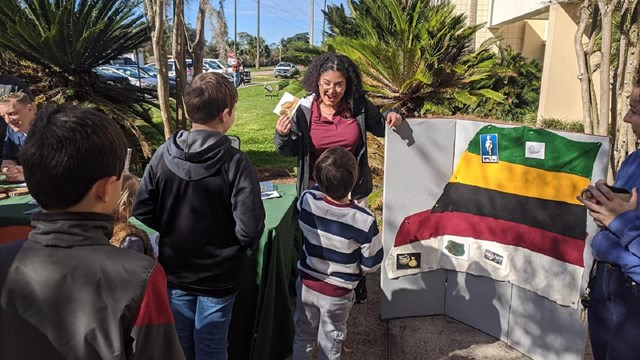
How do we make archaeology meaningful to a child's experiences? Children work from the present backward. They find it difficult to make a leap of understanding from their own environment to other situations distant in time and space. A 1986 survey of a multicultural group of school children in Great Britain elicited such views of history as: "I don't see how it could help you now. Nowadays is so different." Or, "You're in this world now. The past is gone" (Emmott 1989: 25). Children often find social studies--including archaeology--boring as it is usually presented. When archaeological studies begin in a context distant from a child's personal meaning system, it is usually handless, inactive, and unengaging. The following discussion will offer perspectives on bridging the gap between here and there, now and then. If we wish to teach children something about global citizenship, about the past, or about respect for cultural heritage, we must actively seek to make those concepts relevant to their classroom, community, and home. And we should encourage their participation in meaningful activities that address a variety of learning styles (see Gardner 1983). In Piaget's terms, we are simply suggesting that we aid the active lived experience of children (Piaget 1972). Increasingly, we know that learning is an active, constructive, meaning-making process. "The medium is the message." How we teach must reflect the natural development and experience of our students. If we want children to understand the world as an interdependent entity whose development requires active collaboration, we cannot simply tell them about it by "covering the material." We must teach them in ways in which learning is cooperative, active, engaging, and full of hands-on meaningfulness. We must take seriously that children are not primarily passive receivers of information, a mode that is so characteristic of much of our schooling practice. They are human scientists--creators, explorers, discoverers, interpreters, and meaning-makers. Hilda Taba, the great researcher and teacher educator, outlined the ideal teacher-learner/learner-teacher twenty years ago for the Foreign Policy Association's conference on internationalizing the K-12 curriculum. This work offers a framework of the active global learner within which we can place the kinds of activities and interactions that archaeology can contribute (Collins 1982). Taba's active learner develops certain kinds of knowledge, including organized sets of concepts, ideas, and/or generalizations that enable him or her to put masses of data in order. The active learner can process information; that is, analyze data, form generalizations, ask pertinent questions, make inferences, use data to hypothesize, to predict causal change, and as a useful model for inquiry, for analysis, and for probing problems. The active learner is a self-learner and has the intellectual tools and desire to do his or her own data processing and keep on learning. Well-organized visits to archaeological sites or labs, along with preliminary visits by archaeologists to schools for discussions with teachers and classes can offer this sort of active learning opportunity. A key to the success of such a project is the availability of a staff person to carry out the planning of activities and creating of work sheets, artifact boxes, and other learning tools, as well as the stability of a project to continue over a period of time (e.g., Shaw 1989: 5-9). The active learner has a genuine sense of participation, involvement, and commitment. Activities developed out of an encounter with archaeology might include creating an archaeological record of the students' own class or school, doing experimental archaeology or ethnoarchaeology by growing a garden using certain techniques or crops, making pottery with appropriate tools and materials (such as shells, pebbles, and corncobs to smooth the clay), or making a scrapbook of news items related to archaeology. (See Hawkins, 1987, for further discussion) The active learner can face change without trauma; that is, can grasp, take hold of, influence, and control in a constructive manner the change processes underway. The active learner has a capacity to transcend his or her own ethnocentric skin, seeing equivalents in values and universals in the human condition, and possessing the sensibilities that are necessary to live in a pluralistic world. The active learner can handle community, national, or international situations objectively; that is, can treat other peoples' (nations') feelings or value patterns as "facts" or "givens" in a situation. The active learner has a sense of the complexity of issues, both local and global. Students might begin a personal exchange of artifacts of their own culture with students from other cultures, whether it be Minnesota and Japan or California and Tennessee. These "culture boxes" help students confront what they value and try to see the objects they choose as someone from another culture might see them. Teachers and students can create culture boxes of a place they have visited, of a rural or urban contemporary American family, or of the culture of their school community (Enloe 1990). The active learner has loyalties, realizing that loyalty is not a finite quality and that one can be loyal to a range of people or institutions or ideas simultaneously. Emmott's discussion of the British survey of school children looked at children's attitudes about their own varied cultural backgrounds. Most of the children claimed they would pass on more about all aspects of their cultures than their parents did, which the children identified as one reason for learning about the past. They emphasized language, myths, religion, music, and art, in that order. Emmott notes that 89 percent of the children surveyed found family history interesting, and suggests designing projects aimed at creating individual family histories by interviewing grandparents and retirees. This active enquiry would help "create a sense of the personal meaning of the past and its effect on ordinary people's lives" (Emmott 1989: 42). This version of archaeology in our own back yard would be a valuable lesson on the topic of history preceding the classroom visit of an archaeologist who would talk about family histories of a more distant culture.
Conclusion
It is clear that the archaeologist is well positioned to step into the roles of active learner and global teacher, offering a broad perspective on cultures and change over time. Done with care and thoughtfulness, we can present a positive, active message to children that encourages them to understand and respect other cultures, past and present; respect what remains of them, just as they respect themselves and the world around them; and participate in the quest for understanding. By valuing the process and results, we will share in the ownership/stewardship of the past and actively work to preserve it. By sharing ownership we do not lose our right to archaeological resources as scholars and researchers, but we gain a broader base for stewardship of cultural heritage resources. Developing a stronger cultural norm for preservation may take several generations, but it is not beyond our grasp. The public schools are a logical place to begin.
References Cited
Anderson, Lee (1979) Schooling and Citizenship in a Global Age. Social Studies Development Center, Indiana University, Bloomington.
Boulding, Kenneth (1985) The World as a Total System. Beverly Hills, CA: Sage.
Bohannan, Paul (1989) "An Historical Cultures Approach." In Approaches to World Studies. A Handbook for Curriculum Planners, Robert B. Woyach and Richard C. Remy, eds., Needham Heights, Mass: Allyn and Bacon.
Collins, Thomas H. (1982) Getting Started in Global Education. Arlington, VA: National Association of Elementary School Principals.
Enloe, Walter (1990) Cultural Information Exchanges. (forthcoming) Minnesota Department of Education, 660 Capitol Square Building, St. Paul, MN 55101.
Emmott, Kathy (1989) "A Child's Perspective on the Past: Influences of Home, Media and School." In Who Needs the Past? Indigenous Values and Archaeology, R. Layton, ed., London: Unwin Hyman.
Erickson, Erik (1968) Identity, Youth, Crisis. New York: Norton.
Gardner, Howard (1983) Frames of Mind. New York: Basic.
Geertz, Clifford (1973) The Interpretation of Cultures. New York: Basic Books.
Goodlad, John (1984) A Place Called School. New York: Houghton Mifflin.
---- (1988) "A New Look at an Old Idea: Core Curriculum." In Next Steps in Global Education, Willard Kniep, ed., New York: American Forum, pp. 15-23.
Hawkins, Nancy W. (1987) Classroom Archaeology: An Archaeology Activity Guide for Teachers. Baton Rouge: Division of Archaeology.
Kniep, Willard (1988) Next Steps in Global Education. New York: American Forum.
Layton, R., ed. (1989) Who Needs the Past? Indigenous Values and Archaeology. London: Unwin Hyman.
Messenger, Phyllis Mauch, ed. (1989) The Ethics of Collecting Cultural Property: Whose Culture? Whose Property? Albuquerque: University of New Mexico Press.
National Governors' Association (1989) "America in Transition: The International Frontier." A Report of the National Governors' Association, in Access, #85, The American Forum for Global Education.
Piaget, Jean (1972) Science of Education and the Psychology of the Child. New York: Viking.
Selby, David, and Graham Pike (1988) Global Teacher, Global Learner. London: Stroughton.
Shaw, Rachel (1989) "Combining Archaeology and Education--An Example from England." In Archaeology and Education, Vol. I: Issue 1, Fall.
Stone, Peter G. (1989) "Interpretations and Uses of the Past in Modern Britain and Europe. Why Are People Interested in the Past? Do the Experts Know or Care? A Plea for Further Study." In Who Needs the Past? Indigenous Values and Archaeology, R. Layton, ed., London: Unwin Hyman.
Washington, James M., ed. (1986) A Testament of Hope--The Essential Writings of Martin Luther King, Jr. San Francisco: Harper & Row.
Woyach, Robert B. and Richard C. Remy (1989) Approaches to World Studies. A Handbook for Curriculum Planners. Needham Heights, Mass: Allyn and Bacon.
White, Jane J. (1989) "Anthropology." in Charting a Course: Social Studies for the 21st Century, A Report of the Curriculum Task Force of the National Commission on Social Studies in the Schools, pp. 31-36.
Return to the Table of Contents Open the Microsoft Word Version of this Article
|