CLASSROOM ARCHAEOLOGY: INCLUDING ARCHAEOLOGY IN EXISTING CURRICULA, AN EXAMPLE FROM LOUISIANA

Nancy W. Hawkins


Introduction

For more than 20 years, archaeologists and teachers have explored many ways to include archaeology in classroom teaching. Some of the most impressive strategies are (1) resident week-long teacher workshops with excavation and laboratory components (Holm 1985), (2) excavation projects for students (Cook 1985, Cotter 1979, Tirrell 1983), (3) programs at archaeological sites or museums for school groups (Harrison 1984, Tirrell 1983), and (4) lengthy units or courses with a substantial classroom component (Abell 1985, Anderson 1979, Chu 1982, Corbin 1985, Dyche 1985, Hartman 1985, McNutt 1988, Parren 1987, Thomas 1967, also see McNutt this volume).

Educators support and endorse these kinds of activities because of their hands-on, inter-disciplinary nature, and their ability to develop skills in reasoning, problem solving, critical thinking, and social interaction (Abell 1985, Carroll 1987, Dyche 1985, Gettings 1970, Higgins and Holm 1985, McNutt 1988, Rogge and Bell 1989). They provide highly stimulating, enriching experiences that cannot be replicated in other settings.

All of these programs, however, require somewhat extraordinary conditions. For the first three types, the most obvious conditions required are proximity to an organization offering these programs and awareness of their availability. Even in regions in which these may be available and publicized, success depends on: (1) teachers financially able and intellectually motivated to travel to a resident field workshop, (2) students financially and emotionally able to participate in an excavation, (3) students being taken to a museum or site with an outstanding educational program, or (4) an exceptional school that allows somewhat unusual electives or great flexibility within the existing curriculum.

In Louisiana, educational archaeology programs were first developed by the state archaeologist's office in the early 1980's. At that time, no resident workshops or field schools designed for teachers or precollege students were regularly offered in-state or in any of the bordering states. No archaeology courses for any students were offered in schools, and archaeology programs for school groups at museums and sites were limited. Furthermore, the specific content of school courses and length of time to be spent on each topic was outlined at the state level.

Severely limited funding for state archaeological projects forced consideration of how effectively to reach the widest school audience with the least expenditure of staff time and money. Excavation projects were immediately eliminated from consideration because of their expense in both time and money and because of the limited number of persons who could participate annually.

Strategies that were explored, and ultimately implemented in Louisiana were (1) booklets, (2) classroom materials to be used in existing courses, (3) presentations at social studies and science conventions, (4) displays at teachers' conventions, (5) in-service training sessions for teachers, and (6) working with the state Department of Education to amend the state guidelines for basic content of one or more required courses.


Planning

The first concern was deciding what it is about archaeology that a majority of students should know. A course taught to a group of highly motivated teachers or students for eight hours a day for seven days, or to academically advanced students for 50 minutes a day for a semester, can include a broad introduction to archaeology. Difficult priorities have to be set for less intense interaction with less motivated participants. This was accomplished in Louisiana in a loosely step-by step process.

The first step was to articulate the purpose of endorsing teaching of archaeology. Educators want an exciting way to help students gain basic knowledge and skills. Archaeologists should take advantage of this aspect of teaching archaeology, but in the planning stage must focus on the archaeological goals. What is it about archaeology that this educational experience should teach? Generally, the hope is that the content should enhance an appreciation for archaeology and for "the resource." Specifically, two basic interests directed all of the Louisiana public archaeology programs: the obligation to share with the public information discovered through archaeology and the hope that better understanding of archaeology will result in better site preservation.

The next step was to clarify what about archaeology should be taught. In reaching the goal of sharing information about the past as revealed through archaeology, the appropriate content was relatively easy to identify:

  • general and specific information archaeological research has discovered about the people of the state
  • the relative length of prehistory compared to history
  • general dates of human arrival in the Americas and how that compares with the time dinosaurs lived
  • technologies used in the past
  • what archaeologists have discovered about the historic era that written documents do not tell
  • places to visit to learn more about people in the past

For the goal of improving site preservation, a major stumbling block was encountered, and still exists. It is that archaeologists do not know what specific content will result in an interest in site preservation. Some options are:

  • the range of material remains archaeologists study and how they reflect the life of people who left them
  • the importance of context in interpreting archaeological remains
  • how sites are recorded
  • techniques and purpose of excavation
  • special scientific and technical analyses in archaeology
  • archaeological reasoning, hypothesis testing, conclusion drawing
  • the importance of stratigraphy in establishing chronology
  • methods of determining relative and absolute dates
  • the importance of publishing results of archaeological research
  • the importance of conserving sites, threats to sites, and preservation options

The decision then had to be made about which medium or type of experience would best communicate these specific messages. Consultation with teachers and education supervisors indicated that teachers want materials to enhance teaching of existing topics, that require little preparation, that do not require becoming an expert in another sub-area.

For information about archaeological findings, it was decided in Louisiana to use booklets, slide/tape programs, hands-on artifact kits, and to attempt to include archaeological findings in the a social studies course. To try to foster an understanding of the principles and processes of archaeology an activities guide called Classroom Archaeology (Hawkins 1987) was developed.

Another decision had to be made about which grade level to target. Although resourceful teachers of any grade can manage to slip archeology in sometime, it helps in the development of materials to select a specific grade and subject. After consultation with educators, the Louisiana Division of Archaeology decided to focus on eighth grade Louisiana Studies.

A difficult issue was determining a realistic expectation of the amount of class time that teachers will spend with archaeology, and how many activities can be covered in that time. In the published Louisiana Studies guidelines, only one week is allocated to Louisiana Indians, past and present, so targeting the prehistoric time period would limit the time in the semester that archaeology could be used. Materials about findings of archaeology would be developed that could also be used in units about exploration, colonization, and the Civil War.

A major consideration of the educational program in Louisiana was how to publicize and distribute the materials. It was decided to establish several networks for getting materials to teachers. These include teacher's workshops, teacher's conventions, and through parish (county) social studies supervisors. Additionally, the products are publicized through an office newsletter and are included on a list of materials that is enclosed with any item requested from the office.

An essential step in developing the project was commitment to developing ways to monitor use and someday to evaluate effectiveness. It was decided to include an evaluation card with all classroom exhibits, and to develop a follow-up questionnaire for Classroom Archaeology users.


Phase One Implementation

While the planning of the educational programs in Louisiana followed this general sequence, implementation did not always flow steadily and logically. The enabling legislation of the state archaeological agency stated that the program would include "promulgation...of historic and prehistoric findings" (La. R.S. 41:1607). This directive guided early educational programs which were oriented toward creating and making available information about the results of excavations.

A booklet series was already underway before the formal educational effort began. Continuation of this seemed to be the most cost effective single step that could be taken to provide information to both "the general public" and to teachers.

Before beginning any new projects, the outreach coordinator for the Louisiana Division of Archaeology consulted with the social studies supervisor for the Louisiana Department of Education and with teachers. They pointed out that teachers have more than enough to cover in one year and are barraged with worthwhile supplementary materials. The social studies supervisor also discussed learning techniques and social studies skills, and said that any creative activities that develop these skills would be more important contributions than those that simply cover content in a traditional manner.

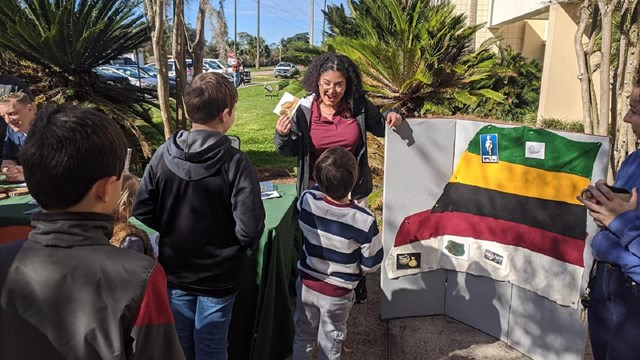
The Division of Archaeology's next step was to develop kits, which are referred to as classroom exhibits. These provide actual artifacts that students can handle, illustrations, maps, overhead transparencies, and an accompanying slide/tape show. Included in the kits are sheets for an inquiry learning activity with the artifacts and illustrations. This is a technique to engage students in active, rather than passive learning (Beyer 1979). The self-contained kits require minimal teacher preparation and elicit enthusiastic comments from teachers. Approximately 5000 students use them annually.

Additionally, a slide/tape show about Louisiana archaeology was developed and placed on deposit with the state Department of Education's slide lending library. This agency duplicates slide programs and lends them to teachers around the state. The side/tape show, the classroom exhibits, and the booklets were all oriented toward promulgating findings of prehistoric and historic archaeology.

Several shortcomings in these programs were identified. First, access to the audiovisual programs and exhibits was limited by number of copies available and required advanced planning. Second, the booklets and slide shows were clearly non-innovative in the method of instruction. Third, the activities were brief, so no additional programs were available to teachers who were interested in spending more time on archaeology. Finally, and most importantly, was the concern that the materials might not encourage site preservation, because they emphasize the findings of archaeology, rather than the process of archaeology.


Phase Two Implementation

It was decided to develop a collection of self-contained, self-explanatory activities to be taught in non-expository style. These activities include the messages identified as possibly important in developing a greater appreciation for archaeology and archaeological sites.

The guide, called Classroom Archaeology, is divided into six sections. The first includes background material for teachers: vocabulary, outline of Louisiana prehistory, recommended books for various ages, magazines and journals, other materials available from the Division of Archaeology, materials available from other sources, and places to visit.

The second part is composed of 17 short activities, each of which can be used alone and can be completed in one class period. The remaining sections require more than one class period. The third part is a series of card games students can play with cards they make showing culture traits of various prehistoric Indian groups, and the fourth part is a class activity recording a site. The fifth provides printed information about archaeological findings at a historic contact site. The students interpret the site based on the artifacts, features, and historic maps.

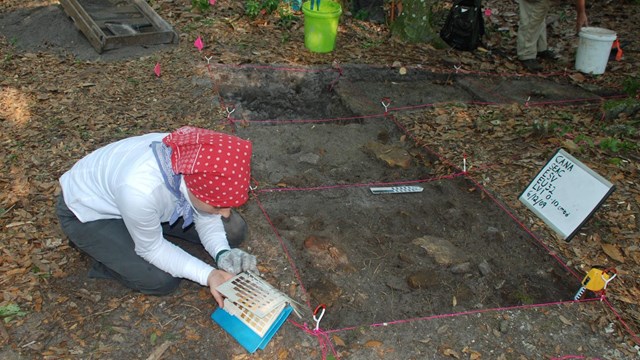
The sixth activity is a simulated excavation in which either students (long version) or teachers (short version) create a site, then students excavate and interpret it. This activity was developed in response to a review of DIG 2 (Lipetzky 1982), a commercially produced simulated excavation activity that is very well received by students and teachers. DIG 2 does a good job of teaching social studies skills and excavation techniques, but it is weak in analysis and interpretation techniques. Its emphasis on the most exciting and exotic aspects of classical archaeology might foster an image of archaeology as being primarily concerned with digging up exotic and wonderful artifacts.

The Classroom Archaeology simulation was designed to encourage creation of a site more likely to reflect those found in Louisiana, to show that archaeology is not continuous fun, that context is important, and that analysis, interpretation, and reporting are also part of archaeology.

Classroom Archaeology was first published in July 1984 and was originally targeted for eighth grade Louisiana Studies classes. Interest from teachers of other subjects and grades showed that the activities were also useful for other classes. A second edition of the guide, printed in 1987, included coded symbols to suggest activities to be used in language arts, science, and art, as well as social studies.

More than 2600 copies were distributed between July 1984 and January 1990, with approximately 200 sent out of state. During the five years since the guide was printed, conversations with users of the guide and other educators raised several questions. Are the Louisiana state curriculum requirements too demanding to allow enough flexibility to use the guide? Are the guides going to people who actually use them, and is the distribution network adequate to ensure that potentially interested teachers are receiving them? The high cost of reproducing the 179-page guide led to consideration of its content. Are the activities useful? Should some be eliminated? The simulated excavation was considered to be too complex for teachers to conduct successfully. Teachers might simplify the project and develop a substitute that failed to teach the processes involved in archaeology.

In an effort to evaluate use of Classroom Archaeology, a questionnaire was sent to Louisiana residents who had requested the guide in writing or by telephone from July 1984 through October 1989. This excludes those who received the guide at workshops, conventions, or via a supervisor or curriculum specialist. Twenty-five percent returned the questionnaire. While this represents only a small percentage of respondents, the results are useful in showing activities that are used relatively more often than others.

The brief questionnaire had a series of six multiple choice questions followed by three open ended questions. The questions in the first section were accessing who requested the guide, what happened to it, how many teachers used it, whether the respondent personally had used it with students, which activities were used, and how many activities the respondent used annually. The short answer section asked with what grade level and subject area the activities were used, which activity the respondent considers best and why, and which activity is considered least useful and why.

The results showed that approximately 80% were teachers, other education supervisors or specialists, education students, librarians, museum docents, scout leaders, and other persons likely to use the guide. Although 12% of the non-teachers used the activities with young people or in teaching demonstrations, the results relating to teacher use will be described here.

Of the respondents who know how many teachers used the guides they received, 36% said one teacher used it, 32% said two teachers used it, 12% said three teachers used it, 4% said more than three used it, and 16% said none used it.

Teachers using the guide taught in kindergarten through college, with elementary teachers and middle school teachers using it equally, followed by high school, college, and kindergarten. The teachers had used the activities three times as often with social studies classes as with science classes. Approximately 20% of the teachers reported using the guide with gifted/talented students.

The questionnaire included a listing of the table of contents of the guide and respondents were asked to check which activities they had personally used. Of the teachers who used any part of the guide, 100% reported using the Resources section of background material, with a mean of four resources used. The most used parts were the lists of recommended books, places to visit, and the outline of Louisiana prehistory. The least used were lists of suggested magazines and journals and materials that may be purchased from other sources.

Of the teachers using the guide, 89% used one or more short activities, with a mean of four activities. The three most frequently used ones (used by more than 40%) were: Newspaper Archaeology (students compile for-sale ads that could have been placed by an imaginary family, exchange sets of ads, then analyze a family's "artifacts"), Today's Artifacts (students pretend to be archaeologists in the future who must describe and assign a function to 20th century artifacts), Time Line (from 10,000 B.C. until today), and Archaeology Words (a vocabulary activity).

Four were used by no more than 10%: Pottery Reconstruction (students reconstruct simulated ceramics), Archaeology in the Library (students read and report about an archaeology article), Special Techniques (students identify scientific techniques used in analysis of a shipwreck), and Stratigraphy and Chronology (students place in order, by age, letters representing strata at sites).

Twenty-one percent of the teachers using the guides used the games activity, 10% used the recording a site activity, 16% used the interpreting a site activity, and 16% used the excavating a site simulation.

Concern about the usefulness of the simulated excavation activity was heightened after reading a questionnaire from a college student who said he used the simulated excavation instructions to conduct an actual excavation, seeing a newspaper article about a teacher-led "dig," and reading the following teacher's questionnaire statement: "We carried out three digs in DeSoto Parish during the month of May 1986. This guide was our 'Bible'...." The hope is that these sites were simulated, but the fear is that they were actual sites.

In the short answer section of the questionnaire, teachers expressed no consensus about the best or worst activities in the guide. The other added comments were complementary, regarding both content and format of the guide.

The results of the questionnaire have led to several future plans. The guide, now out of print, will be reprinted. The simulated excavation activity will be omitted from future editions of the guide because of ethical concerns, and consideration will be given to omitting the four rarely used short activities. A smaller percentage of science teachers are using activities than expected. Consultation with science educators will be undertaken to explore the possibility of adding short activities for science classes.

Teachers in a wider range of grades are using the guide than expected. Use might be increased further by keying all activities to the specific objectives and content of various courses, as outlined by the state Department of Education. This would make it easy to identify places in the school year to use various activities. It is still expected that any one teacher will be able to use only a few activities each year, but it is more efficient to provide one guide to be used in a wide range of grades than to provide separate packets for various classes.

Distribution of Classroom Archaeology could be improved. When it is reprinted, effort will be made to get more copies to science teachers and to gifted and talented teachers. Science teachers are an important avenue to students because of the current emphasis in science education on conservation issues and because of the frequent use of discovery learning techniques in science classes. Teachers of gifted and talented students are expected to provide enrichment activities that supplement the basic content of courses, and therefore have more flexibility than many teachers. While exceptional students are not targeted as the primary school group for whom Classroom Archaeology was designed, they are a part of the school population, and they certainly can be expected to be among the decision makers of the future.

Within the education program of the Division of Archaeology, several additional future activities have been identified. The outreach coordinator is working with the state Department of Education to include in the Louisiana Studies course outline information gained through archaeology and to explore how information about archaeological techniques or site preservation could be included. This provides a way to get information about archaeology to every Louisiana Studies teacher in the state.

Additionally, the need has been identified to conduct more half-day or one-day in-service training sessions for teachers. The more familiar teachers are with a topic, the more accurately they can present it. While the goal is not to reach all teachers, or to expect in-service training before use of the materials, it would provide a core of teachers more aware of materials and techniques that can be used to teach archaeology. A final, long-range goal is to provide an intensive one-week workshop for selected teachers within the state during the summer. Perhaps this could be modeled on the South Carolina program (Judge 1989) which offers this training to prepare teachers for using the guide, Can You Dig It (Hawkins et al. 1989), a South Carolina adaptation of Louisiana's Classroom Archaeology.


Conclusion and Recommendations

Archaeologists have at least four motives for working with educators to include archaeology in schools: to communicate results of archaeological research, to increase appreciation for other cultures, to improve awareness of archaeological methods, and to increase site preservation. Educational programs, such as those in Louisiana, clearly accomplish the first three goals. The unanswered question is whether these lead to increased site preservation.

This is probably the most critical issue facing those involved in research in archaeology and education today. More than 25 collections of classroom activities have now been developed (Smith 1990). The need now is not for more activities to be developed, but instead for existing activities to be evaluated for effectiveness in discouraging unscientific investigation of sites, and in encouraging site preservation. One program, Project Archeology: Saving Traditions (McNutt 1988, also see McNutt this volume), has been evaluated, and has demonstrated through student testing that it is effective in teaching 10 principles of archaeology, including "archaeological sites are a non-renewable resource whose conservation is essential if we are to learn of the unwritten past" (McNutt 1988:4).

Not only must programs as a whole be evaluated, but the components of these programs must be studied. Archaeologists need to determine exactly which activities enhance development of preservation interests, how many activities it takes to communicate the message, how much class time is needed to teach them, and whether they can be taught by teachers with no previous training in archaeology.

Archaeologists must recognize that most teachers will never have the opportunity to attend an in-depth workshop, will never be able to purchase a set of classroom materials, and cannot spend weeks teaching the subject. Excellent programs that require one of these elements are extremely rewarding to students fortunate enough to benefit from them, and are likely to promote site preservation. The unanswered question is whether inexpensive, self-contained activities requiring no previous teacher training also can be effective in promoting site preservation.


References Cited

Abell, R. P. (1985) Inference-Making and Testing in a High School Archeology Course. In Archeology and Education: A Successful Combination for Precollegiate Students. Eds K. A. Holm and Higgins, P. J., Anthropology Curriculum Project, University of Georgia, Athens.

Anderson, D. C. (1979) Iowa's P.A.S.T. (Programming Archaeology for School Teachers). Final Grant Report. The University of Iowa, Office of the State Archaeologist, Iowa City.

Beyer, B. K. (1979) Teaching Thinking in Social Studies: Using Inquiry in the Classroom, rev. ed. Charles E. Merrill, Columbus, Ohio.

Carroll, R. F. (1987) Schoolyard Archaeology. The Social Studies 78:69.

Chu, J. (1982) Kidigger: Exercises in Critical and Creative Thinking through Archaeology. Hanson, Silver, and Associates, Moorestown, N. J.

Cook, T. G. (1985) Using Students in Research: The Lagoon Site. In Archeology and Education: A Successful Combination for Precollegiate Students. Eds K. A. Holm and Higgins, P. J., Anthropology Curriculum Project, University of Georgia, Athens.

Corbin, D. (1985) Introduction to Archeology: A Unit for Middle Schools. In Archeology and Education: A Successful Combination for Precollegiate Students. Eds K. A. Holm and Higgins, P. J., Anthropology Curriculum Project, University of Georgia, Athens.

Cotter, J. L. (1979) Archaeologists of the Future: High Schools Discover Archaeology. Archaeology 32:29.

Dyche, B. (1985) Why Archeology When Your Curriculum is Thinking Skills? Developing a Sequential Archeological Curriculum for Grades 6 to 12. In Archeology and Education: A Successful Combination for Precollegiate Students. Eds K. A. Holm and Higgins, P. J., Anthropology Curriculum Project, University of Georgia, Athens.

Gettings, D. (1970) Unearthing an Indian Culture: A Total Involvement Program. The Science Teacher 37:59.

Harrison, M. (1984) Archaeology Walney. Fairfax County Park Authority, Fairfax, Va.

Hartman, D. W. (1985) Understanding Science through Anthropological Inquiry: Two Cases. In Archeology and Education: A Successful Combination for Precollegiate Students. Eds K. A. Holm and Higgins, P. J., Anthropology Curriculum Project, University of Georgia, Athens.

Hawkins, N. W. (1987) Classroom Archaeology: An Archaeology Activity Guide for Teachers, 2nd ed. Division of Archaeology, Office of Cultural Development, Department of Culture, Recreation and Tourism, State of Louisiana, Baton Rouge.

Hawkins, N. W., South, S., Charles, T. and Walden, M. B. (1989) Can You Dig It? A Classroom Guide to South Carolina Archaeology. South Carolina Department of Education and South Carolina Institute of Archaeology and Anthropology, Columbia.

Higgins, P. J. and Holm, K. A. (1985) Introduction. In Archeology and Education: A Successful Combination for Precollegiate Students. Eds K. A. Holm and Higgins, P. J., Anthropology Curriculum Project, University of Georgia, Athens.

Holm, K. A. (1985) Preparing Teachers to Introduce Archeology into the Curriculum. In Archeology and Education: A Successful Combination for Precollegiate Students. Eds K. A. Holm and Higgins, P. J., Anthropology Curriculum Project, University of Georgia, Athens.

Judge, C. (1989) South Carolina Classroom Archaeology Syllabus. On file with Margaret Walden, Social Studies Consultant, Department of Education, State of South Carolina, Columbia.

Lipetzky, J. (1982) Dig 2. Interact, Lakeside, Ca.

McNutt, N. (1988) Project Archeology: Saving Traditions. Sopris West, Denver.

Parren, L. K. (1987) A Teacher's Guide to 12,000 Years of Vermont's Past. Vermont State Archaeologist's Office, Montpelier.

Rogge, A. E. and Bell, P. (1989) Archeology in the Classroom: A Case Study from Arizona. Archeological Assistance Program Technical Brief 4. U. S. Department of the Interior, National Park Service, Washington D.C.

Smith, K. C., ed. (1990) Pathways to the Past: Educator's Guide to Resources in Archaeology. Museum of Florida History, Tallahassee.

Thomas, G. (1967) Archeological Methods: A Programmed Text. Anthropology Curriculum Project, University of Georgia, Athens.

Tirrell, P. B. (1983) Archaeology for Elementary and Secondary Students. In Anthropology and Multicultural Education: Classroom Applications. Eds Y. T. Moses and Higgins, P. J., Anthropology Curriculum Project, University of Georgia, Athens.


Return to the Table of Contents

Open the Microsoft Word Version of this Article