ARCHAEOLOGY FOR THE CLASSROOM - PROJECT ARCHEOLOGY: SAVING TRADITIONS
Nan McNutt
Introduction
Archaeology education is perceived differently by different people. Archaeologists view archaeology education from the stand point of archaeology. Educators look at the compatibility of archaeology to the existing curriculum. Native people focus on cultural awareness. Although these goals may not be in opposition, meeting the expectation of each interest group can be challenging. However, sometimes upon closer examination, the goals are found to be so compatible, that they are one in the same. Within archaeology education there are a number of goals to be considered, two will be discussed in this article. One goal is to establish good educational practices that are fun and exciting allowing students to problem-solve real life issues in their communities. These practices should address students' learning skills through interdisciplinary themes, increasing the understanding of the relationship between science, technology, and society. Students need to challenge their higher level thinking and, above all, they need to succeed (Carnegie Council on Adolescent Development 1989, American Association for the Advancement of Science 1989). Another goal within archaeology education is to stop the destruction of our national heritage and future data source. Archeological sites, despite the anti-looting laws, continue to be destroyed at an alarming rate (see Domenici, Nickens, King, and McAllister this volume for further discussion of the level of site destruction). Attention must be paid to developing an ethic and civic responsibility which creates respect of others' property even when the ownership is unknown. It is an ethic that does not blossom on its own, but must be nurtured with intentional and sequential intervention. This type of care will produce an advocacy group. Archaeology needs an advocacy group that understands the importance of conservation archaeology and embraces this challenge with tenacity and enthusiasm.
Children as Advocates for Archaeology
Children are the bottom line. They need to be part of something fun and exciting, engaging them with real life situations which stress and stretch to higher thinking skills. Children need recognition for what they can do when empowered (Carnegie Council on Adolescent Development 1989; American Association for the Advancement of Science 1989; also see Smartz this volume). Children can be the advocacy group which falls in love with the adventure of archaeology and carries it through, taking civic pride in their involvement to protect our national heritage. Many actions can be taken to develop an advocacy group, but none will be as important as insuring the instruction of archaeology education in the classroom and other centers of learning. To be effective, the instruction must meet the needs of both conservation archaeology and good educational practices.
A National Model for Advocacy
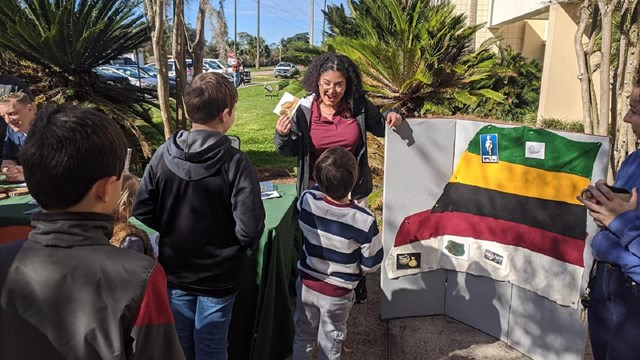
Clumps of students are scattered throughout the grounds of the Bush Home, an historic home site in Seattle, Washington. Laughter, shouts and murmurs of discussions surround each group as a few students photograph the paintworn walls. Others draw specific details of the main house and still others, with the use of compasses, metric tapes and centimeter grid paper, begin the process of mapping this piece of heritage which is quietly rotting away. These students have already completed an initial inventory, combed the early newspapers for references, and have interviewed several old timers who remember the Bush Family. During this final visit they are to complete their "survey", and then send their record to the State Historic Preservation Office. This process, which instills civic responsibility and an ethic of conserving our past, is part of the final unit in the interdisciplinary curriculum Project Archeology: Saving Traditions (P.A.S.T.) (McNutt 1988). P.A.S.T. is a unique middle school/junior high curriculum, concerned with conservation archaeology and educating children. Students are actively involved with ten major principles in archaeology which include: absolute and relative time, stratigraphy, importance of provenience, rates of decomposition, and sites as non renewable resources. Science, social studies, language art, and mathematics comprise the core studies which strengthen the students' basic skills while applying them in a real situation. Most of the classroom lessons are set up for the students to become problem solvers. They understand the expectations of the situation, explore the variables, and explain their outcome. Finally students expand new information into new experiences. Questioning strategies for critical thinking, included in the Teachers Manual and Students Field Notebooks, moves the students beyond asking questions for questions' sake. Students are encouraged to ask questions about things they want to know, while involving the skills of analysis, synthesis, and evaluation. Students' questions then become relevant and thought provoking, stimulating their critical thinking process. Although validated as a Washington State curriculum, P.A.S.T.'s applicability to any region sets it as a national model for teaching conservation archaeology. Designed within its scope are opportunities to apply regional materials, when available, so that the curriculum encompasses both a global and regional view of archaeology (see Messenger and Enloe this volume for a discussion of archaeologists as global educators). Project Archeology: Saving Traditions was specifically designed for students of the 6th through 8th grades, however, the concepts and some activities also apply to the lower and upper grades. In Petersburg Alaska, students in the high school surveying course, with the guidance of a local archaeologist took on the responsibility of mapping five prehistoric fish traps and surrounding areas. This activity has helped the students apply their surveying knowledge and has fostered an understanding of site conservation. In Tucson Arizona, third graders construct an example of an archaeological site by layering soil within clear plastic shoe boxes. Studiously they measure and graph the contours of each layer. This is just one example of how the presented skills are applicable to the lower grades. Upon completion of their graphs and discussions on how archaeological sites are formed, the teacher scoops up a large portion of soil from one of the student boxes and dumps it back into the newly made hole. Some students shriek and others groan, "You ruined it!" The teacher has just set the stage for these students to discuss archeological site looting and vandalism and what they as a group can do about it. This curriculum is not the only instructional material to embrace the challenge of archaeology education. There are a host of others, some singular activities, others regional materials all developed to foster student appreciation for our national heritage and to address the problem of site destruction (Smith 1990, also see Hawkins this volume).
Criteria for Instructional Materials
Not since the controversial national banning of Man A Course of Study (M.A.C.O.S.), a curriculum in anthropology developed in the early 1970's, has there been such a quantity of archeological materials available to the schools. M.A.C.O.S. which presented other cultures' values so outraged many Americans that the curriculum was banned from schools (Rice 1986). Funding sources to develop other anthropological/archeological materials disappeared immediately and institutions of education found other social science studies to take the place of anthropology. In 1975 Project Archeology: Saving Traditions was funded for five years to development and test an archaeology program which was interdisciplinary and scientifically based. By the mid 1980's, when archaeologists, themselves, began developing materials to counter the destruction of archeological sites, a large quantity of instructional materials became available to the schools. A compilation of all these materials published in Pathways to the Past (Smith 1990), identifies and briefly describes what is available. Since its printing new materials have been developed. These materials range from instructions for a simulation dig to the video story of looters among the Mayan ruins (Sunburst Communications 1989). Some of these materials have been developed as isolated activities allowing teachers to pick and choose which activities best fit their classroom studies. Some are units of study to be used as part of the social studies curriculum. Few have a scope and sequence that allows archaeology education to be part of an interdisciplinary study. Archaeology is a science and uses the scientific method along with other related disciplines such as geology, biology, and chemistry. But at the elementary, middle school, and high school levels, archaeology is often taught in social studies textbooks by teachers with little training in the scientific process. Students graduate from high school thinking that archaeology is a mixture of glamorous adventure and stories portraying the ancient world. The vast majority go through life with this misconception, giving little heed to the worthiness of archaeology as a scientific study or to their own role in stopping the destruction of archeological sites. In 1988 a task force was established by the American Anthropological Association to explore efforts for teaching anthropology in North American schools (Selig 1989). Perhaps it is time archaeologists along with educators nation wide, develop a set of criteria regarding what constitutes effective archaeology education. These criteria can be used to review developed materials and make recommendations concerning appropriate modifications.
Archaeologists Benefitting Students
In their publication "Archeology in the Classroom: A Case Study from Arizona", Rogge and Bell acknowledge the importance of developing a strong relationship between educators, the community, and archaeologists. In Arizona, these three groups have joined together to form the Arizona Archaeological Council (AAC) The challenge of archaeology being part of classroom instruction, lies "in getting the ear" of the education system (Rogge and Bell 1989, also see Rogge this volume). In order that classroom instruction focus on the concerns of archaeology, archaeologists must first address the concerns of educators. Becoming familiar with state, district, and school guidelines will inform archaeologists about the essential skills, knowledge and attitudes addressed by educators. The following are examples taken from the State of Connecticut's Common Core of Learning (Connecticut State Board of Education 1987) which defines skills, attitudes, and applications crucial to learning. Students will:
A dialogue between educators and archaeologists will facilitate the understanding of these educational and archeological needs. The vehicle for this dialogue, in most cases, is already established. Throughout the United States educators meet according to disciplines, i.e. social studies coordinators, science coordinators, etc. These groups include university and college professors, museum educators, and fellow educators from industries who align themselves with similar education interest. Educators must hear that archaeology can be used to meet some of the essential skills, knowledge and attitudes included in educational guidelines and that archaeology can be used as a focus for a variety of subjects, i.e. science, mathematics, social studies, language arts, and art. Archaeology is an inquiring discipline and can be used to stimulate students to ask questions and to think critically. Informing education professors, social studies and science coordinators, other administrators, and museum and industry educators as to how archaeology benefits education is paramount. These core groups understand the education system and will be instrumental in gaining entry into the classroom. Archaeologists' reception by an education group depends largely on how instrumental archaeologists are in meeting the group's needs and, in turn, demonstrating the needs of archaeology. Within this role archaeologists can serve as advisors providing information about regional archaeology and resources for classroom use. Archaeologists along with educators can identify instructional materials which meet archaeology education criteria. They can assist in teacher training/in-servicing and pre-teacher education. While the responsibility remains in the hands of the educator, archaeologists must be persistent in seeing that archaeology and archaeologists be included in this education process. As volunteers in the classroom, archaeologists should be considered a luxury. Their audience is limited, if they were to spend the same amount of energy assisting in pre-teacher/teacher education, their efforts would be multiplied. However, while volunteering in the classroom does not create a multiplier effect, it can be a most enjoyable and educational experience for both archaeologist and students. To make this a quality experience, archaeologists involved with a classroom or a field trip should ask that participatory instruction take place prior to and following the visit. The pre-visit instruction serves to reduce the novelty of the occasion, thus preparing the student for the new information (Kubota 1985, Falk et al. 1978). In this manner, the archaeologist has not just heightened the students' interest in archaeology, but has prepared an instructional sequence of concepts and skills concerning archaeology. Before visiting classes, archaeologists should review the information to be presented, identifying ways students can participate through activities or small group discussions. This type of learning has been demonstrated to produce retained learning: the least effective way people learn is through reading (10% retention), hearing (20% retention), looking at pictures (30% retention), while people tend to remember 90% of what they both say and do with real experiences (Edgar 1989). Activities involving individual or small group participation increase the students' retention. Examples include: experimentation with raw materials, i.e., clay for pots (Ehrenhard and Ehrenhard 1988), or small group discussions of archeological dilemmas, i.e. what to do after finding an old pioneer's cabin (Ellick 1990), or classification of fish hooks according to types (Oi and Tamura 1980). Following this type of involvement the students are better able to extend their learning and use their higher level thinking skills to analyze, synthesize, and evaluate (Bloom 1985).
Teacher Support and Training
The development of instructional materials which meets prescribed criteria and the inclusion of archaeologists in the education community, does not insure the success of an archaeology education program in the classroom. These are two important elements but training of teachers and follow-up support by archaeologists empowers the teachers to create effective archaeology education for their students. Project Archeology: Saving Traditions has incorporated a model of teacher training and follow-up support which introduces teachers to the global view of archaeology with regional emphasis. An educational facilitator and an archaeologist team together, with the P.A.S.T. facilitator presenting the classroom materials including various instructional strategies. Modeling forms the bases of instruction, with the education facilitator presenting the activities just as they are to be taught in the classroom. Too often in workshops as well as college courses, teacher training becomes a lecture format quickly passing over the practicum of "hands- on " experience. Teachers need to be taught in the way they will teach. At the same time, the P.A.S.T. facilitator instructs on an adult level, recognizing the teachers as experts in their field. This may seem counter to the idea of modeling but in fact it is part of the modeling process. Students as well as adults need to know that their ideas and actions are valid. The facilitator encourages the teachers to share their ideas and experiences, and to modify the materials to their own situation. This act of ownership by the teachers is vital if the program is to succeed. Scheduling time for feed back from the teachers following each activity is one way to implement ownership. During this time teachers begin to perceive how they might use the materials within their own classrooms. A regional archaeologist is selected to assist with the P.A.S.T. workshops based on this persons' command of regional archaeology and a willingness to work with the teachers after the workshop is over. As the archaeologist attends the workshop, a familiarity with the instructional materials and each teacher is established. A mutual trust is important, enabling the teachers and the archaeologist to work together once the teachers have gone back in their classrooms and the P.A.S.T. facilitator has departed. This follow-up support has taken many forms. In some cases the teachers call the archaeologist to ask questions and share their students' work. In other instances, the teachers ask for periodic meetings as a group, and in some areas avocational and professional archeological organizations have welcomed the teachers as new members. Although this support of teachers by archaeologists appears as a "nicety", it is the element that makes or breaks a program. Repeatedly, good instructional materials have simply sat on the school shelves because teachers began to question the worthiness of their instruction and lack the inspiration to continue. Some form of archeological support is imperative for on-going classroom success.
Conclusion
The integrating of archaeology into society at large and most specifically into the classroom is essential if we are to preserve the sources of future archeological data and our common heritage. In order to accomplish this archaeology and education need to be integrated to meet the goals of archaeology education. The players are clear; students, educators, and archaeologists. We have the instructional materials, and we have, collectively, the knowledge to undertake the challenge. What we need is the will.
References Cited
American Association for the Advancement of Science (1989) Project 2061, Science for All Americans, pp. 7-8. Washington, D.C.
Bloom, B.S. (1985) Taxonomy of Educational Objectives, pp. 144-192. Longman, New York and London.
Carnegie Council on Adolescent Development (1989) Turning Points, Preparing American Youth for the 21st Century, pp. 55-106, Washington, D.C.
Connecticut State Board of Education (1987) Connecticut's Common Core of Learning, pp. 13-16, Hartford, CT.
Edgar, D. (1989) Experience and Learning. Journal of Coll. Sci. Teaching. Nov.
Ehrenhard, J. and Ehrenhard, E. (1988) Did Indians Eat Pizza? Clay Pots. Heritage Education Quarterly 3:2.
Ellick, C. (1990) Archaeology Dilemma Cards. Tucson, AZ., unpublished.
Falk, J.H., Martin, W.W., and Balling, J.D. (1978) The novel filed trip phenomenon: Adjustment to novel settings interferes with task learning. Journal of Research in Science Teaching, 15:2 pp. 127-134.
Kubota, C. (1985) Effects of Novelty-Reducing Preparation on Exploratory Behavior and Cognitive Learning, unpublished dissertation.
McNutt, N. (1988) Project Archeology: Saving Traditions. Sopris West, Inc., Longmont, Colo.
Oi, A. and Tamura E. (1980) Behold Hawai'i. 3.3 Dept. of Eduction, HI.
Rice, M.J. (1986) Curriculum Artifacts: The Remains of Three Anthropology Projects. Practicing Anthropology. 8(3-4):6, 19.
Rogge, A.E. and Bell, P. (1989) Archeology in the Classroom: A Case Study from Arizona. Archeological Assistance Program Technical Briefs. 4.
Selig, R.O. (1989) The AAA Task Force on Teaching Anthropology. Anthro Notes 2.3.
Smith, K.C. (1990) Pathways to the Past, Museum of Florida History, Tallahassee, FL.
Sunburst Communication (1989) The Second Voyage of the Mimi. Pleasantville, N.Y.
Return to the Table of Contents Open the Microsoft Word Version of this Article
|