MODEL STATE/TRIBAL LEGISLATION AND JURY EDUCATION CO-VENTURING TO COMBAT CULTURAL RESOURCE CRIME

Kristine Olson Rogers

and

Elizabeth Grant

Introduction

In many respects, 1988-89 were banner years for archeological resource protection and "archaeophiles" admirers of the ancients. National media focused attention on the Slack Mounds burial desecration case in Kentucky (Harden, "Who Owns Our Past?," National Geographic, Mar. 1989), the Thai temple lintel demonstrations at the Chicago Art Institute, (Wilkerson, "Temple Lintel Pits Thais Against Art Museum," N.Y. Times, July 17, 1988), the Italian government's efforts to recover an ancient Sicilian statue at the Getty Museum (Connoisseur, Oct. 1988; Stille, "The Getty's Aphrodite: Fruit of an Illegal Dig?," National L.J., Nov. 14, 1988) and a U.S. District Court judge in Indianapolis who ordered the return of stolen Byzantine mosaics to a Cyprus church (Autocephalous Greek-Orthodox Church of Cyprus v. Goldberg and Feldman Fine Arts, Inc., 717 F. Supp. 1374 (S.D. Ind. 1989)). Federal shipwreck legislation finally made it through the rocky shoals of Congress (P.L. No. 100-298, 102 Stat. 432 (1988)).

The House Committee on Interior and Insular Affairs held field hearings in the Four Corners area, which resulted in the passage of two more significant pieces of legislation in Congress' 100th session (Act of Oct. 28, 1988, P.L. No. 100-555, 102 Stat. 2778; Act of Nov. 3, 1988, P.L. No. 100-588, 102 Stat. 2983). Doonesbury lampooned Presidential candidate Bush's association with the secret Skull & Bones Society at Yale, holding its members up to ridicule as grave-robbers of Martin Van Buren's tomb (G. Trudeau, Dec. 27, 1988). The Hopis were successful (aided by a National Park Service archaeologist) in blocking potential depredations by LucasFilm in plans to shoot its latest "Raiders" episode at Mesa Verde National Park (Rocky Mountain News, 1988).

The tide has turned against archaeological looters, and it's time for archaeophiles to take advantage of it. Unfortunately, when this tide turns and the artifact supply dries up, the antiquities market also heats up as evidenced by the record Sotheby auction prices from the Indian Art Sale held in November 1988 in New York City (New York Times, Dec. 11, 1988 & July 16, 1989). Hence archaeophiles need to move on several fronts, and move fast.

This analysis will begin with a summary of the recent federal legislation amending the Archaeological Resources Protection Act (16 U.S.C. §§ 470aa-470ll (1979) [hereinafter ARPA] followed by a discussion of how states and tribal governments can follow suit and how federal agencies can be instrumental in building an intergovernmental protection partnership. Finally, readers will be directed to ways of enhancing preservation partnerships to join three essential entities: (1) tribal governments, (2) museums, and (3) private property owners.

Congressional Backdrop - Public Laws 100-555 and 100-588

Senate Bill (S.B.) 1985 -- Senator Domenici's Bill (PL 100-555, signed by former President Reagan on October 28, 1988) had its impetus in the findings of the 1987 GAO Report about archaeological looting on federal lands (see Cheek, Neumann this volume for further discussion of ARPA and the 1988 amendments). In introducing the legislation, Senator Domenici remarked:

Most of the archaeological surveys performed in recent years have been conducted to obtain clearances for development projects [or timber sales] and, therefore are not necessarily directed at those areas having the greatest archaeological resource potential. S.B. 1985 would strengthen the provisions of ARPA by directing BLM, the Park Service, the Forest Service and other federal agencies to develop plans to survey the lands under their control to determine the nature and extent of archaeological resources on those lands (134 Cong. Rec.).

P.L. 100-555 also directs federal land managers to develop processes for reporting suspected incidents of looting. Domenici said: "Improved documentation of looting activity would provide the land management agencies with better data to use in deciding the amount of funds and staff to request for ... the protection of sites and for the apprehension and prosecution of looters." (134 Cong. Rec.)

The principal author worked with Representative Sam Gejdenson (D. Conn.) on the House of Representatives' amendments to ARPA. There was some trepidation about tinkering with ARPA for fear that it would bring out the pothunting lobby in droves, or that the political process would result in a weakened version. The first fear really didn't materialize, but the second did, in part.

After conducting a tour and field hearings in Cortez, Colorado, Representative Gejdenson drafted amendments to ARPA with three objectives:

  1. Clarify the definition of archaeological resource by eliminating the "laundry list" and eliminating the phrase "of archaeological interest."
  2. Reduce the age limit of protected archaeological resources from 100 years to 50 years old. (Rep. Craig from Idaho was adamantly opposed to this change.)
  3. Eliminate the $5,000 felony threshold to provide instead the Arizona model of misdemeanor penalties for surface collection and felonies for digging (Comm. Print 1988).

The final legislation was House Bill (H.B.) 4068 (P.L. 100-588), signed November 3, 1988 by the President. As a result of committee compromise, ARPA has now been amended by:

  1. Adding an attempt provision (to reach those defendants who are caught before they do any damage at a site, but have tools, etc. with them). Unfortunately, Congress didn't define what constitutes an attempt;
  2. Substituting $500 for the $5,000 felony cut-off which may make felonies easier to prove, but which doesn't eliminate the problems with jurors disparaging archaeological damage figures and with battles of the experts over definitions and professional fees (Olson Rogers, 1985:110); and
  3. Requiring each federal land manager to "establish a program to increase public awareness of the significance of the archaeological resources located on public lands and Indian lands and the need to protect such resources," summarized in periodic reports to Congress. This last addition is a step, but doesn't go far enough.

The primary legal attacks on ARPA have concerned the definition of "archaeological resource" (Olson Rogers, 1987:70). A convicted pothunter in Oregon recently appealed to the Ninth Circuit on vagueness grounds, but the court upheld the guilty verdict. The issue is now pending on a petition for certiorari before the U.S. Supreme Court (United States v. Austin, No. 88-3300 (9th Cir. 1990)). Unfortunately, P.L. 100-588, as amended, does nothing to address ARPA's definitional problems (which will continue to be raised across the nation, regardless of the circuit court ruling in the Austin appeal).

As a matter of fact, as this article was being revised, the principal author received an inquiry about a pothunting case in Grand Junction, Colorado (in the Tenth Circuit). In March 1990, a United States Magistrate there acquitted a defendant, caught with screen and shovel digging in an archaeological site, citing concerns over ARPA's definitions. The U.S. Attorney's office sought de novo review in the U.S. District Court.


Congressional Fallback

Federal/state/tribal partnerships need to be built to develop model state statutes and tribal ordinances which supplement federal laws and to consider joint investigative efforts which could be prosecuted through the state and tribal courts, if the federal courts are unavailable (either because federal prosecutors decline ARPA cases or because of unfavorable federal court rulings on ARPA). This is exactly what the BLM did in the 1970's in Utah's Grand Gulch Primitive Area (when the legality of the criminal provisions of the 1906 Antiquities Act was in doubt), and it resulted in eleven convictions of pothunters within a five-year period under the Utah state statute (Fike 1980).

Reliance on the state courts where there are inadequacies in federal legislation is also what former Oregon State Supreme Court Justice Hans Linde has advocated in speeches and opinions, echoing similar suggestions by former U.S. Supreme Court Justice Brennan. When federal constitutional protections were being eroded by a conservative U.S. Supreme Court, Justice Brennan remarked: "The diminution of federal scrutiny and protection ... mandates the assumption of a more responsible state court role"(Brennan 1986:548).

Author Olson Rogers teaches an Archaeological Resources Protection Law seminar at Lewis and Clark's Northwestern School of Law and assigns law students to draft model regional legislation. Fifty such models have been prepared for various states, U.S. Territories, Canadian provinces, counties and tribal lands (on file at the law school). Many states have undertaken similar revisions to outdated antiquities legislation, sometimes prompted by these students' inquiries.


Model State/Tribal Legislation: Cultural Property Protection Act

Thirteen prescribed provisions of this law reform effort follow in an annotated outline:

Section I: Introduction

The preface to any legislation should set the tone by emphasizing that the purpose of the Act is for protection and preservation (not excavation and display). The introduction should be modeled after Arkansas (Ark. Stat. Ann. 13-7-301 (1987)), Pennsylvania (Pa. Stat. Ann. tit. 71, §§ 1047.1b(3), (6) (Purdon Supp. 1988)) and the Warm Springs Tribal Ordinance (Code Chapter 490). It should also cite duties of state officials to report and investigate violations (Domenici Bill) (Act of Oct. 28, 1988, P.L. No. 100-555, 102 Stat. 2778); to prosecute (N.M. Stat. Ann. § 18-6-9(D)); and, on the part of private citizens, to report discoveries.

The state of Utah has one of the broadest provisions with respect to reporting discoveries:

Any person who discovers any site or specimen on lands owned by the state shall promptly report such discovery to the Division of State History. It is the intention of the Legislature that discovery on privately owned lands of sites or specimens should be immediately reported to the Division of State History and that field investigation should be discouraged except in accordance with this act.(Utah Code Ann. § 63-18-27 (1986)).

Ark. Stat. Ann.  13-6-3-3(b) (1987) and N.C. Gen. Stat. 70-1 (1985) contain similar language.

Section II: Definition

A model definition of cultural property would be based on information and sacred values, not artifact-based, and would be geared to regional resources (hence the crucial role of state and tribal authorities -- ARPA was originally drafted by Southwestern states' advocates (Collins & Michel 1985:84), so its definition is slanted toward Southwest ruins and pottery (16 U.S.C. § 470bb(1)). "Resource" should be broadly defined as it was in the original Gejdenson bill (134 Cong. Rec. E486 (daily ed., Mar. 2, 1988)); "sacred object" per the Oregon statute (Or. Rev. Stat. §§ 358.905(6)(a)-(b) (1987)); "contextual information" per the Columbia River Gorge National Scenic Area interim guidelines (U.S. Department of Agriculture, Columbia River Gorge National Scenic Area Final Interim Guidelines (Pacific Northwest Region 1987), at 9); age limit set at fifty years to conform to most agency and tribal regulations (36 C.F.R. §§ 1.4(a) and 261.2 (1988)) and to include most Western historical sites. Tribal ordinances should be incorporated by reference into other jurisdictions' laws to include cultural vegetation and other items of tribal identification. Human remains should not be included in the definition of "resource," but treated separately (Section IV, VII and X).

Section III - Permitting

A permitting program should make clear that the state or tribe possesses the exclusive right to explore and excavate archaeological resources located within the state or tribal lands (Ala. Code § 41-3-1 (1982)). A system must be established for research following Dr. William Lipe's "conservation ethic." Permits should be issued only in keeping with conservation and preservation goals. The goal of the conservation model is "to see that archaeological resources everywhere are identified, protected and managed for maximum longevity" (Lipe 1977:21), which in the case of some, should be indefinitely.

A Board should be established to determine what research is absolutely necessary. The Veterans' Administration Human Subjects Research Review (45 C.F.R. §§ 46.101-24 (1988)) provides an analogous forum (Ala. Code § 41-3-1 (1982). Indian representatives are essential (one for each affected tribal government). Permitting fees would fund patrols, surveys and public education at the state, county and tribal levels.

Clear title to any objects found should be vested in the state or tribal government (no percentage to finder!) Unfortunately, a number of states with underwater archaeological sites treat the resources as salvage items and allow salvors to retain a portion of what they recover. See, e.g., La. Rev. Stat. Ann. §§ 41.1605-.1606 (West Supp. 1989) (percentage of cash value of objects found); N.C. Gen. Stat. § 121-25 (1986) (portion of all relics may be sold or retained by the licensee). Oregon (O.R.S. §§ 273.718 et seq.) allows people to obtain permits to explore state lands for "goods, money or treasure trove." If the state chooses to place the property in a museum, it must compensate the finder for the value of the goods up to $5,000 and 50% of any value above that amount. These types of statutes encourage exploitation of resources and are contrary to the goal of conservation archaeology.

Finally, an ongoing supervision requirement is critical to the success of this system, to allow the tribal or SHPO's agent access to the site throughout the project (Washington, Ch. 44, Laws of 1989 and Utah Code Ann. 63-18-25 (1986)). With respect to private land, recording and removal conditions should be specified, providing for condemnation in the case of noncompliance. Programs for funding private preservation efforts should be initiated, and financed through fines and permitting fees. Mo. Rev. Stat. §§ 253.400-407 (Supp. 1989) (Historic Preservation Revolving Fund Act), N.Y. Parks & Rec. Law §§ 17.01-.11 (McKinney 1984) (Outdoor Recreation Development Bond Act); Pa. Stat. Ann. tit. 32, § 5001 (Purdon Supp. 1988) (Open Space Lands Act).

Section IV - Criminal Conduct

Prohibited behavior should include: "Entering archaeological area with intent ..." (Utah Code Ann. § 63-18-25 (1989)); possession of illegal artifacts (Northey 1982:81); trafficking without certification of origin (Or. Rev. Stat. §§ 358.920(3)-(4) (1987)); removal of cultural property from the state. The state of Alabama has declared ownership of all objects found on aboriginal mounds, earthworks, ancient or historical forts and burial sites situated within the state and forbids the sale or disposal of those objects outside of the state, unless they are exchanged for other objects from other states' museums, libraries or individuals (Ala. Code § 41-3-5 (1975)).

All "garden variety" applicable criminal statutes (e.g. theft, trespass, vandalism, etc.) should be incorporated in this provision (Olson Rogers 1987:81-86). Human remains should be addressed in a separate section with increased penalties. For instance, Washington law provides that the knowing removal, mutilation or destruction of historic graves is a felony and in the event of inadvertent disturbance, the remains must be reinterred. In addition to criminal prosecution, Indian tribes or members are given a civil action for equitable relief or damages against those who have disturbed grave sites. A successful plaintiff may recover attorney fees and punitive damages under this provision (Washington, Ch. 44, Laws of 1989).

Section V - Penalties

Misdemeanor = (maximum one year imprisonment or a $100,000 fine or both) for surface collection (if value of stolen object is less than $100). Felony = (five years, $250,000 fine or both) for surface collection of artifacts worth more than $100 and for all excavation (Ariz. Rev. Stat. Ann. § 13-3702.01 (Supp. 1988)).

Section VI - Forfeiture

State drafters should follow the ARPA model allowing forfeiture in conjunction with or apart from any criminal or civil cases (16 U.S.C. § 470gg(b)(3)), plus mandate forfeiture of illegal artifacts in defendants' possession (Northey 1982:88) (Idaho Code § 67-4122 (1980); Kan. Stat. Ann. § 74-5408 (1985); Or. Rev. Stat. § 273.711 (1987)). Forfeiture should also be allowed for items purchased with proceeds of illegal trafficking activities, similar to many criminal narcotics trafficking statutes.

Section VII - Civil Penalties

ARPA regulations are generally adequate, as long as they are enhanced by provisions for treble damages (Idaho Code § 67-4118 (1980)). With respect to burial violations, a separate right of action should be provided for tribes or enrolled members allowing tribal court jurisdiction (Washington, Ch. 44, Laws of 1989, § 3).

Section VIII - Private Right of Action

Civil enforcement should not be reliant on the state Attorney General's Office to pursue. Individuals, tribal governments or public interest organizations should have available: damages (actual, punitive, plus emotional distress); declaratory and injunctive relief; and provisions for successful plaintiffs to recover attorneys' fees (Or. Rev. Stat. § 358.955) (Washington, Ch. 44, Laws of 1989).

Section IX - Rewards

ARPA's system is an acceptable model, except the maximum reward should be increased to $5,000. ARPA allows a reward to any person who furnishes information which leads to the finding of a civil violation, or the conviction of a criminal violation and for which a fine was paid. If several persons provide information, the money is divided among them. A government employee acting in the scope of employment is not entitled to claim a reward.

The maximum reward under ARPA is $500. Originally, ARPA called for $1,000 reward, but "several members of Congress feared the higher figure might encourage vigilante type activity or more likely frivolous allegations" (Collins 1980:7-8). These fears have proven to be unfounded. In the first eight years of ARPA's operation, only two cases of penalty awards to private citizens were reported (letter from William Penn Mott, Jr., Director of the National Park Service to Senator Pete Domenici (Mar. 13, 1987).

Section X: Tribal Rights

A model statute must: require notification to tribal authorities regarding recovered sacred objects (Or. Rev. Stat. § 358.945 (1987)); mandate forfeiture of items to identifiable tribes or descendants (16 U.S.C. § 170gg(c) (1982)); ensure tribal access to sites (42 U.S.C. § 1996 (1982)); contain a conflict resolution process such as that called for in Charles Wilkinson's exemplary "Ethic of Place" (Wilkinson 1988:401); specify disposition of remains (immediately return to identifiable tribe or descendant except when temporarily needed for prosecution or for critical scientific investigation as determined by the representative permitting board).

In 1976, Iowa passed a law providing for reburial of disinterred Native American remains. As one commentator has noted, the law was the product of a cooperative effort between archaeologists and Indians to resolve the conflict between them and face the problems created by construction projects and looting, their common enemies (Anderson, 1985: 48). The cooperation between the archaeologists and Indians of Iowa has continued through a series of conferences and other educational programs. Anderson suggests that archaeologists work on a regional or state level with the appropriate tribal officials to develop procedures that are tailored to the problems which exist in the area (Anderson: 51).

Section XI - Incentives to Private Landowners

There are numerous tax incentive schemes to draw upon for protection of cultural resources on private land (Alaska Stat. § 29.45.050(b)(2)(B) (1988) (municipality may by ordinance classify and exempt from taxation historic sites, building and monuments); N.M. Stat. Ann. § 7-2-18.2 (1988) (tax credit for one-half of the cost of restoration, rehabilitation or preservation of a cultural property up to a maximum of $25,000)). A land exchange program such as that provided by Washington statute should be expanded to specifically include archaeological resource sites (Wash. Rev. Code § 79.08.109 (Supp. 1989)). Protective measures can also be required as parts of state land use plans, such as Oregon's Land Conservation and Development Commission's Goal Five (Oregon Land Conservation & Devel. Comm'n, Dep't of Land Conservation, Oregon's Statewide Planning Goals 5 (1985) (programs shall be provided that will protect scenic and historic areas and natural resources for future generations); N.J. Stat. Ann. § 40:55D-28(b)(6) (West Supp. 1988) (master plan, where appropriate, should include information on historic sites and their relation to surrounding areas in keeping with site-specific secrecy requirements outlined in next Section).

Eminent domain is a more drastic possibility (Alaska Stat. § 41.35.060(b) (1988)). New Mexico provides for an emergency classification of private land whereby a site can be temporarily placed on a register pending further investigation (N.M. Stat. Ann. § 18-6-12 (1978)). An owner may receive a fair rental value for land to the extent the classification affects the normal use of the property. Historical district designation must be facilitated (Haw. Rev. Stat. § 6E-2 (1984)). Mining activities must be curtailed. Miss. Code Ann. § 53-7-51 (Supp. 1988) gives anyone the right to petition the state to declare an area unsuitable for mining that might damage the area's archaeological value. The Supreme Court of Indiana has recently held that the state's designation of an archaeological site on privately owned land as unsuitable for surface coal mining did not amount to an unconstitutional taking (Dept. of Natural Resources v. Indiana Coal Council, Inc., 542 N.E.2d 1000 (Ind. 1989).

In addition, political pressure can be a form of powerful persuasion and can lead to negotiated deals between governments and private landowners to prevent the destruction of valuable sites. For example, Hawaii's Governor Waihee was able to convince a land developer to cancel plans to develop a hotel on an ancient burial site and to rebury the remains in return for the state's promise to purchase the land (USA Today, Apr. 20, 1989)

Section XII - Exemption from State Freedom of Information Acts

No site-specific information should be available to the public. Sales of public land with known sites should be prohibited (Ark. Stat. Ann. § 13-6-305 (1988) (the Commissioner of State Lands, upon written notice given by the Arkansas Archaeological Society, shall reserve from sale any state lands on which sites or artifacts are located or may be found); Vt. Stat. Ann., Tit. 22, § 765 (1988) (when transferring real property that contains archaeological resources, the state, upon recommendation of the state archaeologist, may condition the transfer in such a way as will protect the resources)). A right of first refusal could also be granted to the SHPO or an archaeological conservancy.

Section XIII - Public Education

Overall objectives for any state cultural resource program include: appropriating fifty percent of "state ARPA" fines to fund designated public education programs; devoting one-fifth of SHPO's job description (i.e., one day a week) to public education activities (Olson Rogers 1986:13, also see Chapter 4 this volume for additional discussion of archaeology and education); requiring paraprofessional components in all state-funded research projects.

Public Education Platform -- Thirteen Planks

All archaeophiles conducting public education programs should begin with the Airlie House Report (see McGimsey this volume). In 1974, with the help of the National Park Service, Dr. McGimsey organized several Airlie House seminars. One, in particular, focused on public education. In the Airlie House Report, Chapter Four is entitled "The Crisis in Communication" and deals with getting the archaeophiles' message out to the general public (McGimsey 1977:78). Its recommendations are:

1. Teach public relations methods to archaeology graduate students.

2. Give professional recognition to public relations as a worthwhile endeavor (not just to "scholarly journals"). Give credit for pieces in popular magazines.

3. Talk to pothunters.

"[t]here will always be certain individuals, generally labelled 'pothunters' who are either unconcerned or simply unaware of the damage they are doing to the resource base. It is important to the profession that communication is maintained with these individuals. In individual instances it may be impossible to convince them to adhere, to whatever degree, to proper scientific methodology. It certainly is impossible if you do not talk to them at all. Even those individuals that show no prospect of being converted can be helpful in giving information on what they find, which again would be a total impossibility if they had been alienated because of the attitude of the professional. Destruction of sites or materials by pothunters should not be supported or condoned in any way, but it should be possible to remain in communication with such individuals without doing either. At least the attempt should be made" (McGimsey 1977:84).

4. Adopt a logo for public recognition.

5. In dealing with the media and laypersons, always ask yourself the following seven questions:

"'Am I sufficiently stressing the need for preservation of archeological resources?' (Avoid creating the impression that archaeological sites are there to be exploited by archaeologists or anyone else)" (McGimsey 1977:85) - Since Dr. Lipe's seminal article in 1974, archaeologists have generally internalized his plea to save study subjects for future scientists, rather than rummage through them all in a fit of professional fervor.

"'Am I fully recognizing the humanistic appeal of archaeology?' (Avoid portrayal of archaeology as a dry-as-dust activity)" (McGimsey 1977:86). In the successful Cortiana prosecution in Arizona, the expert witness, Dr. Adovasio, personalized the main exhibit (a mummified Anasazi infant) by referring to her as "this little girl," clearly conveying to the jury that this was someone's child, not a collectible curio (American Anthropological Association Newsletter, 1988).

"'Am I fully presenting the scientific nature of archaeology?' (Avoid looking like a treasure hunter -- forget objects, talk information.)" Professional topics for lay audiences, should communicate concepts, not frame artifacts as "objets d'arts."

"'Am I pointing out the pertinence of my work to the modern world?"' (Present the social-scientific basis for your research)." In U.S. v. Jaques, an Oregon pothunting prosecution, Dr. C. Melvin Aikens, the government's expert witness, described for the jury how soil and pollen research from the vandalized site could provide data useful to local farmers and agricultural researchers with respect to grazing patterns and crop rotation (United States v. Jaques, No. 83-129FR (D. Or. 1983), aff'd, 753 F.2d 1084 (9th Cir. 1984), cert. denied, 470 U.S. 1087 (1985)).

"'Am I representing archaeological considerations in a manner compatible with the law and with good cultural resource management concepts? (Consider that next year you or some other archaeologist may want the local legal authority to pass a law protecting sites. Lay the groundwork for that understanding and support.)" Probably the finest example of this kind of foresight can be found in Dr. McGimsey's own pioneering work in Arkansas (McGimsey 1972).

"'Am I presenting the interconnected nature of archaeology with other disciplines?" Most local newspapers have a science section which seeks contributions from community residents. Rob Freed, former archaeologist with the U.S. Army Corps of Engineers (Portland District), has been a regular correspondent with The Oregonian concerning such subjects as dovetailing geological and archaeological research theories in the Columbia River Gorge (Freed 1988).

"'Am I making clear the limitations on archaeology and archaeologists?' (Don't create unreasonable expectations. Avoid letting people think that if they find a site and report it, somebody will appear from the big university in the sky, pat them on the head, and excavate everything for free.)" In U.S. v. Barnes, another early Oregon prosecution, an unfortunate example of apparent failure to heed this warning may be found. A defense witness testified as follows:

Q. Did you ever send any of your [artifacts] ... to Oregon State University, to Dr. Cole?

A. Yes, I did.

Q. And did you ever show Dr. Cole the site?

A. Yes, I did. I took him to the site. It was the first time that the University had knowledge of the site.

Q. Well, did he express an interest in excavating the site?

A. ... I urged him to do so, and he definitely said that if they were funded ..." (Trans. p.585) (United States v. Bender, No. 81-119BE (D. Or. 1981)).

[Later testifying about a prehistoric rabbit snare from the site which the same witness had sent up to the University for examination.]

Q. [Mr. Cole] kept the basket and its contents for approximately two years, and refused to acknowledge my letters requesting him to share what knowledge he had learned from the study of the material. I stopped at the University while I was in Corvallis and asked him if he had written a pamphlet on the basket as he had promised. He said no, he had written nothing and didn't even know where the basket was. He eventually found it buried under a heavy stack of old newspapers, somewhat crushed and deteriorated in comparison to its condition when he borrowed it. I was disappointed with both the treatment to myself and the loaned material ...

Is that statement true?

A. That statement is true.

(Trans. pp.602-03) (United States v. Bender, No. 81-119 BE (D. Or. 1981)).

Given those seven questions as a constant backdrop, thirteen strategies for public education have emerged. To be most effective, all should be offered simultaneously as part of an integrated program.

1. Native American Political Participation

Nothing brings the protection message home in a more heartfelt way to the public than tribal outrage over desecration of sacred sites. Nez Perce leaders concerned with the Kelly prosecution in Idaho rented buses to attend proceedings and maintained a "victims' court watch" (Loftus 1986). Allen Slickpoo, a Nez Perce elder, made the point vehemently by saying: "These are my relatives whose skulls you're selling" (see Anyon this volume for further discussion of Native American concerns).

Hopis were able to make their presence felt at Mesa Verde in raising objections over the disturbance of sacred lands. As reported in the Rocky Mountain News in August 1988, "Lucas Films ... bowing to the concerns of the Hopi ... canceled plans to film part of an Indiana Jones adventure movie at Mesa Verde National Park"(Rocky Mountain News, Apr. 24, 1988).

An Executive Producer was quoted as saying "We discovered that this was holy ground to the Hopi Indians.... We feel we have to respect their heritage ..." The Hopi elders' objections were raised by actor Jon Voigt and by Jack Smith, National Park Service archaeologist. The producer noted, "The thing that put us over the top on this was to discover how upset the Indians would be, and certainly we didn't want to cause any kind of disrespect or problem there ..."

The Hopi Cultural Preservation Officer was writing a letter of objection to the Park Service when LucasFilm withdrew. He expressed relief, saying "... These [ruins] have become a complex shrine system for us. Mesa Verde was the home of the Flute Clan."

Another avenue for Native American activists to explore is the use of hex mythology. Virtually every culture has its version: the Egyptian mummy curse (Larson 1986); the AKU AKU warning on Easter Island (Heyerdahl 1958); misfortune spells surrounding the Viking rune stones (Dixon 1963); the chilling coincidences(?) that befell pocketers of potshards at Chaco Canyon as noted on the NPS tourist information center bulletin board. The point is that many pothunters are superstitious and therefore a receptive audience to the rumor that contact with illegal artifacts is not good for one's health.

There is nothing to prevent Native Americans from taking advantage of publicizing these cultural taboos. And there is every reason to cultivate Hollywood stars willing to assist in this endeavor. Exploitation of cult heroes is fair in this campaign.

2. Elementary and Secondary School Programs

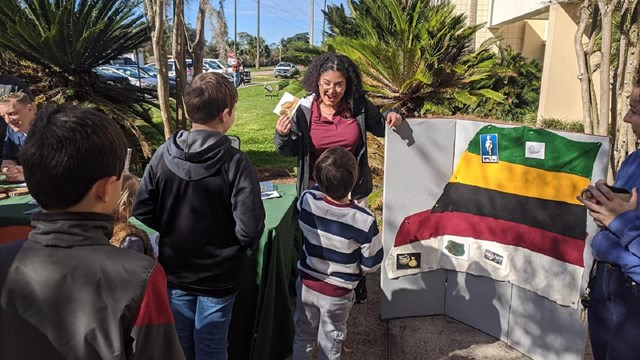
The "Young Igors" of the world have to be set straight. Oregon archaeologists salt sandbox stratigraphy with representative artifacts to give grade school amateurs an opportunity to participate in a professionally supervised "dig" (Wilson 1985). The Head Start Program on the Warm Springs Indian Reservation in Oregon has an elder-devised curriculum promoting cultural pride in pre-schoolers. Provincial leadership in Alberta, Canada provides an anti-pothunting unit for fourth graders (Knudson 1989:106). For additional information on school programs see Lerner, Rogge, Smartz, McNutt, and Hawkins this volume.

3. Private Landowners Outreach

There are many vehicles for converting citizens who are happenstance custodians of cultural resources. The most direct approach is taken by organizations such as the Archaeological Conservancy and the Trust for Public Lands which negotiate for preservation easements or outright purchase (Ford 1983:221, also see Michel this volume). Conversion is also accomplished through proselytizing in popular magazines such as Archaeology (Herscher 1989:67). Praise and other positive reinforcement for enlightened private action to preserve sites also win support. A model program in Kentucky, the Kentucky Archaeology Registry (KAR), has adopted this approach with great success. Its Executive Summary contains this description:

KAR provides cost-effective site protection to significant archaeological sites by educating landowners about their site's significance, involving them in site stewardship and providing management assistance and advice on stronger protection options. Recognition of the landowners' commitment takes the form of personalized awards.

Landowner contact/site registration can be useful site protection strategy in and of itself, or it can be used as the first step in a multifaceted site protection program. That includes the use of recorded land-use agreements, public education, grass roots support, enforcement of existing antiquities laws and active site management (Henderson 1988).

4. Museum Exhibits, Presentations, etc

There are some museums which are not wholly preoccupied with scoring "coups" in the illegal marketplace. To cite some positive examples of museum contributions to the cultural resource protection message: (1) the National Geographic Society's "Stolen Treasures" exhibit interpreting the confiscation of Peruvian burial goods from a convicted New York art dealer (Lewis 1982); (2) the Washington Archaeological Resource Center's travelling show with an integrated team of local, tribal and professional consultants assembling the information packet which accompanies the display; and (3) the Oregon Art Institute's Northwest Native American Art Council, which sponsored a panel on pothunting featuring an archaeologist, an attorney and a representative of the tribal governments in the state. This is the direction in which museum management of the 1990's should be headed (see Brose this volume).

Superb examples of this form of public education may be found in the tribal cultural centers on Western reservations. The Makah Cultural Center in Neah Bay tells the story of the excavation of the Ozette site on the Washington coast. The Gila River Indian Cultural Center just south of Phoenix abuts and interprets the site of the great Hohokam excavation at Salt River. None of these "objectify" artifacts by showcasing aesthetic values.

5. Site Stewardship and Signage

The Arizona State Historic Preservation Officer (SHPO), Dr. Shereen Lerner, has instituted an aggressive site steward program which has received national attention (Destruction of Archaeological Heritage 1988:53, also see Hoffman this volume). Sites with citizen watchdogs have advocates when they are violated. It is far more impressive to have hiking enthusiasts as witnesses (who had the presence of mind to photograph pothunters in trenches), than to parade a string of government law enforcement agents in court (Clayton 1982).

Creative signage can also impact captive audiences (see Jameson and Kodack this volume). A roadside sign in Alaska takes advantage of a prime whale watching spot to tell the story of missing pieces in an archaeological puzzle. A river rafting launch site posting heightens recreationists' sensitivity to archaeological areas downstream. The use of signs like these, physically removed from attractive resources, can educate without inviting invasion.

6. Participatory Archaeology

Fortunately, there are now many fine examples of programs which entail supervising amateurs involved in archaeological fieldwork (see Davis this volume). Peter Pilles, archaeologist on the Coconino National Forest in Arizona has received national recognition for his summer work with volunteers of all ages in the Flagstaff area (Dagget 1989:12). Dr. William Lipe spends his summers with amateurs at Crow Canyon. Earthwatch provides international opportunities.

Paraprofessional training can backfire. Care must be taken to provide an acceptable (and exhausting!) outlet to those with pothunting tendencies, reinforced by unremitting propaganda about the information potential of legitimate fieldwork. Archaeophiles cannot afford to provide training and "inside" information to those who will use it to promote their own treasure-hunts. State and tribal governments might begin with a paraprofessional training and certification program such as that provided by New Hampshire law (N.H. Rev. Stat. Ann. § 227-C:10 (Supp. 1988)).

7. State Commission

As with so many public relations offensives for archaeology, Arizona has taken the lead in using its state's political resources to cultivate a constituency for its cultural resources. When Bruce Babbitt was Governor, the first state archaeological protection commission was formed and the first Archaeology Awareness Week proclaimed (Proclamation, Arizona Archaeology Week, Office of the Governor, State of Arizona (signed by Gov. Babbit on Jan. 18, 1983). See Lerner (this volume) for additional information on Arizona Archaeology Week. Oregon has followed with a proclamation under Governor Goldschmidt and with conferences and legislation sponsored by the State Commission on Indian Services. Washington has adopted Arizona's "Thieves of Time" poster theme for its own campaign, substituting a Northwest carving for the Southwest pottery in the original design.

It is most appropriate as states undertake revisions of their cultural resource laws that official commissions be established in conjunction with such efforts. It is these commissions which can coordinate all the public education planks advocated in this article.

8. Amateur Archaeological Groups

Almost every state has a club of would-be archaeologists. In the last few decades, these organizations have struggled to make the difficult transition from a loose-knit hobbyists' and collectors' "kaffeklatch" to a serious supplement to professional archaeological groups (see Davis this volume). Two which have largely succeeded in this evolution are the Mid-Columbia Archaeological Society (MCAS), under the leadership of the late Nick Paglieri and the Oregon Archaeological Society (OAS).

The MCAS regularly exhorts its members to get involved in protection efforts and has been very industrious in "watchdogging" federal and state agencies (see, e.g., Cultural Heritage Threatened, Mid-Columbia Archaeological Society Bulletin, Jan. 1989) advising readers to write to Congress to protest U.S. Army Corps of Engineers' decision to reduce cultural resource staff in Portland, Oregon District. The OAS, through its newsletter "Screenings" has recently reminded its membership that:

We also believe that by protecting sites from indiscriminate digging, we can conserve many of these vanishing pages of history for future generations, whose scientific technique may be vastly superior to ours.... The artifact in itself should not be the primary objective, but rather the knowledge attained with its recovery.

* * *

Indiscriminate digging and vandalism by the few negate the efforts of the many....

* * *

All violators will be dropped from membership rolls and, if the incident warrants, will be reported to the proper authorities....

* * *

Remember, once a site has been destroyed, it can NEVER be repaired. (President's Comments, Screenings, Oct. 1, 1987, p.1.)

As news of this enlightenment spreads, professionals are gradually becoming more attuned to working with amateurs (rather than scornfully keeping them at bay). One positive example, again in Oregon, involved the close working relationship between the local discoverer of a Clovis-like point in Eastern Oregon and an archaeologist (and lithics expert) from the Corps of Engineers (Dreyfuss 1986:5). The professionals who excavated the site ended up naming it after the amateur who had called it to their attention. For an opposite point of view on the success of this endeavor and an indication of the attitudes (on both sides) which will need to be overcome, readers should skim the June 1989 issue of Indian Artifact Magazine.

9. Professional Archaeological Societies

The Society for American Archaeology has been traditionally open to public membership and regularly sponsors public conferences. It also holds workshops training professionals in public education programming. The Society has recently initiated a special project "Saving the Past for the Future" to assemble interdisciplinary "think tanks" which will concentrate on developing new approaches to promote public efforts for resource protection (Neumann 1989; also see Reinburg, Judge this volume).

10. PSAs, TV Documentaries, etc

Media communication which has the greatest impact comes in dramatic 30-second "spots" produced free for "public service announcements." Various states and tribal governments have been experimenting with a version of the environmental message borne by the profile of an Indian on horseback by a polluted stream showing a tear rolling down his cheek. The archaeophiles' edition portrays an Indian father and son entering a Protestant pioneer cemetery, carrying a pick and shovel, excitedly discussing what "treasures" they can find buried among the graves.

Other longer television productions include successful documentaries such as Arizona's "Thieves of Time" and Oregon Public Broadcasting station's "Time Bandits." Hollywood actors and national political figures can also be drafted for cameo appearances and radio spots. Another successful video is "Assault on Time" produced by the Federal Law Enforcement Training Center, in cooperation with several Federal agencies, For this approach to reach its potential, it must be cast and directed as an aggressive public relations campaign.

11. Law Enforcement Press Releases

Closely related -- indeed, another component of the public relations offensive -- is the issuance of press releases reporting law enforcement activities. One of the objectives of a criminal prosecution is deterrence; yet federal land managers are often reluctant to trumpet indictments and convictions of their "customers." Not only must this reticence be overcome, but managers should go one step farther and also publicize "preventive" law enforcement measures such as monitoring and electronic surveillance of sites (see, e.g., United States Corps of Engineers News Release No. PA 89-90, June 13, 1989 (describing how increased surveillance of sites along the Columbia River resulted in the arrests of two men for illegal digging)). See Des Jean this volume for discussion of a monitoring program at a National Park in Tennessee/Kentucky.

A note of caution, however -- it is imperative that public information officers work with law enforcement officers in co-authoring press releases of this nature. Ongoing investigations can be seriously compromised or undercover operatives endangered by unguarded communications with media representatives.

12. Fact-Finding/Propaganda Trips for Policy Makers

Some public education needs to be targeted at public officials. Greater levels of awareness can be almost instantly achieved by such attention-getting ventures as: hosting a member of the court at an archaeological field station on a wildlife refuge; taking prosecutors on river trips to vandalized areas; organizing "field trips" for FBI agents in conjunction with training sessions; urging land managers to accompany elders to looted burial sites and to attend a reinterrment ceremony; busing Advisory Councils to the scenes of archaeological crimes to observe first-hand bulldozer blade gouges in ancient kiva walls and skeletal material eroding from the shoulders of newly constructed logging access roads. Media representatives may be invited along on any or all of these excursions.

13. Operation SAVE Prototype

The Bureau of Land Management recognized that the best way to protect archaeological research was through a multifaceted approach and instituted Operation SAVE (Save Archaeological Values for Everyone) in 1987 (see Schalk this volume). The program's three areas of emphases are public education, interagency employee training and law enforcement. The BLM's efforts to increase awareness of the importance of cultural resources include distribution of posters printed with a toll-free number for citizens to call to report archaeological crimes. Stickers featuring the same Wishram Indian rock art design as the posters are distributed to school children. The toll-free number has prompted numerous calls.

In its first year of operation, SAVE sponsored training programs for over 400 governmental employees including both managerial and field staff. Through Operation SAVE, the BLM assists federal and state agencies to investigate violations and increase enforcement of laws protecting archaeological sites. The BLM also conducted an aerial surveillance program which led to the detection of fourteen archaeological violations and recovery of seventy artifacts. Future goals of Operation SAVE include strengthening ties to local communities, increasing patrols on public lands and developing a monitoring program for vulnerable sites (BLM, Annual Report, 1989 -- for a detailed description of S.A.V.E., see Schalk this volume). The Operation SAVE logo "Tsagaglalal" has been adopted for the Society for American Archaeology "Save the Past for the Future" project.


Co-Venturing

At the Third Annual Northwest Tribal Cultural Resource Protection Conference in Silverdale, Washington, the Executive Director of the National Advisory Council on Historic Preservation together with the primary author of this article found themselves cast in a "bit part" mediating role much like the cook in Moliere's "The Miser" (G. Gravely trans. 1956:205-207). However, a reconciliation between Indians and archaeologists proved to be a much tougher challenge than that involving an estranged father and son competing for the same woman! That shouldn't be the case.

Cultural resources are mute. Not that they don't have much to convey to those who take the time to listen, to observe, and to learn or to those whose ancestors or heritage they contain. But when their integrity is violated, they cannot testify for themselves.

The 1980's has witnessed the effectiveness of the victims' rights movement, as "reform" legislation swept 47 states and the federal government. The combined political clout of victims and their friends and relatives has resulted in increasing resources for investigation, more arrests of offenders, greater acceptance of evidence at trials about the impacts of crimes and enhanced penalties at sentencing. When cultural resources are victims of pothunters, private developers or governmental project depredations, they likewise need voices to protest their plight.

Frequently in the courtroom, cultural resources are disembodied, objectified. To speak of cultural resources "victims" as dehydrated remains, as items of scientific curiosity, serves to further degrade them. To allow them to go advocateless is to permit their continuing victimization.

That is why Adovasio's description of the mummified infant in the Cortiana case as "this little Anasazi girl" is so compelling. The jury at this trial was less able to disregard the invasion of this human being, because she became more than a "site" or abstract artifact in the jurors' minds.

That's also why the Kelly case resulted in the serious penalties imposed (including costs of reburial) -- because Nez Perce elders rented a bus and appeared at court hearings, held press conferences, and carried picket signs saying "We don't dig Kelly!" and bore witness in the back of the courtroom whenever the case appeared on the docket.

Instead of bogging down in internal squabbles over past slights, why can't the preservation forces join forces? Why has there been no coalition of archaeologists and tribal leaders to go on the public relations offensive in these cases? It is time for the "thieves of time" message to be proclaimed by a chorus of blended voices at every opportunity: in the press, in the courtroom, in the legislature and in the public arena wherever cultural resources are threatened.

It is time to expand the partnership. Tribal governments are essential to this enterprise. They have never been allocated adequate funding to be meaningful players in the protection of their own heritage.

For instance, when the Columbia River Gorge National Scenic Area Act was passed, Oregon county governments received monies from the state legislature for planning purposes. The four affected tribal governments named in the legislation received nothing, until the Gorge Commission applied to Congress for a small appropriation under the tribal government Self-Determination Act (25 U.S.C. § 450(h); (Letter from Stafford Hansell, Chair, Columbia River Gorge Commission, to Rep. Sidney Yates, Feb. 22, 1988). This underfunding is unfair and shortsighted, because Gorge protection cannot be achieved without tribal participation.

The National Historic Preservation Act contains a heretofore unused provision which is of particular interest in this regard. Title 16 U.S.C. § 470-1(d)(3)(B) empowers the Secretary of the Interior (in consultation with the SHPO) to "make grants or loans ... to Indian tribes ... for the preservation of their cultural heritage." It would be a productive step to begin this partnership if representatives of the Department of the Interior would urge SHPOs to work with tribes to apply for such grants.

The second prong of this partnership has got to be museums. Museums have unfortunately often taken an adversarial role vis-a-vis preservationists and Indian tribes, for instance by lobbying against the UNESCO cultural property convention or by proposing legislation to have museums exempted from the National Stolen Property Act (Meyer, 1973:284; Letter from Asst. Attorney Gen. Patricia Wald to Hon. Charles A. Vanik, Subcomm. on Trade, Comm. on Ways and Means (July 26, 1977); Moore, 1988:466). But new curators and directors like Ellen Herscher are starting to push for cooperation with tribes on repatriation issues and for tighter acquisition policies (Herscher 1989:70). Governmental agencies could play a major role in supporting this "new wave" of museum management, and in offering joint ventures in assembling traveling exhibits or interpretive programs.

The third partnership category is another obvious one -- private property owners. It will be impossible to achieve consistent cultural resource management if it only applies on public lands. The Kentucky model mentioned earlier is one worth emulating. Working through SHPOs, federal agencies could enter into agreements with their private citizen neighbors to preserve sites jointly held. Contributing its expertise, the federal agency could foster private site steward programs, offer "Take Pride in America" awards to citizens who do the most for cultural resources, etc.

There are lots of opportunities to nurture this relationship if private outreach becomes a priority. After all, the Kentucky program is funded, in part, by the National Park Service. That agency is a natural to take the lead in forming these kinds of partnerships, and the mandate from Congress is in Representative Sam Gejdenson's legislation.

According to Ruthann Knudson: "We need to develop an overall archaeological research [and preservation] plan for the whole continent. To do it will take scientific and political skills as well as courage and chutzpah" (Knudson 1989:73). Moreover, the proposed partners must envision sinking or swimming together. Otherwise the archaeophiles' audience will lack confidence in the ability of these co-venturers to go the distance.


References Cited

Adovasio, J. M. (1988) Potholder found Guilty in Jury Trial In American Anthropological Association Newsletter, Vol. 29, No. 1, p. 28, Col. 1.

Anderson, D., (1985) Reburial: Is It Reasonable? Archaeology (Sept./Oct.) pp. 49ff.

Brennan, W. (1986) The Bill of Rights and the States: The Revival of State Constitutions as Guardians of Individual Rights. New York University Law Review, Vol. 61, pp. 535, 548.

Clayton, R. (1982) 3 Fined for Indian Burial Ground Violation. U.S. Forest Service Pacific Northwest/Southwest Log.

Collins & Michel (1985) Preserving the Past: Origins of the Archaeological Resources Protection Act of 1979. American Archaeology. Vol. 5, p. 84.

Collins, R. (1980) The Meaning Behind ARPA: How the Act is Meant to Work. U.S. Department of Agriculture, Forest Service, S.W. Region, pp. 7-8.

Dagget, D. (1989) Rocks of Ages. Arizona Highways (April), p. 12.

Dixon, F. (1963) The Hardy Boys: The Viking Symbol Mystery.

Dreyfuss, C. (1986) Legacy of a Vanished People, The Oregonian (June 1) Northwest Magazine, p. 5.

Fike, R. (1980) Antiquities Violations in Utah: Justice Does Prevail. Cultural Resources Law Enforcement: An Emerging Science, 49 U.S. Department of Agriculture, Forest Service Region 3.

Ford, R. (1983) The Archaeological Conservancy, Inc.: The Goal is Preservation. American Archaeology, 3:221-24.

Freed, R. (1988) Major Landslide 900 Years Ago Shaped Life in Columbia Gorge. The Oregonian (February 25), D3:Column. 1.

Geranios R. (1988) Indian Sites, Relics Intact at Hanford. The Oregonian (August 26) C7:Column. 1.

Grimes, W. (1989) Antiquites Boom -- Who Pays the Price? New York Times (July 16, 1989), Magazine 6:3.

Harden, H. (1989) Who Owns Our Past? National Geographic (March) 376.

Henderson, L. (1988) The Kentucky Archaeological Registry: Citizen-based Preservation for Kentucky's Archaeological Sites. Kentucky Nature Preserves Commission.

Herscher, E. (1989) A Future in Ruins. Archaeology (Jan./Feb.) p. 67.

Heyerdahl, T. (1958) Aku-Aku. Rand McNally.

Knudson, R. (1989) North America's Threatened Heritage. Archaeology (Jan./Feb.) pp. 71, 106.

Larson, G. (1986) The Far Side, the Oregonian, Mar. 17 (pp. 13)

Lewis, C. (1982) Peru's Lost Worlds. Washington Post (August 5) D1, Column. 1.

Lipe, W. (1977) A Conservation Model for American Archaeology. Conservation Archaeology (Schiffer & Gumerman) p. 21.

Loftus, B. (1986) Grave Robbers Sentencing Delay Angers Nez Perces. Lewiston Tribune (April 8) A7:Column. 1.

McGimsey, C. (1972) Public Archaeology. Seminar Press.

---- (1977) Society for American Archaeology, The Management of Archaeological Resources: The Airlie House Report.

Meyer, K. (1973) The Plundered Past. Atheneum Press, p. 284.

Moliere, A. (1956) The Miser in Six Prose Comedies of Moliere (G. Gravely translation) pp. 205-207.

Moore, J. (1988 Enforcing Foreign Ownership Claims in the Antiquities Market. Yale Law Journal, Vol. 96, p. 466.

Neumann, L. (1989) Saving the Past for the Future, SAA Embarks on Project to Prevent Looting. Bulletin of the Society for American Archaeology (January), p. 1.

Northey, L. (1982) The Archaeological Resources Protection Act of 1979: Protecting Prehistory for the Future. Harvard Environmental Law Review, Vol. 6, pp. 61, 81.

Rogers, K. O. (1985) Viable Forensic Archaeology through Interdisciplinary Deference and Dialogue: A Prosecutor's Prescription. American Archaeology, Vol. 5, pp. 110ff.

---- (1986) Practical Problems in ARPA Prosecutions (SAA Annual Meeting, New Orleans).

----- (1987) Visigoths Revisited: The Prosecution of Archaeological Resource Thieves, Traffickers and Vandals. Journal of Environmental Law & Litigation, Vol. 2, pp. 217ff.

Reif, R. (1988) A Season That Has Seen Records Toppled Daily. New York Times December 11).

---- (1988) Was this Statue Stolen? National Law Journal (November) p. 1.

---- (1988) The Getty's Aphrodite: Fruit of an Illegal Dig? National Law Journal (November) p. 33.

Wilkerson C. (1988) Temple Lintel Pits Thais Against Art Museum. New York Times (July 17), p. 8, Column. 1.

Wilkinson, C. (1988) Law and the American West: The Search for an Ethic of Place. University of Colorado Law Review, Vol. 59, p. 401.

Wilson, L. (1985) Students Dig Into History. The Oregonian (September 13), B1, Column. 2.

Magazines, Newsletters, Newspapers and Reports:

Bureau of Land Management (1989) Operation S.A.V.E.: Annual Status Report, U.S. Department of the Interior, Oregon State Office, Fiscal Year.

Connoisseur (1988) The Getty Statue: Beyond Legality. P. 202, (October).

Indian Artifact Magazine, June 1989, p. 17

Mid-Columbia Archaeological Society Bulletin (1989) Cultural Heritage Threatened, p. 2.

New York Times (1980) Government Rangers Pursue Robbers of Ancient Indian Graves in Southwest. (June 23).

Rocky Mountain News (1988) Indiana Jones Won't Raid Mesa Verde. (April 24) A 1, Col. 1.

USA Today (1989) Hawaii. (April 20) p. 6A, Col. 1.

U.S. General Accounting Office (1987) Cultural Resources -- Problems Protecting and Preserving Cultural Resources. Resources, Community and Economic Development Division.

Laws and Regulations:

Autocephalous Greek-Orthodox Church of Cypress vs. Goldberg and Feldman Fine Arts, Inc., 717 F. Supp. 1374 (S.D. Ind. 1989).

Public Law (P.L.) 100-298, Stat. 432 (1988).

Act of October 28, 1988, P.L. 100-555, 102 Stat. 2778; "Domenici Bill".

Act of November 3, 1988, P.L. 100-588, 102 Stat. 2983; House Bill (H.B.) 4068.

16 U.S.C. 470aa-47011 (1979) Archaeological Resources Protection Act.

United States vs. Austin, No. 88-3300 (9th Cir. 1990).

Arkansas Stat. Ann. 13-7-301 (1987).

Pennsylvania Stat. Ann. Tit. 71, 1047. Lb(3), (6) (Purdon Supp. 1988).

Warm Springs Tribal Ordinance (Code Chapter 490).

New Mexico Stat. Ann. 18-6-9(D).

Utah Code Ann. 63-18-27 (1986).

Arkansas Stat. Ann. 13-6-3-3(b) (1987).

North Carolina Gen. Stat. 70-1 (1985).

Oregon Rev. Stat. 358.905(6)(a)-(b) (1987).

36 C.F.R. 1.4(a) and 261.2 (1988).

Alabama Code 41-3-1 (1982).

45 C.F.R. 46.101-24 (1988).

Louisiana Rev. Stat. Ann. 41.1605-.1606 (West Supp. 1989).

North Carolina Gen. Stat. 121-125 (1986).

Oregon Rev. Stat. (O.R.S.) 273.718 et seq.

Washington, Ch. 44, Laws of 1987.

Missouri Rev. Stat. 253.400-407 (Supp. 1989), Historic Preservation Revolving Fund Act.

New York Parks & Rec. Law 17.01-.11 (McKinney 1984) (Outdoor Recreation Development Bond Act).

Utah code Ann. 63-18-25 (1989).

Oregon Rev. Stat. 358.920(3)-(4) (1987).

Alabama Code 41-3-5 (1975).

Washington, Ch. 44, Laws of 1989.

Arizona Rev. Stat. Ann. 13-3702.01 (Supp. 1988).

16 U.S.C 470gg(b)(3) (1979).

Idaho Code 67-4122 (1980).

Kansas Stat. Ann. 74-5408 (1985).

Oregon Rev. Stat. 273.711 (1987).

Idaho Code 67-4118 (1980).

Oregon Rev. Stat. 358.955 (1987).

Oregon Rev. Stat. 358.945 (1987).

16 U.S.C. 170gg(c) (1982).

42 U.S.C. 1996 (1982).

Alaska Stat. 29.45.050(b)(2)(B) (1988)

New Mexico Stat. Ann. 7-2-18.2 (1988).

Washington Rev. Code 79.08.109 (Supp. 1989).

Oregon Land Conservation and Development Commission, Department of Land Conservation, Oregon’s Statewide Planning Goals 5 (1985).

New Jersey Stat. Ann. 40:55D-28(b)(6) (West Supp. 1988).

Alaska Stat. 41.35.060(b) (1988).

New Mexico Stat. Ann. 18-6-12 (1988).

Hawaii Rev. Stat. 6E-2 (1984).

Miss. Code Ann. 53-7-51 (Supp. 1988).

Dept. of Natural Resources vs. Indiana Coal Counsil, Inc., 542 N.E.2d 1000 (Ind. 1989).

Arkansas Stat. Ann. 13-6-305 (1988).

Vermont Stat. Ann., Tit. 22, 765 (1988).

United States vs. Jaques, No. 83-129FR (D. Or. 1983), aff d, 753 F.2d 1084 (9th Cir. 1984), cert. denied, 470 U.S. 1087 (1985).

United States vs. Bender, No. 81-119BE (D. O.r. 1981) (Trans. pp. 585, 602-603).

New Hampshire Stat. Rev. Ann. 227-C:10 (Supp. 1988).

25 U.S.C. 450(h).

16 U.S.C. 470-1(d)(3)(B).


Return to the Table of Contents

Open the Microsoft Word Version of this Article