SEAC Home

Public Interpretation Initiative
Symposia/Workshops Training Opportunities | Interpretive Art ProjectsPublications | Information


  THE ARCHEOLOGY PUBLIC INTERPRETATION INITIATIVE
Online article updated October 25, 2004

John H. Jameson, Jr.
john_jameson@nps.gov

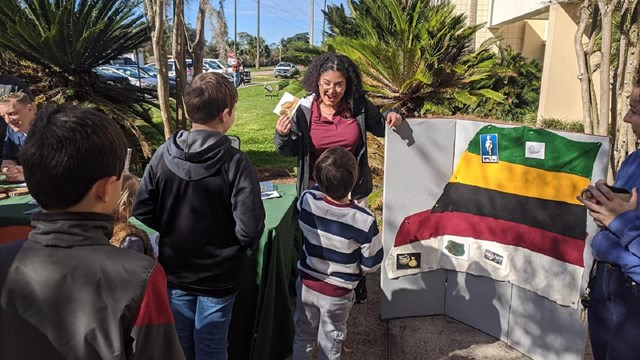
This article outlines the purposes and direction of the Public Interpretation Initiative (the Initiative), a public outreach program initiated and coordinated by the Southeast Archeological Center, National Park Service, Southeast Region. Initiative activities have been designed to facilitate communication among the various practitioners in the field, be they archeologists, interpreters, or educators. National and international activities have included the organization and coordination of separate symposia, workshops, training sessions, publications, and exhibits presented in a variety of forums. Publications on developed Initiative themes from 1997 to the present have consisted of case study volumes and articles relating to the public interpretation and educational archeology. As archeologists, interpreters, educators, and resource managers, we must work together to empower the public to learn about and enjoy its archeological and historical heritage.

PURPOSE

        The Public Interpretation Initiative was developed in response to the growing public interest in archeology, and out of the realization within the professional community that archeologists can no longer afford to be detached from the mechanisms and programs that attempt to communicate archeological information to the lay public. The Initiative helps to accomplish the goals set by the Secretary of Interior in his statement for a national strategy in Federal archeology. The statement outlines basic elements of the national strategy for the preservation of archeological sites, which emphasize public education and participation as well as interagency information exchange. The Initiative also helps to accomplish Section 10 (C) of the Archeological Resources Protection Act (ARPA) that requires each Federal land manager to "establish a program to increase public awareness of the significance of the archeological resources located on public lands and Indian lands and the need to protect such resources." 

THE CHALLENGE

        Though many public programs and exhibits have met some level of success in effectively dealing with the issues of public interpretation of archeological data, many have fallen short in the realm of education and communication. In the l990's and beyond, we must summon ourselves to reach out to the public and involve them in the rich diversity of their national and ethnic experiences. To do that, we must also educate ourselves (those of us charged with keeping our legacy alive) on the issues. The programs and activities of the Public Interpretation Initiative represent an attempt by the National Park Service to bring the fascinating subjects of archeology and cultural history into focus for the public eye. (Ehrenhard and Jameson 1990; Jameson 1991). 

ASSUMPTIONS AND NEEDS

        The basic premise of the Initiative is that many past failures in the realm of public interpretation of archeological and historic sites have resulted from intrinsic differences in perspective between archeologists and professional interpreters and educators. This difference in perspective stems from the more technical and academic interests of the archeologist/historian versus the less didactic goals of exhibit and program designers of providing uncomplicated, educational, yet entertaining interpretive programs. Archeologists and interpreters need to communicate more effectively to insure that the common goal of creating interpretive formats easily absorbed and appreciated by the lay public will be achieved. 

THEME DEVELOPMENT

        Since 1990, through a variety of workshops, training courses, and academic symposia, several Initiative sub-themes, international in scope, have emerged and are continuing to be developed. Major themes have included: (1) the archeologist's vs interpreter's respective roles in developing and designing effective interpretive programs; (2) on-site museum and visitor center critique; (3) the educator/curator/designer planning triad; (4) African-American oral histories, park programs, and popular histories; (5) interpreting culture for younger audiences; and (6) sensitive interpretation in multicultural societies. Programs have been organized at several professional conferences, including the National Association of Interpretation (NAI), the World Archaeology Congress (WAC), the Society for American Archaeology (SAA), the Society for Historical Archaeology (SHA), the American Anthropological Association (AAA), and the Association for the Study of Afro-American Life and History (ASALH). Technical and financial support within the National Park Service has been provided by the NPS Archeology and Ethnography Division and the Stephen T. Mather Employee Development Center. More recent activities have focused on new horizons in public interpretation. Figure 1 is a tabulation of past Initiative activities 1990-1993.

SYMPOSIA & WORKSHOPS

World Archaeological Congress (WAC-5) Sessioin, June 2003: Archaeology and the Arts: the Ancient Muses and other Inspirations

SAA Annual Conference, April 22, 2001 - Symposium/NPS Publication: "Ancient Muses: Archeology and the Arts" E-mail: john_jameson@nps.gov.
Abstract: The practice of archeology, as well as archeologically derived information and objects, can inspire a wide variety of artistic expressions ranging from straightforward computer-generated reconstructions and traditional artists' conceptions to other art forms such as poetry and opera. Although some level of conjecture will always be present in these works, they are often no less conjectural than technical interpretations and have the benefit of providing visual and conceptual imagery that can communicate contexts and settings in a compelling way. We can look at archeology's connections to art and music as a different way of valuing and defining the resource and making it more meaningful to the public. This session examines a variety of examples of this phenomenon as it applies to archeology as inspiration for the arts and to interpretive art as a public education tool.   [  Titles and Abstracts]

Symposium: "Giving the Public Its Due: New Horizons in the Public Interpretation of Archaeology," SOCIETY FOR HISTORICAL ARCHAEOLOGY ANNUAL MEETING, Quebec City, Quebec, Canada, January 4-9, 2000. 

"Archeology and the National Park Idea" Symposium - World Archaeological Congress 1999
        For over one hundred years, the "national park idea" has inspired a myriad of resource conservation and protection efforts around the world. While resource conservation and protection have been the common goals of management efforts, the nature of these programs and the consequences for resource management and public presentation have been strongly influenced by cultural, social, political, and budgetary realities. The management and interpretation of archaeological records in these settings present unique challenges. This session will examine the cross-cultural relevancy and effectiveness of differing strategies for management and public presentation of archeological materials and information. The discussions and conclusions from the session should be useful to resource managers and agencies in recognizing the effectiveness of a variety of management approaches and in not "reinventing the wheel." 
        This session included papers that deal with management and public interpretation of archaeological sites and materials relating to: 

  • Case studies and examples of management and interpretation strategies in national parks and similar conservation areas 
  • The primary motivations for management and public interpretation strategies (i.e. compliance to laws and regulations, preservation, tourism, politics, etc.)
  • Philosophical background to alternative strategies according to cultural, sociopolitical, or budgetary forces and restraints
  • Ccritiques of effectiveness of management and public interpretation strategies

"Reconstructions, Pro and Cons and the Role of Archeology" Symposium and Planned Publication
        The reconstruction of historic and archeological sites and features has long been a controversial subject among professional archaeologists and historians. Some preservation purists have advocated a strict, conservative approach, emphasizing data and material authenticity. They claim that the public is unnecessarily misled by many reconstructions that have not been absolutely verified by archeology and documentary records. Others have advocated a more liberal approach in terms of verification and have emphasized the educational and interpretive value of reconstructions. This session examined the pro and cons and effectiveness of reconstructions as public presentation tools. International examples are discussed that have been influenced by divergent presentation philosophies and political realities. 

TRAINING OPPORTUNITIES

NPS-Sponsored Training
        NPS coordinates and sponsors interdisciplinary training opportunities designed to provide the basic "tools" for interpreters, archaeologists, and program managers and specialists in developing effective presentations that meet federal standards and agency missions. In addition to National Park Service and other federal agency personnel, the courses are sometimes offered to persons working in state and local government as well as private institutions. Courses of study address initial planning procedures; mutual understanding of archaeological technical information by interpreters, exhibit designers, and archaeologists; the archaeologist's and interpreter's respective roles; NPS and non-NPS case studies; on-site program/exhibit critiques; the importance of an interdisciplinary approach and the interaction among the interpretive team players in developing goals and principals; and the effective application of interpretative methods in public programs. 

Course Development
        SEAC and the NPS Mather Training Center are redesigning courses of study to meet newly revised standards and strategies for NPS-sponsored training courses. The new standards are competency-based; we are developing a curriculum for a new training module for archeologists, interpreters, and educators. 

Other Sessions and Workshops

        Periodically, additional 16-24 hour seminars and workshops are organized by SEAC on the topics of public interpretation and education in archeology. Information: For an updated listing of activities, contact John Jameson, e-mail: john_jameson@nps.gov.

Also see: A Colonial Classroom: Fort Frederica National Monument Workshop.

PUBLICATIONS

        Presenting Archaeology to the Public: Digging for Truths (1997) is an anthology of interpretation projects and case studies. Other volumes include the Ancient Muses: Archaeology and the Arts book, a 2003 WAC-5 session with related theme, and a compilation of papers presented in the "Reconstructions, Pro and Cons and the Role of Archeology" Symposium that, with additional contributions, resulted in the 2004 volume The Reconstructed Past. A theme issue of the THE GEORGE WRIGHT FORUM  featured papers and contributed articles stemming from the symposium "Archaeology and the National Park Idea: Challenges for Management and Public Presentation" at the World Archaeological Congress (WAC-4) held in Cape Town, South Africa in January 1999. Also see References Cited and other publications.

INTERPRETIVE ART PROJECTS

        Public archeologists in NPS and elsewhere are not content to rely solely on traditional methodologies and analytical techniques in their attempts to reconstruct human history and bring it to life for the public. We want to venture beyond utilitarian explanations and explore the interpretive potential of cognitive imagery that archeological information and objects can inspire. In partnership with professional interpreters and educators, we use the power of artistic expression to convey archeological information and insights to the public. At our parks and historic sites, we use the archeological record to enhance the visitors' experience, and, working with our interpreter colleagues, help to create opportunities for visitors to form intellectual and emotional connections to the meanings and significance of archeological information and the people and events that created them. Since 1991, SEAC, through its public archeology interpretive art program, has supported national parks and other public agencies in producing art works that help tell the fascinating stories of America's cultural heritage.

        The focus of SEAC's interpretive art program has been the creation of 50+ original oil paintings, drawings, and sketches by artist Martin Pate. In producing these works, the artist works closely with archeologists and interpretive specialists. The goal is to inform and inspire the public, through conjectural interpretive art, about archeologically documented cultures, sites, and events. The images are used in a variety of formats, including posters, book covers, and wayside exhibits. They will be discussed and illustrated in SEAC's 2003 Ancient Muses: Archaeology and the Arts book and Web site.

CONCLUSIONS

        The Public Interpretation Initiative program represents an attempt by the National Park Service to foster a cross fertilization and exchange of ideas toward a more holistic approach to public interpretation. This is achieved through a variety of programs and forums, including interdisciplinary symposia and workshops, publications, and interpretive art projects. Undoubtedly, the key to our success lies in the realization that, whether or not we are trained archaeologists, we are the ones that define and mold the interpretive and educational programs that meet the public's eye. As archaeologists, interpreters, and educators, we can and must act in tandem as a lens to focus the public eye on the learning and appreciation of archaeological and historical resources (Jameson 1991; 1993a; 1993b; 1993c; 1993d; 1994a; 1994b; 1997; 2000; 2001, 2003, 2004a, 2004b). 

REFERENCES CITED

2004a  Unlocking the Past: Historical Archaeology in North America, A Multiyear Public Outreach and Education Project of the Society for Historical Archaeology (Lu Ann DeCunzo and John H. Jameson, Jr., editors). University Press of Florida, Gainsville. [in press].

2004b  The Reconstructed Past: Reconstructions in the Public Interpretation of Archaeology and History (editor). AltaMira Press: Walnut Creek.

2003  Ancient Muses: Archaeology and the Arts (co-editor with John E. Ehrenhard and Christine Finn). Approx. 280 pages, with 47 illustrations and accompanying multimedia CD. University of Alabama Press, Tuscalooosa and London.

2001   Making Good Horse Sense: Interpretive Art at Little Bighorn National Monument, Montana.                  Paper delivered at the 59th Plains Anthropological Conference, Lincoln, Nebraska.

2000   Public Interpretation, Education and Outreach: The Growing Predominance in American                  Archaeology. In Cultural Resource Management in Contemporary Society, One World Archaeology 33, Francis P. McManamon and Alf Hatton (editors). One World Archaeology Series.  Routledge: London and New York.

 [Recent other publications]

Prior to 2000:

1990   Introduction [to archaeology section]. In The 1990 National Interpreters Workshop, National Association of Interpretation, Fort Collins, Colorado. John E. Ehrenhard and John H. Jameson, Jr. 

Jameson, John H., Jr.
     1991    Public Interpretation Initiative. In Federal Archeology Report, Vol. 4. No. 4,
                 Archaeological Assistance Division, National Park Service, Washington, D.C.
     1993a  Public Interpretation Initiative: New Horizons. In Federal Archeology Report, Vol. 6.
                  No. 1, Archaeological Assistance Division, National Park Service, Washington, D.C.
     1993b  The Public Interpretation Initiative Program. SOPA Newsletter, Volume 17, No. 3,
                  Society of Professional Archeologists.
     1993c  The NPS Public Interpretation Initiative Program. Legacy, Journal of the National 
                 Association of Interpretation, Volume 4, No. 3, National Association of
                 Interpretation, 
Fort Collins, Colorado.
     1993d  NPS Program Seeks Communication Among Practitioners and Educators.
                 Archaeology 

                 and Public Education, Volume 3, No. 3, Society for American Archaeology, Public 
                 Education Committee, Washington.
     1994a  The Importance of Public Outreach in Archaeology. Paper presented at the 1994
                 Annual 
Meeting of the Society for Historical Archaeology, Vancouver, British Columbia.           1994b  The NPS Public Interpretation Initiative Program. Public Archaeology Review, Volume
                  2, No. 3, Center for Archaeology in the Public Interest, Indiana - Purdue University,
                 Indianapolis.
     1997   Introduction. In Presenting Archaeology to the Public: Digging for Truths, edited by
                 John H. Jameson, Jr., pp. 11-20. AltaMira Press: Walnut Creek, London, New Delhi.


Information: For further information, contact John H. Jameson, Jr., Southeast Archeological Center, National Park Service, 2035 E. Paul Dirac Drive, Johnson Building, Suite 120, Tallahassee, Florida 32310; phone (850) 580-3011, ext. 243; fax (850) 580-2884; e-mail: john_jameson@nps.gov.

go backto Education & Outreach