|
Natural Setting
| Paleoindian | Archaic
| Woodland | Mississippian
| Caribbean Prehistory |
||
|
|
American Independence and Westward ExpansionGrowth of Urban Areas | American
Revolution | |
|
Growth of Urban Areas and Previous Settlements |
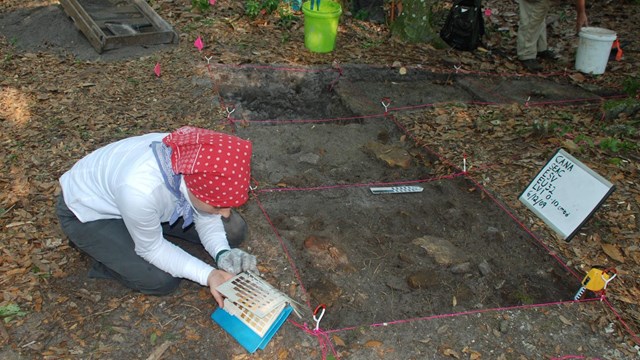
The English strengthened their hold on North America by settling near major harbors, such as New York and Charleston. From these coastal holdings, they ventured inland, constantly pushing the frontier back. During this time, they both traded with and fought the Indians. One significant town that grew out of this trading relationship was Ninety Six, South Carolina, now established as Ninety Six National Historic Site. The name "Ninety Six" may have been derived from a belief of the original inhabitants of the town that they were 96 miles from the Cherokee village of Keowee on the Cherokee Trail. |
|
National
|
Park associated with the growth of urban areas:
|
|
The American Revolution: the War in the South
|
||
MORE ON THE WEB:In
the Footsteps of 'Light-horse' Harry: Archeology & History
at Ninety Six National Historic Site |
In 1755, the French and their Indian allies went to war with England. This was the first European war where the bulk of the fighting took place outside of Europe. Future president George Washington led the early attacks against the French, but was defeated. The war ended in 1763 with the defeat of the French. The French ceded territory south of Canada to the English, including Natchez and Fort Rosalie (Natchez National Historical Park).
To pay for the costs incurred during the French and Indian War, England increased the taxes on the British colonies, precipitating the American Revolution. The French provided aid to the Colonials during the Revolution, which caused the French to increase the taxes on French citizens. This in turn help precipitate the French Revolution. The Continental Congress signed the Declaration of Independence on July 4, 1776, formally declaring the revolution that had begun the year before.
The exiled Loyalist governor of North Carolina had devised a plan to regain control of his state. He planned to gather an army, march to the sea, and link up with British Naval forces. The combined army would then crush the rebellion in the South. On February 27, 1776, while enroute to the sea, the governor's British Loyalists and local Patriots met at the Battle of Moores Creek (Moores Creek National Battlefield). The battle was an overwhelming victory for the Patriots. The British Loyalists were never able to reach the sea.
Unable to complete their rendezvous assignment, the British ships sailed south to Charleston, South Carolina. When the ships attempted to enter the harbor, they discovered that the Colonials had constructed a dirt-and-palmetto log fort (Fort Moultrie National Monument). During the ensuing battle, the British fleet suffered another defeat at the hands of the Colonials.
Following these two battles the focus of the war shifted to the north. Battles were fought over cities such as New York, Trenton, Saratoga, and Boston. By the late 1770s, the war in the north was stalemated with neither side able to gain the advantage.
The British commanders decided that the war could still be won in the south. In 1778 the British captured Savannah, Georgia, and in 1780 captured Charleston, South Carolina. American forces under Horatio Gates were defeated at Camden, South Carolina. Cornwallis then took possession of Camden and Ninety Six (Ninety Six National Historic Site). This left the way clear for Cornwallis to pursue his goals of gathering southern Loyalists and taking the war to Virginia. He planned then to use his southern ports to move men and material into the interior of North and South Carolina.
In late 1780, Cornwallis moved his forces into North Carolina. He assigned Major Ferguson to command Loyalist troops on his left flank. Ferguson placed his army at Kings Mountain, South Carolina (Kings Mountain National Military Park) to await the arrival of the enemy. On October 7, 1780, Major Ferguson's militia was defeated by Patriot militia in a battle where pleas of surrender were ignored. Hearing of the defeat, Cornwallis retreated to Winnsborough for the winter.
The remains of the American army were placed under the command of Nathaniel Greene. Greene divided his army, sending Daniel Morgan into western Carolina. Cornwallis countered, and dispatched Banastre Tarleton and his dragoons to destroy Morgan's army. On January 17, 1781, the two forces met at Cowpens, South Carolina (Cowpens National Battlefield). Morgan skillfully deployed his forces and devastatingly defeated the British.
Cornwallis followed Morgan into North Carolina. However, Greene moved north and consolidated his army. Cornwallis followed Greene into Virginia and then back into North Carolina. On March 15, 1781, the two armies met at Guilford Courthouse, North Carolina (Guilford Courthouse National Military Park). The British forces won a victory but were unable to continue their campaign. Cornwallis retreated to Wilmington, North Carolina. He then retreated into Virginia only to be defeated at Yorktown (Colonial National Historical Park).
The southern campaign broke the will of the British to continue the war. Public sentiment in England turned towards peace. While peace was not declared until 1783, for most purposes the war ended with the southern campaign.
MORE ON THE WEB:Underwater
Archeology |
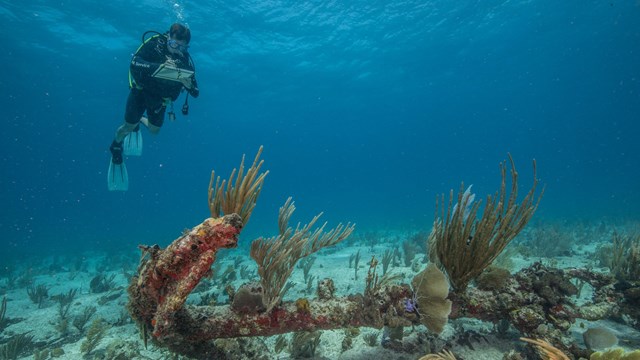
Concerning maritime activities associated with the Revolutionary War, there are several parks in the Southeast that manifest an archeological presence, including Fort Sumter National Monument. The original Fort Moultrie withstood the battering guns of the British fleet under Sir Peter Parker on June 28, 1776, returning fire and sinking several vessels. At Moores Creek National Battlefield, the scene of the opening engagement in the South, the bridge site that crosses the navigable waterway there may yet reveal evidence of the brief but fierce engagement, which dashed British hopes for a quick Southern victory. Elsewhere, in 1781, as an ally of France (but not the American colonies) against the British, the Spanish sent an Armada of sixty-four ships against the British at Pensacola Bay, which quickly fell. This invasion will likely have left some archeological remains in the waters of Gulf Islands National Seashore at Pensacola.
Parks related to the American Revolution:
![]()

MORE ON THE WEB:Exhibit:
The Louisiana Purchase |
The desire for expansion was evident from the beginning of the Colonial era in North America. Some of the early explorers include Dr. Thomas Walker and Daniel Boone. Walker was the first recorded European to use the Cumberland Gap (Cumberland Gap National Historical Park) to cross the Appalachian Mountains. Boone was the first to mark the trail for settlers to follow.
The greatest expansion of land occurred when President Thomas Jefferson purchased the Louisiana Territory lands from France in 1803. These lands had passed from French to Spanish and back to French control following the French and Indian War. President Jefferson sent the Lewis and Clark expedition to explore the new lands to the Pacific Ocean.
Trails, such as the Cumberland Gap Trail (Cumberland Gap National Historical Park) and the Natchez Trace (Natchez Trace Parkway), became increasingly important to the movement of supplies. As towns sprang up along these trails, so did havens for bandits. It is an interesting historical note that Merriwether Lewis died under mysterious circumstance on the Natchez Trace some years after his famous expedition.
In 1813, the Upper Creeks (Red Stick) began a revolt. This was brought on in large part by Anglo encroachment and broken treaties. In March of 1814, Andrew Jackson and his Tennessee militia attacked and killed 800 of 1000 revolting Red Sticks at Horseshoe Bend, Alabama (Horseshoe Bend National Military Park).
Parks related to Westward exploration and expansion:
![]()
MORE ON THE WEB:Introduction
to the War of 1812 |
Following the American Revolution, the United States of America became a significant force in naval commerce. This brought the young nation into conflict with England and other maritime nations concerning maritime trade. These problems led to the War of 1812.
During the War of 1812, the Americans tried to annex Canada, while the British attacked major U.S. seaports. Although the Americans lost most of the battles, they were able to secure an equitable peace. Nine months after the Battle of Horseshoe Bend, before this treaty could take effect, American forces under Andrew Jackson defeated a numerically superior British force at New Orleans. This battle made Jackson a national hero and helped him to eventually win the U.S. presidency.
The War of 1812 had shown the weakness of American coastal defenses. Following the war, a plan was devised that called for the construction of a system of forts at major American harbors. This system is known as the Third American System. It was designed under the direction of Brigadier General Simon Bernard, former military engineer for Napoleon Bonaparte. Work did not begin on the southern forts, such as Pulaski, Jefferson, Pickens, and Sumter, until the 1820s (NPS 1984a) (Fort Pulaski National Monument, Dry Tortugas National Park, Gulf Islands National Seashore, and Fort Sumter National Monument).
Parks related to the War of 1812:
![]()
The development of the coastal forts system relied heavily on the efforts of both military and merchant shipping. Construction alone entailed the movement of massive amounts of materials and men, with the inevitable losses that occur with bad weather and perilous navigation. At Dry Tortugas National Park there are several documented "construction" wrecks, and others are expected to be located. This will probably prove to be the case in other coastal system-related parks in the Southeast, such as Fort Sumter National Monument and Fort Pulaski National Monument, as well as Forts Pickens, McRae, and Massachusetts in Gulf Islands National Seashore, where construction and supply vessels wrecked or foundered.

"A History of the American
Revolution" by John R. Alden
Alden, John R.
1989 A History of the American Revolution. Da Capo Press,
New York.
Draper, Theodore
1996 A Struggle for Power: The American Revolution. Times
Books, New York.
Raphael, Ray
2001 A People's
History of the American Revolution: How Common People Shaped the Fight
for Independence. The New Press, New York.
Ambrose, Stephen E.
1997 Undaunted
Courage : Meriwether Lewis, Thomas Jefferson, and the Opening of the
American West. Simon & Schuster, New York.
Duncan, Dayton, and Ken Burns
1999 Lewis &
Clark : The Journey of the Corps of Discovery. Knopf, New York.
Benn, Carl
1998 Iroquois in the War of 1812. University of Toronto
Press, Toronto.
Graves, Donald E., ed., and J. Mackay Hitsman
1999 The Incredible
War of 1812: A Military History. Robin Brass Studio, Toronto.
Pitch, Anthony S.
1998 The Burning
Of Washington: The British Invasion Of 1814. Naval Institute
Press, Annapolis.
![]()
Return to European
Exploration
Move on to the
United States in the 19th & 20th Centuries