Chapter 5


Conclusions and Recommendations


Archaeological testing at the Copper Queen Store site, AZ FF:9:25 (ASM), was directed toward determining whether the site was eligible for entry into the National Register of Historic Places. This chapter explains how a site is eligible for the register, discusses the criteria under which the Copper Queen Store site might be listed, and relates the archaeological findings to these criteria. Recommendations are also made regarding the potential for any additional work.
 

NATIONAL REGISTER ELIGIBILITY

Maps, documents, an archaeological survey, and archaeological testing have been used to reconstruct the historic use of the Naco Port of Entry expansion property. Construction documents supplied by DWL architects indicate that extensive landmoving is planned in the expansion area. These activities will damage or destroy the cultural features noted on the property. Therefore, these resources must be fully documented prior to their destruction. Also, prior to construction, compliance with the National Historic Preservation Act (NHPA) requires assessment of eligibility for the National Register of Historic Places of any resources that may be affected by the proposed activities.

The National Register of Historic Places was established after the passage of the National Historic Preservation Act of 1966. In order for a property to be listed in the National Register, it must meet at least one of four criteria: It must be associated with historic events or activities (Criterion A); it must be associated with important persons (Criterion B); it must have distinctive design or physical characteristics (Criterion C); or it must have the potential to provide important information about prehistory or history (Criterion D) (National Register Branch 1991:1). Most sites also must be at least 50 years old before they can be considered eligible for nomination. In addition, integrity must be visible through historic characteristics such as location, design, setting, materials, workmanship, feeling, and association. The historic context of a site is often important when establishing National Register eligibility, as it is used to weigh the historic significance and integrity of a property. Historic contexts, including agriculture, archaeology, economics, industry, commerce, literature, government, religion, and so on, help to evaluate each property by establishing its area of significance. As previously noted, the Naco, Arizona Port of Entry is already listed in the National Register. The building was eligible under Criterion A because of its role in politics and government as a customs house and under Criterion C since it is an outstanding example of Pueblo Revival architecture.

Three of the four criteria stated above can be used to evaluate the expansion property. Relative to Criterion A, associations with major historical events on both national and regional levels are quite strong. The battles at Naco, Sonora, in the 1910s and in 1929 took place only yards away. American soldiers were stationed on the property to guard local interests from attacks. Nonetheless, bullets and shells fell in the area, damaging buildings and wounding and killing American civilians and soldiers. Another historical activity that took place on the expansion property was the development of the present Port of Entry. On a local level, the expansion property was important for the economic development of the area and in the growth of transportation routes to the east and south. One of the earliest businesses in Naco was the Copper Queen Store. With other businesses located on the southern edge of Naco, the Copper Queen Store linked area residents to the outside world.

Criterion B, which seeks associations with famous persons, may also apply to the property. The positioning of the Buffalo Soldiers and other members of the 9th and l0th Cavalries along the international border protected American citizens during a time when bullets and artillery shells endangered lives. These African-American soldiers, several of whom lost their lives in Naco, have become famous because of their heroic exploits. They have been honored in 1994 with a United States postage stamp.

Sites qualifying under Criterion C must have examples of important architecture. There are no standing structures on the current expansion property. The survey report (Thiel 1993) noted that several buildings in the proposed expansion property (the bank, the office building, and the store/dwelling) might be eligible for listing as examples of early twentieth-century architecture; however, the property on which these structure stand was not purchased. Therefore, these buildings have not been examined as part of the testing phase. Should the Port of Entry expand into this block, these structures will require an architectural evaluation in order to determine whether they are indeed eligible for inclusion in the National Register.

Lastly, Criterion D states that archaeological sites providing data important to an area's prehistory or history are eligible. Several areas within the expansion zone are potentially eligible. The trash scatter recorded as Feature 5 has garbage discarded by early residents of Naco. This refuse can provide insights into what life was like for early residents, what sorts of foods they ate, or what kinds of objects they purchased and used. Currently, little is known about early twentieth-century life in this region, as most people did not record information about the daily aspects of their lives.

Additionally, areas associated with the Copper Queen complex may yield data on the layout and function of these buildings. Most archaeology in Arizona has been directed at domestic sites; therefore, we know little about the layout of business establishments and have yet to completely document the types of activities that took place there. Currently, many archaeologists are turning to industrial and commercial sites, seeking to document the full range of human activities.
 

HISTORIC CONTEXTS

At stated above, the expansion property appeared to be eligible for nomination to the National Register based on all four criteria. Further recording and testing was planned to determine the extent and significance of the cultural resources. National Register contexts were used in the formation of research questions.

Architecture at the site may reflect the time period in which it was created. The ruins of the Copper Queen Store, its adjacent warehouse, and the adobe-walled compound were recorded since they might represent a type of architecture or design distinctive to the era or geographical region. As an example, the compound wall was built from a material (adobe) that was used (and is still being used) in the Southwestern United States and Mexico. Adobe rapidly deteriorates once it is exposed to the environment, and few such structures have been adequately documented, especially non-residential structures. The goal of recording the structures on the expansion property was to prepare a documentary record of each, one that could be used by future researchers interested in the architecture of the region.

The expansion property was a major center of commerce for the Naco area. The Copper Queen complex served residents by bringing goods into the area for subsequent sale. A study of the complex was directed toward understanding the full range of commercial activities that took place in Naco, Arizona, as well as documenting the store and its facilities. The relationship of Naco, Arizona, with Naco, Sonora--an issue that is particularly timely given the recent discussion of the North American Free Trade Agreement--also was examined briefly. It was expected that artifacts from Mexico might be present. An evaluation of such artifacts might allow for a better understanding of the cross-border relationships.

Military history was studied by searching for traces of the two twentieth-century Mexican Revolutions. Evidence for the Buffalo Soldier encampments around the Copper Queen Store was sought. Artifacts associated with the encampment could allow for a better understanding of what life was like for these men, what types of foods they ate, and in what sorts of activities they participated. It was thought probable that munitions associated with the Mexican revolutions may be present in the study area. Recent work at battlegrounds has revealed that important data can be recovered through the study of spent munitions. Research was directed toward searching for ammunition with the use of a metal detector in likely areas.

Political and governmental relations were studied by examining the effect that certain policies had on Naco residents. Archaeological remains present on the expansion property are directly associated with a number of political activities relating to the border and to the administration of laws. For example, the institution of Prohibition in Arizona in 1914 resulted in the growth of Naco, Sonora, as thirsty Americans flocked to the border. Evidence for illegal activities such as alcohol consumption was sought in trash features located on the property.

Archaeologists are increasingly interested in exploring issues relating to ethnicity. Naco, Arizona, has been occupied by a growing Mexican population through time. A study of artifacts recovered from the trash feature (Feature 5) was directed toward evidence of ethnicity. It was expected that distinctive Mexican artifacts, such as ceramics, might be recovered, as well as Mexican consumer goods or meat cuts that are typically eaten by Mexican and Mexican-American households. The degree of interaction between the residents of the two Nacos might be visible when examining the Feature 5 artifacts. Similarly, artifacts associated with the Buffalo Soldiers were to be studied to determine whether these individuals were actively retaining traditions important to African-Americans.

Lastly, archaeology can provide important data on the lives of early Naco residents. No one bothered to write down what life was like for these people, what foods they may have eaten, or what entertainments they pursued. Evidence collected from the trash east of the compound or from trash-filled pits and outhouses was thought to be a source of knowledge for a better understanding of early twentieth-century lifeways for these border4own residents.
 

RESULTS OF ARCHAEOLOGICAL TESTING

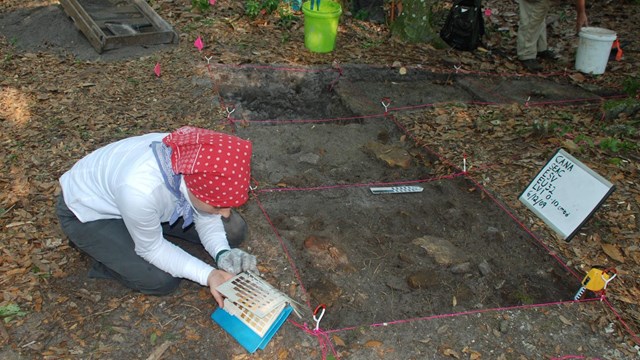
A program of archaeological testing and data collection, guided by the aforementioned research goals, was recommended. Archaeological testing took place in March of 1994 and resulted in the discovery and recording of 46 features. These included building foundations, water pipe trenches, and postholes. Few of the features contained substantial quantities of artifacts, limiting certain planned analyses. As discussed earlier, much of the trash associated with the Copper Queen Store may be present in an archaeological site known as the Old Naco Dump, located east of the expansion property. Despite this problem, the recovered refuse from Features 5, 20, and 31 can be used to examine some of the research issues. Each of the research contexts is discussed below.

Architectural data was collected from the Copper Queen Store, its warehouse, a concrete slab, and the adobe-walled compound. The Copper Queen Store was built to last. It stood on a substantial stone foundation, and its brick walls would be mostly standing today if it hadn't been burned in the late 1980s. The store foundation indicates that the Phelps Dodge corporation was willing to invest in its Naco mercantile store. Unfortunately, little is known about the internal organization of the store; doubtlessly, it was similar to other stores of the era. Goods were displayed in the front windows, enticing customers inside. Shelves lined the walls, and purchases were made at counters where vigilant clerks could secretly sound an alarm should any problems arise. Orders and inventories were recorded in large ledgers, which lay inside the store until it burned.

The Copper Queen Store was, in many ways, the modern supermarket of its time. Besides selling groceries, the store also sold lumber and hardware. These items were stored in a warehouse located north of the store. This building was not substantial. Wood posts were set directly onto the ground, and corrugated iron clad the outside walls. A door opened to the west in an area that could be watched over to prevent thefts of the valuable warehouse contents.

Later, after 1931, an adobe-walled compound was built east of the warehouse. Firewood cutting activities took place in this area, and the buzz-saw mount (Feature 6) survives. Wood was probably shipped in by rail, since little wood would be present in the Naco area, and what was present would have been rapidly depleted. The over six-ft-high walls of the compound ensured the safety of its contents. A pair of outhouses served nearby residents who lacked indoor plumbing, and they were in use until at least the 1970s. The adobe wall survived for only a couple of decades, with its owners applying stucco in an attempt to halt its deterioration. Eventually, portions fell over, and much of the wall melted away.

After the demolition of the Copper Queen Warehouse, a cement slab was poured in 1946. The function of this slab is unknown. Informants suggested that it was associated with the warehouse; however, this is improbable because the slab overlies a portion of the warehouse wall. It is uncertain whether the slab served as a sidewalk, floor, or patio area.

Each architectural feature was described, mapped, and photographed. These records should provide detailed information for future researchers.

Commercial activities associated with the Copper Queen Store could be only briefly investigated. An examination of a portion of the interior indicated that the store contents had not been left in place but had been removed long ago, as indicated by informants. Examination of surrounding features allowed for an understanding of the activities at the store. The store entrance was toward the west, facing the border crossing station. To the south were the El Paso and Southwestern railroad tracks. A loading platform stood along the tracks, and goods were unloaded and carried to the store or its warehouse from this location. Wagon ruts between the store and warehouse suggest that wagons moved in between the two structures. The brick-lined area of a drainage ditch indicates that traffic continued to the east of the warehouse, passing over the chief water main for Naco, Arizona. Other evidence for traffic in the area included hitching posts, which survived into the 1910s along the north side of the store. Automobile tire tracks attest to the growing mobility of local peoples. A railroad side track ran to the east of the store, whereas the main tracks followed the international border. During the first half of the twentieth century, the railroad brought manufactured goods, raw materials, and people in and out of Naco.

The presence of military-related features in the vicinity of the Copper Queen Store was thought possible, and scraping in this area resulted in the discovery of two of the three army period tents depicted in a circa 1916 photograph. These tents housed American soldiers, including the renowned Buffalo Soldiers. The tents differed in size and shape, reflecting individual preferences or merely individual tent sizes. A long trench found in front of the tents may have served as refuge during shelling or when bullets "fell thickly" as Mexican army forces and rebels fought during the Mexican revolution of the 1910 to 1916 period. Several of these bullets were found, indicating that they occasionally landed on the roof of the Copper Queen Store and in nearby areas. The bullets were not present in great numbers; many may have been picked up during the revolutions as souvenirs or perhaps were present in areas not investigated. Border Station personnel stated that they had found ammunition at other times along the border, indicating that other examples exist.

Archaeological features were explored when possible. The majority were architectural or utilitarian in nature, with only a handful containing the refuse left behind by residents of Naco or the employees of the Copper Queen Store.

It was thought that it might be possible to examine aspects relating to government and politics specifically, the implementation of policies during the Prohibition period. During Prohibition, residents of the United States could not legally purchase or consume alcoholic beverages. In Arizona, this began on January 1, 1915, and lasted until 1933. Naco, Arizona, became a parking lot for area residents heading across the border for a drink at the bars springing up in Naco, Sonora. Unfortunately, none of the trash-filled features contained Prohibition period trash; thus, it was impossible to evaluate whether residents of Naco, Arizona, continued consuming alcoholic beverages or followed the law against such behavior. A few alcoholic bottle fragments were recovered from Feature 31, which dates to the first decade of the twentieth century. The persons contributing refuse to Feature 5 were enjoying beer and other alcoholic drinks, downing these liquids in engraved tumblers and champagne glasses.

Ethnicity is an important factor in the United States today. It was also important in the past, and a study of ethnically linked artifacts can indicate whether ethnic groups were present or even whether they associated with one another. The only artifacts that could be clearly linked to non-Euro-American groups were ceramics. These included Mexican dishes and tiles and Japanese dishes from Feature 5 and Mexican ceramics from Feature 20. In the case of the Japanese wares, these probably represent luxury items rather than everyday dishes. Most are delicate bowls and cups. In all likelihood, the residents of Naco had limited interaction with persons from Asia, although Chinese grocers and launderers were living in Naco, Sonora in 1929, and the 1906 papers of a Naco Border Station employee suggest that he was constantly taking illegal Chinese immigrants to Bisbee for hearings. The Exclusion Act of 1902 effectively prevented Chinese or Japanese individuals from entering the United States, so it is likely that no early Nacoans were from Asia, and none are listed in the 1900, 1910, or 1920 census records.

Naco, Arizona, has always had strong ties with Naco, Sonora. The Copper Queen Store is less than 150 ft from the border. Formerly, the border was marked by a few fence posts, unlike today's chain link fence (soon to be replaced with a sturdier, more solid fence). A handful of Mexican artifacts were uncovered, indicating that interaction was taking place over the border. Mexican ceramics from the trash dump, Feature 5, include finely decorated serving dishes; others are coarser vessels used for food storage and cooking, along with decorative tiles and plant containers. The overall number of Mexican sherds was quite small-only seven percent of the excavated sherds. This suggests that the residents of Naco contributing garbage to this feature were not purchasing large quantities of Mexican ceramics during the 1940s and 1950s. Examination of other materials indicated that the residents were using mostly American-made foodstuffs, beverages, medicines, and household goods. Mexican ceramics were also found in a drain spout area, Feature 20.

Lastly, the possibility of deeply buried cultural resources was explored through the judgmental placement of two backhoe trenches. Naco has been occupied by people for more than 10,000 years, and the possibility existed that the expansion property was the site of prehistoric, as well as historic, activities. The only way to identify such activities was through backhoe trenching, which subsequently failed to find any subsurface remains. As previously noted, the expansion property was not a focus of prehistoric activity.
 

The Copper Queen Store Site and National Register Eligibility

Archaeological testing at the Copper Queen Store site, AZ FF:9:25 (ASM), resulted in the discovery of many features. Most of the features were associated with the Copper Queen Store itself. A handful date to the 1910-1916 army occupation of the north side of the store. Several, including the adobe-walled compound and the trash dump, date to after 1930.

In terms of National Register Eligibility, the Copper Queen Store site is probably eligible under Criterion A and Criterion D. The store area was the site of an army occupation during which soldiers camped out in tents and sought to protect American interests during the 1910 to 1916 Mexican Revolution. The remains of these tents, an associated trench, and spent ammunition fired from Mexico were recovered. While potentially eligible under Criterion A due to its association with an important historical event, the photographs, maps, and ammunition recovered adequately document this phase of history. Further work to study the army occupation of the store site might result in additional ammunition being recovered; however, the examples already found should be sufficient. Additionally, the ammunition does not appear to be in well-preserved contexts. Most was found in drain spout areas, where it had washed from the store roof. Unlike battlefield archaeology, there is little need to map and plot ammunition because its origin is already known.

The site is potentially eligible under Criterion B because members of the Buffalo Soldiers were among those guarding the region. However, no refuse deposits associated with these individuals were found, and none may exist on the property. The only physical traces of their occupation are the previously discussed army tents and the trench. These have been completely documented.

Criterion C seeks examples of important architecture. No standing architecture is present on the Copper Queen property. It is doubtful that the four structures documented archaeologically would be eligible for the National Register under Criterion C. The concrete slab (Feature 2) is too young for entry and is unremarkable. The warehouse (Feature 32) is very poorly preserved, and most of the feature has been destroyed by rodent burrowing and its ephemeral nature. The compound wall (Feature 3) is an interesting example of adobe architecture; however, it has many counterparts throughout southern Arizona. The Copper Queen Store (Feature 1) might be the best candidate for the National Register, but it has been effectively destroyed by a fire. The remains of the four structures were carefully mapped, photographed, and described. Little or no additional information would be gained by further investigation of these structures.

Archaeological sites with the potential for yielding new and important information are typically listed under Criterion D. The historic resources at the Copper Queen Store site were studied during a backhoe-scraping program that uncovered about six percent of the original ground surface. Most archaeological features were located in a narrow band around the north side of the Copper Queen Store. The number of features diminished rapidly beyond the store. Few were present in the area east of the store or inside the adobe-walled compound. Although other features are doubtlessly present, they will add little additional data on the diversity of features at the site. In addition, few features yielded artifacts. Those that did had so few artifacts that it was impossible to use the sample to generalize about the lifeways and behaviors of site residents.

The major exception was the trash dump area located east of the compound. Domestic trash from the middle to late 1940s through the late 1950s and early 1960s was present. The two excavation units placed in the trash area yielded a wide assortment of artifacts. It is doubtful that additional collections need to be made, given the date of the deposits. Typically, features must be at least 50 years old to be considered eligible for the National Register. The trash dump appears to be more recent.

In summary, archival and archaeological work has indicated that the Copper Queen Store site is potentially eligible for entry to the National Register under Criteria A and D, and probably is not eligible under B or C. During archaeological testing, the features that would make the property eligible were carefully recorded. Recommendations regarding the future of the property are discussed below.
 

RECOMMENDATIONS

Archaeological testing at the Copper Queen Store site, located in the Naco Port of Entry expansion area, has documented 46 archaeological features. All of the tasks planned for the testing phase were successfully accomplished. In addition, approximately ten times the area originally planned for stripping was scraped using the backhoe. The majority of the uncovered features consisted of postholes and utility trenches. Most features were concentrated in a small area north of the Copper Queen Store. Little evidence for activities survived in the areas east and south of the store, or in the area north and south of the south compound wall.

When combined with archival, photographic, and informant data, a picture of the activities that took place at this site has been reconstructed. One consideration is whether additional archaeological work should be carried out at the site. Desert Archaeology suggests that this is not needed. All of the visible cultural features have been completely mapped and photographed, and several have been sampled. Extensive stripping indicates that most features were situated north of the store. Areas to the east and south are either barren of features or heavily disturbed (such as the area along the border fence). All features that were most likely to contain artifacts were either completely excavated or sampled. The remaining features are mostly water line trenches or postholes. Although further stripping might uncover additional features, these are not likely to add significant new knowledge. John Jameson, the Interagency Archeological Services Division archeologist, concurred with this decision at an on-site visit on March 18, 1994.

It is recommended that clearance be given to the General Services Administration to begin construction of the Naco, Arizona Port of Entry Expansion.


References Cited

Back to Contents