Chapter 4


Archaeological Testing at the Copper Queen Store Site

J. Homer Thiel and Jay Sander

Page 1, 2, 3, 4


Five tasks were to be performed during the testing phase at the expansion property. This chapter summarizes the discoveries made as large areas were stripped down to the original ground surface, test units were placed in a trash area, metal detectors were used to locate ammunition, and all of the features encountered were described, mapped, and photographed.


METHODS

When the archaeologists arrived at the Copper Queen Store site, the area around the store was hidden beneath piles of brick, modern garbage, and several junked cars and trucks. The ground surface in the areas beyond the store was covered with grass and a few bushes, the vegetation becoming denser toward the east. The distance from the international border fence to the south wall of the Copper Queen Store was measured and found to be 145 ft. A grid was established, with the border fence designated 0 N, and a line running 5 ft west of the front porch of the store designated 100 E. Elevations were not calculated. Most of the area was quite level, either naturally or as a result of leveling activities prior to the construction of the store. The only noticeably lower area was just north of the store, where the surface dipped a few inches. The depth of each feature was recorded as depth below ground surface.

A backhoe was used to remove the wall fall from the exterior of the store. The junked vehicles were picked up and stacked on the north side of the property. The backhoe operator, Dan Arnit, has extensive experience at historic and prehistoric archaeological sites. He equipped the machine with a 5-ft-wide scraping blade, and machine stripping of the area began. The northwest corner was chosen as the area to initiate scraping. The operator pulled away the earth, uncovering a thick fill layer consisting of red, sandy clay with many pebbles and cobbles.

Continued scraping exposed a brown, sandy silt that overlay an original ground surface. This surface was a very compact, light brown, sandy clay with relatively few pebbles. Most of the features discovered during stripping either had been cut through this layer or were impressed into it. It was later discovered that this surface overlay the sterile sediments underlying the entire site area, a red, sandy day with a high cobble-and-pebble content.

Stripping continued along the north side of the Copper Queen Store, then along the east side, and a portion along the south wall was also stripped. The area north and south of the south wall of the adobe-walled compound was scraped next. The backhoe then removed sediments along the inside of the east wall of the compound and in the gate area. Lastly, the suspected locations of several buildings along the railroad sidetrack were stripped.

The stripping was very successful in locating features. Typically, features were filled with a bright red, sandy clay or with sediments with a large amount of charcoal and cinders. The color of this fill contrasted with that of the original ground surface, allowing for the easy delineation of cultural remains. Several of the postholes retained their wood posts, and pipe trenches often contained iron pipe.

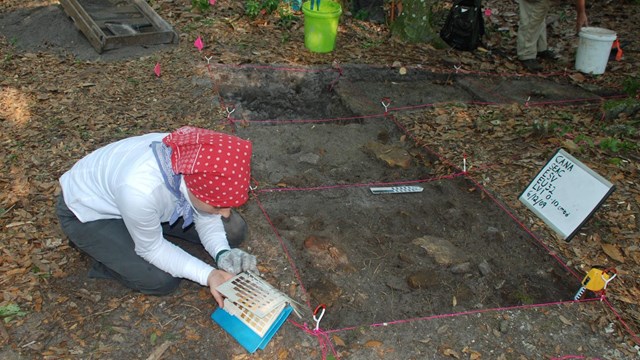
After backhoe stripping, loose dirt was removed from the stripped areas with a shovel and the original ground surface was cleaned with a trowel and broom. In all, 46 features were identified at AZ FF:9:25 (ASM). Several features were excavated in order to determine their function and/or date of construction. The excavators removed soil with a shovel or trowel, passing all sediments through a ¼-inch mesh screen. Artifacts were bagged by material type.

Three test units were placed in the trash dump, Feature 5. Each unit was 3 ft square and was excavated in 6-inch levels. All glass smaller than a quarter was discarded for Unit 1. The amount of refuse was so high in Unit 2 that, for glass and metal artifacts, only the diagnostic fragments could be collected. These included bottle finishes and bases, tin can lids, and identifiable or potentially identifiable metal items. All materials recovered from Unit 3 were collected.

Additional work, including backhoe trenching and metal detecting, is discussed at the end of this chapter. Descriptive forms were filled out for all archaeological features, they were mapped, and most were photographed. Overview photographs were taken from several directions.


ARCHAEOLOGICAL FEATURES AND ARTIFACT SUMMARIES

Forty-six features were documented during the testing phase (Table 4.1 and Figures A.21, A.22, and A.23). Each is discussed below, and where appropriate, artifacts are described.

Feature 1

The substantial ruins of the Copper Queen Store were designated Feature 1 during the initial survey (Figures A.21 and A.24, A.25, A.26, and A.27). This structure was built in 1900 and was in operation until the 1930s. Later it was used as a storage facility by Fred Giesler in the 1950s, and stood vacant by the 1980s. It burned down around 1989.

The store was located from about 145 to 192 North and 106 to 220 East. Specifically, the store was 100 ft 6 inches long (east-west) with a 13 ft 5-in-wide porch on the west side. Most of the building, with the porch, was 30 ft 7 inches wide. An ell protruded from the north side of the store. It was 26 ft 5 inches long (east-west) and 17 ft wide (north-south).

During testing, all of the brick rubble was stripped around the perimeter of the building, exposing the stone foundation. The stone foundation was discovered to be 20 inches thick. It is made of limestone boulders and rocks, mortared together with a crude cement (Figures A.24 and A.25). During construction, a trench was excavated around the perimeter of the building. The foundation rocks were set in place, cemented together, and excess mortar was allowed to ooze into the base of the trench in places. Larger rocks were used at the base of the foundation. In some areas, the foundation rocks were pushed up to the edge of the trench, whereas in other areas, the foundation stood back an inch or two. The foundation is 42 inches high.

The superstructure for the Copper Queen Store was constructed from bricks. Individual bricks measure 4 by 8 by 2.75 inches. The first course was placed perpendicular to the foundation, and the remaining bricks were placed in a standard overlapping pattern. Brickwork survives in a few areas; however, it has largely fallen into the interior.

The cement porch at the west side of the store is not the original porch. Examination of the sediments below the porch indicate that the porch was installed after a fill layer of red, sandy clay with pebbles and cobbles had been brought into the area. The original ground surface, traced over much of the area, lies below this fill. The porch, therefore, dates to after 1916 since the army period tents adjacent to the porch stand on the original ground surface.

The floor of the building was elevated, and a notch is present in the interior of the foundation (Figures A.26 and A.27). Floor joists once rested in this notch. In all probability, floor joist supports once were present in the store interior; however, these were not located, perhaps because they had burned. A section of the store interior was cleared, and it was discovered that no in situ artifacts were present. A compact, red day layer is beneath the floor. Examination of the cleared area with a metal detector indicated that no metal artifacts were present in this sediment. It appears to represent the natural, sterile subsoil.

Fragments of plaster are present, indicating that interior walls were plastered. It was not possible to determine whether the walls had been painted or wall-papered. A number of artifacts that resemble coal lamp mounts were scattered throughout the ruins. These may have been used to light the store prior to the installation of electric lights.

A few other construction details were noted. Two of the tinned iron rain spouts were found; these were identical to the rain spouts visible in the circa 1916 photograph. One has several bullet holes, perhaps incurred during the Mexican Revolution. Lastly, fragments of sheet tin are also present. These pieces were either from the roof or from the interior ceiling.

A photograph taken of the store around 1916 reveals that it had large display windows and a main entrance on its west facade, along with a door and two windows on the north side of the ell (Figure A.11). Informants supplied other details about the store. There were clerk's stations toward the front of the store with an alarm system that could be activated by pulling a lever. Shelves lined the rear of the store, and the floors were made of wood. A balcony stood at the back of the store. This was used as an observation post by the border patrol, where agents could observe the border area without being seen.

In the late 1980s, portions of the store were falling down. The elaborate front facade was collapsing, as were several sections of the walls. Around 1989, a person started a fire on the floor in the interior, probably for warmth or to cook food, and the wood floor ignited. The Naco fire department decided to allow the structure to burn since it was widely viewed as a nuisance and danger. After the fire, all that was left was a pile of brick rubble.

Feature 2

Feature 2 is a concrete slab situated to the north of the store at 214 to 222 North and 198 to 236 East (Figure A.21). The slab was created in three portions, each of which bears a date. The eastern portion, measuring 9 ft 6 inches long and 8 ft wide, is marked "8-21-46." The middle slab, which is the same size, is marked "8-22-46." The western slab, measuring 20 ft 6 inches long by 4 ft wide, is marked "8-28-46."

Along the southern edge of the slab are several indentations indicating that posts once stood around its perimeter. No posts survived, and there are no postholes, indicating that they rested directly on the ground surface. The function of this slab is unknown. Informants suggested that it formed part of the fine lumber storage area inside the Copper Queen warehouse, but this seems unlikely because the warehouse was demolished prior to the construction of the slab.

Feature 3

Feature 3 is a large adobe-walled compound situated to the northeast of the Copper Queen Store (Figures A.21, A.28 41.7 KB, and A.29). The compound runs from 199 to 327 North and from 240 to 349 East. The compound is not visible on the 1931 Sanborn map, but it was built prior to 1946 because by that date, the warehouse that the compound abuts had been demolished, as noted below.

The compound wall is poorly preserved in most places; however, the northeast corner is intact, indicating that the wall originally stood to a height of 6 ft 7 inch (Figure A.28 41.7 KB). At regular intervals along the interior, small abutments helped support the wall (Figure A.29). The wall itself was about 1 ft thick. The south and north walls were 109 ft long, whereas the east wall was 128 ft long. There was no west wall, and it appears that the compound abutted the Copper Queen warehouse. A 12-ft-wide gate is present on the east wall. A pair of 9-in-square wood beams stand at each side of the opening, and the gates were hung on these posts.

Individual bricks measure from 14 to 18 inches long, 10 to 12 inches wide, and 4 to 6 inches tall. The bricks are gray-brown in color, with the mortar cementing them together being a more organic, darker brown material. Straw or grass was used to temper the bricks. The interior and exterior of the wall is coated with several layers of white stucco or plaster. Informants indicate that firewood cutting activities took place inside the compound. The firewood was probably stored inside the compound until it was sold.

Feature 4

A small concrete item was designated Feature 4 during the initial survey (Figure A.21). It is present at 240 North and 404 East. This item is broken, but it appears to represent a piece of concrete poured around a beam or post. The surviving side is 21 inches long.

A 3-ft-square excavation unit was placed around the concrete. About 4 inches of sediments were removed prior to reaching the sterile substrate. The concrete item was found to be loose, so it had been redeposited from somewhere else. Numerous other concrete fragments are present in the area south of Feature 4 Some of these may have come from the hay and coal warehouse that once stood in the area.

Feature 5

A large trash area present to the east of the adobe compound was designated Feature 5 (Figures A.21 and A.30). It is roughly situated from 238 to 326 North and from 415 to 450 East. The total area of the dump is about 88 ft long, north-south, and 34 ft wide, east-west. The surface of the dump was covered with pieces of dishes, broken bottles, tin cans, and other items. Most of the artifacts appear to have been manufactured during the 1940s and 1950s, although more recent artifacts were also present, indicating that trash had been deposited on the dump as late as the 1990s.

Three excavation units were placed in the trash. Two 3-ft-square units were in the highest trash area, and the trash was about 18 inches thick in each unit.

Unit 1 was placed in the southern portion of the dump in a slightly elevated area. Two different types of sediments were present. A dark brown, ashy silty sand that was loosely compacted was present above an orange-brown sandy clay that was slightly more compact. The lower strata had more rocks. Sterile sediments consisted of a very compact, red sandy clay. Despite a high ash content, there was no evidence that in situ burning had occurred. All artifacts were collected from this unit except for non-diagnostic glass and metal fragments smaller than a quarter dollar.

Unit 2 was placed to the northeast of Unit 1, again in a slightly elevated area. The sediments were similar to Unit 1, although more ash and much more charcoal were noted. Artifact density was considerably higher. It was decided to collect only diagnostic glass fragments: finishes, bases, or embossed portions. Similarly, only a sample of tin-can fragments could be retained. Even so, each level contained large numbers of artifacts.

The third unit was placed around Feature 4, in an area where the trash was less dense. Only a single level was excavated before sterile sediments were reached. Glass and metal artifacts were recovered. In addition to the excavated units, a collection was made of all diagnostic ceramics, and a sample of other artifacts was taken from the feature's surface.

Artifact Summary

Three excavation units and a general surface collection of Feature 5 resulted in a wide assortment of artifacts. Excavation Unit 1 yielded a total of 1,256 artifacts, the majority of which were metal. Besides the ubiquitous metal can fragments and rusted nails, crown bottle caps, a large shoe-heel tap, a pair of grooming scissors, and a spent UMC .30-30 cartridge were also present.

The majority of glass artifacts were comprised of clear, green, and brown bottle fragments. Two pieces of turned-purple bottles, manufactured from 1880 to 1917, were present. Other turned-purple pieces were scattered near the unit. Two unbroken clear glass bottles were found: one was a probable perfume bottle, the other a small "Bayer Aspirin" bottle.

Ceramic tableware was present in low numbers. Most pieces were decorated, including a reconstructible saucer with a gilt band at the rim. Other ceramic items included an electrical insulator. Other items gathered were roofing shingles, a rubber band, and a nylon stocking. Counts by material type for Unit 1 artifacts are presented in Table 4.2.

The majority of the artifacts were kitchen-related, reflecting the short use-life of bottles and other food and beverage containers. Most of the architectural artifacts were nails. Given the high ash content of the trash dump, the nails were probably deposited after scrap wood was burned in wood stoves. The functional categories of artifacts from Unit 1 of Feature 5 are summarized in Table 4.3.

Forty-nine animal bones were collected. They have been identified as belonging to common domesticated animals such as cattle (n=14), a pig (n=1), and chickens (n=2). Thirty-two pieces were unidentifiable.

Unit 2 was placed several yards north of Unit 1. The cultural fill turned out to be more dense, and as a result, only diagnostic glass and metal artifacts were collected. A total of 1,949 artifacts was recovered (see Table 4.4).

Again, the vast majority of artifacts were metal, along with a fairly large number of glass items and ceramic tableware. Notable metal artifacts found in Unit 2 included a fused stack of double-edged razor blades, a zipper, the base of a medium-sized light bulb, and two spent cartridges.

One was a .22-caliber cartridge marked "Peter's High Velocity" and dating from 1887 to 1934 (Hull-Walski and Ayres 1989:160).

Also collected were a glass eye dropper, portions of soft drink bottles, ink bottles, beer bottles from the 1940s, and a "Clorox" bottle manufactured sometime between 1929 and 1963. Ceramic artifacts included a flower pot, an "Old Spice" bottle, Mexican lead-glazed dish pieces, and Fiesta-like wares. Other items included nylon stockings, black fabric, tar paper, and a pencil. The functional categories of artifacts from Unit 2 of Feature 5 are summarized in Table 4.5.

Unit 2 differed from Unit 1 in that it had many more kitchen artifacts and significantly fewer architectural artifacts. However, this may have been due to the collection strategy, which was focused on collecting identifiable, diagnostic artifacts. Many broken nails were discarded in the field. As a result, the two samples are not directly comparable.

Forty-nine animal bones or shells were found. These were from cattle (n=7), a pig (n=1), a
cottontail (n=1), chickens (n=6), a turkey (n=1), an oyster (n=1), salt water shell (n=2), and 30
unidentified pieces.

A small excavation unit (Unit 3) was placed around Feature 4, a concrete object. The artifacts found in the unit represent the southwestern edge of Feature 5. Metal can fragments were the best represented, followed by glass bottle fragments and baling wire. Among the glass pieces were the base of a bottle made around 1958 by the Owens-Illinois Company in Los Angeles and the base of a medicine bottle.

Artifacts were also collected from the surface and included a handmade figurine of a seated animal, a bud vase shaped like a woman, a light green jardinere, Mexican serving dishes and tiles, a fragment of a milk bottle from a Bisbee dairy, food bottles, and a rubber button. Many of the artifacts from Feature 5 contained maker's marks and manufacturer's names that allowed their date of manufacture to be determined (Table 4.6).

The domestic trash from Feature 5, which was created by area households, consisted of kitchen-related items, which had a short use life. Two mean dates of manufacture (South 1977) were calculated for the artifacts. One included all items, with those manufactured to present given an end date of 1993 (the date of the initial survey). This date was calculated to be 1945. The second mean date was calculated using only those artifacts for which end dates of manufacture were known. This date was calculated to be 1936, slightly earlier than the other date, which was expected. In all likelihood, these items indicate that the trash mound was probably created in the 1940s and continued receiving artifacts until the 1960s.


Chapter 4 (Page 2)

Back to Contents


Page 1, 2, 3, 4