THE NACO, ARIZONA PORT OF ENTRY

Archaeology on the Border

The current Naco, Arizona Port of Entry building was built in 1936.

EXPANSION PLANS

The Naco Port of Entry (POE) is located in southern Cochise County, approximately six miles south of Bisbee, 35 miles west of Douglas, and directly across the border from Naco, Sonora, Mexico. The present population of the unincorporated town of Naco, Arizona, is about 700.

Based on the trend of increasing trade between the U.S. and Mexico, the U.S. Congress initiated the Southwest Border Station Capital Improvement Program (SBSCIP) in 1988 to improve, upgrade, and expand selected facilities along the border. The Naco POE, designed and constructed in the Pueblo Revival style of architecture in 1936, was one of the POEs chosen for renovation and expansion. The original facility, listed on the National Register of Historic Places, lacked commercial facilities and secure search/detention facilities. Because of these and other limitations, the U.S. Customs Service and Immigration and Naturalization Service requested the expansion and renovation of the POE at Naco as part of the 1988 SBSCIP, and the U.S. General Services Administration (GSA), the facility's owner/operator, began planning to fulfill Customs' and INS's need for state-of-the-art facilities in order to perform their inspection operations in a more effective, efficient, and safe manner. The GSA purchased additional land to the east of the original facility, and DWL Architects & Planners was chosen to design the expansion and renovation.

Before construction could begin, however, the National Historic Preservation Act of 1966 required that archaeological resources present on the expansion property be studied. Desert Archaeology, Inc., performed an archival study, a survey, and test excavations on the expansion property.

SOUTHEASTERN ARIZONA'S PAST

Recorded history of the Naco, Arizona area begins with one of the first Spanish explorers to visit Arizona, Francisco Vasquez de Coronado. He journeyed along the San Pedro River in 1540, leaving no traces of his passage, so his precise route is still debated today. Father Eusebio Kino, a Jesuit priest, was probably the next Spaniard to travel through the area, in the 1690s. The founding of the Presidio Santa Crux de Terrenate, northwest of present-day Naco, was the beginning of Euro-American settlement in the San Pedro River Valley.

The late 1700s and early 1800s saw limited settlement of the Naco area. After all, the inhospitable climate, the difficulty of traveling through the area, and attacks by Apache Indians made southeastern Arizona a challenging place. However, a few brave ranchers and miners were still drawn to the area by grasslands along the rivers and metals and minerals hidden in the ground.

The American period began with the Gadsden Purchase in 1854 when the U.S. bought southern Arizona from Mexico. Settlement of the area in-creased, and Arizona became a separate territory from New Mexico in 1863. In 1881, Cochise County was created from eastern Pima County. Mining and ranching were still the best way to earn a living in early Cochise County, a trend that continues today.

The suppression of the Apache, cheaper transportation routes, and new metallurgical processes allowed many gold, silver, copper, lead, and zinc mines to be established in southeastern Arizona. The towns of Bisbee, Tombstone, Douglas, and Benson were all founded around 1880. In 1915, one-sixth of the state's population lived in Cochise County.

The Naco, Arizona Port of Entry is located on the international border between the U.S. and Mexico in southeastern Arizona.The Arizona Southeastern Railroad line was built almost to the Naco area during 1888 and 1889. In the 1890s, the line was continued across the border to the Mexican town of Cananea, setting the stage for the development of Naco. In 1892, a newspaper reported that a new city was to be built on the railroad line from Station 30 on the Bisbee railway to Nacomara. The new city was to have an American and Mexican customs house and telecommunications with Bisbee.

Although planned as early as 1892, the town was probably not actually established until 1898, when the Phelps Dodge Company decided to pursue copper-mining operations in Nacozari, Mexico. In the same year, voters were listed in Naco Junction. One source claims that John and Etta Towner were the first residents of Naco. In 1899, the Cananea Consolidated Copper Company, headed by an American named William Cornell Green, began operations, and the need for a quicker means of transporting copper ore grew.

GROWTH OF THE TWO NACOS

A railroad track was built to link the mine in Nacozari to mining operations in southern Cochise County, and the twin towns of Naco, Arizona, and Naco, Sonora, grew at the point where the railroad crossed the international border. Naco quickly became a small service center for local residents, still mostly miners and ranchers. In 1899, Naco was reported to have 50 inhabitants, and a post office was opened.

The Mexican government officially moved their Port of Entry to Naco, Sonora, on July 16, 1900. Voter registration lists for 1900 show that the U.S. customs house also had been moved there. Construction of the Naco-to-Cananea railroad began in 1901, spurring further growth. Congress officially established the POE on June 28, 1902.

Naco, Arizona, was mapped in 1904 by the Sanborn Fire Insurance Company.The Sanborn Fire Insurance Company first mapped the town in 1904. The area covered by the map had about 80 homes and 30 businesses. There were five saloons, two churches, a public school, a confectionery shop, a waterworks, general stores, and the Naco Hotel. The 1910 censustaker found 517 people living in the general area.

THE MEXICAN REVOLUTION

The Mexican Revolution, which began in 1910, had a profound effect on the two Nacos. The U.S. Army troops guarded the American side of the border during the 1910s (photo courtesy of the University of Arizona Library Special Collections).Mexican government had come into open conflict with rebel groups protesting government policies. As the fighting spread in northern Sonora, southern Arizonans began to watch the border anxiously. On November 6, 1910, U.S. troops were moved to the border to guard American interests there. Company B of the 18th Infantry, previously stationed at Fort Whipple, was sent to prevent arms smuggling into Mexico. Many naturalized Mexican residents of Arizona were supporting the rebels since they were often friends and relatives.

The following year saw the first battle in Naco, Sonora, which occurred on May 19, 1911. Two years later, fighting intensified to such a degree that many residents of Naco, Arizona, fled the town. In March and April, the 9th U.S. Cavalry stood watch as bullets fell thickly across the border, and they spent much time keeping excited spectators away from the fighting.

The Naco Hotel advertised in the 1924 Bisbee City Directory.Naco, Sonora, had been held by the federal forces, but it soon fell. The town was devastated, and its residents abandoned it. The fierce battles between the government forces and the rebels practically leveled the town. Finally, after 1915 the fighting decreased, allowing residents of Naco, Arizona, to return to their homes without the fear of bullets smashing through walls. Afterward, the Naco Hotel advertised its "Bullet Proof Rooms."

The battles appear to have disrupted the economy of the region. Railroad routes into Mexico were cut off, and trade came to a halt as the government and rebels fought for control of the area. Naco, Arizona, suffered as a result. In 1920, there were only 417 residents left in Naco, and the numbers did not increase substantially in later years.

The 1924 Bisbee City Directory lists the businesses that were operating in Naco, including a pharmacy, a grocery, a hotel, a barber shop, and an auto stage. Customs officials and a Mexican counsel were also located in Naco, as was Troop B of the Tenth Cavalry, also known as the Buffalo Soldiers. The Buffalo Soldiers were African-American, and many of their families lived in Naco, Arizona.

PROHIBITION AND BEYOND

During Prohibition, which began in Arizona on the first of January in 1915, Naco, Sonora, During Prohibition, many people parked their cars in Naco, Arizona, and crossed the border to Naco, Sonora (photo courtesy of the Bisbee Mining and Historical Museum).experienced an influx of Americans seeking alcohol. Many bars opened, including the Del Monte, the Arizona Club, and the Foreign Club. Other amusements included cabarets and a boxing arena. Photographs suggest that these entertainments were very popular.

Another revolt in 1929 created even more excitement. Naco became the only town in the continental United States to be bombed when an inept pilot dropped four bombs on the town, blowing out windows, demolishing a car, and damaging a boxcar. Not surprisingly, many people again left Naco. Afterward, the town continued to see a gradual decline in the number of residents.

In more recent years, the growth of nearby communities has drawn businesses away from Naco, as has the demise of the railroad, beginning in the 1930s. The 1960s and 1970s saw the closure of several nearby copper mines, further harming the local economy. The Naco, Arizona Port of Entry serves as one of the main economic stimuli for the settlement.

ARCHAEOLOGY ON THE BORDER

In the fall of 1993, an archaeological survey was conducted on the expansion property. During the survey, an archaeologist walked over the surface of the land, seeking any evidence for the Overview of the scraped areas next to the Copper Queen Store ruins in Naco, Arizona.prehistoric or historic use of the property. This might have included prehistoric pottery sherds or pieces of chipped stone, historic turned-purple glass (which dates from 1880 to 1917), rusty nails, or even bullets. Seven archaeological features were visible on the surface, including the ruins of the Copper Queen Store, an adobe-walled compound, and a large trash area. The features were found to date from 1900 onward and represented some of the earliest buildings in Naco.

Based on these findings, and on information collected from city directories, maps, newspaper accounts, and other records, the archaeologist suggested that the site might be eligible for the National Register of Historic Places. The National Register was established by the U.S. government to enhance the preservation of historic sites. A property is eligible for listing in the register if it was the site of famous and important events or activities, is associated with well-known people, represents examples of important architecture, or can provide significant knowledge about prehistory or history. The current Port of Entry is listed because it represents an important example of the Pueblo Revival style and for its role as a. customs house.

A program of archaeological testing was planned for the expansion property to evaluate its eligibility. In the spring of 1994, a group of archaeologists from Desert Archaeology arrived, and a backhoe began to scrape away sediments on the north side of the store.

ARCHAEOLOGICAL FINDINGS

A number of features hidden beneath the earth were quickly discovered. These included holes left Wagon wheel ruts were found to predate the Copper Queen Store, since they ran beneath its foundations.where hitching posts once stood; water pipelines; wheel ruts from wagons, automobiles, and a bulldozer (and even a horseshoe print); postholes for a porch and loading dock once attached to the Copper Queen Store; and the remains of an adjacent warehouse. The features yielded few artifacts, although an almost complete whiteware pitcher was collected from a water main trench that once connected the two Nacos.

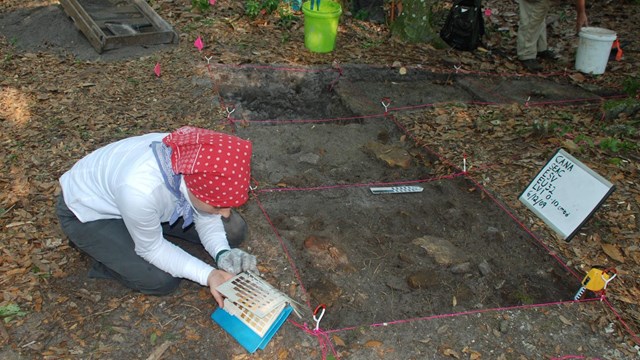
Archaeologists found the holes for two of the army tents. Modern stakes and flagging tape outline one of the tents.Perhaps most exciting was the discovery of small tent stakes left in place in the ground by the American soldiers who set up tents north of the Copper Queen Store about 1916. The archaeologists found stakes for two of the three tents, as well as a long trench where soldiers may have hidden when bullets and shells fell from across the border.

Next, three excavation units were placed in the trash dump area. The recovered artifacts included broken dishes, bottles, nails, animal bones, peach pits, nylon stockings, and plastic toothbrushes and combs. The trash was found to date from the mid-1940s to the 1950s and had been deposited by area residents.

A metal detector was used by Desert Archaeology personnel.A metal detector then was used to search for ammunition fired during the Mexican revolutions. Several pieces were located, indicating that accounts of bullets falling on the American side of the border were true.

Forty-six features, all dating to the historic period, were described, mapped, and photographed. No prehistoric features, nor artifacts, were encountered, although Naco, Arizona, is well known for an 11,000-year-old Paleoindian mammoth kill site located in nearby Greenbush Draw. (This site was excavated in the 1950s by University of Arizona archaeologists.) However, the expansion property apparently was never the site of such prehistoric activities, at least none that left physical traces. Clearance for construction on the POE expansion property was given since the archaeological resources had been carefully recorded.

PUTTING IT ALL TOGETHER

The story of the Naco, Arizona Port of Entry unfolds when the archaeological and archival findings are combined. The Copper Queen Store, a brick building with a massive stone foundation, was constructed on the property in 1900, along with its adjacent warehouse. Naco residents came to the store to purchase groceries, hardware, and lumber. It surely was an important place to socialize and trade stories as well.

The nearby El Paso and Southwestern railroad tracks brought freight and passengers from the east and west, many debarking in Naco. The tent stakes are reminders of the excitement and tension that filled Naco when internal problems occurred across the border. Afterward, it sank into a slow decline since many residents had fled the area.

The Copper Queen Store closed and was used as a warehouse. An adobe-walled compound was built to protect a firewood-cutting area. In the 1940s, local residents began to dump trash on the east side of the property, prior to the establishment of a local dump. This activity ended in the 1950s, and by the 1960s firewood was no longer cut in the compound, which was slowly falling to pieces. The Copper Queen Store accidentally burned in the late 1980s, its walls collapsing into piles of bricks.

The property will soon see a new use as the Port of Entry expands. The archaeological and archival studies have identified and documented the remains left by the people who once lived there. This has allowed important information about the historic past of Naco to be preserved for future generations.
 

ACKNOWLEDGMENTS: Archival and archaeological work conducted at the Port of Entry property was funded by the United States General Services Administration (GSA). GSA and the Interagency Archeological Services Division of the National Park Service evaluated the project. DWL Architects & Planners coordinated the project. Personnel at the Naco, Arizona Port of Entry provided valuable assistance during the project.

Read the Archeology Report (English only)


Back to entry page