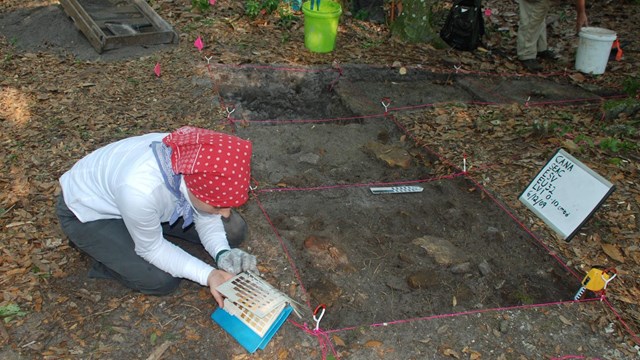
Historic ArtifactsTest Area A enclosed the approximate area of the Monroe House and its associated structures. Of some importance to our understanding of this area were the artifacts recovered from the shovel testing and small block excavation. These artifacts provide clues to the occupants' activities, as well as the temporal position of the deposits. The following discussion presents a brief description of artifacts according to a functional classification system proposed by Sprague (1980-1981). All objects recovered in Test Area A are listed in the Appendix 1 (Historic Artifacts) and Appendix 2 (Prehistoric Artifacts). Personal Items (n=14 specimens; MNI=7).Adornment (n=4 specimens). Three, white, Prosser buttons (Cat. 20, 84, and 91) and a ferrous metal clothing snap (Cat. 26) are included in this functional category. Prosser buttons, a type manufactured from highly compressed, heated beads of glass, are sometimes mistakenly referred to as "ceramic" buttons. All specimens are elliptical in cross-section and have four sew-thrus within a circular well in the center of the button face. The buttons from the Monroe House site are white and vary from 0.43-0.44 inches (10.92-11.18 mm) in diameter. This correlates with the commercial standard size of 18 lignes (1 inch = 40 lignes), a size commonly used with underwear and shirts. The ferrous snap is represented only by a fragment, and little additional information can be provided concerning its possible uses. Medical and Health (n = 1 specimen).This functional category is represented by a single, light aqua, patent, lip bottle finish fragment recovered from S. P. 6N/4W (Cat. 178). This finish probably had a cork closure and is possibly derived from a medicine bottle of unknown type. Indulgences (n =9 fragments; minimum number of vessels =2).Glass fragments representing alcoholic beverage containers were recovered from three shovel tests. Three "black" (very dark olive green) fragments (Cat. 138 and 180a,b) are from one bottle which may have contained wine or ale. This very dark color suggests a time period contemporaneous with the Civil War or before (Fike 1987:13). The other six fragments (Cat. 168) are amber colored and are probably derived from a modern beer bottle. Domestic Items (n =84 specimens; MNI=26).Furnishings (n=5 specimens; MNI=3). Objects noted at the site in this category but not collected (and therefore not listed in the Appendix) were a set of partially buried bed springs and a cast iron skillet. Both were just north of Trench 1, located at grid 1W/10N.
The pressed glass fragments appear to be derived from at least two vessels. One of these is probably a bowl of indeterminate size. This vessel (represented by Cat. 114 and 146) has large rectilinear elements, impressed stars in raised diamonds, and a plain everted rim (Figure 19b). Exposure to the sun's ultraviolet rays has turned the otherwise clear glass to a light violet color. This is a characteristic of glass objects clarified with manganese, a practice in the glass industry between circa 1880 and 1916 (Munsey 1970:55). The two remaining pressed glass specimens (Cat. 145 and 184) are clear in color and display a fine ribbed pattern. Their unaltered, clear color suggests that the objects are of modern derivation and, though placed in this category, it is possible they actually derived from a soft drink bottle. Food and Drink (n =2 specimens).Very little can be said about this category because only two objects were recovered which related directly to food consumption. A pig's molar (Cat. 83) may represent the raising of hogs and pork consumption. A corroded rim from a round tin can (Cat. 154) suggests the use of some form of storebought canned goods. Housewares and Appliances (n = 77 specimens; MNI=21).Food preparation and preservation are demonstrated to a small degree through the recovery of a variety of stoneware and table/teaware. Stoneware (n=9 specimens; MNI =7 vessels) was most commonly used to prepare and store foods during the 19th century. Most specimens from the Monroe House site display a salt glazed exterior, though a few possess a dark brown glaze (probably an Albany slip). Interior surfaces are unglazed, haphazardly glazed with an Albany slip, or salt glazed. Interior and exterior glazing combinations suggest that at least seven different vessels are represented. Vessel forms include two jugs (Figure 19a), a large (mixing?) bowl, a crock, and three vessels of unknown shape. Table/teaware is represented by 55 whiteware fragments and three porcelain fragments. The shape and decorative features suggest that at least twelve vessels are represented in the collection. These include:
Portable Illumination (n = 10 fragments; minimum number of specimens =2).At least two kerosene lamp chimneys are represented among the curved glass objects. Nine fragments are from a clear globe of uncertain shape. One of the fragments (Cat. 139) is a crenellated rim. A second globe may be represented by extremely thin, purple glass specimens. All objects of this category are probably related to the farmhouse occupied by the Monroe and Blue families rather than to the battlefield antagonists since they are consistent with typical permanent residential domestic activities. Architectural Items (n = 700 specimens).Construction Materials (n = 92 specimens). This subcategory includes all objects or materials used in the actual fabric of a construction. Objects of this category recovered from Test Area A include window glass, bricks, mortar, and plaster. Window glass (n = 76 fragments), all flat glass specimens under 3.20 mm in thickness, varies from clear to light green in color. Bricks (n = 5 specimens), as would be expected, occurred in relatively large numbers in the block excavation at the chimney ruins. Only five specimens were collected. One complete brick and three fragments are from test excavations at the collapsed chimney feature. The other collected specimen is derived from a shovel probe at 2N/1E. All remaining bricks encountered at the chimney feature were left at the site, and most of these remain in their original place of discovery. The only complete specimen collected (Cat. 5) is a handmade brick of poor construction. It appears to have been made in a mold, and the coarse, wet clay was allowed to slop over the edges to a considerable extent. There are no marks on any of the specimens to identify the manufacturer. Mortar and Plaster (n =11 specimens). One mortar fragment and ten plaster fragments were encountered during the test excavations at the location of the collapsed chimney. These had no distinguishing characteristics. Construction Hardware (n = 608 specimens) includes all objects used as fasteners or otherwise attached to construction materials. Nails (n = 606 specimens) are the single largest artifact category recovered from Test Area A. The sample includes cut nails (n = 472), L-headed cut brads or finishing nails (n=7), wire nails (n=22), and unidentifiable nail fragments (n =105). The pennyweight (d) is the standard means of referring to nail size, and the sample from Test Area A range in size from 3d (1 1/4 inch) to 40d (5 inches). William Lees, as a part of his nail analysis of the Jotham Meeker Farmstead, examined two 19th-century, standing structures to ascertain the functions of various-sized nails used in their construction (Lees 1986:95-96). He notes the following correlations:
Lees also noted the relative absence (</=0.4 % or less of the sample population) of nails 16d and larger at a log cabin site in Kansas. Finally, the relative proportion of smaller nail sizes in the sample was proposed by Lees to be directly related to the structure's roof size; e.g., the larger the roof area, the higher the percentage of number of 2d-4d nails commonly used in shingling. About 60% of the nails recovered from a structure dating to the 1830s and 1840s, with at least 978 square feet of ground space, were sizes 4d or less. Excavations at a smaller structure (exact dimensions uncertain) at the same site returned a nail sample in which only 23.7% were 4d or less in size. The 479 cut nail population recovered from Test Area A includes 3d (n=49, 11.2%), 4d (n=60, 13.7%), 6d (n=35, 8.0%), 8d (n=155, 35.3%), l0d (86, 19.6%), 12d (34, 7.7%), 16d (n=10, 2.1%), 20d (n=6, 1.3%), 30d (n=4, 0.8%) and 40d (n=1, 0.2%). The relatively large number of nails 16d and greater in size (n=21, 4.4%) suggests the likelihood that the structure at 31HK248 was a frame building. The relatively small percentage of size 4d or less nails (24.8%) may suggest a structure smaller than 978 square feet. However, if the house were roofed with tin, as many houses in the United States were from the Colonial era on (telephone conversation, Hunt with Charles Maston, MWR Restoration Specialist, December 21, 1993), then one would expect a smaller number of nails for roofing. One would also expect the proportions of roofing nails to be reduced for multistory structures. For the moment, then, no conclusive evidence is available relating to the size of the structure tested at 31HK248. Screw (n=1 specimen). A single no.18 (0.25 inch 1.064 mm diameter) wood screw was recovered in Trench 1. The shaft of the ferrous metal screw is broken, preventing its length from being determined. Staple (n= 1 specimen). The only staple recovered in Test Area A is from S.P. 7N/1E and most likely derived from a fence. Transportation Items (n = 7 specimens).A variety of items related to transportation were recovered from various areas of Test Area A. Most of the objects are probably related to horse harness, among which are a cuprous rivet (Cat. 25), a cast brass buckle (Cat. 4), a possible trace chain (Cat. 157), a ferrous swivel (Cat. 147a), and possible ferrous metal buckle tongue (Cat. 147b). Two shoes were recovered, one for a horse (Cat. 28) and the other for a mule (Cat. 180). These objects may be related to the military engagement at Monroe's Crossroads, although it is equally or more likely that they are associated with the agricultural activities of the Monroe/Blue farm. Firearms/Martial Items (n =4 specimens).Literally thousands of objects related to this category were noted at the site. Only four objects predating the military reservation were collected in the subsurface investigations, however. These include a .45 caliber bullet (Cat. 28), a decorative device for a gunstock cut from sheet copper (Cat. 11), a .22 short casing (Cat. 10), and a .54 caliber bullet (Cat. 127). Unidentified Function Items (n =92).Unidentified function items from Test Area A were classified solely by their raw material class (glass, plastic, metal, and stone). Glass objects in this category (n=59 specimens) are all curved glass fragments and derived from bottles. None could be assigned to a vessel shape or functional category due to their uniformly small size. The small fragment size is similar to that observed by one of the authors (Hunt) in public areas at Fort Union Trading Post National Historic Site where glass sherds were broken and rebroken by human and animal traffic. Some sherds were melted to various degrees. This may indicate that the Monroe House was burned after it was torn down. Plastic (n =1 specimens). One piece of yellow celluloid recovered from Trench 1 is a fragment of an unidentified, round-edged object. Metal (n=31 specimens). Thirty objects in this subcategory are of ferrous metal. The remaining specimen is the remnant of a mutilated, lead cylinder. Stone (n =1 specimen). One small fragment of slate was recovered in the chimney ruins. This may be derived either from a slate roofing tile or a writing tablet. Prehistoric Artifacts (n =33 specimens).Human-modified, lithic objects recovered from Test Area A are related to an unidentified, prehistoric occupation (see Appendix 2). All but one are quartz flakes which vary in color from clear (n=1) to white (n=31). One of these (Cat. 88) appears to exhibit some retouching along one edge. Aside from the flakes, one crude, bifacially-worked tool was recovered which appears to be manufactured from a dense, buff-colored, limestone cortex. These objects were found to be widely distributed throughout Test Area A. No boundaries for this component can be defined given the present data base.
|