Chapter 4
TEST EXCAVATIONS:
ANALYSIS AND RESULTS

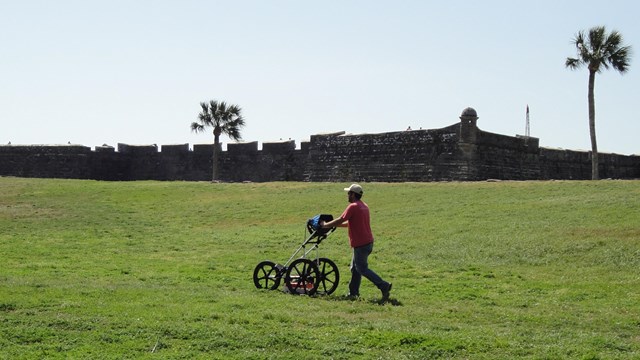
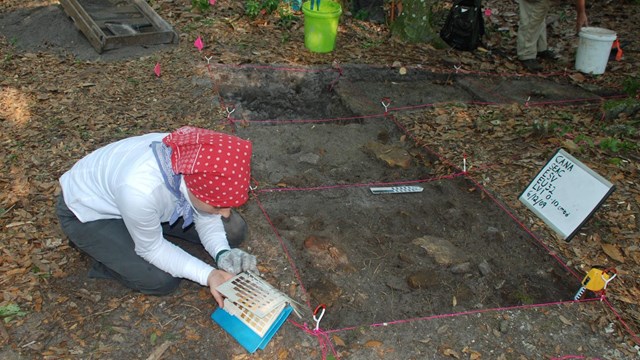
The traditional archeological investigations at the Monroe's Crossroads house site and adjacent areas yielded a wide variety of data. Some specimens can definitely be attributed to the battle, while many are primarily related to the pre- and post-battle site occupation. Most artifacts represent items lost or discarded by occupants of the site or are construction related. This chapter details the test excavations and ground penetrating radar investigations. It also describes the artifacts and features located and interprets the results of the project testing phase.

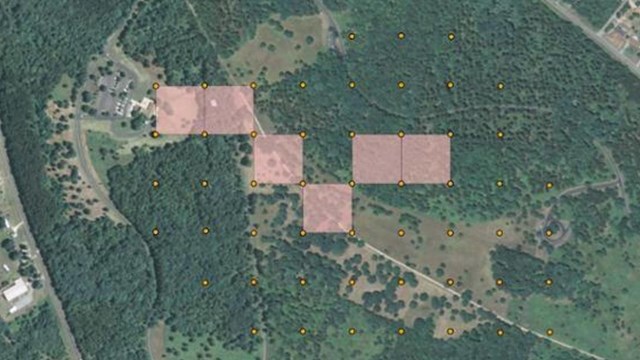
SELECTION OF TESTING LOCALITIES

Areas were chosen for investigation according to several factors. Primary among these was that test locations fall within the area proposed by the Army as a situational leadership training site for small combat units. Based on this requirement, a cemetery located on the southern edge of the battlefield was excluded from investigation. Also excluded were segments of the battlefield related to the withdrawal of Confederate troops after the main engagement.

Finally, a small portion of the battlefield in an active artillery impact area east of Blue's Road was not investigated for safety reasons.

An equally important factor in selecting test areas was the Army's desire to identify cultural features which played prominent roles during the evolution of the battle at Monroe's Crossroads. The proposed training area will incorporate signage identifying the locations of Civil War-era roads, buildings, and troop encampment locations. Therefore, features which appeared to be of cultural origin were targeted for investigation

Test Area A was selected because it contained a mound of bricks believed to be the ruins of the Monroe House chimney. As noted earlier, the Monroe House was occupied by General Kilpatrick who used the structure as his temporary headquarters. The goal of testing in this area was to identify the location of the Monroe House, a log barn, and other farmstead outbuilding sites.

During the crew's introductory walkover of the site at the initiation of fieldwork, bone fragments were noted immediately east of a swampy area which served as a refuge for Union troops during their retreat in the initial stages of the battle. The discovery raised the question of whether the bones represented an eroding battlefield grave. A small test unit was placed over the exposed bones to make that determination. This location was Test Area B.

Cemeteries within the battlefield were laid out, marked, and enclosed by the U.S. Army in 1921. These locations reportedly held the remains of 39 unknown Union soldiers.

Figure 11 - A grave for Confederate soldiers is marked at Long Street Presbyterian Church.At least some, if not all, of the Confederate soldiers killed were exhumed after the battle. Some were apparently reburied at Long Street Presbyterian Church (Figure 11 at left) a few miles away, while others were reclaimed by family members and buried elsewhere.

Questions arose whether the marked areas were indeed the actual burial locations and whether the dead represented Union forces exclusively. This led to one large and four small cemeteries being selected as Test Areas C-G.

A large deep depression, which had been identified by some as the former site of the Confederate burial area, was selected for investigation as Test Area H.

During the introduction of the MWAC crew to the site, Bill Kern noted that the actual locations of the historic Blue's and Morganton Roads remained unknown. A number of new roads had been created since the battle, most after the military reservation was established.

The walkover on the first day of fieldwork led to the identification of several deep linear features which were proposed as possible remnants of the historic roads. These two traces were therefore targeted for investigation.

TEST AREA A: THE HOUSE SITE

Test Area A is an 30 m x 50 m rectangular block which has its long axis oriented northeast-southwest, more or less paralleling Blue's Road. Datum 1 (arbitrarily established as site mapping coordinate 1000N/1000E) is situated at its extreme easterly corner. This is the site recorded for the Monroe House, the headquarters of the Union troops on the eve of the battle and an element of the battlefield.

Architectural History

Despite a deed search reported by Thomas Loftfield (1979:28), the structural history of the Monroe House site remains quite vague. Loftfield has stated that the house and 500-acre Rocky Mount Plantation were "well established" prior to the farm's 1832 transfer from Malco[l]m Munroe [Monroe] to his son Charles M. Monroe. Charles died in 1866, a fact that led Loftfield to assume that the house remained in his possession until then. When sold to Neill S. Blue in 1881, the tract was described as containing Charles Monroe's dwelling house.

Loftfield further states that the house stood close to the road (the road is not identified by Loftfield) and that a test excavation by Loftfield's firm sometime in 1977 or 1978 identified a brick chimney base at the edge of the present road. The brief site description in Loftfield's report identifies the site as "approximately 200 meters south of the intersection of Blue's Road and Longstreet Road" (Loftfield 1979:G-97). The chimney base identified by Loftfield's team is at the same approximate location as that tested by the MWAC team in 1993 and is probably the same entity.

Little is known about the structure's physical characteristics. Its only known depiction (Figure 13 - 57 KB) is an illustration in Harpers Weekly published three weeks after the battle (April 1, 1865). Four structures appear in the picture's center. The Monroe House is shown as a two story, "dogtrot" style house. It is gabled, has a large porch covered by an extension of the roof, and has brick chimneys at the center of each end. A smaller structure, perhaps an outhouse, is depicted immediately to the right of the house. Two log structures, perhaps storage buildings or slave quarters, are shown some distance to the left of the house.

Interpretation of this illustration is very difficult. There is no way to determine whether Harpers Weekly obtained the view from a war correspondent or artist who witnessed the battle or whether it is simply the product of some publisher's or editor's caprice. It is certain that baffle details are incorrectly portrayed. This leads one to doubt the veracity of the Monroe structures' depiction. One must conclude that the accuracy of the illustration is uncertain at best.

Figure 14 - A residence belonging to the Blue family as seen in 1891. (Leslie's Weekly)A structure probably contemporaneous with the Monroe House and which may have been similar is a residence owned by one of the Blue families (Figure 14 at left). This structure was once located in the general vicinity of the Monroe House. An 1891 Leslie's Weekly photograph of that structure, now in the National Railroad Museum collection, shows a building similar to the one in the 1865 Harpers Weekly illustration of the battle. This appears to be a central-hall or Georgian-style house, a category which includes "dogtrot" houses. This vernacular style was widely built in the southeastern United States during the first half of the 19th century and continued to be built well into the 1880s in some locations (Marshall 1981:52).

If the Monroe House was of the vernacular style portrayed in these two images, one would have a number of expectations regarding orientation and form. With regard to orientation, the dwelling may have faced Blue's Road. In form, the building would have had large brick chimneys, one at each end of the structure and, most likely, a spacious veranda-style porch on its front side. It may also have had an addition on the back which served as a kitchen or had a separate summer kitchen building.

Archeological Investigation

Small-scale Block Excavation

This focused on a concentration of brick believed to represent a chimney base. Of some relevance to this investigation was determining the nature of this brick concentration. Did it consist solely of a jumbled pile of bricks or was there some pattern in the brick deposition? If there was a patterned deposit, what information would it provide about the location of the hearth and the direction the hearth faced? The first step in implementing the block excavation was to lay out a horizontal reference grid containing excavation blocks of uniform 2 m square size oriented with the cardinal directions. Because no locational references relative to the site datum were available when the grid was established, an arbitrary reference system was used. Each excavation unit was named according to its relative location in the grid; i.e., numbered from north to south and lettered from east to west (Figure 15 - 55 KB). Units C2, C3, D2, and D3 lay over the hump of bricks and were chosen as the primary investigative units An attempt was made to leave bricks in place as encountered to provide excavators with a visual reference for patterning, if patterning actually occurred.

At the initiation of excavations, it was obvious that the brick concentration had been disturbed sometime in the past. A large, ovate depression in the southeast corner of excavation unit C3 and a somewhat smaller depression in the southwest corner of excavation unit D3 marked the disturbance (Figure 15 - 55 KB). These may be locations of treasure hunters' holes or perhaps test pits excavated by Loftfield's 1977-1978 survey crews.

As fill was removed, it became apparent a patterned deposit (or feature) of brick did exist in the eastern portion of the mound (Figure 16 and Figure 17). This consisted of at least five north-south alternating rows of brick laid on edge. Above, between, and for about 50 cm to the west of the patterned bricks was an area of desiccated, burned brick. This was interpreted as a hearth area.

Although the hearth's orientation could not be determined for certain, all of the patterned bricks lay on the east side of the burned area. This was tentatively assumed to mark the interior edge of the brick hearth, based on the pattern of the bricks and a knowledge of mid-nineteenth century construction techniques. The house would therefore be expected to lie on the east side of this feature.

Scattered among the bricks on the west-central and northern margins of the mound were sandstone chunks. One large, sandstone block was also noted at the northeastern margin of excavation unit D3. These may be the remnants of sandstone footer stones used to raise the Monroe House above the ground surface, similar to the sandstone pedestals supporting Long Street Church located a few miles to the east.

Almost no brick or sandstone was encountered in the center of the brick mound. This was apparently a result of past excavations, whether authorized tests of Loftfield's crew or unauthorized digging by vandals. In association with the general brick hearth area, however, is a somewhat jumbled alignment of bricks. The general orientation of this alignment is northwest to southeast, and it appears to represent a chimney which collapsed toward the southeast from the hearth area.

Shovel Probe Testing

The general goal in Test Area A was to clarify the distribution of historic artifacts in the vicinity of the Monroe family homestead and to identify the locations of additional structures associated with the house.

In Test Area A, probe holes were excavated 5 m apart within a 150 m2 area. The grid was aligned with and bounded by the current Blue's Road and an unnamed firebreak road. The long axis of the grid included 11 holes in a somewhat northeast to southwest alignment (aligned with Blue's Road) and were numbered from 1N to 11N, respectively. The short axis consisted of six holes aligned more or less with the firebreak road and labeled 1W to 5W. When this grid was completed, two additional lines of shovel probes were excavated, one on each side of Blue's Road.

These were labeled 0W (on the northerly side of the road) and 1E, respectively. Altogether 75 shovel probes were dug.

There were no shovel probes within the block excavation or at survey Datum 1 (which lay in the junction of modern Blue's Road and an unidentified historic road). Shovel probes were excavated to a compact, yellow, gray clayey sand, a level interpreted to be unmodified by human activity. Depths of these holes varied to 36 cm from the surface.

Shovel probe testing was hampered to a considerable degree by modern disturbances and intrusions. Shovel probes were not excavated at 7N/1W, 10N/0W, 11N/0W, and 11N/1E. 10N/0W and 11N/0W lay within the disturbed margins of the firebreak road and Blue's Road junction. 7N/1W was within the boundaries of excavation unit C3. The location 11N/1E was not investigated because it was situated within the linear depression believed to be a historic road or trail, a depression which was being mechanically tested (see below).

Although shovel probe holes were dug at 4N/2W, 4N/3W, 9N/0W, and 11N/4W, all were marked by modern disturbances. The hole initiated at 4N/2W lay within a large circular depression initially believed to represent a possible historic feature. Excavation was quickly abandoned, however, because buried plastic spoons, cellophane, and other modern debris was unearthed. This material appeared to represent the remains of an Army food kit, and the depression was interpreted to be one of many modern "foxholes" scattered across the site. Modern disturbances were also indicated by the recovery of a M1 or M14 rifle cleaning rod, a Ml rifle ammunition clip, and mixed soil fill at 4N/3W, 9N/0W and 11N/4W, respectively. Modern objects were not collected.

Excavation of the other 69 shovel probes resulted in recovery of 176 objects (excluding six fragments of modern bottle glass) from 50 of the tests. Most objects were located within the first few centimeters of surface fill, which was distinguished by a dark organic humus, or with the layer below consisting of a brownish gray, loamy sand. None were encountered below 20 cm or from within the upper layers of yellowish tan or grayish yellow, compact, clayey sand underlying the two darker layers.

Despite clear evidence for considerable modern disturbance to the site, it is clear that the historic component of the Monroe House site is quite extensive and continues beyond the shovel tested location. A prehistoric component is reflected through the recovery of quartzite flakes. This component is very sparse, has no apparent concentration of materials, and occurs throughout the site.

The locations of historic artifact concentrations were quite restricted and can be illustrated using SURFER computer software. This program can plot the number of objects recovered from each shovel probe to generate an artifact density contour map (Figure 18). A steep-sided peak immediately north of the mound of bricks marks the location of the major artifact concentration (Midden 1) at the Monroe House site. Shovel testing in this area indicated a sheet midden which is relatively dense and, at the same time, very restricted both horizontally as well as vertically. Other details about this midden cannot be determined without further testing. Nevertheless, its contents (the large number of nails recovered combined with the largest concentration of domestic debris), as well as its limited distribution suggests that this may be near a rear door and/or represent a portion of the collapsed Monroe House.

A smaller concentration of artifacts represented by a linear ridge running from 4N/1W to 5N/2W about 10 m (33 ft) west of the brick mound is labeled Midden 2. It is not clear what this concentration represents. Its linear character may simply reflect the fact that only two points with somewhat higher concentrations of artifacts are involved. If this line were represented by three or more points, it would be more convincing as a feature.

Chapter 4 (continued)

Table of Contents