Chapter 3
THE BATTLE AND LAND USE OF MONROE'S CROSSROADS
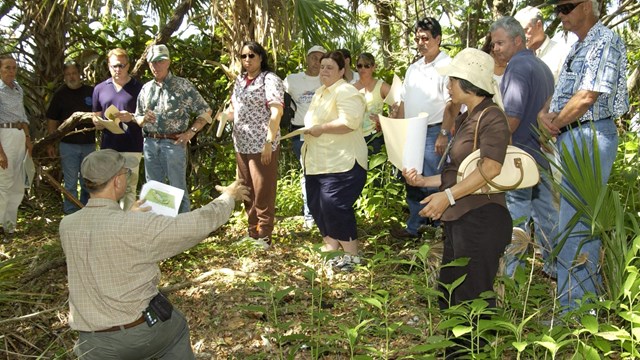
Monroe's Crossroads Battlefield is situated in the Sandhills subprovince
of the Atlantic Coastal Plain province (Loftfield
1979). This environmental context influences the weather patterns
and vegetation that exist or have existed at the site. The land form is
rolling hills consisting of sandy loam deposits. The sandy soils of the
site support longleaf pine and turkey oak with the under story dominated
by wiregrass.
The rolling nature of the land form allows a few small rises to appear,
but there is no significant relief. The change in elevation on the battlefield
is less than 100 feet. There is some outcropping of underlying bedrock,
usually appearing as small knolls, on the west edge of the site. Oak has
become a dominant tree species in modern times as a result of fire suppression
measures. The oak is being eradicated through mechanical and chemical
means to restore the setting to the pre-fire suppression era.
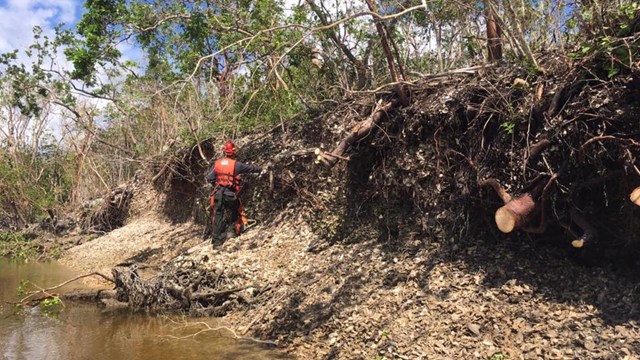
Waterways - the creeks - are shallow and not deeply entrenched. Nicholson
Creek runs in a north to south direction on the western edge of the site.
It is an intermittent creek that played an important role in the battle.
The creek bank is currently heavily covered with turkey oaks and shrubs,
such as huckleberry and blueberry, and switch cane.
Historically, or at least during the years of the Civil War, the battle
site was farmed. The vegetation would have consisted of most of the same
species, although their density and distribution would have been radically
different due to the agrarian activities.
The earliest, 18th-century, Euro-American settlers were predominately
of Scottish heritage and grazed cattle and sheep. They also grew some
crops, including oats and corn. During the early 19th century, the turpentine
industry dominated in the cash economy. This was followed by timber cutting.
By the early 20th century, there was a return to corn production and the
introduction of cotton as a crop (Loftfield
1979:22-24).
The turpentine industry appears to have been a mainstay of the rural
economy in the area up to the time of the Civil War. It continued for
many years afterward, although in reduced circumstances, into the early
years of the 20th century (Robinson
1991).
There is no precise data on what the Monroe farm produced, but the presence
of open fields and outbuildings are known from the reports of the engagement.
It is reasonable to assume that the inhabitants of the Monroe farmstead
raised a few crops, perhaps grazed some livestock, and may have dabbled
in logging or the production of turpentine. The stumps of turpentine trees
noted throughout the project area attest to the fact that turpentine production
was a part of agrarian activities at the site at some point during its
occupancy.
According to research by Loftfield
(1979:28-29), Charles Monroe, owner of the site during the Civil War,
acquired the 500-acre farm in 1832 from his father. Charles Monroe added
to his property, through a grant from the state, a tract of four and one-half
acres on the east side of Nicholson Creek. He continued to hold title
to the land until he died in 1866. The family sold the property in 1881
to Neill S. Blue.
The land entered the public domain in 1917 with its acquisition by the
U.S. Government as part of the new Camp Bragg. Mrs.
J.W. McLauchlin (n.d.) states in her memoirs that the property was
owned by three sisters and a brother, a Mr. Monroe, at the time of the
battle. She further recalls that Mr. Monroe was living in the house alone
in March 1865. The only other person on the property was a black
woman known as Aunt Hannah who lived in a log house in the yard adjacent
to the main house.
Lofifield (1979:28) noted that
the deed transferring the property to the Blues recorded the land as lying
on both sides of Morganton Road on the east side of Nicholson Creek at
the confluence of White Marsh and Nicholson Creek. The tract was noted
to contain the Monroe dwelling house. The house is reported to have stood
close to the road (Oates 1972:405).
The Charles Monroe house site is designated 31HK248 in the trinomial
site system, and the Monroe's Crossroads Battlefield is 31HK249.
THE BATTLE
By March 1865, the Confederacy had been split asunder. Union troops had
driven wedges of men and destruction through the deep south. General William
T. Sherman had marched north from Savannah, Georgia through the Carolinas
toward Virginia where he was eventually to join General U.S. Grant. U.S.A.
(USMA 1843) in the siege of Petersburg.
During Sherman's march through the Carolinas, he burned Columbia, South
Carolina (Crewdson 1981), pushed
on into North Carolina and, by early March, was nearing Fayetteville.
Sherman divided his veteran army of 70,000 men into two wings. Cavalry
was used to screen the infantry's march as the army moved relentlessly
north.
Brevet Major General Hugh Judson Kilpatrick (Figure
3 - 46 KB) commanded Sherman's left flank cavalry division which acted
in a screening role during the campaign. Kilpatrick's primary mission
was to protect the left flank of Sherman's army. Sherman had directed
Kilpatrick to avoid, if possible, engaging the Confederate cavalry because
he was to save his division for an expected major battle near the Virginia
border.
The Battle of Monroe's Crossroads was not
a planned engagement, but one of happenstance for both combatant groups.
Although not well documented in the historical literature, the battle
is the source of several articles and unpublished papers. Many of the
articles are recollections published in the Confederate Veteran as
a result of a call by John Dubose. Dubose apparently was attempting to
gather information for a book, subsequently published, about Confederate
Lieutenant General Joseph wheeler, C.S.A. (USMA 1859). The following
summary of the battle is derived from a variety of sources, particularly
Dubose (1912a; 1912b; 1921), Northrop
(1912; 1913), Hamilton (1921),
Nye (n.d.), Daly
(n.d.), Miller (1991),
The Official Records of the
War of the Rebellion (1895),
Oates (1981), Barrett
(1956), Brooks (1909; 1911),
and Bowman and Irwin (1865).
Other specific citations are also referenced in the following summary
where appropriate.
As Sherman's army marched by parallel roads toward Fayetteville, Kilpatrick
arrived at Rockingham, North Carolina on March 7 where he skirmished with
Wheeler's Confederate cavalry. The weather was cold, wet and rainy
during early March 1865 in North Carolina, making campaigning miserable
at best.
On March 8, Kilpatrick marched along muddy roads and crossed rain-swollen
creeks and streams (Figure 5 - 149 KB). He moved
to the head of Drowning Creek where he encamped. The 9th of March saw
the column moving again in a torrential downpour. Kilpatrick learned from
his scouts that Lieutenant General William Joseph Hardee's, C.S.A.
(USMA 1838) infantry had recently moved to the north. He also learned
that General Wade Hampton's (Figure 2)
Confederate Cavalry was to the west moving to join Hardee's command.
Kilpatrick ordered his Second Brigade to march along the Morganton Road,
the First Brigade to deploy along the Chicken Road, and the Third Brigade,
along with the Fourth Provisional Brigade (dismounted), to follow the
Yadkin Road on the move toward Fayetteville. The latter was to halt at
Green Springs (Monroe's Crossroads) for the night. The Yadkin and Morganton
roads intersected west of Green Springs. Kilpatrick, with his staff and
an escort of 15 men and one officer, moved to join the Third Brigade.
The Union order of battle (Figure 6) for the Third
Brigade, taken from the Official Records of the War of the Rebellion
(Hereafter cited as OR 1895;Morris
1912), was Brevet Major General Judson Kilpatrick, commander of the
3rd Cavalry Division; 3rd Brigade Colonel George E. Spencer and Colonel
Michael Kerwin; 1st Alabama Calvary (U.S.) Major Francis L. Cramer (wounded
and captured March 10), Captain Jerome Hinds, and Major Sanford Tramel;
5th Kentucky Cavalry (U.S.), Colonel Oliver L. Baldwin and Major Christopher
T. Cheek; 5th Ohio Cavalry, Major George H. Rader. The 4th
Provisional Brigade (dismounted) was commanded by
Lieutenant Colonel William B. Way and consisted of 1st Regiment, Major
Charles A. Appel (captured March 10); 2nd Regiment, Lieutenant Colonel
William Stough; and 3rd Regiment, Captain John B. Riggs. The 4th Provisional
Brigade was made up of dismounted men from each of the other brigades.
According to Starr (1985:579),
the dismounted regiments were composed of 1st Regiment men from the 3rd
Indiana Cavalry, 8th Indiana Cavalry, 2nd and 3rd Kentucky Cavalry (U.S.),
and 9th Pennsylvania; 2nd Regiment men from the 92nd Illinois Mounted
Infantry, 9th Michigan Cavalry, 9th and 10th Ohio Cavalry, and McLaughlin's
Ohio Squadron of Cavalry; and the 3rd Regiment of men from the 1st Alabama
Cavalry (U.S.), 5th Kentucky Cavalry (U.S.), 5th Ohio Cavalry, and 13th
Pennsylvania Cavalry. The commands' armaments are not well documented,
but Kilpatrick (OR Volume 47, Part
1, Page 855-857) notes that portions of his command were armed with
Sharps carbines and that the 9th Pennsylvania troops were armed with Joslyn
carbines. Cox (1882:180) states that
the dismounted brigade, composed of about 400 men, had been armed with
rifled muskets and bayonets at Savannah.
The various units of the command arrived at Charles Monroe's farm located
near the crossroads during the evening hours of March 9. According to
Nye (n.d.:5-6):
Lieutenant-Colonel [William B.] Way's [U.S.A.]
brigade of about four hundred dismounted men, having in charge the
ordnance wagons and the division headquarters train, arrived at Monroe's
Cross-Roads at nine o'clock that stormy night, and camped in line along
the road in front of the Monroe farm house. Colonel Spencer's Third
Brigade filed on past the house and turned off into a large open field
lying on the ridge about a hundred yards north of Green Springs. Shelter
tents were thrown over fence rails and saplings. Picket lines were quickly
stretched between pine trees; the artillery was parked about fifty yards
or less from the house, on a slight rise at the top of the ridge, probably
near the point where the two principal grave plots are now located.
The wagons were also near the farm yard. Colonel [George E.] Spencer
[U.S.A.] states that he picketed the country carefully in the
direction of Fayetteville, leaving Colonel Way to picket the rear....
Colonel Spencer and his staff soon made themselves comfortable in the
little farm house, from which the inhabitants had fled; he was joined
here by Kilpatrick and his staff and the private mounts belonging to
these gentlemen were tied to the railing of the front porch, and the
garden fence. There were also in the building two ladies, said to be
refugees from Savannah, who were following Kilpatrick's column in a
buggy.
Captain T. (Theo) F. Northrop, U.S.A., was in charge of Kilpatrick's
scouts. He (Northrop 1912; 1913)
indicated his command was not satisfied with the open Monroe farm as a
camping ground and moved across the swamp some distance to camp for the
night.
The
Confederate movement prior to the March 10 engagement was equally difficult
in the rainy weather. General Wheeler's (Figure 8 at left) column
was marching toward Fayetteville and on the evening of March 9 was also
closing on Green Springs as a campsite. Kilpatrick's Third Brigade arrived
ahead of the Confederate column.
According to Major General Matthew C. Butler, C.S.A. (SC College),
(Figure 9 at right) (1909a:443-447),
in his personal account of the battle, Captain John Humphrey's, C.S
A., squadron of the 6th
South Carolina Cavalry was in the advance, with Wheeler's Division
bringing up the rear. About dusk Humphrey halted at a road
intersection where he observed signs of a heavy mounted column that preceded
Butler's movement along the same road. While Butler and
Humphrey were discussing the situation, a squad of about 30 cavalrymen
was discovered moving up the road. Humphrey stated he had no men
out, and Butler moved down the road to meet the unit. It was too
dark to recognize who they were, but Butler hailed them. They identified
themselves as the 5th Kentucky (U.S.), which Butler knew to be
one of Kilpatrick's units.
Butler ordered the officer in charge to ride forward. When the
Union officer was in the midst of the Confederates, General Butler
identified himself and demanded the Union officer's surrender. The
officer surrendered himself and his men, as well as a stand of regimental
colors. Butler was unaware that he had captured Union General Kilpatrick's
personal escort and had just missed an opportunity to capture the general
himself and his staff.
Butler reported to General Hampton who began plans to attack
Kilpatrick's camp at daylight the next morning. Butler and his
men moved on about four miles and bivouacked without unsaddling their
horses or making fires. Butler threw out videttes and skirmishers
and laid down to rest. About that time, another Union officer stumbled
into the Confederate lines and was captured. He provided Butler with
some information on Kilpatrick's position, at least enough to allow Butler
to capture Kilpatrick's pickets and reconnoiter the camp.
Confederate Lieutenant Colonel Barrington S. King was in command
of the Cobb Legion while Colonel Gilbert (Gid) J. Wright, C.S.A.,
was in charge of the brigade. According to Howard
(1901:12), it was at 2:30 a.m. that Lieutenant Tom Donahoo of
the Cobb Legion, accompanied personally by General Butler, captured
the Federal vidette and pickets on the road without disturbance.
According to Brooks (1909:55),
Butler's biographer, one of the coolest acts of the war was accomplished
by General Butler when on the evening of March 9 he personally
rode up to Kilpatrick's picket about dark and demanded their surrender.
He identified himself and said if a shot was fired he would have them
all shot. The pickets surrendered without a shot and, according to the
account, identified themselves as members of the 5th Kentucky Cavalry
(U.S.).
Butler observed that Union General Kilpatrick had moved around
the head of a swamp and pitched his camp in front of it. Kilpatrick had
his rear and right protected by the swamp, but his left was entirely exposed.
Confederate scouts were sent into the camp. At least two actually entered
the camp, and, unchallenged, made their way back to the Confederate lines
with two captured Union horses each.
Confederate Generals Hampton, Wheeler, and Butler agreed
to a daylight attack. Butler (1909a:444-445)
recalled the order of battle was:
... inasmuch as Wheeler's command was stretched back
for some miles in column of fours, I should close up my division in
column of regiments and be prepared to move when the head of wheeler's
column appeared in my rear; that I should follow up the road taken by
Kilpatrick, move around the head of the swamp, as he had done, and fall
suddenly on his camp from that [the west] side, while wheeler was to
move through the woods to the right and attack from the rear. Young's
brigade, commanded by Colonel Gid Wright, of the Cobb Legion, was moved
to the front, having occupied the rear in the day's march.
The Confederate order of battle (Figure 7) is somewhat
of a mystery, due either to the inadequacy of record keeping at the time
or to the loss of the records in the waning days of the war. However,
Colonel E.E. Portlock's inspection report for March 1865 (reproduced
in Dodson n.d.: 21) indicates Wheeler's
Cavalry Corps consisted of Humes' Division (Brigadier General William
Y. C. Humes, C.S.A.,VMI 1851) with at least portions of 1st, 2nd,
4th, 5th, 8th, 9th, 13th, and Shaw's Battalion Tennessee Cavalry;
3rd Arkansas Cavalry; 8th and 11th Texas; 2nd and 9th Kentucky
Cavalry present in late March or early April. In addition,
the Corps was made up of Allen's Division (Brigadier General
William W Allen, C.S.A., Princeton 1854) which had some elements of
the following units present in late March: the 3rd, 8th, and 10th
Confederate Cavalry; 1st, 3rd, 12th, and 51st Alabama Cavalry;
and 1st, 2nd, 3rd, 5th, and 12th Georgia Cavalry. Apparently
Iverson's Division, a battalion of Artillery, several regiments
of Humes' and Allen's Divisions, as well as the equivalent
of 32 companies from the units identified above, were absent on special
details to other locations.
Various recollections by battle participants also support the presence
of some units identified above. Inzer
(1904), Hood (1906), and Jones
(1911) identify the 51st Alabama as present. McDowell
et al. (1906) discuss the role of the 3rd Alabama Cavalry in
the fight, and Allen (1911)
mentions the 5th Tennessee Cavalry, while Bennett
(1911) recalls the role
of the 4th Tennessee Cavalry. Holman
(1911a), of the 8th
Texas Cavalry, recalled their role in the fight, and (Holman
1911b) provides a roster of the 8th Texas Cavalry as well.
Watkins (1912)
reports the role of the 6th Georgia Cavalry.
Butler's Brigade (Brigadier General Evander M. Law, C.S.A., SCMA
The Citadel 1856) was formed May 28, 1864 and was composed of the 4th,
5th, and 6th South Carolina Regiments of Cavalry. The 4th
South Carolina Cavalry was armed with Enfield rifles in April 1864.
They usually fought as dismounted cavalry in infantry formation. Apparently
this approach was adopted by Butler's Brigade for the remainder
of the war (Brooks 1909).
As the Confederate units moved in the night to position themselves for
the attack, the rain halted. Heavy mists and fog obscured the Union camp.
The attackers were positioned with Butler's Georgians of the Cobb
Legion as the assault unit on that northerly line. Howard
(1901:12) indicates the
Confederate forces waited in column until early dawn before commencing
the attack, with the Fulton Dragoons of the Cobb Legion in
the lead. Howard notes that the Federal camp was mostly asleep, but some
were preparing coffee and breakfast. The Cobb Legion charged along
the road in front of the house where Jim Jack, a member of the
command, was killed.
Butler also instructed Colonel Wright to send in a squadron
under a bold captain as the attack commenced. They were to take and hold
Kilpatrick's headquarters, with an eye toward capturing the Union general.
A Captain Bostick was selected to lead the capture team. Butler
held Law's Brigade in reserve.
Wheeler organized his command in five, attacking regimental columns.
Humes' Texans were on the Confederate extreme right, with Harrison's
Texas Brigade in the center (Brigadier General Thomas Harrison,
C.S.A.). Just south of the Morganton Road was Allen's Division,
with Hagan's Alabama Brigade (Colonel James Hagan, C.S.A.)
in the lead and on the left, apparently above the swamp. Wheeler also
intended to capture Kilpatrick and had placed Shannon's scouts
in front of Hagan for a dash into the camp (Captain Alexander
M. Shannon, C.S.A.). Dibrell's Tennessee Brigade was held in
reserve (Brigadier General George G. Dibrell, C.S.A.).
As Kilpatrick's buglers were about to sound reveille, the Confederates
charged the camp. The Union camp was quickly overrun by the pistol bearing
and saber wielding Confederates. Private
Wiley C. Howard (1901:12)
thought that some of the command chased Kilpatrick for more than a half
mile before Kilpatrick made his escape. Howard misidentifies the
Federals as troops from Michigan, but he notes that there were hand-to-hand
combats on numerous occasions during the battle.
As the Confederates made their charge through the camp, many Federal
troops were caught unaware, but many also rolled over in their blankets
to grab their weapons and returned fire. Others were hacked by sabers
before they could rise from their slumber. The Union soldiers near the
front of the assault were caught totally by surprise, and many surrendered.
The Cobb Legion reportedly (Howard
1901:13) captured numerous prisoners and partially routed the Federals.
Many other Federals seized their weapons and fell back to the swamp.
Others apparently stayed their ground because wild hand-to-hand combat
ensued. Howard (1901:13)
describes one incident where a Confederate trooper named Shed,
wounded in the ear, was engaged in combat with a Federal trooper.
Howard struck the Yankee in the back of the head with a right parry
blow from a saber, thus saving Shed who was later killed at the battle
of Bentonville. Some Union troops fled to the south and southwest
into swampy areas where they reformed and directed fire toward the Confederates
in the camp. Howard (1901:12)
indicates when the Federals reorganized they formed dismounted, four ranks
deep in a phalanx, and were armed with Spencer rifles (carbines?).
Humes' Texans, in their attempt to cross Nicholson Creek, found
the ground too swampy to cross with mounted troops, and they apparently
encountered heavy fire from the 1st Alabama Cavalry (U.S.). The Texans
withdrew and moved to the north where they entered the camp by way of
Wheeler's route.
Chapter 3 (continued)
Table of Contents
|