Chapter 2
ARCHEOLOGICAL PROJECT METHODS

In archeology it is not enough to know where artifacts were found, but also where artifacts were not found. A primary research goal of the Monroe's Crossroads Battlefield Archeological Project was to define the limits of the battlefield. The first requirement, then, was to develop field procedures capable of examining the entire battlefield. Faced with examining a large area, and assuming that most artifacts of war would either be metallic or associated with metal, metal detectors were employed as inventory tools based on the success of the technique at Little Bighorn Battlefield National Monument (Scott and Fox 1987; Scott et al. 1989).

The use of metal detectors operated by knowledgeable people has overwhelmingly proven its value, not only in locating metallic objects, but also nonmetallic remains. Nonmetallic items such as bone and leather were found when metal detectors sensed nearby metal objects. The recovery methods, which meticulously uncovered artifacts with minimal disturbance, were an integral part of the field procedures at the Monroe's Crossroads site.

The metal detector survey and excavations located more than one thousand artifacts, most of which are battle-related. Precise locational control was accomplished through the use of a total station transit and electronic data collector. The instrument was a Lietz SET3C total station transit with a SDR33 data recorder.

Each transit shot was recorded on the data recorder and given a previously established identification code. The specific artifact number was provided by the SDR33 used in auto-generate point mode. At the completion of a given day's work the recorded data was down-loaded onto a laptop computer containing the SOKKIA software program MAP.

The raw file was processed by the computer and a map of that day's finds was then displayed. The MAP files were then transferred to AutoCad, a software package used to refine and complete the basic illustrations created with MAP. The completed series of maps provides a clear picture of the nature of artifact distributions and associations. In turn, this precise locational information allows us to ask how and why these contextual relationships between artifacts came about. The how and why questions represent inquiry into the behavioral aspects of the fight.

The fieldwork was conducted in June 1993 and focused on metal detecting and block excavation. A second field investigation took place in April 1994 and focused on testing Ground Penetrating Radar anomaly locations.

FIELD METHODS

The fieldwork consisted of two phases: (1) the inventory phase and (2) the testing phase. The inventory phase employed electronic metal detectors, visual survey methods, and piece-plot recording techniques. The testing phase consisted of test units excavated at specific locations. Details of each phase are explained below. Procedures generally relevant to all phases follow.

Inventory Phase

The inventory phase included three sequential operations - survey, recovery, and recording. During the survey, artifact finds were located and marked. The recovery crew then carefully uncovered subsurface finds, leaving them in place. The recording team then plotted individual artifact locations, assigned field specimen numbers, and collected the specimens.

Survey

Survey operations were designed primarily to locate subsurface metallic items with the use of electronic metal detectors. Visual inspection of the surface was carried out concurrently with the metal detector survey. The survey crew consisted of a crew chief, metal-detector operators, and visual inspectors. We maintained a survey continuity by using the same volunteer crew chiefs, Irwin and Riva Lee, for the project's duration.

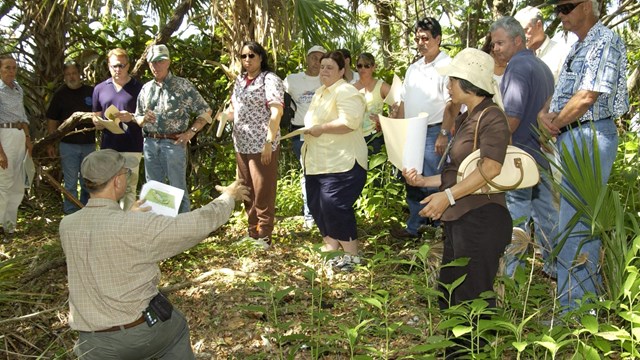
We used various metal detector brands during the survey, which covered about 5,000 square meters. Volunteer operators furnished their own machines, and this contributed to the variety of equipment. The standardization of machines (i.e., all one brand), though perhaps methodologically desirable, was highly impractical. Like models operate on the same frequency, causing interference at close intervals. We therefore needed to alternate different brands of machines on the line to ensure adequate survey coverage. Metal-detector operators were aligned at approximately 3 to 5 meter intervals. The operators walked transacts oriented to cardinal directions or, upon occasion, followed orientations dictated by topographic features. Orientation and interval spacing were maintained by direction from the crew chief. Because of the rough terrain, deviations in spacing were unavoidable. The daily composition of the detector crew ranged from five to eight operators.

Detector operators proceeded in line, using a sweeping motion to examine the ground. We estimate that each operator covered a sweep of 1.5 to 2 meters depending on individual height and technique. A pin flag was placed at each target located by an operator. As soon as the location was pinned, the operator continued along the transect. In some instances, the location was excavated immediately to provide the operator with a check on machine performance. This was occasionally necessary because of the sophisticated nuances of interpreting machine functions such as depth readings, metallic and object type-differentiation functions, object size interpretation, and pin pointing of subsurface objects. The usual procedure was to mark the location and leave it intact for the recovery crew.

Recovery

The recovery crew excavated artifact locations marked by pin flags and left the artifacts in place for recording. This team consisted of excavators and metal-detector operators. The number of operators and excavators varied from day to day depending on the workload.

Excavation procedure was based on the concept of artifact patterning, a central tenet in the research strategy. Provenience data - the location in space and the position in the ground of every artifact - were considered of primary importance. Excavation therefore proceeded with great care to expose artifacts without disturbance.

Hand tools, such as spades, trowels, and dental picks, were used to expose subsurface artifacts. Excavators were assisted by metal detector operators to ensure in-place exposure. Detector operators provided pinpointing and depth information to the excavator, thereby allowing a careful and accurate approach to the artifact. In some instances, accidental disturbance of the artifact occurred. Information to that effect was left at the artifact location to alert the recording crew. Artifacts were rarely found at depths exceeding six inches. After exposure, the pin flag was left upright at the location to signal the recording crew.

Recording

The recording crew assigned field-specimen numbers, recorded artifact proveniences, and collected the specimens. Recorders backfilled artifact-location holes upon completion. The crew consisted of an instrument operator, a rod person, and one or two recorders. Artifacts were assigned sequential field-specimen numbers beginning at 1000. Records were coded in the SDR33 data collector (System Data Recorder Model 33), and a hand written field-specimen catalog was also kept as a backup. The locational and catalog information was transferred from the SDR33 to a laptop computer daily.

Each artifact marked by a pin flag was piece-plotted as follows. The instrument was set up at an established datum point. Distance, azimuth, and coordinate point readings for each artifact location were recorded electronically. Distance was read to the nearest millimeter, as well as the north and east coordinate to the nearest second of a degree. The instrument operator transmitted this information to the recorders by portable two-way radio or by unaided voice. Recorders identified the artifact to the instrument operator who entered the appropriate artifact code in the SDR33. The recorders also entered the information in the catalog.

Testing Phase

Approximately 1,806 square meters of Monroe's Crossroads battlefield and the Monroe House site were tested using various methods (Table 1). Each test area was labeled alphabetically from "A to H." Exploration of every area was undertaken in several ways depending upon the specific nature of the study locale and the information sought in each area. Selection of test areas was based upon the data recovery goals of the project. These goals were to determine the presence or absence of Civil War-era burials and structures extant at the site during the battle. Exploratory methodology was quite varied, the method chosen for implementation depending upon the objectives of the investigation in each test area and the period available for work in that area. Six investigative techniques were implemented. These used various degrees of machine excavation and/or manual excavation and included machine scraping, machine trenching, manual shovel shaving, manual shovel probing, manual test excavation, and small-scale manual block excavation.

Machine Excavation Techniques

Machines offer the archeologist tools which can remove large amounts of fill quickly. Machines are the grossest tools the archeologists can apply to an investigation. Misapplied, they can do considerable irretrievable harm to an archeological resource. Applied correctly, however, machine excavation can allow the archeologist to assess and explore large portions of a site within a very short period and with minimum damage to the site's contents. Crucial factors in its implementation are a relatively short time frame for fieldwork in conjunction with a relatively large area to be investigated.

At Monroe Crossroads, all machine excavation at the site was conducted using a blade and backhoe mounted on a tractor. These tools were used in two ways. The blade was used in Test Area C to scrape quickly the upper 3 to 5 cm of soil from relatively large portions of a cemetery area. The resulting expanses open to view were then examined for soil stains in an attempt to locate Civil War-era grave sites or other cultural features. The backhoe was used to explore quickly a number of large cultural features. These trenches provided the archeologist with a view of the stratigraphy in each location. The stratigraphy provided clues to the origin of each feature. Backhoe trenching was carried out in Test Area H, a relatively large depression identified as a possible Confederate cemetery. The backhoe was also used to dig trenches across large linear depressions interpreted as possible historic traces of Blue's Road and Morganton Road.

Manual Excavation Techniques

  • Shovel Shaving
    This is a technique where thin horizontal layers of the ground are removed. In effect, the shovel is used to peel back layer after thin layer of soil. Often the area exposed to such treatment is more extensive than a small test or excavation unit, although shovel shaving can be used to remove fill from such units if their size, artifact density, and fill conditions warrant. The technique is implemented for a variety of purposes in archeological investigations. At Monroe's Crossroads battlefield, the method was directed toward exposing, identifying, and delineating soil stains or potential cultural features (in this case, graves) at cemeteries in Test Areas C, D, E, and F. Once these were identified, test excavations were usually implemented to provide more detailed information within a smaller unit of space.
  • Shovel Probe Testing.
    The exploratory tool of shovel probe testing allows the investigator a "quick and dirty" review of a relatively large area's overall contents. It provides less detail about horizontal distributions than shovel shaving, but much greater information is gleaned with regard to the vertical distributions of a site's artifacts and cultural-temporal components. The method is extremely useful because it can provide a considerable amount of information about site composition with little time and effort.

    Data derived through shovel probing can include evidence for artifact concentrations, feature locations, cultural/temporal composition, as well as the horizontal distribution of such elements across the site. This is the most exploratory of the manual investigative methods utilized in that it provides generalized information relating to "where" and "what" rather than specific information of intersite relationships that detailed archeological analyses require.

    As such, shovel probing is often the first procedure implemented where the ground is obscured by vegetation, the area of investigation is relatively large, and where the archeologist desires quickly to narrow the investigation spatially to maximize data retrieval.

    As befits the "quick and dirty" appellation, the method of shovel probing is quite simple. The excavator digs a vertical hole which is about the width of a shovel, 30-40 cm diameter. Fill from the hole is either troweled or screened through 1/4-inch hardware cloth to identify and recover any possible artifacts. Changes in fill texture and color and, where possible, the vertical levels of artifact recovery, are noted. The hole is excavated to a culturally sterile level (where no artifacts occur and/or where the fill ceases to be modified through human action). It is then backfilled.

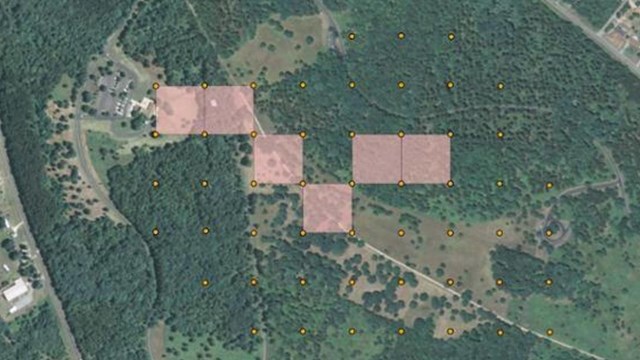
    At Monroe's Crossroads, shovel probing was used to explore Test Areas A and G. The general goal in Test Area A was to clarify the distribution of historic artifacts in the vicinity of the Monroe House and, if possible, identify the locations of structures associated with the Monroe House. The purpose of shovel probing in Test Area G was to recover locational information related to a line of sandstone interpreted as a possible structure foundation. In both areas, shovel probing was implemented in a non-random grid pattern.

  • Test Unit Excavation.
    Test units were excavated by hand in all investigative locations except Test Area G. This method of exploring a site is usually implemented where more detailed information than that afforded by shovel probing is sought but where time, funding, or investigative limitations preclude larger scale investigative methods.

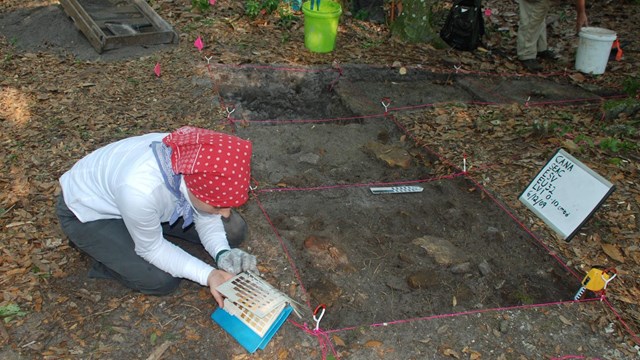
    Excavation units are invariably rectangular in horizontal plan and excavated in levels. This allows better horizontal and vertical control of information during the excavation by improving the level of mapping accuracy. It also provides the excavator with a somewhat larger spatial area from which to make inferences about human activity.

    At Monroe's Crossroads, test units were generally used where soil stains suggested that a burial feature might exist. An exception was in Test Area A where test units were used as a kind of large-scale shovel test in an attempt to locate structure edges.

    Each unit in an investigative area was labeled numerically from one to n. Although test units varied in size, they were invariably rectangular in outline and metric in scale. Excavation of these units used 20 cm levels with all fill from each level screened. The southwest corner of these units served as the mapping reference point (0N-0E). A string datum was established at this location and used as a 0.00 cm vertical reference point or datum. All depths were recorded in centimeters below that datum, e.g., -20 to -40 cm below datum (B.D.).

    Features encountered during testing were excavated separately from the surrounding fill wherever possible. Feature outlines were usually rather vague, however, a probable by-product of the sandy quality of the soils which exacerbated leaching of soil stains. Nevertheless, features were largely explored with trowels rather than by shoveling. Each artifact discovery was piece-plotted as it was encountered. That is, the position of each object within the test unit was mapped with regard to its horizontal and vertical distances from the unit's mapping reference point. In many instances, metal-detecting equipment was used to determine the locations of objects within the test unit prior to their excavation.

  • Small-scale Block Excavation
    This excavation technique was implemented only in Test Area A. This was the most intensive method utilized at Monroe's Crossroads. Block excavations provide the greatest detail of information with regard to intra-site associations of objects and stratigraphic units created through human cultural behaviors and natural processes. Although methodology can vary considerably depending upon the nature of the site and the investigative aims of the archeologist, it generally follows the methods employed with test unit excavations. The investigation differs only with regard to its larger scale, utilizing a number of contiguous rectangular reference units to explore a site. This greater scale makes it the most labor and time intensive procedure and returns a similarly greater mass of data.

    At Monroe's Crossroads, a small-scale block excavation was utilized to explore and examine a mound of bricks believed to be the ruins of one of the Monroe House's hearths. Because the specific location of the house and its orientation were uncertain, the goal was to ascertain the orientation of the hearth. In this portion of North Carolina, houses of the antebellum era often had hearths at opposite ends rather than in the interiors of the structures. Therefore, the orientation of the hearth would identify the orientation and location of one end of the Monroe House.

    Excavation proceeded using an arbitrary string datum similar to the method described for measuring depths from the surface. Removal of fill was accomplished largely by trowel due to the large amount of bricks and stone and the desire to leave them in place for mapping purposes.

Analytical Procedures

The methods employed in cleaning and analyzing the artifacts are the standard laboratory procedures of the Midwest Archeological Center. Essentially they consist of dry brushing or washing the accumulated dirt and mud from each artifact and then determining the condition of the artifact to see whether it requires further cleaning or conservation. For analysis and identification purposes, some metallic items required a treatment in dilute glycolic acid to remove oxides that had built up on them during the years they were in the ground. After cleaning, each artifact was placed in a self-sealing, clear plastic bag with its appropriate Field Specimen (FS) number and other relevant information on the bag. The artifacts were then identified, sorted, and analyzed.

The identification, sorting, and analysis consisted of dividing the artifacts into classes of like objects and then subsorting the artifacts into further identifiable discrete types. Sorting and identifying the artifacts were undertaken by personnel experienced with artifacts of this period. They compared the artifacts with type collections and with standard reference materials.

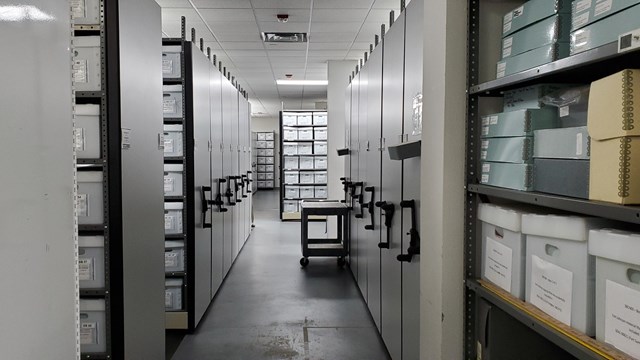
Presently the artifacts and original supporting notes, records, and other documentation are held at the National Park Service's Midwest Archeological Center. Upon completion of the project, the artifacts will be returned to Fort Bragg for collection, display, and for use in further scientific research.

Firearms Identification Procedures

A primary analytical tool of the project is Firearms Identification. The comparative study of ammunition components is known as firearms identification analysis. Firearms, in their discharge, leave behind distinctive metallic fingerprints or signatures on the ammunition components. These signatures, called class characteristics, allow the determination of the type of firearm (i.e., model or brand) in which a given cartridge case or bullet was fired. This then allows determination of the number of different types of guns used in a given situation.

Furthermore, the class characteristics allow the identification of individual weapons by comparing the unique qualities of firearm signatures (individual characteristics). This capability is important because, coupled with the precise artifact locations, identical signatures can be used to identify specific combat areas. This can be done with cartridge cases and bullets even though the actual weapons are not in hand. With this information, patterns of movement can be established and sequences of activity can be more precisely interpreted.

Law enforcement agencies have long used the investigative technique of firearms' identification as an aid in solving crimes. Two methods commonly used by the police include comparisons of bullets and cartridge cases (Harris 1980; Hatcher, Jury, and Weller 1977) to identify weapon types from which they were fired.

Police are routinely successful in matching bullets and/or cartridge case individual characteristics to the crime weapon simply by demonstrating that the firing pin, extractor marks, or the land and groove marks could have been made only by a certain weapon. In the event that weapons used in a crime are not recovered, police can say with certainty, on the basis of the individual characteristics of recovered bullets and cases, that specific types and numbers of weapons were used.

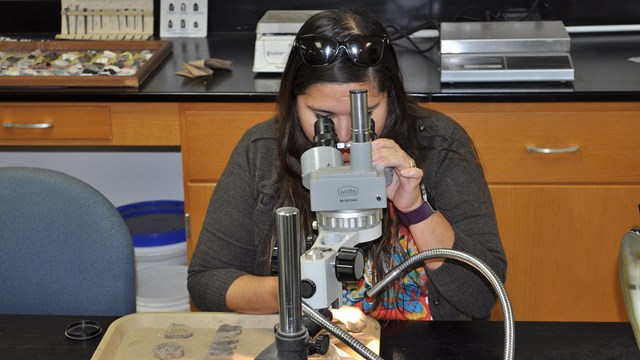
The comparison microscope is critical to the analysis of ammunition. Simply, the microscope is constructed so that two separate microscope tubes are joined by a bridge with prisms mounted over the tubes. Two separate images are transmitted to the center of the bridge where another set of prisms transmit the images to central eyepieces. The eyepieces are divided so that each image appears on one-half of each eyepiece. Movable stages allow the objects under scrutiny to be manipulated so that they can be directly compared for class and individual characteristics.

All cartridges, cartridge cases, bullets, and other ammunition components were analyzed utilizing these firearms' identification procedures. The specific results of the analyses are discussed in the artifact analysis and interpretation chapters.


Chapter 3 - The Battle and Land Use of Monroe's Crossroads

Table of Contents