ARCHEOLOGY AT F.E. WARREN AIR FORCE BASE

       Long before military families pulled their travel trailers into F.E. Warren Air Force Base's FamCamp, Native American families pulled their travois into similar areas. Native Americans began camping in the base area as long as 11,500 years ago. As the town of Cheyenne developed around the base, the area served as an important preserve for these sites.
 
 
Left: Early PaleoIndian Clovis projectile point from about 9,500 B.C.
 

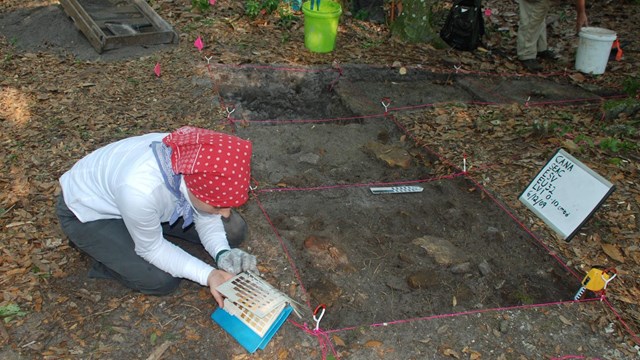
Even on the base, however, day-to-day activities can destroy the remains of previous inhabitants. One of these partially destroyed sites is the FamCamp Archeological Site. The north end of the site was destroyed by the railroad, the east side by an access road to the railroad, and the west by a quarry. Still, from this small site remnant, archeologists can examine the activities that earlier campers carried out at the site. From the information found at archeological sites on the base and in the surrounding area, we can try to understand the human balance with the environment since the last glacial period. When a site is destroyed, unique information is lost that would have added to our knowledge about human interaction with the environment.

Artist's conception of a Wooly Mammoth
PaleoIndians (10,000 B.C. to 6,000 B.C.)

       As the glaciers to the north retreated, much of the Crow Creek area was covered in boreal forest. The summers were cooler than present, but the winters were warmer and less severe. The first people using the base area were small groups of very mobile PaleoIndian hunters. They camped, hunted, fished, and gathered plants for a variety of uses. Large mammals, first mammoth and then bison, were killed in the late fall or early winter to procure meat for use during the long winters. By killing the animals in the early winter, caches of meat could be frozen. The stored meat would help feed people until spring when edible plants began to grow again and small mammals came out of their burrows and nests and could be hunted.

Archaic Cultures (7,500 B.C. to A.D. 500)

       From about 7,000 to 5,000 B.C. the climate was much warmer than today. The Central Plains supported fewer people than before and these people concentrated their camps around water sources and perennial streams. People near the mountains, such as those in the area of the present-day base, probably spent greater parts of the year in the higher elevations, returning to the plains for the cooler seasons.

       After about 5,000 years ago, the climate began to be similar to the present climate. Relatively minor climatic changes, however, continually affected the human population as they do today. About 5,000 years ago, a number of new artifacts appeared in the mountains and plains of Wyoming.  In fact, so many new traits appeared so quickly that most archeologists think new people moved into the area. Archeologists call this the McKean Phase. McKean people used large pits, filled with rocks, to roast foods, par-ticularly plant foods. They also used seeds and bulbs more intensively than previous peoples, although McKean artifacts are also frequently found at sites where bison were slaughtered and butchered. Evidence of the McKean people disappears about 3,000 years ago.

Left: Late Archaic Pelican Lake projectile point

       The Pelican Lake Phase succeeded McKean in most of Wyoming and the Pelican lake lifestyle may have evolved out of the McKean lifestyle. These people continued to depend on both hunting and gathering plant foods. with the hunting of bison of particular importance in the plains.

Woodland and Late Prehistoric Cultures (A.D. 500 to A.D. 1500)

       The next several thousand years saw further increases in plains populations. Innovations in weaponry and food processing allowed increasingly efficient exploitation of the environment to support these people. About 1,500 years ago, the spear-thrower was replaced by the bow and arrow. Also, there is evidence of pemmican production during this period. Pemmican is a form of dried meat mixed with berries which lasts for a long time and is highly portable. Finally. teepee rings are a common archeological feature during this period, suggesting that the familiar skin teepees were in use. During this period, the the archeological site near the FamCamp was used.
View interpretive oil painting of the archeologically revealed Plains Woodland scene at the on-site FamCamp Archeological Center. 

  Above: Ceramic pots like this one may have been used at the FamCamp Archeological Site

THE FAMCAMP SITE


Above: Antelope bones were found by archeologists at the FamCamp Site. These
  modern Pronghorn antelope were photographed at the site in 1991.

       The FamCamp archeological site was used during the Late Plains Woodland. These people made their living by hunting and gathering plant foods, but used ceramics similar to that of the nearby groups that also farmed. A hearth at the FamCamp site was dated by radiocarbon to about A.D. 650. The projectile points found at the site are styles that also date to this period at other sites. Two pieces of ceramics were found at the site, parts of a pot broken during use at the site.

       Antelope and bird bones were found at the site, suggesting that both were hunted from this location. The tools and bones found suggest that the antelope may have been killed and butchered elsewhere and only select portions of the animal processed on site. Much of the antelope meat was probably eaten at the time of the kill. The bones were smashed and boiled to release the bone grease, possibly to make pemmican. Extra meat may have been dried to add to the food stores. Bones of smaller mammals, possibly rabbits or squirrels, were also found. These animals may have been trapped or snared near the site and both their meat and hide were important. Berries and goosefoot and pigweed seeds were also found in the hearths, suggesting that these were also eaten.


Right: Projectile point found at the 
  FamCamp Archeological Site
 

       People at the FamCamp site probably moved from the plains in the winter to the mountains in the summer. The FamCamp site is likely a spring or fall site in this pattern. In the spring, people used Crow Creek as a travel corridor, moving into the mountains for the cooler summer weather. Also, because the growing season in the mountains is delayed, plants ripen later in the season. In the late summer and fall, people would move out of the mountains. They would assess their food stores for the winter and they concentrate on gathering sufficient food and providing the clothing and shelter needed for winter survival.

       The FamCamp area is a poor location for a long winter camp because of the lack of firewood in the area. The cottonwood trees presently lining the creek are recent additions as they were planted during the military history of the base. Archeological analyses of pollen collected from the site suggests that willow and berry bushes were the main woody plants in the immediate area, and neither make good firewood. It is likely that dung was frequently used for fuel in the base area. Places with large trees,  such as nearby Pine Bluffs, would make a better winter camp location.

       The story of the prehistory of the F.E. Warren Air Force Base is the story of human interaction with the environment. Through time, increasingly efficient means of exploiting the resources supported increasingly large human populations, which in turn had an increasingly dramatic effect on the environment. These are trends which continue today and our study of the past helps us to better understand today's problems.

PLEASE REMEMBER:

  • Archeological sites are fragile resources that are easily destroyed. Collecting artifacts damages the information in sites and, in some cases,  makes it impossible to understand the story that  archeology can tell about the site.
  • Collecting either historic or prehistoric artifacts from federal land is also illegal. Please report anyone that you see collecting to the base police or to the address below.
Also see: For further information, contact: Richard Bryant, Archeologist, Environmental Management Office, 300 Vesle Drive, F.E. Warren Air Force Base, WY 82005, phone: (307) 773-3667, fax: (307) 773-4153, e-mail: richard.bryant@warren.af.mil.

Return to SEAC Publications