National Park Service
2035 E. Paul Dirac Drive
Johnson Building, Suite 120
Tallahassee, Florida 32310 phone (850) 580-3011
fax (850) 580-2884 Webmaster: John Jameson
john_jameson@nps.gov

Winner of the National Park Service Keeper of
the Light Award
Interaction and Exchange Among Prehistoric Caribbean Societies, St. Croix , U.S. Virgin Islands (Cont'd)
They made grinding, pecking, chopping, and cutting tools out of stone, shell, coral, bone, and wood, into forms such as awls, knives, flake tools, bone points and harpoons, hooks, metates, grinding stones, adzes, celts, and hammerstones. Other artifacts associated with Saladoid culture and daily life activities include carved shell masks, pendants made of shell and turtle bone, stone net sinkers, and ceramic spindle whorls used to spin fibers into thread. They weaved baskets out of grasses and leaves, and made cloth, nets, and other objects from native cotton and possibly other plants.
There is evidence for extensive circum-Caribbean and interisland trade networks among the early Saladoid cultures in the form of a far-reaching lapidary industry using exotic materials.
These people participated in broad networks of interaction, communication, and exchange of information and goods that maintained and continued traditions of pottery making and decoration. These communication and trade networks also moved stone objects made from materials not available locally. Over time, there was a gradual divergence of series and styles into regionalized traditions that developed within growing local and regional interaction spheres.
By around A.D. 600, political and economic fragmentation resulted in a massive reorganization of the forms of leadership and social status that eventually developed into the hierarchical chiefdoms of the later Ostionoid period (ca. A.D. 1200-1400), commonly referred to as the Taíno. As populations increased and villages either grew or budded off, a need for further self definition of in-group status membership developed. The growing of manioc and using of clay griddles remained a mainstay of Ostionoid subsistence, but new agricultural practices were developed and adopted. During this time, villages became hierarchically ordered, but the basic settlement pattern remained the same. Some villages remained small and may have served as agricultural hamlets or activity camps while others grew to be regional centers of power.
The ancient communities of the Caribbean should not be thought of as a single, massive society, following a single ruler or even sets of rules. Instead, they should be viewed as separate villages and tribes linked together by similar belief systems, world views, and practices and activities. Even those who lived on a single large island, like Puerto Rico or Hispaniola, were divided into many different communities, where they formed alliances, waged battles, and followed different leaders.
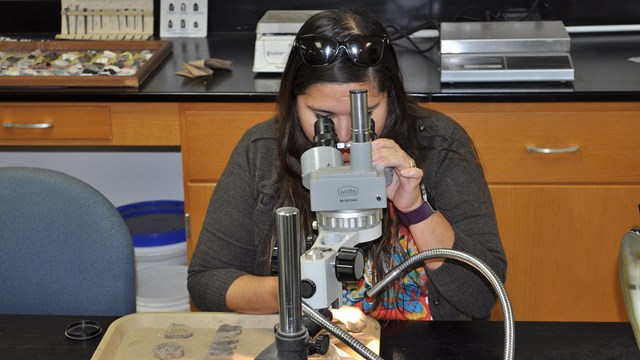
There have been many unanswered questions surrounding both the production of pottery and the movement of finely carved stone objects, how objects with very similar styles came to arrive on the islands, and how these styles changed over time on most of these islands. It has long been assumed that these ancient societies and communities interacted with each other, sharing knowledge, advice, and even gossip. These communications would account for similar changes in style and production in many kinds of goods, such as pottery, stone, and even carved shell and bone. But did these people move objects themselves? Did they trade pottery and stones, did they take things with them and bring home other goods? These are the kinds of questions that are best addressed through controlled, scientific studies that produce undeniable answers. Chemistry studies on objects made from stone and clay (geochemistry) can produce such answers.
Chemical studies of pottery from across the Caribbean have yielded evidence that the movement of goods between islands is nearly constant, through both prehistoric and colonial times (Carini 1991; O’Connor 2001; Potter 1996). In general, these studies found, through an array of techniques, including proton induced x-ray emission (PIXE) and x-ray diffraction (XRD), emission spectrography, infrared absorption spectrophotometry, x-ray fluorescence, petrographic microscopy, and electron scanning microscopy, that while some ceramics were traded between islands, others were used in close proximity to where they were produced. There have also been few compositional studies of lithic materials recovered from these archaeological sites. Dr. Hardy’s study was an attempt to answer these questions specifically on the ancient societies of St. Croix.
Next. . .
Back