AN APPROACH TO VANDALISM OF ARCHEOLOGICAL RESOURCES

Ray A. Williamson and Fred M. Blackburn


Abstract

This paper examines the role of public education in archeological sites. In particular, it explores the part avocational archeologists and other interested laymen can play in protecting and preserving cultural resources. These individuals, many of whom are located near the archeological resources, constitute a small but highly influential subgroup of the public. They form the core of the non-professional public that is knowledgeable about archeological preservation. Although our experiences relate particularly to the Southwest, the lessons they provide for educating the public apply to any geographical region.


Despite a variety of laws designed to prevent the loss of U.S. cultural resources from theft, including the Archaeological Resource Protection Act of 1979 (16 U.S.C. 470aa et seq.) and its associated regulations, vandalism and pothunting are taking an increasing toll on archeological resources, especially in the Southwest (Bassett 1986; Goodwin 1986; Hill 1986). In parts of the Southwest, depressed economic conditions and the high values collectors place on prehistoric pottery, projectile points, and other artifacts have contributed to the losses already suffered each year as a result of energy and housing development, road construction, erosion, and neglect (Wildesen, 1982). Indiscriminate, deliberate destruction of sites has also become a problem as increasing numbers of people have mobile access to previously inaccessible areas. The impacts on public lands are particularly acute.

What can be done to prevent or inhibit the ravaging of archeological sites? In its study of the role of technology in archeology and historic preservation, the Office of Technology Assessment (OTA) (1986:101-104) examined a number of methods for protecting cultural resources from deliberate destruction (Table 1).

TABLE 1

Technologies and Methods for Protecting Sites from Deliberate Destruction

  • Use of protective barriers to restrict entry (fences, gates and boulders)
  • Use of interpretive signs
  • Permanently affixing large historic artifacts or monuments
  • Use of informants and secret witnesses
  • Use of unarmed rangers
  • Use of electronic monitoring devices
  • Use of alarm system

Although such preventative methods are more or less successful, depending strongly on funding and the availability of personnel, OTA found that public education was among the most effective methods for prevention (OTA 1986:ch.6) because only education can alter the climate of public opinion that exists in and near the communities where vandalism occurs most frequently.

The Preservation Message and the Public

Concern for the preservation of cultural resources must come from a variety of directions—from public officials and the law enforcement community to just plain folk. Table 2 enumerates groups with a potential interest in preserving U.S. cultural resources. They constitute the public that archeologists must reach in order to improve the nation's ability to preserve cultural resources for the future.

TABLE 2

Components of the Public

  • Avocational archaeologists, many of whom are members of state and local archeological societies, have a clear interest but they may need a focused high-level program to maintain it.
  • Local civic associations provide a forum for the preservation message as well as a target audience.
  • Collectors of artifacts are an important segment of the public that needs to understand and appreciate archeological methods and the context for the items they collect.
  • Educated lay people, often energetic and intellectually curious, are potential avocational archeologists; more important, they are enthusiastic couriers of the conservation message.
  • Historic preservation associations provide a forum for historic preservation programs and outreach to a broader public.
  • Legal professionalsjudges and law enforcement officials—need to understand the legal basis of, as well as the need for cultural resources protection.
  • Park (federal, state, local) visitors, many of whom are predisposed to hear a conservation message, can be educated to think about conservation in a wider context than a particular park or region.
  • Professional archeologists, surprisingly many of whom are unaware of the extent of looting and vandalism, obviously have a major stake in reducing loss of archeological resources.
  • Public officials are particularly important as they make decisions every day that affect the protection of archeological resources.
  • School childrenmillions of children—visit archeological sites each year; the messages they receive at the site, in school, and in the media will form their attitudes toward cultural resources and archeology later in life.
  • Urban public, to whom the proximity of archeological sites causes special concern, have many avenues open to them for education about archeology and conservation.

The educational task facing archeologists and other professionals involved in preserving our cultural heritage is to change public attitudes toward our cultural resources, whether historic or prehistoric. Each of these "publics" requires a different approach, yet the message is the same—looting and vandalism of archeological sites impoverish us all. Such activities rob us of scientific information about past cultures and of part of America's heritage. In short, losing cultural resources through vandalism and looting severely diminishes our quality of life.

Archeologists face three main tasks. They must:

1) educate people to understand the nature of fragile cultural resources and the rate and extent of losses;

2) help the public develop a stake in solving the problem;

3) encourage the public to become active in protecting cultural resources.

Because changing people's attitudes involves social change, and social change is by its nature generally slow, each group must be approached in a distinctive way. We believe that for avocational archeologists and educated lay persons, the most effective way to approach these tasks is by helping them experience archeological sites and artifacts directly in the original environmental setting. To that end, we have experimented with integrating an informal program of education about cultural resources protection into our research programs. As will become clear herein, involving our research participants in the preservation of cultural resources develops as a by-product of our research and generally is a matter of self-discovery.

Experiences in the "Outdoor Museum"

During the past ten years, we have collaborated on programs of research and education in the Four Corners area where Arizona, Colorado, New Mexico and Utah meet (Williamson and Blackburn 1985). Williamson's research interests have focused primarily on Anasazi and Navajo astronomy (Williamson 1987). Blackburn has pursued a long-term "reserve archeology" project to recover the provenience of thousands of artifacts taken from southeast Utah's Grand Gulch in the late 19th and early 20th centuries, now housed in collections throughout the United States and in other countries (Blackburn 1988).

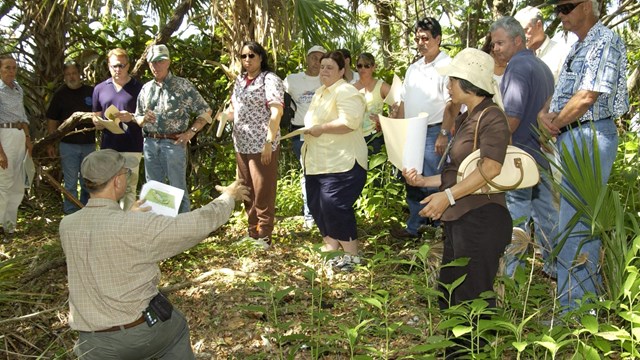
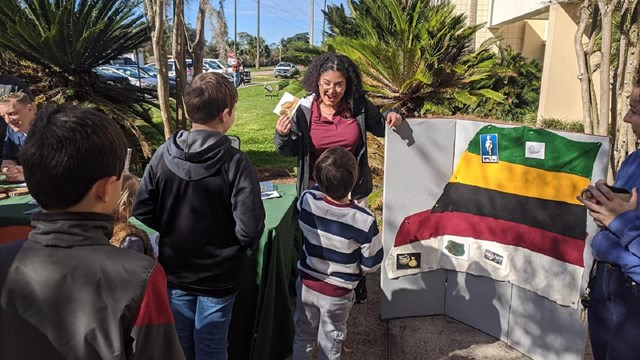
Both of us have a keen interest in exploring and preserving the myriad cultural resources of the Four Corners and introducing interested lay people to the natural and cultural resources of the "outdoor museum." As we use it, the term outdoor museum has three levels of meaning. It refers geographically to a place or region, but it also refers to an environmental setting and a state of mind. The outdoor museum in which we have worked is the vast open lands in the Four Corners region. Participants in the outdoor museum experience the total archeological environment, which includes the natural surroundings as well as sites and artifacts. Instead of passively reading captions in a contrived exhibit, visitors to the outdoor museum become actively involved in the discovery process. Their ability to see, touch, or smell artifacts in their natural setting draws them into the excitement of learning about past cultures.

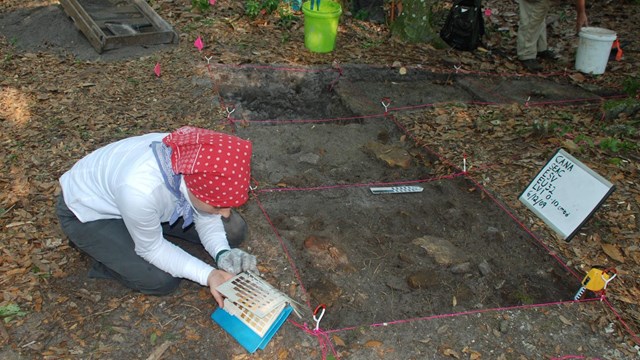
The nature of our research demands a large degree of survey, measurement, and documentation. A typical project lasts approximately five days, and involves from 12 to 18 individuals. Participants, especially those who are new to the region, generally spend the first two days learning to "read" the landscape for clues for cultural remains, and building a group identity that sustains them for the remainder of the project. By then, most participants are able to contribute to the project by keeping field notes, drawing sites, or making maps. We place strong emphasis on observation and recordation. Mapping is especially important. As they work, participants observe and begin to ask questions.

Although our primary focus in these programs is on a specific research topic such as the detailed examination and documentation of a basketmaker cave in Grand Gulch or the astronomical survey of a group of Anasazi dwellings, we place considerable stress on exploring the effects of natural and human agents on the sites we study. We attempt to involve participants in a dialogue about the relationship of different cultures to the land, and how these cultures have changed it over time.

For example, one of the southeast Utah sites we have documented in the course of other work is a cave that was first occupied by Anasazi, who seem to have used it as a temporary shelter when hunting game or gathering seeds. Centuries later it was discovered by cowboys who made it a regular campsite. These cultural groups apparently recognized the relative comfort this cave afforded both summer and winter. That two such disparate groups, separated in time by hundreds of years, found the same site attractive, intrigued our participants and sparked a lively discussion about the natural resources available locally. It also engendered a spirited debate over the removal of historic artifacts. To several of the participants these seemed of less importance than the Anasazi remains. Others argued that the historic remains might even be more vital because they were an important record of cowboy life 80 to 90 years ago. Finally, the group reached the conclusion on its own that all the artifacts should remain in place.

Although we enter into these discussions for the sake of educating our research participants, we observe a strict code of conduct while in the outdoor museum. No artifact, no matter how unusual or valuable, is removed from the site. To archeologists this may seem obvious, yet some newcomers to the cultural riches of the Four Corners have a difficult time observing this rule, despite the strictures of federal law. For people used to pocketing small objects of interest, the collecting instinct dies hard. We use discussion and questioning to help participants draw their own conclusions concerning preservation.

Occasionally, participants may find an object of great artistic or archeological value. We examine, photograph, and measure the object, and then replace it as close to where it was found as possible. In some cases, it is necessary to make a special effort to hide the artifact. In all cases, we leave a note with the artifact explaining that it was deliberately left in place. The task of replacing artifacts always generates discussion. What should we do with such finds? Won't they be safer in a museum where someone can care for them?

The answers to these and other questions are sometimes difficult to reach, especially if the artifact is particularly unusual or valuable. Nevertheless, in some ten years of educational projects, we have only removed two or three items to a museum setting, and then only after it became clear that they might be threatened by acquisitive travelers in the outdoor museum.

Because most of these projects require several days in the field far from urban amenities, participants have lots of time to discuss the questions posed by the outdoor museum. We make a special point of bringing up these topics around the campfire after dinner. Short readings, stories, and discussion raise additional questions about the sites.

Effects on Participants

As a result of potential participants' vacation schedules, most of our research excursions take place throughout the summer months. Not everyone finds the experience of hiking through the canyons on a hot summer day, confronting clouds of "no-see-ums," and still trying to document a site, fulfilling. Yet most do and come away from the experience with a new sense of themselves and a better understanding of the fragility of the archeological resources.

Participants in our research seminars often proceed through three states of discovery with respect to their own attitudes toward cultural remains. First, they discover for themselves, in the setting of the outdoor museum, that a serious problem exists. After several days of observation, discussion, and documentation, they see that archeological sites are disappearing fast, many as a result of pothunting, malicious vandalism, intense visitation, or just plain thoughtless collecting. Second, after investing several days in documenting the condition of the sites, they become personally involved. They are well aware that by assisting in the documentation of the sites and adding to the database about them, they are already participating in the preservation process.

Finally, they begin to ask how they can become more involved. Many participants answer their own question by taking part in other archeological programs, perhaps those involving excavation. For a few, it may even mean going back to school. More than one individual has found direction for choosing a university program by participating in one of our research projects. We urge participants to take the preservation message back to their own communities and to become involved in historic preservation where they live.

Effects on Local Community

Changing the attitudes of the local community is an extremely important component in the drive to improve the climate for preservation of our national patrimony. As Nickens et al. (1981) noted in their study of attitudes about looting and vandalism of archeological sites, local people can be fiercely protective if they feel they have something important to lose from their communities.

The effects of these research projects on the local community are more subtle and difficult to identify clearly. Although we draw some participants from the region, most are from the urban centers, drawn to the experience as a change from urban life. Therefore, we directly affect the opinions of relatively few local inhabitants.

Perhaps the strongest effects derive from articles in the local newspapers about our research and from public lectures that we give in the local community. In addition, the participants spend time in the small towns surrounding the sites before and after their research experience. They contribute to the local economy and often explain to the shopkeepers and motel operators why they are in town. Finally, in planning and stocking our expeditions, we make a point of using local suppliers who gain financially from the influx of new business. This "trickle-down" effect is sometimes troublesome because local people tend to be suspicious of outsiders, especially those who might be seen as trying to give them advice. Nevertheless, in our experience, the purely economic benefits are beginning to be appreciated and have an effect on changing local attitudes toward the value of preservation.

Conclusions

The United States is in a crisis situation with respect to maintaining our cultural heritage. The primary task we face as individuals concerned about the protection and preservation of cultural resources is to change public attitudes about what is there to be preserved. Affecting people's attitudes and habits is difficult and takes a long time. Yet, our experiences have convinced us that this is one of the most effective ways to tackle the problem, especially in communities where sites on public lands are relatively easy to reach.

Our program demonstrates that serious problems with looting, vandalism, and general neglect exists. Participants cannot ignore them because the effects of looting and vandalism are obvious, pervasive parts of the landscape. Second, participants develop a natural stake in preservation through participation. They have assisted in documenting and interpreting the sites we visit, and they are mentioned in our published papers. Finally, people often ask what they can do. As noted above, we encourage them to become involved and to share their experiences with others from the local community and in their own communities at home. Many of them do.

Our efforts are only a small part of what can be done. Other educational programs, some focused on more traditional archeological approaches, make their own contribution to altering local values. We are all learning to be more effective as we proceed. As we look to the future, it will be important to relate programs in local areas to the broader regional, national, and international context. We also need to reach a broader group of participants. Finally, our work has focused on public lands. Although vandalism and looting of public lands has received most of the attention in the Southwest, archeological sites on private lands are just as important. Better education should protect them as well.

Recommendations

1) More archeologists should become involved in educational programs that reach the various publics. This can take a variety of forms, from giving public lectures to writing for popular journals. The story of archeology fascinates and finds a ready audience.

2) Archeologists should involve more of the public in their research. This takes considerable effort as willing but untrained amateurs can inflict substantial harm on a site. Nevertheless, amateurs have a lot to offer in labor and even insights on the research problems at hand. In our research, we have developed a strong respect for the amateur and what he or she can provide.

3) Archeologists should especially involve local avocational individuals and groups. Avocational archeologists can make substantial contributions to a research project. Involving local individuals helps to promote local pride in local sites.

4) Archeologists should make a special effort to educate local, state and federal public officials, including law enforcement agents, about the nature of archeological research. It should be possible to arrange a series of short educational trips that would bring these officials into contact with cultural resources. Archeologists need to become more politically astute.

5) Traditional indoor museums should help sensitize museum visitors to the concerns of preservation in the outdoor museum. Museums reach a lot of people, yet the preservation message is seldom dealt with; it is as though they have no stake in the problem.


This paper derives in part from the OTA report "Technologies for Prehistoric and Historic Preservation." However, the views expressed herein are the authors' own and do not necessarily represent the view of the Office of Technology Assessment, the Technology Assessment Board, or the Congress of the United States.


References Cited

Bassett, Carol Ann
-1986 The Culture Thieves. Science '86, July/August, pp. 22.29.

Blackburn, Fred M.
-1988 "Current Programs in Southwestern Archaeology: Needs for Community Involvement." Presented at the International Symposium on Vandalism: Research, Prevention and Social Policy, April 20-22, 1988, Seattle, Washington.

Goodwin, Derek V.
-1986 "Raiders of the Sacred Sites." The New York Times Magazine, December 7, pp. 65-87.

Nickens, Paul R., Signa L. Larralde, Gordon C. Tucker, Jr.
-1981 A Survey of Vandalism to Archaeological Resources in Southwestern Colorado. Bureau of Land Management, Colorado, Cultural Resources Series, Number 11.

Office of Technology Assessment
-1986 Technologies for Prehistoric and Historic Preservation. U.S. Government Printing Office, Washington, D.C.

Robbins, Jim
-1986 Sacking an Ancient Culture. High Country News, August 16, pp. 1, 10-13.

Unknown
-1987 Living the Sky: The Cosmos of the American Indian. Norman, Oklahoma: University of Oklahoma Press.

Williamson, Ray A.
-1987 Technology and Archaeology. Presented at the May 1987 Meeting of the Society for American Archaeology, Toronto.

Williamson, Ray A. and Fred M. Blackburn
-1985 "The Living Earth and the Outdoor Museum." In Is the Earth a Living Organism? James Swann, ed. Audubon Expedition Institute.


Return to the Table of Contents