|
Shortly after the Friends of Historic Snee Farm, Inc. donated the plantation to the National Park Service, Blaine Cliver, Historic American Buildings Survey conducted a brief study of the house to assess its condition and determine if any immediate stabilization work was needed. His study determined contrary to the widespread belief, that the house had not been constructed until about 1830, more than a decade after Charles Pinckney had sold the plantation to Francis Deliesseline. As a consequence of this discovery, the Friends of Historic Snee Farm, Inc. with the Park's cooperation, hired a group of architectural experts and an archeologist to undertake a more detailed independent study of the structure to determine its date of construction. The experts concluded that Cliver's assessment was correct.
![]() The Search for Charles Pinckney's Big House Preliminary Investigations Thus in the autumn of 1992, we had no Charles Pinckney house and no clear historical evidence of where to begin unraveling the mystery of the lost plantation. Historic land plats were not particularly helpful in understanding the built environment because they lacked the necessary detail for the period of Pinckney ownership. Although patented by 1696 and perhaps settled as early as 1685, the earliest existing plat of Snee Farm was drawn in 1738. Unfortunately, it shows only the boundary of the plantation. A sketched plat map prepared for Francis Deliesseline in 1818 provides some information on land use and roads in the vicinity. The earliest plat with convincing architectural detail was prepared for William Mathews in 1848. Unfortunately, no plat has been discovered that records the plantation when he purchased it in 1828. Extensive archeological investigation was the only way to find remains of the Pinckney era at the Park. SEAC's Investigations Begin in Earnest Structure 12, built as a cotton gin in the
1870s, was excavated in February of 1992 because it was situated where
the visitor parking lot was to be located. SEAC's search for Charles Pinckney's
plantation English tableware, cutlery, wine bottle glass, windowpane, nails, bone, and tobacco pipes were among the more than 20,000 items recovered from the 13 X 30 feet kitchen. Two wine bottle seals, one embossed with "C PINCKNEY 1766" the other with "C Pinckney"; provided indisputable evidence that the kitchen was used by the Pinckneys. A 1722 English coin, and Spanish eight reales coin dating from 1746-1788 indicated this structure probably formed part of the plantation prior to Pinckney's ownership. The mean ceramic date calculated for all excavation units associated with the kitchen was 1781; the mean ceramic date calculated for debris lying on the floor was nine years earlier or 1772. Approximately 30 feet northeast of the kitchen, we exposed the foundation of a slave quarters discovered by Brockington in 1987. This building measured 15 x 23 feet with a 4.5 feet fireplace extension on the south side. It was probably constructed during the first half of the 18th century and may have functioned as a valued house slave's or perhaps the overseer's house. An assortment of buttons (ranging from sleeve to military coat buttons) indicates that it was occupied by Confederate and subsequently Union troops during the Civil War. The date of its destruction has not been determined but it certainly occurred before the 1920s. The mean ceramic date of 1818 was calculated for this structure. This date would be much earlier if it had been razed at the same time as the kitchen. As it was not torn down at that time; it must have been in better condition. Architectural evidence and analysis of materials from a small building allow us to conclude that it was a smokehouse measuring 11 X 15 feet. It was built after the Pinckney kitchen was torn down. The second slave cabin, measured 12 X 16 feet and sat on six brick piers. This structure was constructed in the 18th century, and like the other slave cabin or overseer's house it had been leveled by the 1920s. By the end of 1993, it was clear that the East yard contained four structures. Three of them; the kitchen and two houses (Structures 13, 14, and 16) were used during Pinckneys' ownership. It was also clear by this time that none of the structures in the East Yard were the remains of the Pinckney Big House. The presence of what we initially interpreted as a privy north of the standing residence and the enigmatic Feature 104 discovered in 1991 led us to further examine these areas. The privy turned out to be a well. The initial test pit excavated in 1992 produced a variety of artifacts dating to the 18th and early 19th centuries. The presence of later material in the unit is not surprising as the Hamlin family constructed a lean-to kitchen at the back of the house at the turn of this century. The addition of the northeast wing in the 1930s and the placement of flower beds around the northeast wing by the Ewing's introduced even later materials and disturbances to the soil column. Excavation of the well was completed in April 1995. It was packed with wall plaster that came from the razing of a rather elaborate house. The larger part of a polychrome Delft charger, a silver demitasse spoon engraved with Charles and Francis Pinckneys' initials and a wine bottle seal imprinted with the word "Pinckney" were recovered confirming the association of the well with the Pinckney era. An 1826-penny recovered from the upper portion of the well indicates it was filled in 1826 or shortly thereafter. The contents of the well provide clues regarding the character of 18th
century plantation house. It must have been imposing as it was plastered,
the coin indicates the date of its destruction and a limiting date of construction
of the existing plantation house. It is likely that the existing house
was constructed early in Mathews' tenancy of the farm shortly after 1828.
Artifacts of special note Conclusions drawn from this work were that the main house, the kitchen and the well were in use during the same period; they were associated with Pinckney ownership and were destroyed at the same time. Excavations north of the well did not disclose any structural remains, i.e., no Big House, and indicated that the frequency of 18th century artifacts decreased in that direction.
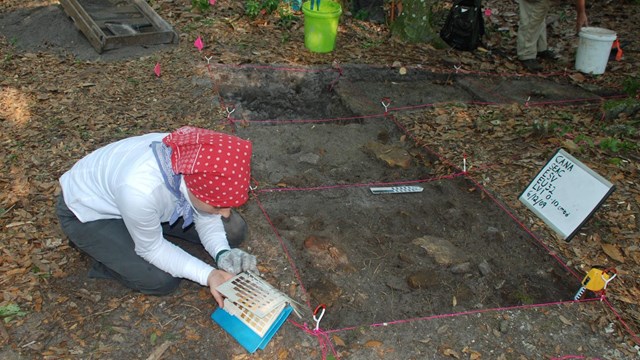
![]() Another possible location of the 18th century Big House was the area around Feature 104. Considerable attention and care were given in uncovering this area because small pieces of wall plaster were recovered during the 1991 trench excavations in this area. It seemed that an imposing building once occupied this area. Perhaps the Pinckney residence? Structure 11
In addition to Structure 11 excavations, two excavation units were opened under the currently standing south porch. This was done in order to confirm Julia King's and Ken Wild's hypothesis that this current structure was built over the debris of a razed 18th century structure, quite possibly the main house of the Pinckney era. Unfortunately these two excavation units did not contain any evidence of architectural features. The extensive excavations in this area demonstrated that Structure 11 was quite small for a planter's residence. It measured only 15.25 X 23.5 feet; hardly the comfortable place where General William Moultrie and Colonel Charles Cotswoth Pinckney were paroled after the fall of Charleston during the Revolutionary War. In 1997, as we proceeded with the analysis of the material, Keel began to have misgivings regarding the hypothesis that this was the major 18th century residence. Although the mean ceramic date for the structure area was 1779, the problem was that datable items, a 1722 Rosa Americana penny and a wine bottle seal impressed with Simon Gowen 1726, placed the use of the building earlier in the 18th century. We recovered a 1772 George III penny resting directly on top of one of the piers (Feature 320) which indicates that this structure was razed by that time. Additionally, we had to conclude that the ornately constructed Feature 104 was not part of Structure 11. Finally, the location and distance of 175 feet from this dwelling to the well and 135 feet to the kitchen (Structure 13) would not be convenient for service to a primary residence. In order to resolve the perplexity of Structure 11 and Feature 104, excavations were conducted in the Spring 1997.A formal excavation of the slave village was also scheduled to take place during this season. Further investigation of Structure 11 revealed a series of features which were originally part of the west wall of the structure. Removal of upper levels of rubble provided additional information regarding the layout of the structure as well as events that occurred after its destruction. Additional testing for the 18th century main house was also conducted in the yard directly south and southeast of the currently standing Visitor's Center. No structural features were present, but several pit features containing historic artifacts were revealed. Testing during this season provided information which indicates that there are no intact foundations east or south of the currently standing 19th century structure, in addition there are no 18th century deposits north and west of the house. These result of these investigation indicate that perhaps the hypothesis that the main structure of the Pinckney era is buried under the existing 19th century house is correct. The rest of the spring 1997 season was spent testing the slave village. Several shovel tests were conducted in expectation of locating additional slave cabins. Two possible features were encountered along with historic ceramics, colonoware, agricultural items and Native American ceramics.
Results from the previous season's work suggested that further excavations
be conducted underneath the currently standing structure. Investigations under the house continued during September 1-11, 1998. Nine excavation units (260 ft2) revealed a substantial portion of a large pit (profile view). This pit measures 30 ft East/West and at least 7.5 ft North/South.. Recovered materials consist of 18th and 19th century ceramics, nails (wrought and cut), container and windowpane glass, pipe stem and bowl fragments, faunal remains, charcoal fragments and 7113 pounds of rubble. Plaster samples and delft tiles with painted surfaces were also recovered during these investigations. The patterns painted on the Delftware fireplace tile was popular from 1650 to 1800, so it is reasonable to suppose that the structure or at least the fireplaces were constructed sometime between the late 17th century and the beginning of the 19th century. This information indicates that a sizable structure once stood in the same location as the currently standing nineteenth century structure. Based on interpretations made from investigations during 1997 and 1998, and in hopes of being able to recover information which could link the razed structure with the Pinckney era, 38 units were excavated during the 1999 field season. Funding for this project was graciously provided by The Friends of Historic Snee Farm. To begin investigations, we relocated the pit feature exposed during the 1998 season. Further examination revealed that the pit extended to the east and north, and outlined a cellar approximately 30.5' X 22'. A builders trench for the cellar walls provided support for the superstructure. Helping to verify this hypothesis, a large intact portion of a brick wall was uncovered laying on its side in the northern extensions of the trench. A series of scars indicated that the house was supported on brick piers beyond the cellar walls. Distinctive patterned Delft tiles were recovered again from the east and west sides of the structure defining the probable location of fireplaces. Artifacts recovered during these excavations are indicative of an 18th
century residence owned by a person with financial and political status.
Many of the items were imported from England or had been acquired in Europe. It appears as though the county seat of Governor Charles Pinckney was
razed, its remnants lay buried under the currently standing structure.
Our archaeological investigations have solved the mystery of the missing
plantation, and discover a part of American history that was previously
unknown.
|