Contents

Index
Introduction
Border Disputes Begin
Taylor Ignores Demands
Victory Belongs to Mexico
A General's Dilemma
The Siege Continues
Ampudia Decides Not to Charge
Armies Clash at Palo Alto
Soldiers Fight In the Chaparral
Search Leads to the Past
Farmers Left Traces
Unsanitary Conditions Take a Toll
Bandit or Hero
Citizens Plea For Help
Civil War Reaches Texas
A Helpless Giant Can Only Watch
Confederates Retake Fort Brown
The French Pose a Threat
A National Cemetery Is Declared
Doctor's Risky Efforts Succeed
Violence Erupts Again
Fort Brown Becomes A Ghost Town
Pancho Villa Strikes
Booming International Trade Leads To U.S. Customs Expansion And Fort Brown Studies


Citizens Plea For Help

Leading Brownsville citizens, without U.S. troops nearby, appealed to officials across the border for help. Jose Maria Carbajal, an influential Matamoros resident, agreed to negotiate with Cortina who grudgingly left Brownsville for his ranch about six miles up river. Still, his fame among poorer Mexicans grew, as did his army. His notoriety spread throughout the Rio Grande Valley to the point that any banditry that occurred was blamed on him whether he was involved or not, a situation he seemed to relish, according to historian Bruce Aiken.

The fight between Cortina and those who wanted to stop him escalated. A Brownsville posse joined militia from Matamoros to attack Cortina's forces at his ranch, but they were beaten back and lost two cannons in a hasty retreat. Soon after, one of Cortina's men, Tomas Cabrera, was taken captive in Brownsville. Cortina threatened to attack the town again and burn it to the ground unless the man was released. But before he could fulfill his threat, Texas Rangers, commanded by Captain William Tobin, arrived and hung Cabrera. Next, they went after Cortina, but his forces repelled them.

During these struggles, Cortina issued two proclamations asserting the rights of Mexicans in Texas. He also appealed directly to Texas Governor Sam Houston to defend those rights, but his string of successes was about to end.

Because of appeals from Brownsville citizens, the U.S. Army again sent troops to Fort Brown. The fort's new commander, Major Samuel P. Heintzelman, led a force against Cortina, dealing him a stinging defeat. Cortina's army, now grown to about 400 men, suffered 60 casualties and was forced to flee into Mexico.

Cortina's attack on a Rio Grande steamboat also failed when Texas Rangers commanded by John ("RIP") Ford crossed the border to block his maneuvers. Again, the Mexican had to retreat.

Colonel Robert E. Lee next assumed command of Fort Brown and the surrounding military district. He threatened to invade Mexico unless Cortina's hostilities ceased. At the same time, Lee began quiet negotiations with Mexican authorities, gaining cooperation and respect. One Mexican official said of him, "There is a man of honor."

Cortina and his battered force vanished into the Burgos Mountains. There they remained, causing no trouble along the border, for about a year. He returned to the valley during the Civil War to battle Confederate forces then controlling Texas, but suffered another major defeat and again retreated. In subsequent years, he actively participated in Mexican political squabbles and twice named himself governor of the Mexican state of Tamaulipas. Eventually, because of United States diplomatic pressures, Mexican officials arrested Cortina in 1875 and transported him to a jail in Mexico City.

Return to Top

Civil War Reaches Texas

Soon after Texas seceded from the Union in 1861 to join the new Confederate States of America, state officials demanded that federal troops abandon Fort Brown and leave all supplies for the Confederacy. U.S. Army Captain B.B. Hill complied with the request to leave, but not before destroying many supplies.
1860 sketch of Fort Brown.
A government draughtsman made this sketch of Fort Brown in 1860. The drawing appeared in "Harper's Weekly" magazine. While mountains appear in the background, there are actually none near the site.

The Confederates took control of the fort and remained there for a time. Military clashes scarring the southeastern landscape of the United States and killing thousands seemed far away from south Texas. Gradually, however, the U.S. Navy strengthened its blockade of Southern ports, making it increasingly difficult for the Confederacy to export its primary crop, cotton, to Europe and to receive valuable imports to sustain its armies and civilians.

Confederates, as a countermeasure, used blockade runners who camouflaged fast-moving ships along river banks or rarely-used shores before setting sail and trying to slip through the thick net of ships flying the U.S. flag. Brownsville became another increasingly important avenue for trade as the blockade tightened.

From all over Texas and nearby Southern states, farmers too old, young, or infirm to fight, along with slaves still in bondage, rode wagons loaded with cotton to the banks of the Rio Grande. Taken across the river into Mexico, the cotton was then driven by oxcart toward the coast and the mouth of the Rio Grande. There, at the once sleepy town of Bagdad, ocean-going ships anchored by the dozens, waiting to load and unload precious cargoes. Bagdad mushroomed from a small fishing village into a bustling city of 15,000 people, becoming a polyglot of diverse nationalities lured by the possibilities of earning gold from the trade.

Return to Top

A Helpless Giant Can Only Watch

Bagdad and Brownsville boomed because the Union navy had become a helpless giant, watching the blossoming trade, but hampered from interfering by an earlier diplomatic agreement. Cotton from Southern states, once transported across the border, became Mexican goods, and the Treaty of Guadalupe Hidalgo, ending the Mexican-American War, stipulated that the United States would respect Mexico's right to international commerce along the Rio Grande.

Frustrated Union strategists decided to act, but in a manner that didn't violate the agreement. In November 1863, General Nathaniel P. Banks launched an invasion toward Brownsville from Brazos Santiago Island on the Gulf of Mexico coast. Hearing of the Union approach, Confederate General H.P. Bee ordered Fort Brown's evacuation. Confederate soldiers set fire to the fort and dozens of bales of cotton as they left and dumped other cotton, waiting for transport across the Rio Grande, into the river. Fort Brown's fire spread to downtown Brownsville, leaping from one building to the next as smoke and panic engulfed the town. Law and order departed with the army and looting began.

Fearing approaching Union troops, many Brownsville citizens fled across the river, seeking sanctuary in Mexico. Adding to the panic was a tremendous blast as flames engulfed the Fort Brown arms depot. Some 8,000 pounds of explosives erupted, creating a blast so massive that it sent a heavy wood beam sailing through the air across the Rio Grande. The beam crashed into a customs house in Matamoros.

Union troops soon occupied what was left of Fort Brown. They slept in tents and began rebuilding, using bricks stockpiled during the construction of the Immaculate Conception Catholic Church, the picturesque cathedral still in existence in Brownsville.

Fort Brown became the Union staging ground for raids against wagon trains carrying cotton toward Mexico. As Union patrols became more vigilant, the wagon drivers changed routes to avoid them, crossing the border more to the north and west, upstream on the Rio Grande and farther from Fort Brown. Once the cotton crossed the border, Mexican soldiers, commanded by General Santo Benevides, provided safe escort to Bagdad, protecting the cotton from thieves.

Union troops, forced to travel farther and farther from Fort Brown to block cotton from reaching the border, were vulnerable to hit-and-run raids by Confederate soldiers led by John "RIP" Ford. Ford, a doctor, acquired the nickname "RIP" during the Mexican-American War when he took time to write "Rest in peace" on soldiers' death certificates. Pressed for time as casualties escalated, he shortened the benediction to "RIP."

Return to Top

Confederates Retake Fort Brown

During the Civil War, Ford and his troops were increasingly emboldened by their successes against Union troops. Union officers, fearing an overwhelming attack, decided to abandon Fort Brown and retreat to the coast. Before leaving, they apparently returned several thousand bricks to the Immaculate Conception Church, according to a soldier's diary entry.

In July 1864 Confederates once again took possession of Fort Brown and remained until the war ended. In fact, Fort Brown troops fought in one of the last land battles of the Civil War at Palmito Hill about 15 miles away, a battle fought after the conflict was officially over. Confederate General Robert E. Lee had surrendered at Appomattox, Virginia five weeks earlier. But how much troops in south Texas from either side knew about the Confederacy's collapse is a matter of historical conjecture. Some Confederate troops had already headed home, at the very least sensing that the end was near.

Certainly, the ambitious commander of Union troops, Colonel Theodore Barrett, yearned for combat, perhaps to boost his career. He probably knew more fighting was unnecessary. Nonetheless, he launched threatening moves toward Brownsville and Fort Brown, and Confederate forces responded.

On May 13, 1865, Confederate troops commanded by John "RIP" Ford attacked Union soldiers and sent them fleeing toward their base on Brazos de Santiago Island. A running battle continued over about five miles before shooting finally stopped. John Williams was killed, one of the last casualties of the Civil War, which all told took some 670,000 lives from injury and disease.

Return to Top

The French Pose A Threat

U.S. troops retook what little remained of Fort Brown. Confederate soldiers, in the closing years of the conflict, had neither the will nor the resources to make many repairs, and the fort was in poor condition. Consequently, many of the U.S. soldiers lived in Brownsville, occupying homes abandoned by residents who had fled to Mexico in fear of United States reprisals because of their support for the Confederates. The troops at Fort Brown became part of a large Army buildup along the border, prompted by concerns over events in Mexico during the Civil War.

The central government in Mexico City was under the thumb of the Austrian, Ferdinand Maximilian Joseph, known as Maximilian, who was named Mexican emperor by the French who had invaded the country. The U.S. government threatened to invoke the Monroe Doctrine and invade Mexico unless Maximilian stepped down.
1879 building plans.
These sketches of building plans drawn in 1879 show a structure from Fort Brown that was studied, then dismantled to make way for new U.S. Customs facilities. This building, once a school and library, eventually will be reassembled for tours.

Mexican revolutionaries also agitated for Maximilian's removal. The dispute spread to Matamoros, where fighting broke out between two factions. The United States ordered troops, led by General Thomas L. Sedgwick, into Matamoros, ostensibly to protect the U.S. Consulate and other foreigners living there, but also to show willingness to fight to oust the French.

Sedgwick withdrew within about a week when the rival factions in Matamoros ceased fighting and united behind Benito Juarez, who executed Maximilian and became Mexican president.

For a while, the commander of Fort Brown troops and those stationed nearby at Brazos de Santiago Island was General Phillip Sheridan, whose place in history was already assured because he led the cavalry that rode behind the beleaguered Confederate Army and forced Robert E. Lee to surrender, ending the Civil War.

Gradually, Brownsville's citizens returned, many of them pardoned for their support of the Confederacy. Fort Brown soldiers continued to live in Brownsville, but now they stayed in temporary huts instead of private homes. By 1867, fort rebuilding began in earnest, but the project had barely started when a powerful hurricane, one of the worst on record, struck the coast in October, leaving horrible devastation. The coastal city of Bagdad, Mexico, so important during the Civil War, was virtually destroyed. The storm also blew apart many buildings in Brownsville and Matamoros, tearing off roofs and flattening walls. Fort Brown was once again in shambles. Most of the new buildings only recently completed were leveled by the powerful winds.

Return to Top

A National Cemetery Is Declared

Rebuilding began yet again. Administered by Captain Alonzo Wainwright of the Quartermasters Corps, construction over the next 12 years led to between 40 and 70 new buildings, including seven officers quarters, a headquarters building, and a hospital, said to have been the most beautiful hospital on any U.S. Army post. It was during this era that the U.S. government designated the small island surrounded by the Fort Brown Resaca as a National Cemetery. Here victims of the Mexican-American War (including Major Jacob Brown), the Civil War, and the many epidemics that had plagued Fort Brown were buried.

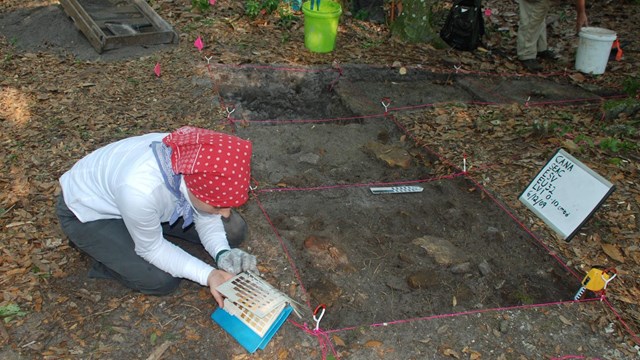
In the 1990s, archeologists located several layers of soil containing pieces of brick buried beneath the Brownsville Civic Center. Researcher William Hunt thinks one of these layers possibly represents rubble left from the 1867 hurricane destruction and the building demolitions that followed. If he is correct, the findings may help future researchers pinpoint other remnants from the storm and the new buildings constructed soon after.

Archeologist Douglas Potter, also working in the 1990s nearby, discovered pieces of pottery, bits of glass, brick fragments, and pieces of metal that perhaps came from workshops in the Fort Brown complex. In 1869, carpenter, blacksmith, and paint shops were apparently clustered together at the fort.

Return to Top

Doctor's Risky Efforts Succeed

Randall MacKenzie, who served at Fort Brown during the 1800s, became famous for his role in the 4th Cavalry's battles in the West against Native Americans who resisted settlers moving into their lands.

The 9th and 10th Cavalry, the Buffalo Soldiers, also spent time at Fort Brown. According to local historian Bruce Aiken, these African-American troops were some of the most professional to serve at the post in the closing decades of the 1800s. They patrolled more miles from Fort Brown than any other units during the era.
The Historic Brownsville Museum.
The Historic Brownsville Museum is housed in the former Southern Pacific Railroad Lines depot downtown. The ornate facade shows the influence of Mexican architecture in the town.

For the most part, life at Fort Brown in the later part of the 1800s was fairly routine. There were occasional patrols to root out cattle thieves but few other activities. For many soldiers in this outpost far from major cities, life was terribly tedious, and they entertained themselves by drinking. Alcoholism became a significant problem, even though soldiers were often able to buy only poor quality whiskey in Brownsville.

Epidemics continued to bedevil the troops, especially lethal yellow fever. In 1882, a young Army surgeon, Lieutenant William Gorgas, arrived in the midst of a yellow fever outbreak. Because Gorgas had never had the disease and therefore was not immune, his superiors forbade him from entering hospital wards.

Gorgas, ignoring the orders, tended the sick and also conducted postmortem studies on diseased victims. When his experimentation was discovered, he was arrested, but talked his way out of trouble and was released a few hours later. Because of his work at Fort Brown and later in Cuba, Gorgas was able to determine ways to eliminate yellow fever.

About the same time that Gorgas arrived at Fort Brown, construction began on a small, two-room building designed to serve as a school and a library for soldiers and their families. Called Building Two, the structure was originally designed in 1879 to be made of wood. In 1880, however, another powerful hurricane crashed into south Texas, again causing major damage at Matamoros, Brownsville, and Fort Brown. After surveying how the storm pulverized wooden structures, officials at Fort Brown probably insisted that Building Two have brick walls.

Archeologist Randall Moir and his crew determined that Building Two was erected sometime between 1882 and 1884. From then until 1907, the building's main function was as a school. There are no records between 1907 and 1922 detailing how the structure was used. Documents from1922 seem to indicate that the building served as a chapel. Beginning in 1922, the building became housing for soldiers or fort guests. At some point it may have also been used as a fort post office. Later it housed the Brownsville Historical Society museum.

Because of the General Services Administration and the City of Brownsville, the building was preserved, rather than demolished, when the expansion of U.S. Customs facilities required its removal. The structure was carefully studied, then dismantled, and is now stored, waiting reassembly in an as yet undetermined site where visitors can share in this part of the area's past.

Return to Top

Violence Erupts Again

1920s postcard showing entrance to Fort Brown.
A postcard from the 1920s shows the Elizabeth Street entrance to Fort Brown. Two soldiers stand near the guard house on the left ready to grant or deny admittance to visitors. Fort Brown housed soldiers during both World War I and II.

In 1906 word spread in Brownsville that white troops stationed at Fort Brown were to be replaced by African-American soldiers of the 25th Infantry, tough men who had served in Nebraskan Indian country.

Rumors described the new group as near barbarians who would stage drunken orgies and rapes. By the time the soldiers arrived, mistrust and outright contempt for them was widespread. Some were cursed, pushed around, and knocked to the ground. Saloons formerly open to white solders were suddenly closed to the newcomers.

Bitterness grew among the black soldiers, until late one night a small group of them fired shots into Brownsville residences and pushed their way into a saloon, where they shot and killed the bartender. They also wounded a town constable, shooting him in the hand, and killed his horse. They fired more shots at the Miller Hotel, the best inn in town.

Return to Top

Fort Brown Becomes A Ghost Town

The rampage caused an uproar and brought on hearings by the U.S. Congress. Eventually all of the black soldiers at Fort Brown were drummed out of the service, and the post was closed. Graves from the military cemetery, including remains of Jacob Brown, were exhumed and moved to the National Cemetery at Pineville, Louisiana in 1909.

By 1910, the fort resembled a ghost town with empty buildings and livestock grazing on the grounds, but then events in Mexico led to its revival. When Porfirio Diaz resigned in 1911 as Mexican president after 31 years, fighting erupted between factions seeking to choose his successor. By 1913, the U.S. Consul in Matamoros reported pillaging in the streets, and troops were again dispatched to Fort Brown.

Return to Top

Pancho Villa Strikes

Longstanding resentments simmered between the United States and Mexico, boiling over in 1915, when two signal corps officers took off in a small airplane in April from the Fort Brown cavalry drill field. Their mission was to spy on the movements of Mexicans allied with the revolutionary Pancho Villa. The pilots claimed that they never crossed over into Mexican territory, but whether or not they did, Mexicans shot at them with a machine gun and other weapons. The pair managed to return to Fort Brown safely, earning the distinction of flying the first U.S. military plane ever to be targeted by gunfire.
The former hospital of historic Fort Brown.
The former hospital of historic Fort Brown is now part of Texas Southmost College.

In October the same year, bandits lassoed railroad tracks six miles north of Brownsville, splitting them apart, then waited until an approaching train derailed. The engineer was killed in the crash, clearing the way for the bandits to climb quickly aboard the train, where they robbed the passengers and shot two dead.

Soon after, Pancho Villa and a band of about 400, invaded the United States and attacked Columbus, New Mexico, where they torched portions of the town and killed 19 people before fleeing back into Mexico. An outraged U.S. President Woodrow Wilson deployed troops all along the border, and Fort Brown was again a busy outpost.

Fort Brown was also important during both World Wars. During the activation of forces for World War II, the 12th U.S. Cavalry was transferred from Fort Brown and replaced by the 124th Cavalry of the Texas National Guard, which was the last cavalry unit in the nation to give up their horses and also the last regiment housed at Fort Brown. The 124th left to fight in Burma in the Far East, leaving behind only a few soldiers at Fort Brown, which was soon deactivated. By 1948, what was once Fort Brown belonged to either the City of Brownsville or Texas Southmost College.

Return to Top

Return to the First Page


Remnants of the earthen walls of the original Fort Brown.
Remnants of the earthen walls of the original Fort Brown are visible in this historic sketch. This first Fort Brown was abandoned at the close of the Mexican-American War and the dirt was later used to build levees along the banks of the Rio Grande River. Two more forts were later built nearby with the same name, and archeologists have learned considerable information about their pasts through excavation and other research.

Booming International Trade Leads To U.S. Customs Expansion And Fort Brown Studies

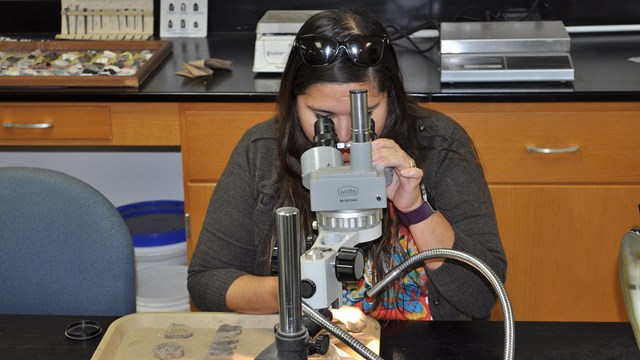
Thriving trade between the United States and Mexico prompted expansion recently of truck inspection and administration facilities near the International Gateway Bridge, linking Brownsville, Texas and Matamoros, Mexico. Archeological and historical research preceded construction so that important knowledge about the site would not be lost. In the Brownsville area alone, an average of more than $3 billion in trade goods enters each year into the United States over bridges spanning the Rio Grande River. About six million vehicles annually pass into the U.S. from Mexico over the same bridges. Trucks, comprising some 300,000 of the vehicles, carry everything from farm products to textiles to automotive parts.

The U.S. Customs Service of the Department of the Treasury monitors this traffic to prevent entry into the country of illegal drugs, tainted food, counterfeit products, illegal weapons, and other contraband. "We are here to enforce some 500 laws and to protect U.S. residents from narcotics or terrorists or patent violations," explains Jorge Flores, Port Director. Interdicting illegal narcotics is a top priority, with Customs agents at the international bridges near Brownsville frequently stopping would-be smugglers attempting to sneak drugs into the United States. Agents use specially trained dogs to help them find hidden narcotics.

Working with U.S. immigration officials and inspectors from the U.S. Department of Agriculture, Customs officials also try to facilitate easy movement of legal goods across the border, a flow that has dramatically increased because of new trade agreements between the two nations. "We walk a tight wire. It's a balancing act," says Flores. "We try to address our responsibility to halt illegal items without sacrificing efficiency." He added, "We're here to protect the public's interests."

Return to Top

Return to the Index