On the upper Savannah River near Elberton, Ga., and Calhoun Falls, S.C., lies the Richard B. Russell Dam and Lake - authorized for construction by the Flood Control Act of 1966 for the purposes of hydropower generation, recreation and flood control. Originally known as Trotters Shoals, the damsite is situated about midway between the Clarks Hill and Hartwell dam and lake projects of the U.S. Army Corps of Engineers.

Construction of the Russell project by the Corps' Savannah District was initiated in 1976. The District began filling the lake in October 1983. The lake reached its full power pool elevation of 475 feet above mean sea level in the winter of 1984 and covers 26,650 acres of land. In all, about 52,000 acres of land were acquired for the lake inundation, the dam, road and railroad relocations, project operations and recreational areas.

The National Historic Preservation Act of 1966 (Public Law 89-665) and the Archaeological and Historic Preservation Act of 1974 (Public Law 93-291) required the Savannah District to study cultural resources within the area of the project. Working with the Archaeological Services Branch of the National Park Service (U.S. Department of Interior), the Corps has provided funds for intensive archaeological and historical investigations. These investigations were administered by the National Park Service, as contracting agent for the Corps.


     Richard B. Russell Dam and Lake


4
The Richard B. Russell project area includes about 600 prehistoric and historic sites - 68 of which were excavated and documented. Investigators also interviewed numerous local informants and searched historic tiles and records. Because of the variety of cultural resources identified, the entire Russell project was nominated to the National Register of Historic Places as a Multiple Resource Area.

This booklet is divided into sections corresponding to major aspects of the cultural resources program for the Russell Multiple Resource Area:

  -- Initial surveys (inventories) identifying the sites

  -- Archival and oral history research

  -- Documentation of significant historic buildings and engineering elements

  -- Prehistoric and historic site investigations, with intensive data recovery

Because these studies have produced a wealth of information on the Russell project area, this booklet can only highlight some of the important investigations and findings.

The Corps' goal has been to make the Richard B. Russell cultural resources program a model project - one which will benefit the general public and the scientific community by documenting and preserving the cultural record of the Georgia-South Carolina Piedmont.


Russell Lake


5

The initial step taken was to identity the cultural resources within the Russell Dam and Lake project area.

Beginning in 1977, the Institute of Archaeology and Anthropology of the University of South Carolina conducted, under contract, an inventory of cultural resources on over 27 percent of the land. The survey was devoted to locating historic standing structures and prehistoric and historic archaeological sites. The Corps wanted to develop an initial picture of the archaeological record of the area which would be affected by the Corps project. Under this inventory, the university team discovered and recorded 490 sites. The team's findings are contained in a 530-page document, titled The Report of the Intensive Survey of the Richard B. Russell Dam and Lake, Savannah River, Georgia and South Carolina.

A second inventory was performed by the Historic American Buildings Survey and the Historic American Engineering Record (both now combined under the National Architectural and Engineering Record (NAER) of the Department of Interior). This survey identified all remaining standing structures and significant engineering elements in the project area. It recorded 93 domestic buildings and eight engineering structures, and is contained in Appendix A (The Inventory) of a report titled, All That Remains: The Traditional Architecture and Historic Engineering Structures; Richard B. Russell Multiple Resource Area, Georgia and South Carolina.


6

The U. S. Army Corps of Engineers began extensive historical investigations of the Russell area while the inventories were underway. This work provided an overview history of the area.

The History Group, Inc., of Atlanta, a professional historical research firm specializing in southeastern cultural resources, performed the major work. Their work was intended to complement the NAER inventory of standing structures. It concentrated on the history of the development of the entire project area - especially the history of land settlement, economy and culture. The Corps needed this background information for the later archaeological investigations of specific historic sites and engineering elements already identified in the inventories.

The History Group team consisted of historians, an archaeologist, a folklorist, an anthropologist, a cultural geographer, and additional researchers and interviewers. The manuscript generated by this research group not only serves as a background document, but more importantly, represents the first available synthesis of historical information on the Georgia-South Carolina Piedmont. The study is titled Historical Investigations of the Richard B. Russell Multiple Resource Area.

The team first searched State and regional bibliographies, government documents, archives and manuscript collections. The group then conducted onsite research at county courthouses and local historical societies, university libraries, the Institute of Archaeology and Anthropology in Columbia, S.C., and other sources of information. Team members made tour field trips to the project area for preliminary observations and to interview residents to record their oral traditions (unwritten information passed down to descendants).

The 352-page document covers agricultural, demographic and transportation developmental patterns. The area's history, local culture, genealogy, and landmarks, such as Fort Independence and Millwood Plantation, are also included. Many maps, tables and illustrations provide important information on the study area.


7
Because blacks were the majority population of the project area throughout most of the 19th and 20th centuries, an important part of the project was to write a history of the Afro-American experience in the region. Most public records are silent on the black population. In order to arrive at a black perspective of history in this area, a more extensive oral history project was needed. Dr. Eleanor Ramsey, an anthropologist with the Institute for the Study of Social Change at the University of California, Berkeley, was contracted to accomplish this study. When completed, the study should place blacks into the right perspective as a significant factor in the southern historical tradition. Ramsey's work is tentatively titled Power Without Power: The Making of a Black Community. In her study she is dealing with topics such as how blacks acquired and maintained land, the growth and importance of the black church in the community, and the black farmer's role in the economy.


Dr. Eleanor Ramsey interviews residents


  A study team member prepares a drawing of a historic site


8

Another important aspect of the cultural resources efforts within the Russell Multiple Resource Area was the detailed recording of historic standing structures and engineering elements.

This work was performed by the Historic American Buildings Survey and the Historic American Engineering Record. The result is a document titled All That Remains: The Traditional Architecture and Historic Engineering Structures; Richard B. Russell Multiple Resource Area. It consists of a 354-page publication with Appendix A (The Inventory) and Appendix B, consisting of large, measured ink drawings and descriptions of selected structures. The document presents a historical background on housetypes and other architecture in the area, and site-plan arrangements of these structures on the landscape. Nineteen site reports prepared for National Register-eligible properties are contained in Section 2 of this document. These include:

Domestic Properties in Georgia

Alexander-Cleveland House
William Allen House (Beverly Plantation)
Reuben J. Anderson Farm
W. Frank Anderson Farm
Dye-White Farm
Grogan House (Eureka)

* See appendix in back of this brochure for brief statements on historical significance of these structures.


     Alexander-Cleveland House 


9
Domestic Properties in South Carolina

Caldwell-Hutchison Farm
Featherstone Tenant Farm
Harper-Featherstone Farm
Harper-Featherstone Tenant Farm
Long-Hutchison Farm

Engineering Structures

Abbeville Hydroelectric Power Plant
Blackwell Bridge
Ga./S.C. Memorial Bridge
Gregg Shoals Dam/Powerplant
Pearle Cotton Mill and Dam
Sanders Ferry Bridge
Seaboard Coast Line Railroad Bridge
Smith-McGee Bridge


Blackwell Bridge at old site on Beaverdam Creek


Blackwell Bridge at new site in Coldwater State Park


10
Floods in 1852 and 1908 destroyed many bridges and millsites along the Savannah River and its tributaries above Augusta, and the extant engineering elements recorded in this document are an example from the history of engineering resources in the area.

The two hydroelectric plants were documented because of their significance in relation to early sources of electricity in the southeastern United States. The Gregg Shoals Dam and Powerplant became outdated and was deactivated in 1955. Pearle Mill and Dam represents the milling industry operative within the boundaries of the Multiple Resource Area. Its varied history is closely associated with the William Allen House/Beverly Plantation.

One engineering structure and two buildings from a domestic farm which would have been covered by the Russell Lake were relocated to preserve their historic characteristics. Blackwell Bridge, built in 1917, has been preserved as a part of a pedestrian trail crossing the lake within Coldwater State Park in Georgia. Army engineers from Font Stewart, in cooperation with the Savannah District, U.S. Army Corps of Engineers, attached flotation devices to the bridge and towed it to its new site in 1984. Relocated from its previous site on Beaverdam Creek, the bridge exhibits important features of the American system of pin connections. It is the largest remaining steel truss bridge in Elbert County, Ga.

The dairy barn on the Harper-Featherstone Farm was relocated to a proposed Hutchison Living History Farm within McCalla State Park in South Carolina, where it will be used as part of a historical interpretive center. The barn is a large mortice and tenon (hand hewn) structure dating to the late 1800's. The wellhouse from this farm was moved to the Abbeville County Museum and will serve as a memorial to 11 victims of a drowning accident at Harper's Ferry in 1920. The wellhouse, with wooden peg construction, which was built before the turn of the century to house butter and cheese, also served as a smokehouse.


Harper-Featherstone Dairy Barn


11

Pearle Mill


Hutchison Log House


Harper-Featherstone Wellhouse


12

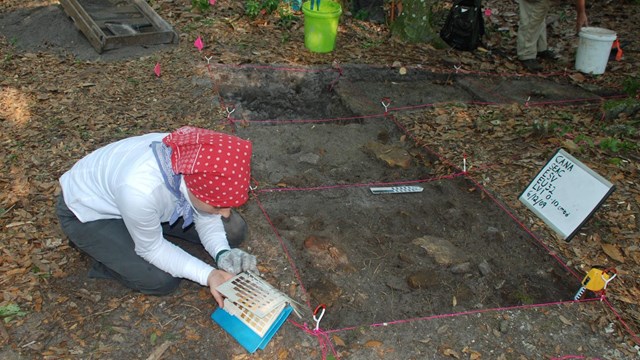
The archaeological investigation of prehistoric and historic sites was another approach to studying the Richard B. Russell Multiple Resource Area. These investigations revealed that sites in the area ranged in age from the end of the last Ice Age to the early 20th century (see chart on page 14). Archaeologists used a variety of techniques - from surveying to complete excavation - to recover and record remains of past human activity. Information about the function of a site and the density of its population was also gathered by recording features, such as hearths, burials and stains in the soil from rotted house posts. Arrangements of such features offer clues to social and community organization.

Prehistoric Periods

For thousands of years, before Europeans arrived in the New World, American Indian groups lived in the Savannah River valley. Periodic floods left sediments in the flood plain along the river - burying many objects used by these early inhabitants. This process repeated itself over the years, and more recent sediments covered older ones.

The change in types and styles of artifacts found within these layers of sediment reflect some of the changes in American Indian life through time. Some of these changes were technological, like the invention of pottery and changes in hunting weaponry, reflected in the size and shape of projectile points. Other changes were stylistic, like the different ways in which the surface of pottery was decorated.


Prehistoric clay pots from Russell Lake area


13

Projectile points and pottery sherds


At the end of the Ice Age, around 9000 B.C., small bands of hunters and gatherers visited this area. Among their tools were skillfully made spearheads, used as weapons against Ice Age animals like the mastodon and mammoth.

The period from 8000 B.C. to 1000 B.C. was a time of successful adaptation to a changing environment. The deer became an important food source, and new types of spearheads were made to kill this swift animal. This period also saw the spread of the oak-hickory forest, which was to dominate and provide abundant foods, like the acorn and hickory nut. By 2000 B.C. the people had become masters of the forest. They cleared areas to attract game and to encourage growth of edible plants.

From 1000 B.C. to A.D. 800 the forest-based culture continued to flourish. A network of trade and alliance among populations spread ideas and traditions throughout the Southeast. Pottery, used for cooking and storage, was common by the beginning of this period, and people lived in villages much of the time. Styles of pottery changed as new decorating techniques were invented and shared. By the end of the period, use of the bow and arrow - reflected in smaller projectile points - became widespread.

The native culture became increasingly complex from A. D. 800 to A.D 1500. Corn, squash and beans were introduced in the region probably from central Mexico, where they had been domesticated. Large villages were scattered along the major rivers to take advantage of the fertile bottomlands. Hunting remained important, and arrowheads were refined into a small triangular form. Artistic innovations continued with pottery being made in a variety of shapes.


14

                                               Paleo-Indian Period
                                         (10,000 - 8000 B.C.)

                                               Archaic Period
                                                      Early (8000 - 6500 B.C.)
                                                    Middle (6500 - 3000 B.C.)
                                                    Late (3000 - 1000 B.C.)

                                               Woodland Period
                                        (1000 B.C. - A.D. 800)

                                       Mississippian Period
                                       (A.D. 800 - A.D. 1500)

                                       European Contact


15
Historic Periods

European explorations during the 16th and 17th centuries brought disease and destruction to the native people of the region. By the middle of the 18th century, colonists with slaves settled in this pant of the Savannah River valley. They brought with them flintlock muskets and new cultural traditions from Europe and Africa. Homesites like Fort Independence were fortified to defend settlers from Creek and Cherokee Indians. Eventually, the Indians were defeated and treaties were signed. The native people who had lived in the area for thousands of years were forced west with the continually expanding settlement of Americans in search of new land.

Significance of the Piedmont

For many years, archaeologists in the Southeast had considered this part of the Piedmont as a cultural backwater peripheral to the major centers of activity to the north, the west and the coast. Investigations demonstrated that, rather than being in the shadows, the area was itself a significant center of innovation and activity from the days of the first appearance of man on the southeastern landscape.

An equal measure of success has occurred in the investigation of historic sites. These have focused around four topics of special interest to the scientist and layman alike: the Revolutionary War period; the transition from ante-bellum to post-bellum society in the 19th century; the industrial revolution of the rural South; and the resurgence decline of the Cotton South from the period of the Reconstruction to that of the Depression.


Fort Independence artifacts


Next page