|
17 - Freedom's High Price (Click images to enlarge) If ever a region needed Reconstruction, it was the South after the Civil War. So much was destroyed by invading Union soldiers, retreating Confederates, and simple neglect while everyone focused on the conflict. Many generations would come and go before the damage faded from view; bitterness and memories of the devastation would persist long after visible reminders disappeared. Merely getting from one place to the next was often an ordeal. Roads were rutted and frequently impassible. Bridges had collapsed or been burned. Railroads, never in the best condition even before the war, were frequently out of service. Union troops had twisted the rails into knots or wrapped them around trees into pretzel shapes called "Sherman neckties" in honor of the conquering Union general. On many farms and plantations, fences were down and weeds overran untended fields. Buildings left standing by Union forces showed the wear and tear of four years of neglect. Livestock was all but gone. But worst of all, tens of thousands of men who once helped perform the everyday tasks of rural life were never coming home. The Civil War, the bloodiest conflict ever in the United States, killed 670,000 men. Some 40,000 died from Georgia alone. Those who did return were often wounded, crippled, or sick. At best, they were exhausted and dispirited from their terrible defeat. Planters and well-to-do farmers had also lost the forced free labor of slaves who suddenly found themselves adrift in an often hostile environment. They were
now free, but had no homes or money and often few skills beyond farm work.
Many were understandably reluctant to continue laboring for men who had
once enslaved them. There Southern state legislatures, still controlled by whites, sought to restrict blacks' new freedoms through legislation. Typical laws limited voting rights and ordained that freed slaves could work only in the lowest paying jobs. Called "Black Codes," the laws also excluded them from owning guns, serving on juries, and testifying in trials against whites. Racial tensions continued to mount. Ill will in Columbus rose ominously when black cavalry troops arrived to occupy the city and ensure federal law was obeyed. Black Union outfits had distinguished themselves during the war, but their presence stirred only deep resentment among many white Southerners, feelings that were sometimes reciprocated by the soldiers. Things came to a head on February 12, 1866, when one of the black soldiers fired a rifle from an upstairs window of his Columbus barracks. Apparently, he had no specific target in mind, as long as the person was white. The bullet hit James Warner, shattering his leg. Warner was the engineer instrumental in Confederate naval construction of the Chattahoochee and Jackson. The wound was so severe that doctors had to amputate, but their efforts proved futile, and Warner died some time later. The white community was outraged and hungry for vengeance. Only careful negotiation between city officials and the United States military averted full-scale riots in Columbus. A shaky peace held, however, and the black soldiers were withdrawn. In the face of a flood of Southern laws sanctioning racial discrimination, the United States Congress adopted the 14th amendment to the Constitution guaranteeing equal protection under the law. The amendment also required every state to allow black men to vote before the state could elect representatives to Congress. Federal troops supervised voter registration to guarantee compliance. Nearly all men, regardless of race, could vote, if they first swore allegiance to the United States, although some ex-Confederate soldiers and government officials were banned from balloting. Many other eligible white voters boycotted elections. Women did not win the right to vote until 1920 with the passage of the 19th amendment to the Constitution. With the power of the federal government behind them, black men from the South for the first time ran for and were elected to state and national offices. In 1868, for example, Georgia elected 32 blacks out of a total of 216 representatives to the state legislature. Still, some Southerners refused to accept the new equality with former slaves and hid behind hooded disguises to prey upon them. Some former Confederate military men, following the lead of Robert E. Lee, worked for peace. Others, however, such as John B. Gordon and Nathan Bedford Forrest, led efforts to terrorize blacks. The tactics of the Ku Klux Klan and similar groups added a dark page to Southern history. Documentation of their activities is spotty because they enforced a code of secrecy, but there is strong evidence that the Klan went on rampages in many areas, beating and murdering blacks. Entire black communities fled their homes to escape the nighttime raids. Klan harassment was especially severe just before elections to scare the new voters away from the polls. Still, with the economy wrecked by the war, both blacks and whites were often forced to cooperate for survival. For blacks, this meant returning to the fields and the only life many had ever known. Some continued to work for former slave masters and grappled with the unfamiliar issue of how much they should be paid for their efforts. For their part, planters worried about the dependability of workers who could come and go at will. Many tried a number of labor arrangements before settling on something satisfactory. Because of federal urging, many signed contracts with field hands. But rather than guaranteeing the workers would not be subjugated, as the government intended, some of the documents tied blacks to the land in arrangements similar to slavery. Typically, a contract dictated that the worker couldn't leave the plantation for a year without the owner's permission. The planter would supply food, housing, and clothing, as he did during slavery, only now he also paid a small salary.
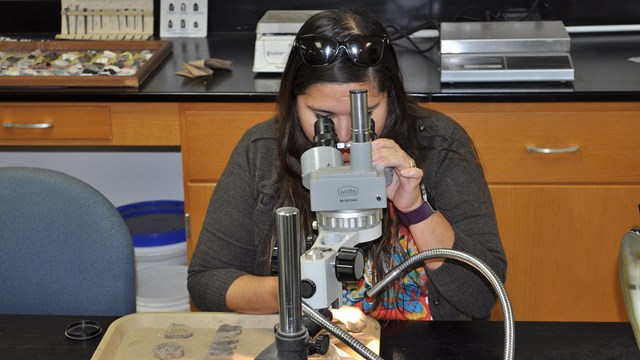
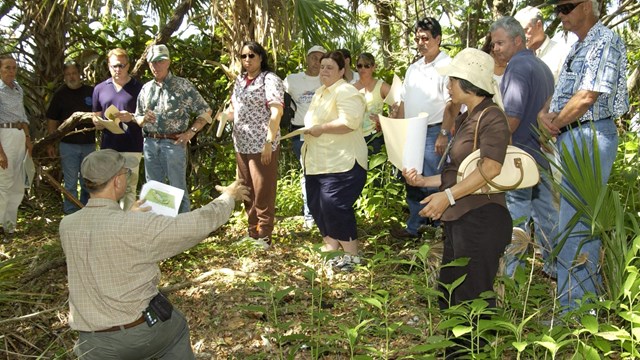
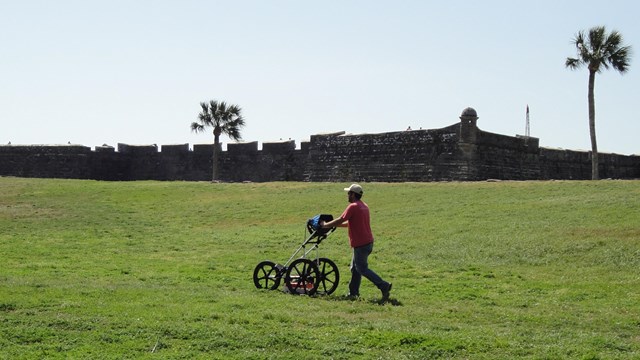
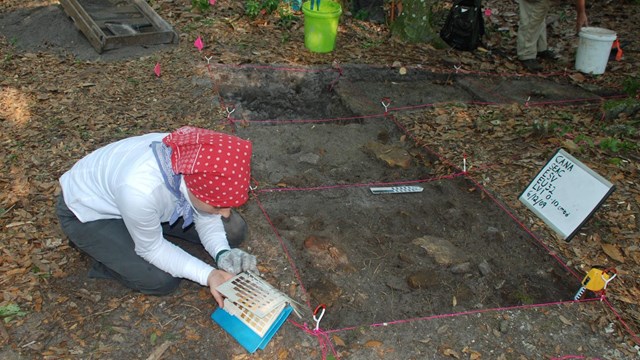
Archeologists, lead by the husband and wife teams of Rita and Dan Elliott and Karen and Dean Wood, examined land records, census reports, and other public documents from Reconstruction to follow the lives of some local landowners and form a clearer picture of what transpired in the period. They learned, for example, that Joseph Lee became one of the wealthiest property owners in the northern portion of what became Fort Benning. In 1850, Lee owned land in Muscogee County valued at $2,000. He also had 23 slaves who apparently spent most of their time clearing land and making other improvements. In this early period, the farm produced only a small amount of corn and oats, and there was about $900 worth of livestock. Only about 160 acres could be considered improved, probably plowed and planted. Lee also owned about 450 unimproved acres, probably uncleared fields and forests. In the following ten years, Lee dramatically increased his wealth. By 1860, he owned 800 improved acres and 760 acres unimproved. The value of his property had skyrocketed from $2,000 to $20,000, and his personal wealth was estimated at $46,000. Lee had also more than doubled his number of slaves. There were now 50 and most were old enough to work. Lee reached his financial peak in the years just before the Civil War. By 1860, he was 44 years old, married, and had six children. His livestock was worth $4,000 compared with $900 just a decade earlier. Lee had also diversified his plantings-growing 120 bales of cotton, 6,000 bushels of corn, 2,000 bushels of sweet potatoes, and 500 bushels of peas and beans. Then war erupted, and his fortunes began to decline. Lee apparently retained about the same amount of land, but his personal worth plummeted to only $6,000 by 1870. Census figures show that in just ten years, much of his wealth, about $40,000 worth, had vanished. His improved acreage was cut in half. He grew fewer crops than before the war, and his overall production fell. His cotton harvest dropped from 120 bales to 56, and he produced only 4,000 bushels of corn compared to 6,000 bushels earlier. He paid $3,000 in wages. Things became so tenuous that Lee risked debt to keep his farm afloat. In 1873, he obtained a loan of almost $5,000 to buy provisions for his livestock and fertilizer and other supplies to plant the next crop. To secure the loan, he pledged much of his land to the Columbus firm of Allen, Preer, and Illges. Apparently, Lee's willingness to jeopardize his holdings paid off. He repaid the loan and kept his farm, but the strain at the age of 64 of so much debt may have also weakened him. He died less than two years later, sometime before December 1874. Despite his economic woes, Lee was still one of the most prosperous people in the area at the time of his death. The Ritch family suffered even more setbacks because of the war, perhaps because they were not as prosperous as Lee before the conflict began when their property was valued at $7,325, and their personal estate was worth $20,000. There were ten children in the family, four boys and six girls, listed in the 1860 census. The eldest son, Thomas, was 19, the only son old enough to join the Confederate army. In the next census, in 1870, Thomas had disappeared from the family listing. Researchers suspect he was killed in battle. In addition to the personal grief family members apparently sustained, they also experienced drastic financial reversals. Their property lost about half its value in ten years and was now worth only $3,700. The family's personal estate had dwindled to $2,600, down from $20,000. The 1870 census showed that the two eldest sons, John, 19, and James, 17, both worked on the family farm. Their father was 56 years old. Ten years later, the 1880 census showed that the family survived the postwar economic crunch and managed to keep the farm. The two eldest sons had moved away, and one of them, James, farmed 70 rented acres nearby. The youngest son, Edward, then 21, still lived at home, as did his six sisters, all between 30 and 40 years old. The sisters were unmarried, except for one. In all likelihood, the women had few eligible men to consider as mates because so many were killed in the war. By 1900, the two parents had died and the second oldest son, John, returned to manage the family farm. Living with him were five unmarried sisters, ranging from 47 to 59 years old, and a 30-year-old nephew. Federal efforts to reconstruct the South waned and eventually ended as people in the North lost interest in the well-being of the former slaves and in spending any more money on the vanquished region. By 1876, Reconstruction was over, and all Federal troops withdrew. State governments controlled by the Republican party, which included numerous black officials, were turned out of office and replaced by conservative governments dominated by whites. Southern state legislatures soon retracted most rights blacks had gained and instituted segregation. Blacks were relegated, with few exceptions, to society's lowest rungs. By custom or by law, they often were forced to accept the poorest paying jobs, attend inferior, part-time schools, and submit to an inferior social status. Despite the immense obstacles they faced, there is evidence that some blacks were able to buy land in the Fort Benning area after Reconstruction. Little is known about most of these landowners. Two brothers, George and Washington Williams, originally from Virginia, bought land in 1878 in the northern portion of what became Fort Benning. Eventually their property was subdivided, but most of it continued to be owned by blacks until it became part of Fort Benning.
The Canteys were one of the early prominent black families in Russell County, Alabama and lived close to what is now Fort Benning. Former slaves, the Cantey family members achieved success as entrepreneurs and were responsible for establishing the first African-American school in Russell County. A descendant, Alma Thomas, gained world renown as an artist and is the subject of an exhibit at the Columbus Museum. Gradually, in the years following the Civil War, a new system for organizing rural labor took hold in much of the South. Many owners of large tracts of land began parceling out acreage to tenants. The landowner usually provided a small house for his tenants. Sometimes he also supplied farm tools, animals, seeds, and fertilizer, everything necessary, except the labor, to plant and harvest a cotton crop. Called share cropping, this arrangement required tenants to pay the owner one-third to one-half of their harvest. In other arrangements, the owner provided only the house and land, while the tenant was responsible for buying all supplies and equipment, as well as farm animals. The tenant agreed to pay a fixed rent in cash or a portion of the harvest. Cotton continued to be the most important cash crop. Demand soared in the years immediately following the Civil War because of a worldwide shortage. Consequently, many farmers didn't diversify because cotton brought the best price. Also, they continued to grow cotton because they could get credit by agreeing to repay loans with part of their next harvest. Lenders generally considered other crops too perishable to serve as loan security. Many farmers plunged deeper and deeper in debt, especially between 1873 and the 18901s when cotton prices stalled. Low land prices and depressed economic conditions also led to much land speculation. Research by Dan and Rita Elliot and Karen and Dean Wood demonstrates that many parcels in the northwestern part of Fort Benning, near Upatoi Creek, changed hands frequently after the war. Many of the owners were from out of state. Speculation was particularly rampant near the Muscogee Railroad that ran along the northern border of what later became the military reservation. This area also experienced a slight growth spurt after the Civil War as more people settled near the small towns of Upatoi and Box Springs close to the railroad. Upatoi, in Muscogee County, was about 17 miles east of Columbus and in 1880 had a population of 20, a church, and a school. The community also had the luxury of daily mail service because of its location only about three fourths of a mile from the railroad. By 1886, Upatoi's population rose to 150. There was now a mill for turning corn into grist, a sawmill, three blacksmith shops, and a store. The owners of the gristmill and the store also worked for the railroad. A group of Christian idealists selected land near Upatoi in 1896 for what they hoped would be a perfect community. Their attempt at establishing a utopia was sparked by a belief that the nation was sinking into moral decline. The founders believed that over-crowded cities and increasing industrialization were prime culprits for the downturn. They chose a thousand acres along Dozier Creek that overlapped what is today Fort Benning as the site of their community. They called the settlement Commonwealth because residents agreed to devote all labor to the common good. People from around the nation migrated to Commonwealth, some from as far away as Spokane, Washington. The greatest number of settlers, however, came from North Carolina. The community grew sufficiently to merit its own post office, but eventually the effort collapsed. By 1901, Commonwealth had disbanded. The post office was transferred to the town of Upatoi. Other residents of the sand hills continued to struggle with erosion. There was little incentive for tenant farmers to care about preserving precious topsoil on land they didn't own. Few practiced soil conservation, and this lapse, coupled with dependence on cotton, which robbed the earth of nutrients, led to low yields and poor soils. The higher elevations were often crisscrossed with gullies. There were apparently some attempts to drain wetlands near major creeks so that these more fertile lands could be farmed, but how successful the efforts were is unknown. Ralph Albertson, who lived at Commonwealth, cogently summarized the problems many farmers faced. The land at the religious commune, he wrote, was about half "upland and half swamp. The swamp was rich, black land very hard to cultivate, but very productive. The upland was mostly worn out cotton land." About six miles from Upatoi was another small railroad town, Box Springs. Located close to the Fort Benning boundary, Box Springs, in Talbot County, grew to 150 residents in 1886. Besides serving as a business center, it was also an important juncture for tourists who left the train there and traveled to nearby mineral spring resorts, White Sulphur Baths and Parade Springs. The resorts attracted people searching for relaxation. A stage coach traveled regularly between Box Springs and White Sulphur Baths. Tourists stayed in White Sulphur Baths' hotel that had room for 200 guests. In the early 1900's, cotton boomed again. Prices rose for a while and farmers struggled less than before. Then, in 1915, the boll weevil invaded from Texas and devastated cotton crops. Farmers throughout the region suffered, but not only because of the weevils. Much of the land in the Fort Benning area was exhausted. Even without the insect infestation, yields were declining. Then cotton demand slackened, setting off a panic. Farm owners booted some tenants off their land; other tenants just gave up and left. Whites streamed into Southern towns such as Columbus looking for work. Many blacks left the area altogether in a mass migration to northern cities such as New York, Philadelphia, and Chicago. Towns, including Box Springs and Upatoi, began losing population. The Great Depression in the 1930's caused even worse conditions, causing more people to abandon the rural, small-town life. Better roads and the automobile made it easier for people to bypass small towns and take their business directly to big cities. Many small towns, established as centers of commerce, lost their primary reason to exist. Today, Upatoi has only a few residences and almost no businesses. Box Springs also has shriveled in size. Throughout the 1800's and into the 1900's, mills, operated with water power, were vitally important to rural life. One of the most important mills in the Fort Benning area came to be known as Eelbeck. As often happened, a community developed around the mill and was also called Eelbeck, a place so special that even today people lovingly recall time spent there. Besides the many fond memories, Eelbeck also produced a World War II hero who survived a harrowing ordeal.
Chapter 18: Wheel-Spun Memories Return to the Table of Contents
|