12 - A Forgotten Church

(Click images to enlarge)

Shortly after the Creeks were banished from Georgia, state officials held a lottery in 1827 to distribute free land in Muscogee County, including much of the area now occupied by Fort Benning. Officials awarded lots of 202.5 acres, small enough, they hoped, to encourage development of individually-owned farms.

The land lottery generated considerable excitement across the state. Any male citizen of Georgia, age 21 or older, could participate and gain one chance to win property. If married and a father, he received two chances. Women could participate only if they were widows. Slaves were ineligible.

Entrants could register at any one of the state's county courthouses. Their names were then forwarded to the state capitol, then in Milledgeville, where state workers wrote them on lottery tickets and placed them inside a large wheel. They also labeled other tickets with lot numbers, identifying land to be given away, and placed these tickets into a second wheel.

Anticipation crackled in the air as the time for the drawing arrived. An official drew a ticket with a name from one wheel and simultaneously reached into the second wheel to get a ticket with a land lot number. The person whose name was drawn won the property free of any charge, except for a small recording fee of $4 per 100 acres.

Winners could occupy the land or sell it. Many sold to eager speculators who hoped to resell at a profit. Buyers considered parcels along the Chattahoochee River especially valuable because of rich alluvial soils, which were regularly replenished by periodic floods. Ready access to water transportation was another important bonus. Some buyers were able to assemble many contiguous lots, which became prosperous plantations.

Those who could afford the biggest acreage also were frequently able to buy slaves to perform much of the work for them. These landowners often accumulated handsome profits from selling cotton and used the money to buy more land and slaves to work it.

The most successful plantation owners were shrewd deal makers who used far-flung contacts to get the highest prices for crops and the best credit terms to finance their operations. They, like the small farmers, had to be wily enough to survive the periodic panics when cotton prices nose dived or lending money dried up. They also had to weather natural disasters such as droughts, when crops withered and the river dropped so low that it became impassable.

One of the most successful enterprises in the Fort Benning area was the Woolfolk Plantation. John Woolfolk began accumulating his substantial holdings along the river in 1828 until his plantation stretched south from about eight miles below Columbus and encompassed some 5,000 acres. The plantation included the location of at least one, and perhaps two ancient Native American mound sites, as well as the land where the Creek village of Kasita once stood.

Figure 75: Eli Whitney's Cotton Gin.Cotton was the principle cash crop of the time for everyone, wealthy planter and struggling small farmer alike. The invention near Augusta, Georgia of the cotton gin in 1793 by Eli Whitney proved a boon to cotton growers. The gin removed seeds from the cotton fiber, a laborious task previously done by hand. Still, cotton profits were far from a sure thing. The plant rapidly depletes soil nutrients, a primary reason why farmers in the uplands, away from replenishing Chattahoochee River floods, often faced especially difficult challenges.

Figure 76: Rampant Erosion in the South (38.8 KB).Erosion was another serious problem plaguing sand hill farmers. When they cleared trees to make room for crops and houses, the top soil, no longer held by roots, easily washed away. Then they hastened the erosion with the plow. Soil loss and decreased fertility worsened because most farmers were either unfamiliar with crop rotation, contour plowing, fertilization, and other beneficial techniques or chose not to practice them. Then, too, most of the sandy soils had never been terribly rich and were unlikely to sustain the voracious nutrient appetites of crops like cotton and corn for long, whatever the farmers did.

The pioneers who first moved into the back country arrived when the region was still considered wilderness. Often, with little help, they had to clear the land, then struggle to survive far from neighbors. Many had trouble holding onto property and sold out. Typically, ground changed hands quickly and often.

For example, a man named George H. Johnson drew lot 242 in district nine during the lottery, property on Fort Benning's eastern side. Within ten years, he sold to James Sullivan. Within merely two more years, the land had changed hands two more times.

Similar quick land turnovers occurred repeatedly in the back country. Little is known about many of the land owners because they left few written records. In the case of lot 242, however, historians and archeologists have determined that one of the early owners built a mill for grinding grain into grist. This grist mill was powered by the fast-moving waters of Pine Knot Creek. In later years, owners replaced the original structure with another mill nearby. A community, which came to be known as Eelbeck, grew up around the mill and remained viable into the twentieth century.

Settlements often clustered around mills, which were gathering spots for farmers to talk with neighbors, arrange business deals, and have their corn turned into meal and grain into grist, used in baking bread.

Settlers also used churches as social centers where they could gather with others in a common purpose. Archeologists at Fort Benning learned a great deal about early life by studying a long-forgotten cemetery discovered during the construction of the Carmouche firing range. They also uncovered evidence of two mysterious deaths of questionable causes.

By studying land records, researchers determined that 12 early settlers came together in March of 1832, five years after the land lottery, to organize the Mt. Gilead Baptist Church. Not much is known about these founders, but it is likely they were small farmers who had to travel significant distances on horseback or by wagon to attend church gatherings. Probably because of the distances involved, they agreed to meet only one Saturday a month to conduct church business and one Sunday a month for worship.

On May 1, 1832, the congregation appointed three commissioners to oversee construction of a church on donated property. According to the deed, Jesse Cabannis transferred two and a half acres to "the deacons of the Baptist church at Mount Gilead…. for and in consideration of the love, good will, and affection... for the said church." The name Jesse Cabannis is unlisted on the church rolls, but the names Mary and George Cabannis do appear. Perhaps they were his relatives.

The members built the church on a high ridge. Nearby, on the same ridge, they set aside a place for a cemetery. A spring flowed from the hillside below the cemetery, sending a small stream cascading down toward Uppity Creek. By the end of the first year, the congregation had grown to 33 members. During the first 17 years, some 60 people belonged to the church, though not all at the same time.

Mt. Gilead Baptist Church closed in 1849 when the members erected another sanctuary about six miles away. They must have felt some pangs of regret as they shuttered the old building and abandoned it. Perhaps some stood in the cemetery and thought of the friends and relatives buried there.

The new building signaled a fresh start and a new name, the County Line Baptist Church. The church continues to exist today with an active congregation. Over time, as members died and others took their place, people forgot about the first building and cemetery. The original building decayed, along with the wooden markers that likely identified the old graves. After awhile, there were no visible traces that either a church or graveyard had ever existed. A place once so important had vanished.

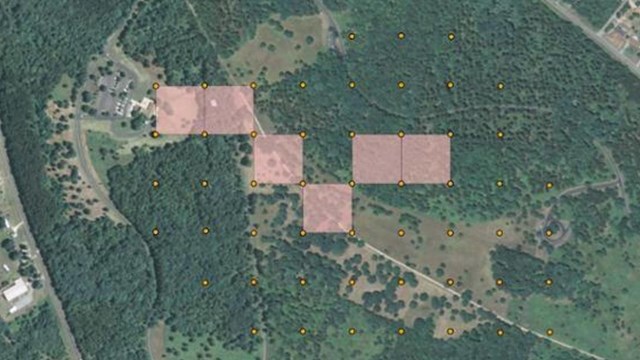
When the cemetery was finally rediscovered, the U.S. Army took every precaution to ensure it was quickly studied and then moved to another location out of harm's way. By examining the Figure 77: A Map Showing the Mt. Gilead Cemetery (83.6 KB).remains, scientists, led by archeologists Dean Wood and Chad Braley, determined that the church members long ago had enjoyed fairly long lives, if they survived beyond their first 11 years. The beginning years of life were particularly hazardous. Eighteen of 29 burials were either children or newborns. Five were infants.

There was only one burial that might be attributable to a teenager, a female identified as younger than 21 when she died. No other remains were found for anyone between the ages of 11 and 30 years old.

A shotgun blast probably killed one of the children. Scientists located shot gun pellets buried with the body of a child who was between five and six years old at the time of death. Researchers were unable to locate any records explaining exactly what happened-whether the child was murdered or killed in an accidental shooting. The complete story of this long ago tragedy may remain one of the unsolved mysteries of Fort Benning's past.

Scientists did note that some of the child's front teeth were misaligned. Another child, about seven years old and buried nearby, had front teeth misaligned in almost exactly the same way, prompting speculation that two children were possibly siblings.

Researchers analyzed chemical elements in all the remains by removing small sections of bone before the burial relocation. This analysis led to conclusions that one child, about seven or eight years old, may have been poisoned. Bone tissue from the child, who was about four feet tall, disclosed extremely elevated levels of both arsenic and iron.

It is possible that arsenic leached into the bone tissue from the surrounding soil, but the quantities were significantly higher than in any other burial. Large amounts of iron normally accumulate in the human body when arsenic is introduced into the system. The body responds to the poison by mass producing red blood cells, as well as by producing a great deal of hemoglobin, concomitantly boosting iron levels.

Again, scientists were left with a mystery about exactly how this child died. Arsenic was used extensively as an agricultural pesticide, but no other sign of poisoning appeared in the other burials. Whether this child died by accident or was deliberately poisoned remains unknown.

Most who survived beyond childhood had an excellent chance of living into middle age or even old age. Five of the burials were of individuals older than 60. One woman lived to be 84. Researchers were surprised by the apparent longevity of the adults buried in the cemetery, considering the extreme hardships and privations the settlers must have encountered. The average life span of a white male adult was about 59 years, while a woman's life span was about 65 years. Those responsible for the placement of the graves apparently wanted the deceased pointing in the general direction of the setting sun. The grave diggers made the graves about four to six feet deep, apparently in rows, and oriented them in an east/west direction.

Another burial revealed a 61-year old man who must have suffered enormously. He broke his left thigh bone near the hip at some point, and after the accident, failed to keep his leg immobile long enough to heal properly. The break never mended. As a result, the top part of the bone remained sheared completely across and separated from the bone shaft. Both the head of the leg bone and the shaft had been rubbed smooth because of the constant friction caused by the man's attempts to walk. He must have been hobbled with a debilitating limp and excruciating pain.

None of the burials revealed lead poisoning, a malady the settlers' more affluent contemporaries did sometimes suffer. The well-to-do of the plantations were exposed to lead in utensils, pewter, and plumbing, while the back country inhabitants were largely poor farmers without plumbing or expensive tableware.

Seven of the individuals buried in the Mt. Gilead Cemetery suffered chronic ear infections that in at least one instance probably caused death. The ear infections were so severe and so poorly medicated that the bacteria spread to the mastoid portion of the skull, just behind the ear, causing small crater-like openings symptomatic of a condition called otitis mastoidea. The infections must have been quite painful.

Scientists detected high copper levels in the remains of a 31-year-old man who apparently died of otitis mastoidea. Copper levels typically increase in people with severe infections. Scientists also noted that people with the ear disease tended to have low levels of nutrients such as iron, zinc, calcium, and phosphorous. The remains of these people also exhibited decreased strontium, perhaps due to the breaking down of body tissues because of chronic infection.

A likely source of the infection was common "swimmer's ear" contracted from bacteria in nearby Upatoi Creek. Swimming, bathing, or holding baptisms in the creek, all likely activities for early settlers, could have infused bacteria into the ear. Similar ear infections can also erupt as a by-product of measles, influenza, or upper respiratory diseases. Whatever the source, the infection, if allowed to grow unchecked, will rapidly spread to the mastoid region of the skull, causing extensive suffering and declining health.

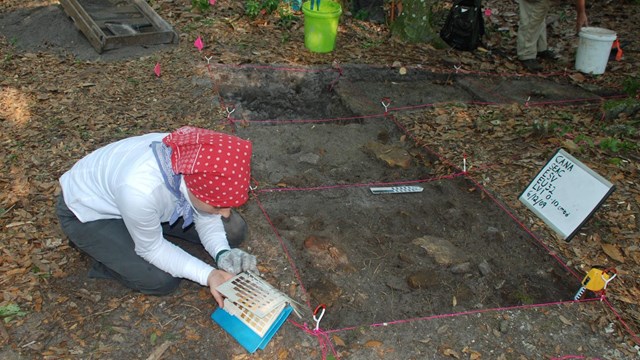
Figure 78: A Cemetery Investigated by Archeologist Erwin Roemer (42.0 KB).Scientists were also able to determine the sex of ten of 11 adults in the cemetery. Surprisingly, in only one instance were the graves of a man and woman placed side by side. Three of the burials of women were slightly more elaborate than any others in the cemetery. Fabric, held in place with brass tacks, covered the outside of their coffins. Most of the newborns and children were covered with either a shroud or blanket inside their coffins.

While people in this era could expect to live a reasonably long time, most were relatively unhealthy during their lives. Most spent their years in hard, physical labor far from medical care. They often suffered with bad teeth and experienced the debilitating effects of trauma, infections, or other diseases never treated successfully. As they aged, many suffered from arthritis.

The burial remains had much less of the element strontium than two people buried in the same area about 30 years later, an indication the earlier settlers ate much more meat. They probably hunted a great deal because there was still plenty of wild country all around, teeming with game. They may also have raised some herd animals such as cattle.

Apparently, there was one African-American buried in the Mt. Gilead Cemetery, an 11-year-old. Scientists were unable to learn any significant details about the child. They did note there was one person listed on the church rolls as "Tom (col)", presumably meaning that he was "colored."

Blacks and whites often attended church together prior to the Civil War, but blacks generally were required to sit in segregated areas such as the balcony, if there was one. Blacks were in many ways the invisible people of the period. Most were slaves, rarely listed in any written documents and then only by their first names. Slave surnames were often the same as their slave holders', a mark of ownership.

While slavery was vital to the South's prosperity, many whites were not slave owners. For example, on the eve of the Civil War, the 1860 census showed that out of a total population of almost 600,000 whites, there were only about 41,000 slave owners in Georgia. There were, however, about 6,000 plantations with 20 or more slaves, and some of these plantations had several hundred slaves.

Most farms were small in 1860, with more than 31,000 farms less than 100 acres. Many such farms had no slaves, or only a few.

Slaves rarely could read or write and were therefore unable to record their own history. Denying education to slaves was common in the South, often sanctioned by law. For example, Georgia law, as early as 1770, forbid anyone to educate slaves, although a few white landlords defied the prohibition. One slave who did learn to write was Olaudah Equiano. Born in West Africa, he was sold to slave traders at age 11 and brought to the United States. Eventually granted his freedom, he wrote about his experiences in his autobiography:

"The first thing I saw when I got to the coast [of Africa] was the sea and a slave ship waiting for its cargo. These filled me with much astonishment and terror. When I was carried on board, I looked around and saw a large furnace boiling and many black people chained together. I no longer doubted my fate. I was soon put down under the decks. There with the terrible stench and crying, I became so sick and low that I was not able to eat. I wished for death to relieve me. Soon two white men offered me food. When I refused to eat, one of them held me by the hands. My feet were tied and I was severely whipped.... The closeness of the hold, the heat of the climate, so crowded was it that each person scarcely had room to turn... It almost suffocated us. This brought on sickness and many died. I became so low I was put on deck. One day two of my country men who were chained together jumped into the sea.

"They preferred death to a life of such misery. Then another followed their example. I believe that many more would have done the same if they had not been prevented by the ship's crew. Two of the wretches were drowned, but they got the other and flogged him unmercifully for attempting to prefer death to slavery."

The conditions described by Equiano were typical on slave ships, according to various historians. Disease rampaged through many of the ships, with one in eight Africans perishing on board, by some accounts. Other reports cite deaths on some ships of half the human cargo - or more.

Chapter 13: Prosperity for a Few

Return to the Table of Contents