|
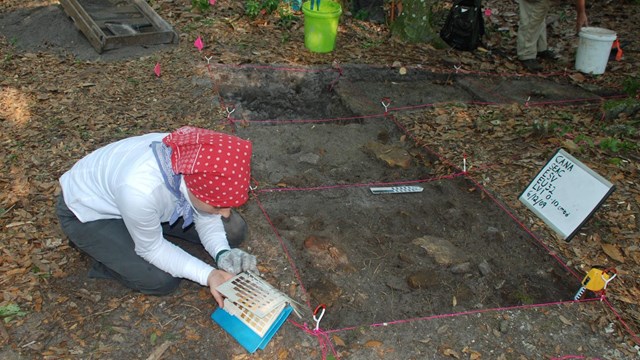
Finding a Village, Losing to Thieves In 1958, Staff Sergeant David Chase was searching for the site of the Yuchi Indian village that once stood on Fort Benning land. Off and on, for two years, archeologists had tried to locate the site, but had come up empty handed. The village, which existed in the 1700's and early 1800's until the Yuchi were removed by Federal troops, should he near the junction of Uchee Creek and the Chattahoochee River, writings by Indian agent Benjamin Hawkins seemed to say. But archeologists could find no trace of the settlement. Finally, Harold Huscher, an archeologist with the Smithsonian Institution, recommended that Chase search further south of Uchee Creek on the Alabama side of Fort Benning. In early June, Chase took a weekend walk with his son. They were about a mile south of Uchee Creek, walking along a fire break recently ploughed. Walking near the Chattahoochee and near a small, unnamed stream, Chase noticed that the ground was strewn with pieces of Indian pottery and other ancient refuse. Chase called in other archeologists and the digging began. After awhile, the archeologists were able to confirm that this indeed was the location of Yuchi Town. Chase, Huscher, Frank Schnell Jr., and Frank Schnell Sr. all participated in preliminary investigations that took place sporadically between 1958 and 1962. Anthropologist Joseph Mahan Jr. also brought a group of student volunteers. These early investigations turned up large clay-lined rectangular pits, the remnants of housing, burials, and a number of Indian artifacts and European trade goods. But there is much more to be learned. The U.S. Army is sponsoring ongoing investigations at the site in cooperation with Yuchi Indians living in Oklahoma. The investigations, in time, should disclose many more key details of earlier Yuchi lifestyles. Investigating such a magnificent relic of Indian culture offers an unparalleled opportunity for those wanting to learn more about the history of the Southeast. However, there has been a down side to finding the site. Unauthorized pot hunters have invaded the excavation area and broken into Indian graves looking for artifacts. Archeologist Chad Braley has demonstrated that such looters have dug more than 1,000 holes at the site. These unauthorized digs are illegal, and if caught, pot hunters face possible imprisonment and fines up to $10,000. To stop future degradations, the Army has installed electronic surveillance equipment at the site. Looters destroy scientific evidence by removing artifacts and by disturbing soil layering so important to research. And the damage is irreparable. Whenever any unauthorized digging occurs, part of our national heritage vanishes forever.
|