6 - Seeds of Change

(Click images to enlarge)

Sentinels of the past's secrets, the great mounds are legacies of what the human will can accomplish. The builders had no bulldozers or other machinery to help them, only their strong backs, hands, and legs. They made some mounds only a few feet tall. Yet even these small monuments were often hallowed ground with potent symbolism for people living for miles in all directions. Other mounds were much more impressive, soaring toward the sky like small mountains and offering breathtaking views from their summits.

Figure 41: Generalized Mississippian Mound Complex (52.8 KB).Mounds preserved at places such as Ocmulgee and Etowah, Georgia, Moundville, Alabama, Spiro, Oklahoma, and Cahokia, Illinois draw thousands annually. Even today when visitors ascend these monuments, they often linger at the top in peaceful contemplation just as the builders must have done some thousand years before. If there is a breeze to catch, on even the hottest days it seems to drift over the earthworks.

The human effort required to create the largest mounds was extraordinary. From dawn till dusk, the prehistoric workers toiled. They moved back and forth from great borrow pits, collecting sand, clay, and dirt into baskets, then carrying them to the emerging mound. Emptying the baskets, they used their feet to compact the soil, then returned to the pits for more dirt. The ribbon of workers moved in this procession day after day.

As the mound slowly grew, they built a ramp up its lace toward the top and eventually added wooden steps. At last, when the height and shape of the creation were satisfactory, the builders collected clay from the river bank to coat the entire mound, sealing in the dirt and reducing the chance of erosion of all their labor.

While the exact construction methods sometimes differed, mound building occurred in many places at about the same time. Mound centers flourished mainly along major rivers in many areas of the South, but also emerged as far north as Wisconsin and as far west as Oklahoma. Vast numbers of these monuments, however, did not survive into the modern era. These mounds, including some built on Fort Benning land, have vanished, destroyed by looters, construction projects, farming, and erosion. Enough were spared and preserved, however, to allow scientific exploration. The archeological excavations, coupled with written accounts from early Spanish and French explorers, document the powerful role the earthworks served in human life.

They reached their zenith of importance during the Mississippian era, Which takes its name from the Mississippi River where a complex, new culture evolved about A.D. 700. It was along the fertile banks of the continent's largest river where people congregated in small cities centered around mounds.

The most impressive of these cities was Cahokia in southern Illinois. with more than 100 mounds spaced over about six square miles. Cahokia's largest monument is Monk's Mound, named for a group of Trappist monks who established a monastery there in 1809. Monk's Mound rises majestically over the countryside some 100 feet and at the base covers about 15 acres.

Once, long before the monks found their way to Illinois, a great Mississippian leader resided at the peak of Monk's Mound in a large building, 104 feet long and about 48 feet wide. The structure probably also served as a council house for the ruler's advisors and as a temple. Cahokia's leader ruled from the ancient city over communities and farms dispersed over some 125 square miles.

Some think as many as 40,000 people once lived in Cahokia, while others, including James B. Griffin, a noted mound authority, doubt the population ever exceeded 8,000. Regardless, Cahokia and other mound centers, because they knit so many inhabitants together into a structured, hierarchical society, constituted major change for North American people.

The mound building culture gradually attracted followers far from the Mississippi River along other waterways. The second largest mound center ever discovered, Moundville, once flourished in Alabama. There, along the winding Black Warrior River near Tuscaloosa, Mississippian people built 20 mounds around a seven and a half acre plaza. The largest mound rises some 60 feet. Moundville's leaders controlled trade, whether there was war or peace between competing factions, and the distribution of food among people over an area of about 240 square miles.

At times, the center was home to many, although exact numbers are impossible to determine. Between A.D. 1230 and A.D. 1300, inhabitants built a stockade fence around their settlement and people began moving from the surrounding area inside the enclosure.

At other points during the Mississippian era, most of the population loyal to Moundville was dispersed into the surrounding region, apparently living in small farmsteads. Only the leaders and their servants stayed full-time at the mound center, suggests research by archeologists Vernon Knight and Vincas Steponaitis.

While Moundville served as the administrative and religious hub for the area, there were other mound centers not far away with leaders subordinate to Moundville's rulers.

One of many interesting facets of the Mississippian culture was the followers' tendency to build different types of earthworks for different purposes. For example, some mounds were for burials only. Others were enormous, flat-topped, earthen pedestals for sacred temples, some of which were lavishly decorated with statues and other ornaments. The society's elites also built their homes and meeting places atop some flat-topped mounds.

Mississippian rulers had both religious and secular power, a potent combination that allowed them to wield enormous influence over large territory. People living some distance away often paid tribute to these leaders, sometimes in the form of choice parts of slain deer. Toward the close of the era, paramount chiefs at some mound centers held sway over virtual states. Chiefs from other, less powerful mound centers formed alliances with these paramount chiefs, forging formidable military alliances, according to archeologist David Halley.

The heads of mound centers probably inherited their positions, much like the kings and queens of Europe. Lineage was traced through women, but men governed most mound centers. There were, however, a few Mississippian societies led by women. When the leader or chief of a mound center died, his authority, in most cases, passed to his sister's son.

Elevated status was probably enjoyed by all of the leaders' relatives, who, at least in the larger mound centers, also lived atop mounds.

At Moundville and Cahokia and many other centers, the great ceremonial mounds were often spaced around a large plaza where residents played games. One of the most popular was chunkey. Key to the contest was the chunkey stone, a disk, sometimes made from highly polished stone. The game began with the stone rolled on the ground. Contestants threw spears in the direction they thought the stone would land, and the player won whose spear landed closest to the place where the stone finally stopped.

The plazas were also gathering spots to hear speeches and partake in religious ceremonies. Leaders, sometimes wearing masks and colorful costumes with a profusion of feathers, jewelry, and ceremonial weapons, paraded on the mounds high above the assembled citizenries. Rulers used the occasions to call forth blessings upon their people and the fields where they grew corn, beans, and squash. The precise rituals enacted, unfortunately, went unrecorded and are lost.

Figure 42: Early Mississippian Averett Potsherds.The people who lived on Fort Benning land during the first centuries of the Mississippian era (A.D. 900 to 1250) are somewhat of a mystery. They followed the Averett culture, and unlike many of their nearby contemporaries were not overly dependent upon mounds. Until recently, most scientists argued that these people were not mound builders. Recent research, however, suggests that residents did erect at least one mound near Fort Benning.

The lack of extensive mound building led archeologist Gail Schuell to argue that the people who lived on Fort Benning land participated in a less complex society than their neighbors nearby to the north and south. Building mounds and houses atop them was a way for Mississippian people to legitimize their leaders' authority, she suggests. The absence of mounds Figure 43: A Shell Necklace.attributable to the Averett people may mean they lived under few levels of leadership. There is still much to learn about these people, however.

Averett sites are scattered across Fort Benning. Several may represent villages, according to the work of Staff Sergeant David Chase, while others were probably small farmsteads or hunting camps.

By the Middle Mississippian era of A.D. 1250 to A.D. 1400 and the Late Mississippian era of A.D. 1400 to A.D. 1550, the great majority of sites occurred along the Chattahoochee. Agriculture was often the lure for settlers along major rivers. They were drawn by the fertile soils, Figure 44: Engraving of Indians Preparing and Planting a Field (57.6 KB).which were nourished by periodic flooding. But precisely when people on Fort Benning land began growing significant amounts of corn is one of the questions to be answered by additional research. Clearly, residents of mound centers, villages, and small farmsteads near Fort Benning grew substantial corn crops, as well as beans and squash. Farming was so important that at larger communities special priests waited until they perceived conditions were auspicious then summoned everyone to the fields for planting. As the crops began growing, primary responsibility tending them fell to the women, with men standing guard at night to scare away rabbits, deer, and other hungry creatures. Everyone likely joined in the harvest.

Inhabitants on Fort Benning land in the first centuries of the era, however, may not have been so dependent on corn. Perhaps they chose to live along the Chattahoochee because of its value as a route of transportation. Mississippians often used rivers as their pathways to trade and had grown quite skillful at crafting sleek canoes to glide across the water. For their boats, they kept a sharp look out for stout trees that fell in the woods because of high winds, erosion, or some other cause. They hollowed out the center of such a tree with stone axes and burned away the hard core they couldn't remove with axes.

Carefully, they shaped the two ends of the canoe into sharp points that could slice through the water, quickly and silently. They also carved lightweight paddles. They traveled miles by canoe to trade or to make sneak attacks on enemies. David Chase discovered beads fashioned from ocean seashells in an Averett-era burial on Fort Benning, an indication of the trade that occurred.

Still, there is some hint that people in the Fort Benning area during the Early Mississippian era of A.D. 900 to A.D. 1250 did grow corn. David Chase found a bit of evidence of corn growing at one site he excavated in the 1950's. More recent findings were uncovered at the Carmouche site. The excavation near Upatoi Creek produced significant clusters of Early and Middle Mississippian-era artifacts, as well as remnants from much earlier eras discussed in previous chapters. Archeologists uncovered several possible corn seeds. None could be definitively identified, however. Even if they could be confirmed, there weren't any corn cob fragments discovered and no other evidence of corn. If corn was grown at the location, it was never a significant crop. This does not mean, however, that the residents didn't grow corn somewhere else.

Archeologists Dean Wood and Tom Gresham suspect the Carmouche site may have served as a short-term camp for hunting or collecting wild plant foods. The people who used the site probably also lived at a more permanent location nearby where soils were more fertile. While there was insufficient evidence to say absolutely that Carmouche was a short-term camp, the archeologists pointed out there were no burials, suggesting that inhabitants probably did not stay for extended periods because Mississippian people often buried the dead beneath their homes.

People who camped at the Carmouche site used a drill archeologists call a microtool. Long and stubby, the microtool resembles a spike. At the Carmouche excavation, the devices tended to be about an inch long and about one-third of an inch wide. Unfortunately, because of mixing of soils from different time frames, scientists were unable to say for certain which tools were used during the Mississippian era and which were used earlier.

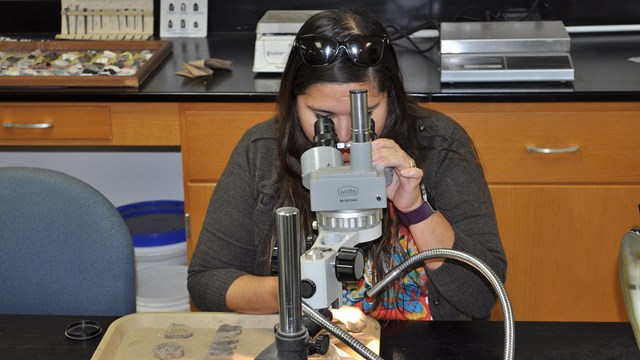
Eight whole or partial microtools were found. By examining them under a microscope, researchers detected shell polish on the tips of at least three. The polish partially extended up the sides, indicating the microtools were used for drilling or punching holes into shell.

Mississippian people valued seashells and willingly traded food and other goods for them. Their Figure 45: A Shell Gorget from Etowah.favorite was the large conch or whelk shell, which they made into various kinds of jewelry, including the delicately carved gorget - a type of pendant. The ideal shell had a wide central spiral, called the columella, and a colorful whorl, the part fanning out from the central column. The artisan carefully cut the whorl away from the shell central column. The column, about the size of a stick, was then cut into small beads, which archeologists call barrels or disks. Or the entire columella might be saved, a hole drilled in one end, then the shell piece hung from a necklace of beads or cord. The finished ornament resembles an upside down tornado frozen in shell.

The making of the gorget involved cutting out a square, circle, or oval from the relatively flat shell whorl. The artisan then drilled holes into the gorget to hang it from a necklace. Detailed representations of birds and animals, both mythical and real, were often carved into the gorgets. Some of these images are so fluid they seem alive. Other designs represent ominous-looking creatures from the underworld. The likenesses probably symbolized beliefs and group affiliations of the person who wore them, as well as the individual's leadership position.

Archeologists found flat grinding stone tools at the Carmouche excavation that were probably used for crushing plant foods, indicating consumption of these foodstuffs even at what was probably only a short-term camp. There were also many pottery pieces. People during the Early Mississippian era at the site mainly produced plain pottery, with little or no decoration, a significant change from the intricate, complicated stamped pottery of the Woodland era.

Why they preferred unadorned vessels is one of the mysteries about the Averett people. They tempered the clay vessels with sand and grit and used small amounts of ceramics identical to wares made at the major mound centers to the north and south - Etowah and Rood's Landing. Archeologists infer from this that the Fort Benning area may have been a buffer zone between territories ruled by the two mound centers.

Figure 46: Two Marble Statues from Etowah.To the north, near Cartersville, Georgia loomed Etowah where a powerful Mississippian chiefdom developed. Now preserved as a state park, Etowah was built around six major mounds, one about 60 feet tall. A temple once stood on the pinnacle and may have also served as the residence of the primary chief. Skilled artisans created magnificent ceremonial objects at Etowah, including carvings and statues.

They also made a polished stone disc with scalloped edges, large copper sheets embossed with male figures wearing falcon costumes, and an intricate head dress pieced together with sheets of copper. Two statues carved in marble of a kneeling man and woman were uncovered from a burial mound where more than 500 people were interred, some of them probable leaders dressed in ornate costumes and accompanied by numerous grave goods.

The community was well defended. A deep ditch partially encircles the 52-acre site, and the Etowah River forms another boundary. There was also a stockade fence with bastions where sentries stood watch. The defenses made the center practically invulnerable and indicate the sporadic warfare that erupted among Mississippian people.

Sources of conflict were seemingly inevitable in the Mississippian culture. Because they built their main settlements along major rivers, greater numbers of people competed for a limited amount of land.

This competition helped fuel disputes, suggests archeologist Lewis Larson, who spearheaded much of the archeological research at Etowah. Political rivalries arose between different mound centers over such crucial resources as hunting territories, agricultural lands, and trade routes, according to archeologist David Anderson.

In his research into Mississippian settlement in northwest Georgia, Anderson has shown that as population densities increased so did warfare.

Another reason for fighting was that some Mississippian groups forced their way into areas where people lived under less structured rule and still practiced Woodland customs depending more on hunting and gathering food. This may represent how the Rood's Landing mound center was established south of Fort Benning. Located on a peninsula formed by Rood's Creek and another smaller creek, the mound center was also well protected with moats and a stockade fence.

Covering some 15 acres, the site included eight, possibly nine mounds, with five apparently located around a large open plaza. Excavations disclosed that at least some of the flat-topped mounds were built in several stages, typical of many Mississippian mound centers. These building episodes probably began when a structure atop the mound was deliberately burned. More dirt was then added to the mound, which was then covered with a new cap of clay. Such building events were probably tied to rituals of renewal and purification.

Singer Moye, another major mound center associated with Rood's Landing, was only about 17 and a half miles away.

This site once was a town with six platform mounds and an earthlodge, a building covered with dirt figure 47: The Reconstucted Earthlodge at Ocmulgee National Monument in Georgia (38.9 KB).except for the central smoke hole. A similar earthlodge has been reconstructed by the National Park Service at the Ocmulgee National Monument near Macon, Georgia.

The Ocmulgee earthlodge, reconstructed over the original floor, has 50 clay seats rising slightly off the floor and aligned along the lodge wall. Three seats, raised higher than the rest on a bird-shaped platform, were probably reserved for the most prominent leaders.

The pattern of human settlement not far south of Fort Benning consisted of major ceremonial centers such as Rood's Landing and Singer Moye, smaller villages with one to three mounds, and the smallest of all the settlements, farmsteads. Everyone depended on crops for much of their food.

One of the smaller villages, Cemochechobee, spread out over about 150 acres and had three mounds. Located in Clay County, Georgia, along the Chattahoochee, the site demonstrates what was apparently true of many Mississippian centers-mounds were often built on land already considered special and sanctified for many years. An archeological team led by Frank Schnell Jr., Gail Schuell, and Vernon Knight probed below two of the mounds. They found that before the mounds were built, early residents had set aside part of the area as a carefully tended burial ground. Another section seemed connected at different times either to important ceremonies and games or to housing for the elite.

One interesting aspect of an early pre-mound configuration was what must have been a tall tree pole, about two feet in diameter, that stood in the midst of the ceremonial area. Archeologists think such poles were important to Mississippian villages. Males sometimes practiced their shooting skills, trying to hit targets 30 to 40 feet up on the poles with a bow and arrow. The poles may have also served as places to hang war trophies or to chart the sun's path in changing seasons. Athletic contests, such as the spear throwing game chunkey, were often played nearby. At least by the time Europeans arrived, the post was important to a game played by men and women. Called the single pole game, the goal was to gain possession of a small, hard ball and to score points by flinging it against the pole higher than a designated mark. Bonus points were won by hitting an animal skull or some other object attached even higher on the pole. Women threw the ball with their hands, while men used sticks with webbing on the end.

The men also used the sticks in a game similar to lacrosse called "little brother of war." Two teams ran up and down a field, struggling to control the ball and trying to throw it with their webbed sticks through goals at each end of the field. The contests could be brutal, resulting in many injuries and, occasionally, deaths.

In pre-mound levels at Cemochechobee, there was also a clay fire pit more than three feet in diameter and a little over a foot deep. A wide, flat ring of clay, apparently about eight inches wide, circled the pit. Here people apparently maintained the sacred ceremonial fire, perhaps keeping it continually burning. Adjacent to the fire was the burial of an adult male. A pole spud, a symbol of rank formed out of greenstone, was placed in his right hand, and there was a fragment of copper on his right shoulder. The body was in a rectangular tomb oriented with the cardinal directions and covered with a series of charred logs or bark strips. Both of his feet were severed and missing from the grave.

The mound centers south of Fort Benning impacted local residents, though to what extent is difficult to know. Certainly pottery similar to ceramics used at the Rood's Landing site and Figure 48: Ceramics from the Rood's Creek Mounds.associated mound settlements appears at Fort Benning. At the Carmouche site, for instance, people using Averett pottery also cooked with globe-shaped jars with handles that apparently came from farther south. These jars were made with a coarser paste than what the Fort Benning people normally used and were probably gained through trade, surmised Dean Wood and Tom Gresham. These vessels were preferable for boiling foods for longer periods than the more straight sided jars more commonly used by people living on Fort Benning land. The coarser paste and rounded shape of these jars made them stronger and more durable under intense heat.

Pottery decorated with complicated stamping associated with the Etowah mound center to the north also appeared at the Carmouche site. This pottery often featured designs of nested diamonds - one diamond shape inside a larger diamond, inside another diamond. The designs were carved into a wooden paddle, then pressed into the clay. Also associated with Etowah were nested concentric circles and other curving designs. The Etowah pottery tends to be similar in paste, temper, vessel size, and form with the Averett pottery made by residents of the Fort Benning area.

By the Middle Mississippian period of A.D. 1250 to A.D. 1400, the people living on Fort Benning land used pottery associated with the Rood's Landing site to the south almost exclusively, although Fort Benning inhabitants were still on the periphery of that chiefdom's influence, suggests archeologist Dan Elliot. However, by the Late Mississippian period of AD. 1400 to A.D. 1550, people on Fort Benning land were apparently more under the influence of mound-based chiefdoms.

One of the most important settlements of the time was at the Bull Creek site, just north of Fort Benning. Excavations there conducted by Isabel Patterson and others in the 1930's demonstrated that there was once a village covering about three-quarters of a square mile. Found with some burials were ceramic containers shaped to resemble dogs. Some of these dog effigy pots were painted with scroll motifs. Large villages from this era have been located on Fort Benning along the Chattahoochee and its major tributaries. During this stretch of time, population reached new heights on Fort Benning and agriculture had firmly taken hold. Scientists note that occupation sites from this era shift away from sandy soils to more fertile silt loam soils.

There were also mounds on Fort Benning. However, because they all disappeared long ago, there is disagreement among archeologists about precisely how many mounds once existed and where. At Engineer's Landing on the Chattahoochee River banks, there were perhaps two mounds. Harold Huscher of the Smithsonian Institution investigated the site after the presumed mounds were gone and discovered stains in the earth, indicative of ancient rectangular houses, but no definitive evidence of a mound.

Also in the vicinity of the main post, near the confluence of Upatoi Creek and the Chattahoochee, another village existed that apparently featured two mounds. Floods in the 1880's apparently badly damaged the earthworks, and eventually farming destroyed them.

Clarence Moore, an archeologist who traveled the Chattahoochee by steamboat, apparently visited this site in 1907. He reported that the mounds were small and worn down by plowing. By the time David Chase visited the site in the 195015, the mounds had disappeared, as well as most evidence of a settlement that once existed.

Other mounds may have stood on Fort Benning, but traces of them haven't been found. One or more platform mounds also existed at a site just north of the post. Called Kyle Mound, the site may have been visited in the mid-1800's by Charles C. Jones Jr. He definitely saw mounds on or near what became Fort Benning, but archeologists aren't sure exactly which mounds Jones described. One of the largest of these earthworks, Jones wrote, "was used to construct a heavy dam, and nothing was found in it save a shell drinking-cup and bits of charcoal."

Pottery is one of the most abundant artifacts found from this period. People living on Fort Benning land during the closing centuries of the Mississippian era used ceramics decorated in a variety of Figure 49: Intact Ceramic Vessels Displayed at Etowah, Georgia (33.4 KB).ways. Sites reveal large amounts of complicated stamped pottery, much of it with curving designs. Potters also decorated with incised lines, punctations, or check stamps resembling the waffle-like decorations first seen in the preceding Woodland period.

People living in the Fort Benning area also traded for small amounts of pottery associated with northern Florida. Some Florida locations where the pottery apparently originated have revealed European trade objects.

Figure 50: Pottery Designs Found on Sherds at Bull Creek (69.3 KB). Figure 51: A Mississippian Dog Effigy Pot from Bull Creek.

These first signs of European contact with native cultures signalled the beginning of major change in the Southeast. In the next era, the mound cultures collapsed forever. Fort Benning gradually became an important heartland for Creek Indians.

Chapter 7: Invasion and Devastation

Return to the Table of Contents