Research Techniques Call for Patience and Care

The Carmouche site proved to be one of the most important indicators of early prehistoric settlement on Fort Benning. Excavation began in the fall of 1983. The first step was to clear vegetation from the toe ridge overlooking Upatoi Creek. Next the archeological team dug a series of holes, about 16 feet apart, all across the site. The holes were about one foot deep and one foot across. The dirt from each hole was carefully sifted through a screen with quarter-inch mesh. The dirt passed through, but spear points and other artifacts remained on the screen. These artifacts gave the scientists their first glimpse of the extent of human occupation at the site.

Next, they dug three long trenches, each six and a half feet wide and, in some places, two feet deep. They mapped the soil layers they observed along the trench walls, noting colors and textures. They also photographed the soil layers and collected artifacts uncovered by digging. These artifacts revealed for the first time that the site was used during many different eras, prompting the scientists to expand the excavation to an area more than 400 square yards in size.

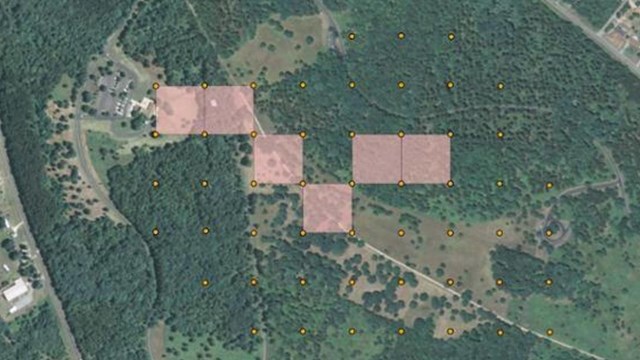
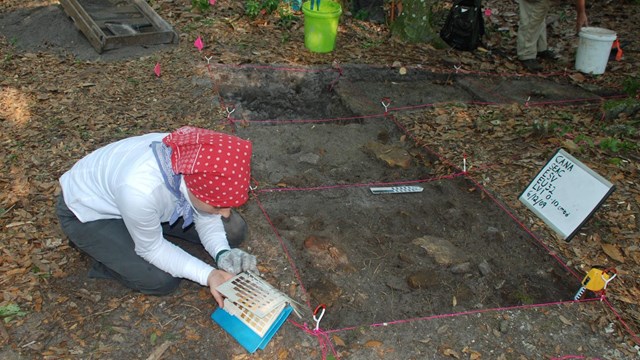
They set posts in the ground, marking the site into a grid of squares. Then workers dug about four inches in the first square. They sifted the dirt through a quarter-inch screen and placed any artifacts found in plastic bags, labeled with the exact location of discovery. They also hand picked bone fragments and charcoal pieces from the screen and placed them in vials, which were also stored in the plastic bags.

Methodically, the team dug in one square after another until the entire area was exposed about four inches below the surface. They dampened this freshly exposed surface to help highlight any stains. The stains, called features, could represent a pit once used to store food, the residue from a wooden post used in prehistoric housing, or the remnants of a tree root. Scientists, trained to tell the difference, carefully examined each stain. If they determined that one resulted from past human activities, they drew a representation on a site map. Dimensions of these stains and the colors were carefully recorded.

The archeologists then carefully removed one half of the stained soil with a trowel, again sifting the dirt through the screen. One of the crew drew a representation of the stain's profile. If an archeologist thought the stain deserved further study, the rest of the stain was cleared away by hand, and the dirt from the stain was filtered through an even smaller screen with one-eighth inch openings. Samples were collected from the stains such as charcoal for radiocarbon dating and soil from which ancient pollen might be extracted.

When all the stains at one level had been studied, the team dug deeper. They went back to square one and removed another four inches. Square by square, they dug down to this new level. By the time they were through, they had peeled back nine levels of dirt. The last level was about three feet below the original earth surface.

Return to Chapter 4