4 - Shaping the Earth

(Click images to enlarge)

The people cleared a stretch of land near the Chattahoochee River for the camp where they would stay for several months perhaps longer. They slashed and pulled out the smaller vegetation of bushy plants and young trees then went to work on the larger trees the ones they couldn't cut down with hand tools. With axes and stone knives they peeled away the bark as high as they could reach. Eventually the trees would die and stand like eerie skeletons around the campsite.

To build their huts, the men used small trees chosen when they cleared the site. They rejected pines because the wood was too brittle and likely to break when bent. They used young hickory saplings and some oaks all about a foot in diameter at the base. The men hacked away all the branches using stone axes made from quartz or chert.

After they stripped branches from the saplings, they soaked the poles in the river to make them more pliable. After a time, they waded in to retrieve them and carried them to the spot where they intended to build. Using shovels made from deer shoulder bones and wooden handles, they dug a circle of holes, all about eight inches deep. The distance across the circle was about seven yards. They lodged the tree poles into the holes, packing clay around the bases to hold them secure, then bent the poles, made supple from soaking, toward the center of the circle. Then they tied the ends together in a dome-like frame and interlaced long sticks through the frame to support a cover of animal hides, which the women were preparing.

Using bone and stone tools, the women punched holes in the deer skins then laced them together, before placing the animal hides on the frame of the hut. Everyone added a layer of plant thatch and strips of bark on top, taking care not to cover the hole deliberately left in the roof for smoke to escape. There was also another opening on one side of the structure, a doorway with a pleasing view facing the river.

Figure 23: Various Layers at the Carmouche Site (34.1 KB).The band stayed in their riverfront home for months until the air began to cool and the leaves changed color. Then they gathered their few belongings to travel to another place where hunting would be best, the Carmouche site where the Bradley Fighting Vehicle firing range now exists. The change of setting stirred excitement for everyone. They knew that deer had grown fat from the long summer of grazing and a rich diet of acorns and hickory nuts. The men eagerly discussed the upcoming hunt so important to their winter survival. The women carried large baskets woven from strips of oak, which they would use to collect fallen nuts.

At their destination, a ridge overlooking Upatoi Creek, once again they prepared their campsite. The men cleared away vegetation, but this time there was no need to erect substantial shelter because they would be staying only briefly. They used poles from young trees as they had before, but built only lean-tos. They dug shallow holes and jammed in the poles, leaning them at 45 degree angles from the ground. They propped up the poles by lashing them to tree trunks. Everyone then covered the frame with thick layers of leaves and tree bark.

They also dug a series of holes of varying depths around the camp. Some, about six inches deep, were for storing nuts. Others about the same depth would be used to bury garbage. The shallowest holes were for campfires, which they lined with stones. Several family members searched for flat pieces of sandstone along the edges of Upatoi Creek to use for cracking hickory nuts and acorns and grinding and crushing seeds and plant foods.

Once shelter was ready, the men built a series of wooden frames to dry meat from the upcoming hunt. Into the ground, they stuck four sticks, each forming a v shape at the top. They laid a framework of sticks in an arrangement resembling a barbeque grill into these notches. A fire of green logs beneath the frame would smoke the meat, preserving it for the cold months ahead. Next to these frames the men stuck two more poles in the ground and stretched a deer skin between them. This baffle would block the wind and help ensure that smoke from the fire wafted upward toward the meat.

Figure 24: An Awl Made from a Deer Ulna.Later, the men sharpened their spear points and lashed them to wooden spear staffs. Small pieces of chert and sparks flew in the air as they worked. The clinking sounds of toolmaking were often drowned out by laughter as they told stories and boasted and teased about their hunting prowess. A group of children watched from a distance for a while, then began chasing one another and racing into the woods.

Some 5,000 years later, archeologists led by Dean Wood discovered remnants of such an encampment at the Carmouche site, a place also visited by others much earlier in prehistory. Evidence of the drying racks, baffles, and lean-tos appeared in the ground as stains-residue from posts that had long since rotted away. The stains measured from six to 12 inches in diameter and revealed that posts were anchored in the soil to a depth between four and eight inches. While the age of many of the stains could not be determined, some certainly represent posts erected during the Late Archaic era.

Figure 25: Sketch of a Posthole from the Carmouche Site.Archeologists also located the residue of 11 pits at the site, represented by stains that were from about one to three feet in diameter. These pits ranged from about eight inches to about two feet deep. Traces of wood charcoal were found in one pit about 16 inches below the soil surface. Radiocarbon dating revealed the charcoal was burned about 1910 B.C., within the Late Archaic era. The era lasted more than two thousand years between about 3000 B.C. to 700 B.C.

Also uncovered were 12 grinding slabs, large flat rocks used to pulverize seeds and other plant foods. Early people placed food on a slab, then crushed and ground it with smaller, fist-sized rocks called grinding stones or manos. These smaller rocks found at the site were formed from quartz, quartzite, sandstone, and, in one instance, gneiss. The repeated grinding wore away broad, shallow depressions in the slabs.

All of the grinding slabs, with one exception, were made from sandstone, easily available in tabular form in Upatoi Creek and in the flood plain adjacent to the creek. While grinding slabs were used during different prehistoric eras, the growing appetite among Late Archaic people for various plant foods makes it likely that a number of the grinding slabs and stones found at the Carmouche site date to this time.

Scientists found 12 pitted nutting stones at various levels of earth at the site. Coupled with a large amount of hickory shell found, the pitted rocks seem to indicate that throughout prehistoric time the site served as a place for collecting nuts. After breaking the shells in the cavities of the nutting stones, early people often crushed the nut meat into a kind of meal or flour on the grinding slabs. Native Americans Europeans encountered added hickory and acorn meal to soups to thicken them and also made thick breads from nut meal. Researchers think that Archaic people prepared similar foods. Most acorns required more preparation than other nuts to be palatable. The acorns, shells partially cracked, were placed into shallow depressions in the sandy soils. Then hot water was poured repeatedly over the shells until distasteful tannin leached away. Prehistoric people learned that the sweetest acorns generally fell from trees associated with the white oak family, identified by round-cornered leaves.

Flat stone ornaments called gorgets also appeared at the Carmouche excavation between 12 and 20 inches beneath the surface. The artifacts apparently came from the Late Archaic era. People drilled holes in the gorgets, made from sandstone and soapstone, to string them on necklaces as pendants. Soapstone is a relatively soft rock found in the Piedmont region of both Alabama and Georgia, and it is especially associated with the Late Archaic years when people used it often and in a variety of ways. Frequently greenish in color, soapstone may also be white, gray, or almost black. A type of talc, soapstone, also known as steatite, has a greasy or soapy feel, which explains the derivation of the name. Prehistoric people used this relatively soft rock for carved bowls.

Earlier people had roasted meat over an open flame and prepared stews in animal skins placed in the ground, adding red-hot rocks for heat. They may have also used crude bowls of wood or sandstone, but these containers couldn't withstand fire. Because wood burned and sandstone cracked, to cook in vessels made from them probably required heating the food with the same hot rock technique used in animal skins. The constant heating of rocks was inefficient and tedious. A better solution was the soapstone bowl, a breakthrough because soapstone can withstand the intense heat of a campfire.

Figure 26: Outline of a Prehistoric Bowl in Soapstone Boulder.Soapstone's texture and composition vary considerably, and the people who stayed at the Carmouche camp would have learned to gauge which types could be best shaped to their liking. Even so, knocking loose a chunk large enough to serve as a bowl wasn't easy. Half-emerged bowls left imprisoned in rock divulge just how difficult the task could be. A forceful assault with a mallet was required to free a large, convex-shaped rock from a boulder. Then the bowl maker chiseled out a shallow depression in the detached stone, forming a vessel that was both solid and heavy.

Finding soapstone wasn't a problem for Late Archaic people camping at the Carmouche site. Soapstone outcrops are nearby, perhaps as close as 20 miles to the north.

Clearly, soapstone was valuable to those who stayed at the Fort Benning site. Fragments from six different soapstone bowls were uncovered. The stone was also a coveted trade item during this era.

Pottery was even more important than soapstone in its long-term implications for people of this time period. No one knows for sure how pottery developed, but archeologist Dean Wood speculates the invention was accidental. Perhaps after a rainstorm, people built a fire on damp clay. After the fire died and ashes cooled, someone noticed that the texture of the clay had hardened. Lifting the clay to examine it more closely, observers would have wondered at the way the earth maintained its shape. After studying the hardened clay for a while, they perhaps carried it to the river and dipped it in the water. When they lifted this first bowl, the water stayed inside. Through trial and error, they learned to duplicate the process that had formed the first clay vessel.

Authorities are fairly certain that the first pottery in North America was used around 2500 B.C. along the Savannah River, the border between Georgia and South Carolina. One major find of this early pottery was on Stallings Island near Augusta, Georgia. Here in the late 1800's archeologists investigated a massive heap of mussel shells 12 feet tall, 500 feet wide, and 1,500 feet long. The shell mound was left by large crowds who gathered during the Late Archaic period to fish in the river, eat shellfish, and renew acquaintances with others from far flung territories. The shells they discarded served as a shield against acidic soils and helped preserve a fascinating collection of artifacts, including decorative pins, shell beads, and bone and stone pendants. There were also fragile fish hooks and other bone tools, including awls-long needles used for punching holes to lace hides together.

Stallings Island visitors had learned to fortify pottery by mixing plant fibers such as grass, roots, or Spanish moss into the moist clay. Knowledge of the technique gradually spread to people across much of the South. The Fort Benning area perhaps played a significant early role in the dissemination of pottery.

Shortly after people along the Savannah River began using ceramics, others located to the south along the St. John's River in Florida also began making pottery. Within a thousand years, the invention had spread to Louisiana. How pottery reached Louisiana cannot be answered definitively, but this was a time of widespread trade. The use of pottery initially passed along the fall line from east Georgia until it reached the Chattahoochee River, theorizes Kenneth Sassaman. Once pottery use reached the Fort Benning area, it soon spread south along the Chattahoochee River until it reached the Gulf Coast and then moved west into Louisiana. From Louisiana, pottery spread into the interiors of Alabama and Tennessee.

Research Techniques Call for Patience and Care

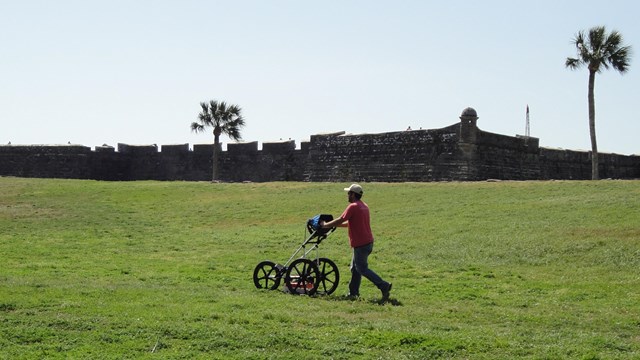
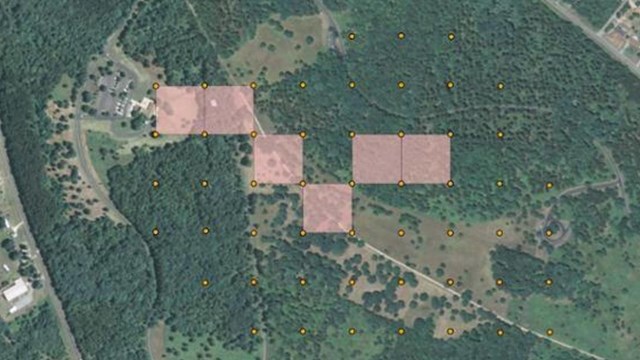
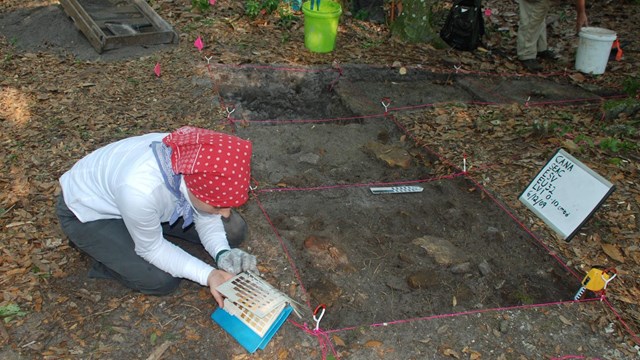
The Carmouche site proved to be one of the most important indicators of early prehistoric settlement on Fort Benning...


When precisely pottery use became widespread on Fort Benning land is still unclear. At the Carmouche site, however, charcoal in a pit about five inches deep dated to around 1910 B.C., perhaps the approximate date for the earliest pottery at the site. Some think, however, that pottery did not reach the area until about 1000 B.C.

At the Carmouche excavation, researchers unearthed more than 200 sherds of fiber-tempered pottery. By studying the texture, they determined that the pottery was probably made from nearby clays. Potters were probably women, if observations of contemporary pre-literate societies accurately reflect customs of prehistoric Native Americans. However, with the difficulties inherent in living in the wilderness so long ago, cooperation and role sharing were likely.

A prehistoric potter began by locating a spot along the edge of a river or creek where she could dig up a lump of clay. She cupped her hand into the river and sprinkled the water on the clay to keep it wet and also moistened some leaves and wrapped them around the clay for the walk back to camp. There she began making a pot by kneading thin roots and fibers into the clay to strengthen it. Gradually, she molded the mixture into a bowl, continuing to sprinkle on water to keep it malleable. Satisfied with the bowl's shape, she used a flat stick to smooth away rough spots. (Later, potters learned to twirl clay into long rolls which they coiled on top of each other to form vessels).

The potter sometimes decorated a bowl, but not always. If she wanted to make a design, she used a sharp object-a stick, bone, antler, or river cane-to stick gently into the clay, causing an indentation. Archeologists call these marks punctations. On some bowls, the potter made a series of punctations. On others, she made a punctation, then dragged the stick across the clay, then made another punctation. This punch and drag design appeared on sherds discovered at the Carmouche site.

Once the bowl was shaped and decorated, the potter left it under a hot sun to dry. The final step involved stacking kindling and larger pieces of wood around the bowl, then setting the wood ablaze and keeping it burning for a long while. Only when the potter scraped away the smoldering ashes did she learn if her creation survived the inferno or cracked into uselessness.

Prehistoric potters in the Fort Benning area eventually learned to add sand or grit from bits of rock to clay for temper. At first, they added the sand or grit along with fibers, but eventually they omitted fibers completely. Fiber-tempered pottery tended to shatter when exposed directly to hot flames, but the grit and sand acted as strengthening agents. While fiber-tempered pottery was so fragile it could be used only in cooking on top of a hot rock, the pots made with grit or sand were strong enough to be put directly into a camp fire.

Archeologist Albert Goodyear thinks the progression from depending primarily on roasting foods, to using boiling stones, to cooking in pots placed on hot rocks, to using soapstone bowls and pottery directly in the flames was spurred by growing population and diminishing territories. The resulting pressure on resources would have encouraged people to develop and accept more efficient cooking methods, which would have made cooking stews and other foods easier, enhancing nutrition. Healthier diets increased survival rates for everyone, but especially the young.

People were probably staying longer in one place than before, another factor leading to growing populations. Anthropologists have documented that birth rates climb when nomadic people begin to settle. In all, scientists have located 85 Late Archaic sites on Fort Benning, evidence of growing population. They also associate the use of pottery with people becoming more established. However, long-term occupation sites for this period on Fort Benning remain elusive. The Late Archaic sites discovered so far apparently served as short-term camps. Typical is a site, called RU95, examined on the Alabama side of the post by a team directed by archeologist Martin Dickinson. Researchers located only scattered pieces of fire-cracked rock, several hammerstones, a few tools, and flakes left over from toolmaking.

The many small camps discovered lead some to think the area continued to be a buffer zone. People who stayed predominately in the Piedmont and others who lived mostly in the Coastal Plain may have both visited the Fort Benning area, if this theory is accurate.

Research just south of Fort Benning, however, at Lake Walter F. George supports thinking that people were staying in place longer during the year. Archeologists Vernon Knight and Tim Mistovich found evidence of camps occupied for at least one season at the lake sites.

Figure 27: A Late Archaic Point.Scientists have discovered large numbers of Late Archaic artifacts on Fort Benning, including atlatl weights used to balance spear throwing mechanisms. Spear points from this era generally have wide, square stems. Many of these projectiles discovered on Fort Benning resemble the Savannah River Stemmed point, called the Broadpoint because of its large blade. Similar spear points appear along the East Coast as far north as New England.

After the harshness of the Middle Archaic era, the climate moderated. The temperatures and humidity levels were similar to those today, and sea and river depths stabilized. Different bands may have come together occasionally to catch migrating fish, and such cooperative efforts may have marked the beginnings of hierarchical leadership, the first inkling of tribal rule. Certainly, during the final centuries of the period there were more camps near the Chattahoochee, perhaps to take advantage of fishing. People were eating more plant foods, perhaps collecting seeds from flowering species such as sunflower, and replanting seeds each year.

Longleaf pine trees may have covered much of the Fort Benning area, except the flood plains, during the Late Archaic years, according to archeologist Tom Gresham. The pine barrens apparently thrived until the coming of the Europeans, who instigated wide-scale tree cutting. Today's predominantly dwarf oak forest replaced the longleaf pines, with a mixture of turkey oak, blackjack oak, dwarf oak, and pines. Some scientists think, however, that by the Late Archaic period at least some of the dwarf oak forest was already in place.

In the closing centuries of the Late Archaic era, a new development in northeast Louisiana likely affected life along the Chattahoochee. On a creek called the Macon Bayou, people constructed a series of six long ridges of earth, one inside the other, in a giant horseshoe shape about three quarters of a mile wide. The open end of the horseshoe bordered the curving bayou. The ridges were about ten feet tall and about 100 feet apart.

Late Archaic residents built their dwellings on the ridges. They also opened up four straight passageways through the earthworks. These pathways spread out from the bayou like the rays of the sun.

Directly behind the ridges, the people accumulated enormous amounts of dirt to build a mound 75 feet high, the approximate height of an eight-story building. This mound was apparently designed to resemble a bird with a wing span of 680 feet; one of the first major earth effigies built anywhere in North America. Another mound, about a half mile away, was smaller, a little more than 20 feet tall, and may have served as a place for cremating the dead. Archeologists discovered bits of charred bone in the mound in a bed of ash.

Late Archaic people built two other mounds at the site, which is now called Poverty Point and is preserved as a park by the state of Louisiana. Researchers estimate that people collected perhaps one million cubic yards of earth or 40 million, 50-pound baskets full of dirt to build the various earthworks. There was nothing quite like this place anywhere in North or South America at the time, about 1000 B.C.

The people of Poverty Point were great traders. They sought out the finest stones from as far away as Ohio and Illinois to make tools and fascinating art. They turned amethyst, galena, red and green talc, jasper and other stones into beads, small tablets, and pendants. Most visually pleasing of all are the bird and human effigies they shaped from glistening red jasper.

It is difficult to say which came first, the flowering of Poverty Point or the trade in which its residents participated. There is evidence, however, that many different people, not just those directly associated with Poverty Point, joined in trade during this era. Pottery use spread throughout much of the South, and red jasper beads made in Louisiana appear in Tennessee and as far away as Florida. Soapstone bowls were used at Poverty Point far from any soapstone source.

The people living in the Fort Benning area likely were part of the trade involving Poverty Point, thinks archeologist Dan Elliot.

It is certainly conceivable that people living near the Chattahoochee helped supply or pass along soapstone bowls destined for Louisiana. What objects they may have received in return is uncertain, but the exchange of goods often leads to an exchange of ideas. Perhaps people living on Fort Benning land learned from their trading partners new ideas about political organization, religion, and how best to grow plant foods.

The cultivating of plants would become increasingly important in the next archeological period, the Woodland era. Mound building would also become more important, pottery making skills would improve markedly, and a mysterious ceremonialism would take hold along the Chattahoochee. But before these developments, some aspects of Late Archaic society collapsed.

There were no more major gatherings of people harvesting shellfish at places such as Stallings Island on the Savannah River in east Georgia by 1000 B.C.

By 500 B.C., the people of Poverty Point in Louisiana had abandoned mound building and slipped back into a less complex existence, similar to how their ancestors lived centuries before.

The reasons for the decline of these cultures haven't been fully explained. There is the possibility that around 1000 B.C. climate was a factor. The glaciers advanced slightly and sea levels fell a few feet, nothing comparable with the Ice Age, but perhaps enough to diminish the availability of inland shellfish and limit the runs of migratory fish. These changes may have inhibited some groups from depending so much on major rivers.

Population, while still quite small compared to today's standards, may have grown too rapidly in some areas, straining the capacity of some groups to maintain cohesion and, in some cases, heightening tensions with neighbors. Whether the cause was the weather or population increases or some other factor, fighting definitely erupted in some places because burials from the period in Indiana and Kentucky reveal spear points inside human skeletons.

Yet, there was apparently no change in climate to explain the decline of Poverty Point and no signs of warfare or unrest. Perhaps residents simply lost interest in creative endeavors. They stopped making elaborate stone ornaments, ending the need to seek out exotic-looking stones through long-distance trade.

On Fort Benning land, the Early Woodland era began somewhat haltingly. The number of sites attributable to the period drops slightly from earlier eras, perhaps an indication that fewer people were visiting the sand hills.

The Woodland era overall, however, is associated with dramatic change that altered lifestyles along the Chattahoochee.

Chapter 5: Rituals and Commerce

Return to the Table of Contents