|
Chapter 9 (cont.) Early English observers in North America noted that the chief or Micco drank the black tea first, then the rest of the council followed in strict hierarchical order. Status was also reflected in the seating arrangement, but rank wasn't necessarily permanent. A councilor could achieve higher status by great valor in war or exemplary peacetime accomplishment. Everyone sat on rectangular benches resembling cots. Animal skins and cane mats stretched across the wooden frames, which rested on four short posts or stilts stuck in the ground. Similar furniture served as beds and seating within their homes. Inside the council house, the cots were arranged in a single circle or in several circular tiers, similar to a theater-in-the-round, depending on the number of members. After the chief drank black tea, he smoked a pipe filled with a mixture of plants, perhaps including tobacco, which originated in North America. With much solemnity, the leader blew smoke to the east, then towards the other three primary directions. Then he passed the pipe to his next in rank, who took his turn, followed by his subordinate, and so on until everyone had smoked. Only then did the meeting officially begin. Despite the importance of rank, all councilors had the right to speak, and eloquence was greatly admired. The advice of older men known for their wisdom was carefully considered, but on all issues the gathering sought consensus. With all the preambles and the desire for unanimity, meetings could stretch on for hours.
Other postmolds indicated more than 40 structures within the two Rucker's Bottom villages; and experts suspect that signs of even more shelters were disguised amid the many postmolds accumulated over several generations of building and rebuilding. Most houses in the first settlement were round, with diameters between 13 and 26 feet. In the second village, rectangular buildings predominated, although round ones also existed. In both villages, there was evidence of many small structures, which in most cases probably represented store rooms (sometimes called barbacoas). These storage sheds probably sat on stilts greased to keep out varmints. Some of the other small structures may have served as kitchens, steam rooms, or menstrual houses; Europeans noted that menstruating women were segregated from the population as a matter of purification. The steam houses used by historical Indians were tightly-sealed buildings where heated rocks were moistened with a mixture of water and ground parsnips. Sitting in the resulting steam, then immediately swimming in the river, was considered therapeutic. Kitchens at Rucker's Bottom were possibly partially open sheds. There were also perhaps outdoor hearths. Maybe the villagers gathered around these open fires at night to tell the important stories passed on from one generation to the next. Europeans relayed some of the rich lore they heard, such as the old Cherokee myth about a time just after earth's creation when all animals and plants were supposed to stay awake for seven days and seven nights. Only the cougar, the owl, and a few other animals and plants persevered until the week's end. Because of their endurance, the cougar and the owl were rewarded with the ability to see well at night, while the pine, spruce, and other evergreens were allowed to keep their leaves year round. The rest of the trees were forever forced to lose their leaves once a year.
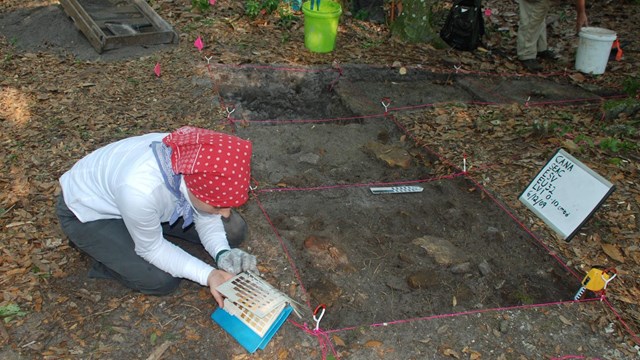
Both winter and summer houses were constructed at Rucker's Bottom. Researchers concluded that tightly-spaced postmolds found in well-defined patterns were remnants of winter homes, which, like the council house, were covered with thick clay. Historical accounts describe such shelters with low doors leading into L-shaped entranceways that blocked cold winds. A cultural paradox was that the people admired an individual's ability to withstand cold and wet, but kept their winter homes quite warm with the combination of insulating clay walls and indoor hearth. The flames, stoked in the morning, unleashed a cloud of smoke, which could only partly escape through a single ceiling hole, making the interior quite smokey. By nightfall, the fire was reduced to hot coals covered in ashes, radiating heat throughout the small space. If temperatures dropped too much in the night, someone merely poked the ashes with a stick to expose the red coals underneath. Little additional warmth was needed from clothing, which suited the inhabitants, who preferred to wear as few garments as necessary. Both sexes usually chose not to cover their upper bodies except in winter when they wore loose-fitting mantles of animal furs and skins. In warm months, the men wore only loin cloths, and the women dressed in knee-length skirts. Summer homes were built much simpler, with greater spaces between wall posts and only a thin clay coating, if any. In historic times, some houses had openings near the roof lines to allow in fresh air, but others had no openings other than entrances because of a desire to keep out insects. Excavations
in one likely winter house at Rucker's Bottom were especially productive.
Rectangular, with possible rounded corners, the dwelling left a postmold
pattern measuring about seven-and-a-
Residents of the winter house probably played indoor games to amuse themselves because small pottery disks associated with the pastimes were also found. The ubiquitous, prehistoric activity, toolmaking, also occurred within the shelter because small, stone flakes were found. Most toolmaking at Rucker's Bottom, however, took place outdoors. The final glimpse into the residents' possible habits was found just outside the door. A cluster of bones, including skulls, from small and large animals was unearthed there, indicating that the people either buried or stacked at least some of their garbage in the spot. Human burial places at Rucker's Bottom changed over time. The earlier villagers dug graves throughout the community, sometimes below the floors of their houses, or just outside the dwellings, or in the earth beneath the plaza. In the second village, most burials appeared between the middle of the settlement and the river. The concept of a cemetery was apparently developing because no graves at all were found in the half of the village farthest from the river. There were also some graves outside the village's ditch and fence perimeter. In some Mississippian communities, there were formal mortuary buildings placed on mounds or set aside by fences. Such structures sometimes served as charnel houses where corpses were kept until they deteriorated and only the bones remained. The bones were then buried. This practice was apparently not followed at Rucker's Bottom. A burial custom that was followed, at least in several instances, was putting the remains of children into clay pots. A miniature pot and a ceramic pin found near one of these burials were likely grave goods. Clay wares in graves were also unearthed at Simpson's Field on the South Carolina side of the study area. Investigators detected a small, Mississippian homestead where one or several dwellings once stood. Beneath the floor of an identified shelter, they discovered two burials. With one, the poorly preserved remains of a child about 10 years old, they found five, miniature pots. The pots, standing only from two-and-a-half to five inches tall, were well preserved, apart from some nicks from a plow which had passed over them. Despite their smallness, the artifacts provided good examples of the sorts of jars, bowls, and bottles Mississippian people in the area used.
Few grave artifacts appeared at Rucker's Bottom, suggesting an equality among the people which may have grown over time because more objects were found with earlier village burials. About half of the graves in the first village revealed goods, compared with about one in ten of the later settlement's burials. None of the objects were especially remarkable, and they were as likely to be found in the graves of females as males. Male burials were perhaps slightly more elaborate, with pots or beads predominating among the objects found, while the female burials tended to contain pins, rattles, or stone tools. The grave goods at both villages proved to be less elaborate than those found at Beaverdam Creek Mound where more of the elite lived. Individuals who did receive special burial attention at Rucker's Bottom included a man found with 500 small, perforated shells from the coast of the Atlantic Ocean. The shells were probably part of a breast plate or other chest garment that had disintegrated. A chert arrowhead was found by his shoulder, suggesting he was buried with his bow and arrow. The grave of a woman about 30 was unusual because she appeared to have been placed in a small log tomb that had rotted away. Marks from short posts remained in the burial pit that apparently were once part of the tomb. She was also once wrapped in a shroud that left stains in the soil as it disintegrated. A small, battered rock, a tool of some sort, was also in her grave. Archeologists
noticed that some burials appeared to be clustered close to one another,
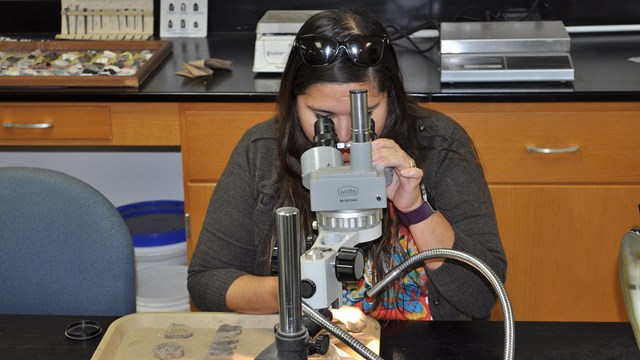
perhaps Altogether, archeologists discovered more than 100 burials in the two villages. A sample of 24 burials was closely studied by scientists at Wake Forest University, under the direction of David Weaver. They determined that only about a third of the people lived past age 30. They also learned that the villagers suffered much more serious dental problems and bone diseases than those buried at Beaverdam Creek Mound. Dental disease often became so acute that it spread sickness to bones throughout the body, sometimes causing death. Bone tests showed frequent evidence of osteophytes, abnormal growths, and osteomyelitis, infection and inflammation of bone marrow. In contrast, the only serious dental problems at the mound site occurred in a few adult women, and were probably caused by the stresses of pregnancy. These skeletal analyses established that Rucker's Bottom residents weren't as healthy as those at the ceremonial center, perhaps because the elite at the mound enjoyed a superior diet. The studies also uncovered other facts. Women at both the mound and villages averaged a little over five feet tall, while men from the villages stood about five-and-a-half feet tail. Based on a small number of samples, men at the mound possibly were slightly taller, perhaps another indication of superior living conditions.
Residents of the early village at Rucker's Bottom depended on a variety of food sources, including fish, small mammals, and shellfish caught in the Savannah River and Van Creek. Bone chemistry analysis detected higher zinc levels in their burial remains than in those of the later villagers, indicating they ate more meat. When the second village existed, fewer smaller animals were eaten, and deer became more important. A possible explanation is that the later people spent more time farming and building defenses, so when they hunted, they pursued primarily bigger game that would provide the most meat for their efforts. Roasting deer legs over an open fire was a popular way for them to prepare food. Disposed bones from game were often gnawed by animals, presumably dogs, but surprisingly no dog remains were uncovered. Interestingly, some of the gnawed bones came from bears. Later Indians probably wouldn't have allowed their dogs to chew bear bones because they believed the bear's spirit would come back to haunt them and bring misfortune on their people. In the same vein, Indian hunters asked most animals for forgiveness before they killed them, and any hunter who omitted this ritual risked illness caused by the animal's angry spirit. Many turkey and turtle remains surfaced at both villages, although the turtles were probably more important for their shells, which were used for containers and rattles. Residents of both villages also ate the same wild plant foods such as hickory nuts, acorns, maypops, and grapes. But corn was perhaps the only crop both settlements grew. Yet, for the later villagers, who may have grown more corn because of a greater population, corn was proportionally less important in their diets. Instead, the later villagers apparently ate many more acorns than the earlier inhabitants. This jump in acorn consumption was surprising because acorns require considerable preparation before they are edible. Unlike hickory nuts, which were apparently eaten less often by the later villagers, acorns have a shorter storage life and deliver less food for the effort required. Acorns had to be boiled to remove bitter tannic acid, then pounded into a pulp, which was dried to form meal. Josselyn Moore of the University of Michigan theorized that to grow more corn, villagers had to clear more fields. As they leveled fields for planting, they probably eliminated many hickory trees in the process. Then, when the fields were eventually allowed to lay fallow, the first trees to take root were pines, followed by acorn-bearing oaks. Only in older forests did the hickories grow. The consumption of so many acorns probably also meant that the later villagers weren't producing enough food for their needs. In historical times, Indians ate acorns to ward off starvation when other foods were scarce. There were also other signs, besides the bone diseases that plagued them and their struggle for adequate food, that the people of both villages didn't have easy lives. Many of the animal bones found had been broken or hacked into pieces, apparently to fit into cooking pots. This indicated cooks were struggling to squeeze every possible morsel, including marrow, from the bones. Perhaps the villagers eventually gave up the struggle altogether and moved somewhere far beyond the Savannah River in hopes of finding better conditions. This is one possible explanation for their abrupt disappearance. Whatever the cause, with the end of the second village at Rucker's Bottom, a stretch of repeated human existence on the river bluff, beginning with PaleoIndians of the Ice Age and continuing throughout much of prehistory, came to a close. Chapter 10: Conquistadors and a Princess Return to the Table of Contents
|