Figure 74: Mississippian House Replica (41.7 KB).
(Click images to enlarge)

CHAPTER 9

Villages Found and Lost
A.D. 1300 to 1450 The Mississippian Era


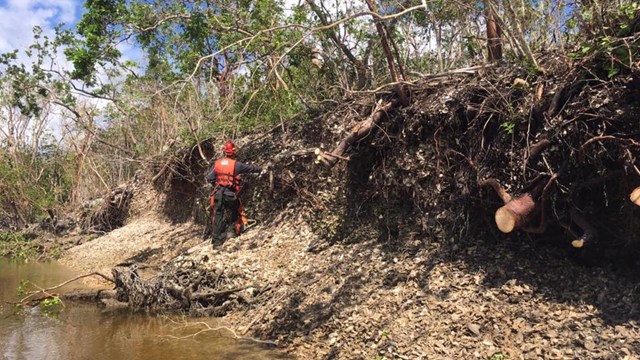
The river had served the people well when its waters wore away a natural harbor at the base of a bluff near their village. Within the 20 protected yards of this semicircle, they could collect water in gourds and pots without venturing into the swiftest currents flowing about ten yards farther out. The harbor also provided them with a safe haven for bathing and swimming, and an ideal dock for their canoes, which they prized because making them took much time and effort.

To form one of the dugout boats, they sought a stout tree, which they chopped down, then hollowed by hand with stone tools. Any of the tree core that couldn't be removed by hand was set afire until only a shallow cavity was left. Finally, they shaped the canoe's two ends into points to make it swifter, and carved wood paddles to help them guide it through the river and creeks.

The bluff, about 13 feet tall, and the river below it provided some protection from attack for the villagers whose houses were built around an open plaza about 40 yards away. But they also needed other defenses, which they strengthened over time.

They began by digging a semi-circular ditch. Then several yards behind the ditch and parallel to it, they built a stockade fence. The ditch and fence looped around the community, which was spread out over about 6,000 square yards. As the population expanded and the fence began to deteriorate, they built another fence with bigger posts, this time up to a foot in diameter, compared to the six-inch wide posts of the earlier one. This second fence stood behind a rectangular ditch that enclosed 2,000 more square yards than the first ditch.

Preparing the second set of fortifications began with digging the long rectangular ditch. Workers loaded the dirt they removed from the ditch into baskets, then carried it about six-and-a-half yards towards the village where they dumped it. They packed this dirt into a long, low embankment where the fence would stand, then dug another trench, about eight inches deep, in this embankment. Next they placed the fence posts in the trench, carefully packing clay around the post bases to hold them in place. They left several openings in the fortifications where residents could come and go to hunt, tend their fields, or dump garbage.

The village sat on a terrace near where the Savannah River joined a small tributary called Van Creek, which occasionally overflowed into a swampy marsh. The people occasionally dumped their trash in this wet area behind the village. About 400 yards on the other side of the marsh, there was a small rise where hunters prepared game before taking it into the village.

While earlier dwellers on the same terrace had pledged their loyalty to the elite living at the ceremonial mound center near Beaverdam Creek, these new inhabitants were aligned with a different religious and political authority twice as far away. Nearly 15 miles separated them from the newer center at Rembert where there were several mounds, one 32 feet tall.

The distance between the Rembert mound center and their community, considerable in prehistoric times, possibly allowed the villagers more autonomy than those who had lived on the terrace before. But the distance could have also meant more isolation, necessitating more vigilance. Perhaps, with the rise of the new mound center farther away, the village near the bluff became more important to neighboring people living along the Savannah River in small, unprotected homesteads. Maybe they considered the village a haven in times of war, and an alternative place to the mound center for festivals and ceremonies.

Yet, no matter how vital this village once was and how hard people worked to protect it, this settlement was eventually abandoned. After about 250 years of human occupation, suddenly, inexplicably, no one claimed the land overlooking the river anymore. And not only did people desert this village, but others who occupied land for more than 200 miles along the river, all the way to the Atlantic Ocean, abruptly disappeared. By about A.D. 1450, nearly everyone was gone in a perplexing departure that scientists have yet to understand fully.

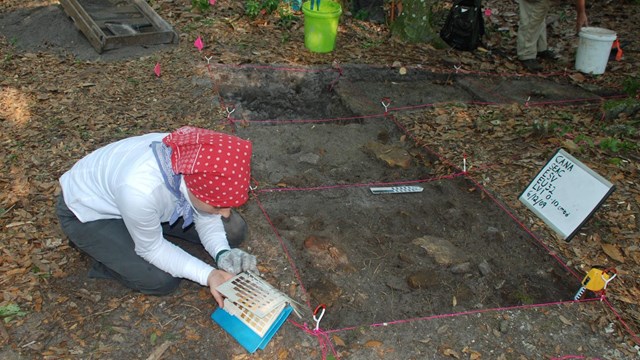
But excavations at the site of the former village, called Rucker's Bottom, in Elbert County, Georgia, did reveal other significant information about the last prehistoric years in the Russell area. Before that information could come to light, however, archeologists had to organize an immense research operation encompassing three seasons of digs in 1980, 1981, and 1982.

Coordination of the undertaking was almost as massive as the piles of dirt eventually removed from the site, which stretched a half mile long and revealed artifacts from many prehistoric epochs. A small army of workers, professionals and volunteers, were involved, and an array of heavy equipment was marshalled into place. The heavy equipment often operated simultaneously and included a bulldozer, motor grader, front-end loader, and a tractor-pulled scraping blade. The machines cleared away top soil, dug trenches, and moved tons of earth while a relentless summer sun baked the soil and the workers.

To ensure that the field work was carefully done, archeologists themselves drove and operated the big machines, taking turns at the controls every few hours in a battle against fatigue exacerbated by the intense heat.

The site soon took on the look of a small village once again, teeming with workers and interested bystanders who lived nearby. Those actually doing the research included independent archeologists, as well as archeologists employed full-time by the National Park Service and the U.S. Army Corps of Engineers. Many universities, including Wake Forest, Georgia State, South Carolina, Georgia, Wisconsin, and Michigan, were represented, either by offering field classes at the site or by conducting related research. The hundreds of volunteers nearly doubled the amount of work that could be accomplished. Among the helping hands was an entire high school class that traveled all the way from Jackson, Michigan to spend spring vacation. Weekend barbecues became a favorite occasion to honor everyone involved.

All these individual contributions helped excavate a site that proved to be rich in archeological detail. While one group of scientists examined evidence from Archaic periods, others pored over remnants of the Mississippian era nearby. Work proceeded sometimes at a snail's pace, demanding patience. Fifty days of careful observation and recording were spent finding and mapping stains just in the Mississippian sectors, which covered several acres. Altogether, the site contained perhaps as many as 10,000 prehistoric stains, every one potentially significant.

Figure 75: Artist's Depiction of a Mississippian Village at Rucker's Bottom (38.0 KB).Gradually, as the research progressed, archeologists determined that Rucker's Bottom was the setting for two distinct Mississippian villages. The first existed between about A.D. 1200 and 1350 during the height of the ceremonial center near Beaverdam Creek when the people who lived at Rucker's Bottom had no elaborate fence and ditch defenses. About the time the mound center collapsed, the first village at Figure 76: Outlines of Defensive Ditches at Rucker's Bottom (40.7 KB).Rucker's Bottom was abandoned, and the second one established. The center of the later settlement was only about 100 yards away from the middle of the first village. It was this second village which was enclosed by elaborate fortifications.

David Anderson and Joseph Schuldenrein, research team leaders, confirmed the existence of these separate villages, in part through radiocarbon dating and from differences in pottery styles found in the two areas. They further detected a span of about 20 yards between the two settlements that was relatively free of the earth stains that would indicate houses or other structures, another sign that the first community did not merely expand, but that another entirely new village developed. But why one village was abandoned for another so close by is unclear.

Map 11: Important Mississippian Archeological Sites (92.4 KB).The two villages shared similar layouts. Houses in both were circularly arranged around a plaza where a great tree pole was erected for games. Archeologists found pits filled with hundreds of pounds of boulders, indicating where the heavy posts were once moored. Males sometimes practiced their archery skills by shooting at targets hung from such posts 30 to 40 feet overhead. They also played athletic games like chunkey, the disk and spear contest, in the surrounding plaza.

A post was also central to a game that women joined in, at least by historic times when Europeans observed them. This was the single pole game; its object was to gain possession of a small hard ball and score points by throwing and hitting it against the pole higher than a designated mark. Bonus points were won by hitting an animal skull, tree limb, or some other object lodged even higher on the pole. Women threw with their hands, while men used sticks with webbing on one end. The same sticks were used for another game similar to lacrosse and reserved only for males.

The lacrosse counterpart was extremely combative, commonly leading to many injuries, and sometimes even deaths of players, who called the game "little brother of war." To play, two teams ran up and down a field, fighting for possession of the ball, and trying to fling it with their webbed sticks through goals at each end of the field to earn points.

A round council house-also called a rotunda or hot house-was also part of each village. Both of these buildings were about the same size, between thirteen and sixteen-and-a-half yards in diameter, twice as big as any other structures in either settlement. Stains from center support poles were found in one of the council house floor patterns; concentric circles of posts were found in the other.

Such shelters were also part of Cherokee and Creek Indian cultures several hundred years later in the Southeast. Descriptions from Europeans who saw them tell of roofs that rested on poles which ran lengthwise from a point high above the center of the buildings, as much as 25 feet above the ground. These roof poles slanted downward, supported by other poles standing upright in a circular or octagonal pattern. The roof poles continued six feet past the first circle of support poles, ending on another set of poles stuck in the ground. This second set of support posts, about five feet tail, formed another circle outside the first one. The outside ring of support posts was ribbed together with stripped branches and covered with thick clay, forming a wall. The roof was also sealed with clay, then covered with pine bark shingles. Builders left a small smoke hole at the roof top, but because of the insulating clay even the smallest fire could easily heat the interior to a high temperature, prompting the name "hot house". Entrance was gained through a door placed at the end of a six-foot long hallway that led into the center of the structure.

The building served many functions. Dances and festivals were held there, especially in winter during bad weather. Guests from outside the village also sometimes slept in the council house, as well as anyone else who had no other place to stay, including the sick requiring isolation. But the shelter's most important purpose was to provide space for the chief and his council to meet in winter.

Figure 77: 1981 Photo of Rucker's Bottom Excavations (36.7 KB).Council houses may have been common during the Mississippian period in villages that were part of weak chiefdoms, according to Chester DePratter. A chiefdom was weak when the leader resided at a ceremonial center, such as the one near Beaverdam Creek, but his followers who lived at other locations retained considerable autonomy.

Figure 78: Details of the Second Village at Rucker's Bottom (162.0 KB).Many chiefdoms strengthened as the Mississippian tradition developed, gaining both people and territory within their purview until they became almost the equivalent of small states. But even among these most powerful and complex chiefdoms, some village independence remained. How people governed themselves at the village level during the Mississippian era is not known for certain. Scientists have gained insight, however, into village life through the writings of Europeans who arrived in the Southeast later and observed the Creeks and Cherokees. No viable mound centers remained by the time the English arrived in the 1600's; and there were no more powerful chiefdoms. Gone, too, was use of most of the striking ceremonial artwork so important when the mounds dominated.

Diseases brought to North America in the 1500's by Spanish explorers killed thousands of Indians, and many others were deliberately slain by the treasure seekers, some of whom considered the native people they met less than human. Those they didn't slaughter, they may have robbed, taking the precious corn and other foods the Indians depended on for survival. The Mississippian culture collapsed possibly as a result of these many deaths and stresses.

Nonetheless, what the English saw and recorded of village government 150 years later was probably similar to what existed during the Mississippian tradition, at least in the outlying villages. During the Mississippian era, such outlying villages were the political backwaters of the mound-based chiefdoms.

A village like either of those at Rucker's Bottom probably would have had its own village leader or headman, who was the representative of the more important leader who resided at a ceremonial mound. The authority of the local headman probably depended to some extent on the cooperation of those who lived under his sway. At least by the time the English arrived, the village chief could sometimes be removed from office if his people grew dissatisfied. The English also observed that to make any important decisions, the village chief convened the council composed of important men of the settlement. (Generally, politics was left to men.)

Figure 79: Smooth, Pitted Cobbles. Figure 80: Holes Used to Hold up Posts at Rucker's Bottom.

The notion, therefore, of a powerful village chief among early people in the Southeast is inaccurate, if ceremonial mound center chiefs are excluded. Certainly by the time the English came on the scene, the village chief led only with considerable help from the council. And even then, the chief was not responsible for settling many important matters because vital decisions were instead often made by clans and lineage groups, which were traced through women.

For example, a father was not considered related to his own son, not part of his son's lineage. Instead, the boy's upbringing was the responsibility of his mother's brother, even though the boy's father lived with his wife and son in the same house. Women also owned the houses, and probably the farm plots where they raised food for their relatives. Planting was a communal effort for both women and men, although women were primarily responsible for growing crops.

Clans were comprised of various lineages, possibly distant blood relations, associating themselves with the same animals or natural phenomenons, such as eagles or the wind. Being part of a clan sometimes meant heavy responsibilities. If a member was murdered, for example, the other clan members, not the village chief and council, were obligated to avenge the death. Senior members of clans and lineages also enforced other rules, including strict prohibitions against adultery, and they settled disputes with other lineages. They also held power of approval over marriage proposals involving the group's females.

What was left, disputes which couldn't be resolved by lineages and clans, planning of public works, negotiations with visiting ambassadors from other villages, and matters of war, were the issues the chief and council considered.

Their deliberations, in winter when they met indoors, seemed to take place in a hazy cloud of dark mystery, at least to English onlookers. The windowless council house was lit by a campfire or sometimes by river cane arranged to burn in spiral shapes on an earth mound in the building's center. Many traces of this burnt cane were found in the Rucker's Bottom excavation.

As the fire burned, the building grew rapidly hotter inside its thick clay insulation. Council members further warmed themselves by drinking a bitter hot drink, containing much caffeine, from a ceremonial conch shell or a special cup. Parched holly leaves and stems were boiled in an adjacent building to prepare this beverage called a-cee or black tea. Evidence of such adjoining buildings was found in both Rucker's Bottom villages. Possibly they were supply houses for items used inside the council house, or perhaps homes for village leaders.

Chapter 9 (continued)

Return to the Table of Contents