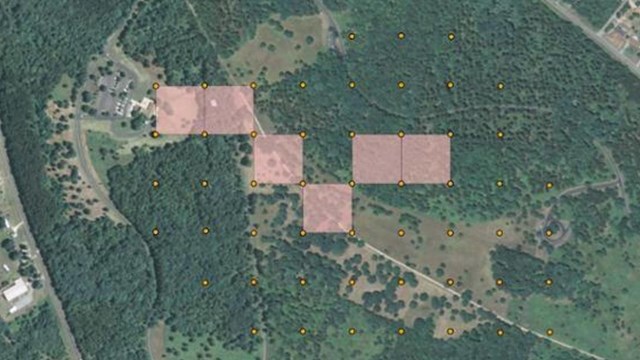
Map 2: Early Archaic Sites (94.4 KB).
(Click images to enlarge)

CHAPTER 3

A Break with the Past
8000 to 6000 B.C. The Early Archaic Era

Changes in prehistoric human lifeways occurred slowly, over hundreds and even thousands of years, as early people followed closely in their ancestors' footsteps with only slight variations. Even when they chose different paths, the departures were often so gradual that they would be imperceptible to most observers. Only the skilled eye of a scientist could detect many of the subtle early signs of altered habits. Contrasted with the lightning-quick progress of the space age, this ancient pace of change seems excruciatingly slow.

But consider how few early peoples' needs were and how adequately their world satisfied those needs and the continuation of time-honored practices becomes easier to understand. There was little impetus to change a way of life that worked successfully for generations. When prehistoric residents did shift behavior, often they were responding to changes in their environment.

Figure 10: A Savannah River Tributary (34.9 KB).The world the residents of the Savannah River valley knew in the next cultural tradition, the Early Archaic period of 8000 to 6000 B.C., was both different and similar to the one found by PaleoIndians. Their lives were also both changed and alike.

The river valley these people knew had formed slowly over tens of thousands of years as the earth's crust shifted and the river steadily carved a deep path by wearing away metamorphic and igneous rocks. Igneous rocks formed from cooling lava from the earth's hot core, while metamorphic rocks developed from igneous or sedimentary rocks transformed under the tremendous pressures and heat of the dynamic earth. Sedimentary rocks resulted from the sediments deposited slowly by ancient seas or rivers.

As it forced a course with unrelenting assault on the rocks, the Savannah River wound steadily through the bottom of a bowl-shaped valley. The floodplain-the relatively flat area at the bottom of the bowl where the river dropped sediments at flood stage-was not especially wide compared to neighboring rivers' floodplains, but did extend as much as a half mile from one side to the other.

The river at normal flow was also fairly broad, ranging up to 400 feet across. Valley walls cradling the river were steep, up to 400 feet above the water in spots, but mostly less than 200 feet high, which was still a formidable descent to the river.

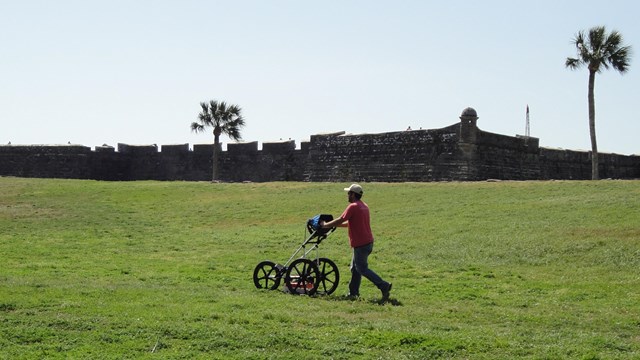
A rolling landscape of brownish red soils, called the uplands, stretched above the river valley and the valleys of the larger tributaries. These undulating expanses of land, dotted with areas of level Figure 11: A Field Worker Doing A Surface Collection (33.6 KB).ground, appear today much the same as when the early residents saw them. Ridges, consisting of long, fairly flat summits atop the many upland hills, were favored campsites during the Early Archaic period, along with high ground adjacent to rivers.

Noticeably different in Early Archaic times was the climate, grown warmer and wetter than in early PaleoIndian days. Changing vegetation resulted, with a thick forest sprouting in the uplands where before patches of woods were separated by broad, open fields of herbs and shrubs. Herbs had thrived before because of the cooler, drier conditions, but as the air warmed and the rains increased, first pine colonized the formerly open areas, and then oaks supplanted the pines. Herbs and shrubs became only minor components in the landscape. Oaks now dominated, but gum, chestnut, beech, and pine trees also grew.

In the river valley, the forest was also in flux. Spruce, fir, hemlock, and pine trees disappeared, replaced by oak, gum, hickory, and other deciduous trees that seasonally lose their leaves. The spruce and fir were among the last lingering reminders of the cold days of the Ice Age when northern evergreens flourished in the southern Piedmont. We know of their former existence from tiny, fossilized grains of pollen discovered in the soils of the Russell Reservoir area by Mark Sheehan and other scientists.

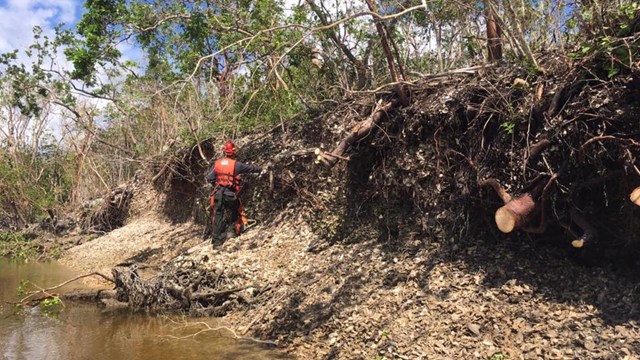
During the Early Archaic era, the Savannah River was swifter and prone to more snaking bends than in modern times. The waterway maintained the same general direction as today, but sometimes migrated into adjacent channels, producing changes in the landscape. As the Savannah flowed, it eroded soft earth in its path and added platforms of land called levees along its banks. After floods when the water retreated, the river dropped sediments of sand and silt on these levees, so that eventually some stood ten to 13 feet above the river at low water. When the river's course shifted, new levees formed. The older levees, sometimes also called terraces, continued to stand above the surrounding floodplain. The terraces and levees, along with islands in the river, provided people with favored locations for camps and villages throughout prehistory.

There was no regularity to this process of levee building. Sometimes the rain-swollen river swept tons of sediments along, resulting in heavy deposits. Other times, only a fraction of an inch of sediment was left. But it was during these low-deposition periods that soils began to form from old sediments left exposed to the coalescing powers of sun, wind, and rain.

Secrets of the Soil

Understanding what an environment was once like is important because of its role in shaping human activities...


Ironically, the river deposited the most materials after droughts. Dying vegetation in parched uplands could no longer hold the soil, so that erosion occurred when heavy rains finally fell. The sudden rush of water skimmed off dirt and carried it hurtling towards the river, increasing flooding and sedimentation. Conversely, during wet periods, upland vegetation flourished, knitting the soil together, preventing heavy erosion, and leaving the river with little to deposit.

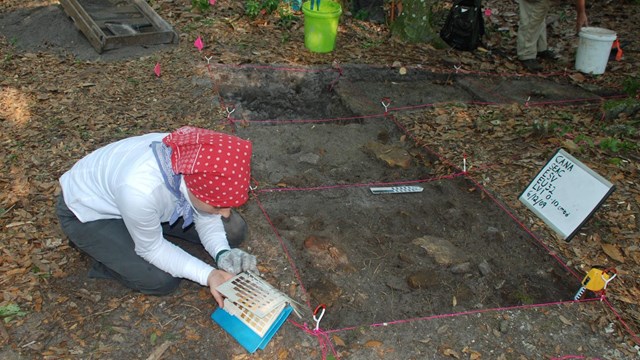
Geologist Antonio Segovia learned from his study of the area that droughts occurred as often as a thousand years or more apart and lasted as long as 200 to 500 years. Droughts then, as now, says the geologist, were harsh for all living things. River tributaries and nearby springs evaporated, killing Figure 12: Taking Soil Samples from Different Levels (34.8 KB).plant life and smoothing the way for lightning-induced forest fires, which further denuded the landscape. Wildlife suffered, and at times perished in the hostile conditions. When rainfall returned to normal levels, nature's recovery was slow. The hardy pine, with its fire-resistant seeds and ability to grow even where topsoil rich in minerals was scoured away, was the first tree to reappear in open areas. Oaks and other hardwoods slowly followed and resumed the task of holding soils in place so that fertility could revive.

While some archeologists don't think prehistoric droughts in the Southeast were nearly as fierce as those described by Segovia, most assume that environmental change often kindled resourcefulness among prehistoric people who learned new ways to cope. There is no sign of significant drought at the start of the Early Archaic period, but there were major differences for these descendants of PaleiIndians. Gone forever were the wooly mammoth and giant ground sloth that had provided food and clothing for the hunters and their families. By 10,000 years ago, many species of large mammals that had once lived on the continent were extinct. Consequently, hunters were forced to pursue smaller animals more often and a greater variety of them to satisfy their needs.

People scattered across the land adapted in various ways to the changing world. There were enough similarities in their responses, however, to mark the beginning of the Archaic cultural tradition, which spread widely from the East Coast to the Great Plains by 8000 B.C. Where the tradition began is uncertain, and it was not embraced everywhere, with a PaleoIndian lifestyle continuing for some time in parts of the West. Archeologists, for example, uncovered a PaleoIndian site in Colorado dated to 6500 B.C., where hunters had forced a stampede of bison over a cliff and into a seven-foot gully. Hundreds of animals were crushed to death in the thunderous upheaval as they fell on top of each other, providing the people with enough food for a month or more.

Early Archaic people along the Savannah River did not likely experience anything quite so terrifyingly dramatic in their hunting. At the start of the era, there were probably no more than 150 inhabitants in all, and they had the entire river valley, more than 250 miles long, and the surrounding uplands mostly to themselves.

They were nomads, moving throughout much of the year, but not wandering aimlessly. Their traveling had purpose and pattern. They preferred the Russell Reservoir area in summer and fall, year after year, sometimes using the same campsites repeatedly.

Contrasted to PaleoIndians, there were now two distinct patterns to these later peoples' settling, not just one. The first, considered by many to be a year-round custom for people in late PaleoIndian times, occurred in the winter. That's when Early Archaic people set up basecamps about 50 miles south of the reservoir in the inner coastal plain. One such site, called G. S. Lewis, in honor of an avocational archeologist, was located on what is now the grounds of the Savannah River Site in western South Carolina. From there, Early Archaic hunters might venture out, perhaps for several days at a time, to look for game, while women and children remained at the basecamp all winter.

The second pattern began when warm weather arrived, signaling greater mobility for everyone. Men, women, and children moved up and down the river, towards the coast in early spring, then into the rolling hills of the Piedmont in late spring. Sometimes they camped in the uplands, other times on the terraces and levees of the Savannah River valley. They Figure 13: A Rock Cluster at Gregg Shoals.particularly favored raised land sandwiched between junctures of tributary streams and the river.

The length of time these groups spent camped at a particular spot varied and could last up to several weeks. Hunters might leave their campsite briefly, and women might hike short distances away to collect hickory nuts and other plant foods, but everyone returned at night. During the day, people who left to seek food rarely traveled more than eight miles away from where the band was gathered. Whenever game became scarce, they all moved on to find another spot for setting up camp.

This view of Early Archaic life, developed by David Anderson and Glen Hanson, was based directly on information gathered in the Russell Reservoir studies, as well as other research. It counters earlier ideas that people of this era were relatively sedentary.

Other researchers' findings elsewhere helped inspire this theory. Working along the Haw River in middle North Carolina, for example, Stephen Claggett and John Cable found that Early Archaic people there also changed camps frequently. The two archeologists also discovered that the tendency to move the entire family became more prevalent over time as the centuries passed and the Early Archaic period drew to a close.

Early Archaic people undoubtedly built sturdy shelters at their winter base camps, and at both their winter and summer camps, they participated in a number of activities. But evidence left over from these activities and traces of their shelters are rare in the eastern United States because of the thousands of years gone by since then and because of an environment hostile to preservation. We know that the focal point of their camps was the fire, encircled by stacked granite or quartz rocks. Heat from the fire, used for cooking and warmth, sometimes cracked the stones. Impervious to time, however, the hearths remained undisturbed for 10,000 years just as they were built. Nature played a role in suspending them in time by gradually burying the stones with dirt, which researchers carefully removed centuries later in their probe for Just such remnants of prehistoric life.

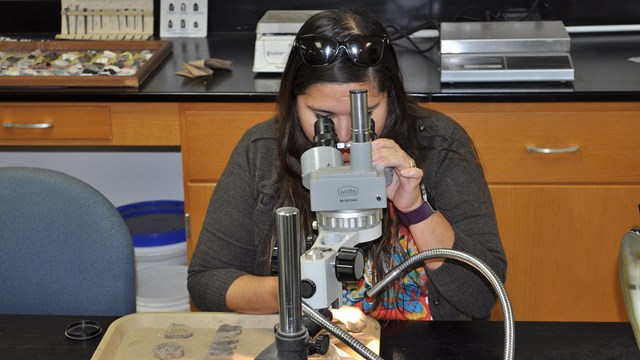
Hunting and gathering food continued to preoccupy human energies in the Early Archaic years, as well as preparing tools for tasks associated with subsistence. People could rely only on themselves and their own resourcefulness to make weapons and implements that would ensure their survival. Like the hearths they left behind, their tools, uncovered in the soil, add more details to what we know of their lives. Choosing the best raw materials for tools was the crucial first step.

Early Archaic people most preferred quartz, especially vein quartz. More than half the artifacts discovered at the largest Early Archaic site found in the reservoir, Rucker's Bottom, were made from this hard rock. Vein quartz is abundant in the Piedmont in soft shades of rose, grey, and yellowish brown, but the toolmakers liked best the white, translucent variety known as cold cream jar or milk glass quartz. Perhaps they preferred the milky quartz because of its pleasing appearance. Also favored, but much rarer was crystal quartz. Resembling glass, and at times almost transparent, tools of crystal quartz sparkle in sunlight like jewelry.

But beauty alone could not have determined their choices. Hunters learned that the quality of quartz varieties differed substantially, and they were able to recognize which ones contained the smaller crystals that made the rock easier to chip into pieces. They found quartz mostly in rocks along the ground, in cobbles smoothed by pounding by rivers and streams, and in veins a few inches thick to several feet wide that appeared as outcrops. Superior resistance to weathering compared to other minerals results in quartz appearing as an outcrop.

For about a century at the beginning of the era, people continued to make the Dalton spearpoints which first appeared in the Late PaleoIndian period. But for most of the 2,000 years of their era, Figure 15: Boom at Gregg Shoals Used to Lift Out Dirt (44.4 KB).Early Archaic people made new types of spearpoints with corner or side notches. Called Kirk and Palmer points, these projectiles have two indentions near the bases, one on each side. These small grooves held the binding in place that attached the points to the spear shafts. Sometimes the base below the notches formed a square stem, but not usually. Many of these points were shaped like miniature Christmas trees.

Frequent targets for these spearpoints were white-tailed deer, valued not only for their flesh, but also for their hides and antlers. Hunters also pursued raccoons, rabbits, opossums, squirrels, beavers, muskrats, and turkeys. Sometimes shorter handles were attached to the spearpoints so they could be used as knives or saws, and small serrations were chipped into the edges of the points to ease cutting.

While shapes varied somewhat, similar points to the Kirk and Palmer were used throughout the eastern United States, as far north as New England, indicating there was interaction among people from different regions.

Insight into ancient manufacturing is also gained from the refuse left where the spear-points were made. For example, when a hunter reduced a stone with blows, he knocked off progressively smaller flakes. Larger, broader flakes suggest the early stages of spearpoint making, while small, thin, and flat flakes came from the final steps, or from later resharpening.

Assuming no trade occurred with others, the people living part of the year along the upper Savannah River traveled as much as 180 miles to get the rock for some of their spear-points, making the weapons worth saving and resharpening. Nearly 20 percent of the Early Archaic chipped stone tools at the Rucker's Bottom site were made from rocks mined some distance away. Easily-worked chert from the Coastal Plain was the most popular of these rocks. Quartz, on the other hand, was so plentiful that hunters did not resharpen quartz spearpoints as often as those made from chert. Often they just discarded quartz spearpoints and made new ones.

If they were not especially prone to recycle their quartz weapons, toolmakers were conscious of using by-products of spearpoint production. They recovered some flakes fallen to the ground, sharpened them, and used them as other tools. The most important of this category was the scraper, which they used to peel away meat and hair from animal hides. They wore the hides as garments or stretched them over bent saplings to create shelter.

Figure 17: A Scraper.A few scrapers were meticulously honed to a razor edge and attached to handles. But not many of these more formal versions were found, another sign that Early Archaic people rarely stayed in one place in the reservoir area for long. Rather, they made many scrapers quickly, off-handedly, used them, and then tossed them away.

A circular flake called a graver, with a small sharp projection, was probably used to punch holes in hides so they could be tied together. Another common tool was the pieces esquilles-a square or rectangular flake used as a wedge.

These stone implements were only part of a hunter's tool kit. There were also many other objects made of bone, wood, and fiber, which deteriorated over time, and so were not uncovered in excavations. Some of the stone tools, like the pieces esquilles and gravers, were used to make wooden implements such as digging sticks and spear shafts.

Peeling Back the Layers

Over time, soils and the residues of human existence are buried, leaving a map, of sorts, for archeologists to follow...


Perhaps the most likely tool to be overlooked today is the pitted rock because it so resembles an ordinary stone. But close examination reveals the small pits-usually found in the center of quartz cobbles or granite chunks-which were formed when prehistoric people pounded the rocks with a hammerstone (a hard rock used as a hammer). Stoneworkers may have used the pitted rocks as platforms or anvils upon which they made other tools. The pits were also ideal for holding acorns or hickory nuts so that they could be cracked with a hammerstone. Abrasions are visible on both pitted rocks and hammerstones, attesting to their uses.

Wielding implements as rudimentary as the hammerstone did not preclude prehistoric people from developing intricate, high quality tools. Ann Tippitt and William Marquardt discovered that Early Archaic toolmakers at the Gregg Shoals site used an advanced technique that did not show up again along the same section of the river until several thousand years later. The method involved shattering crystal quartz rock on an anvil stone, then shaping the fragments to produce extremely sharp blades which were quite small. These tiny blades were probably lodged between split sticks, then used in delicate cutting tasks.

There were also other signs that Early Archaic people were fairly sophisticated. Life spans were short-a man and woman were elderly if they lived to be 40. The reproductive period was therefore Figure 18: A Bifurcate Spearpoint.comparatively brief and left little time for the prolonged adolescences and drawn-out courtships of today. The drive to find partners, however, was somewhat hindered by the lack of choices in a relatively sparse population. Too, many hard miles of walking, shadowed by all the dangers of the wilderness, separated prospective young mates from different bands. The solution may have been pre-arranged gatherings, festive occasions where many people from great distances congregated to celebrate new unions and to exchange information.

Figure 19: The Rucker's Bottom Site (38.1 KB).Similar occasions took place throughout the eastern United States, documented by the large accumulations of stone tools and spearpoints found at select locations. Often, the meetings took place on high ground that loomed above everything else nearby. Eagle Hill at Fort Polk in west-central Louisiana was one such site. Easily visible for miles, Eagle Hill stands between three major rivers-the Sabine, Calcasieu, and Red-all likely homes to various bands.

For people living along the Savannah River, a preferred spot for the congregations was along the fall line, the geologic boundary between the rolling Piedmont and the Coastal Plain. The fall line almost slices the two states in half.

Archeologists have identified one potential reason why this boundary of demarcation was favored. People traveling from the coast inland to the Piedmont saw rocks and shallows in the major rivers for the first time at the fall line. Here was the first place where they could ford wide rivers like the Savannah on foot fairly easily and without great risk.

Map 3: The Fall Line and Various Sites Nearby (81.9 KB).Those living part of the year in the reservoir area probably made the journey to the fall line in late autumn to meet with others who spent most of the year along other major rivers in Georgia and South Carolina. Archeologists David Anderson and Glen Hanson think that bands from as far away as the Ocmulgee River in central Georgia and the Neuse River in eastern North Carolina may have participated in this particular mating network.

What ceremonies, if any, they held to mark a couple's union, or any other activities the bands may have engaged in, are lost. Nor do we know how people, spread out across so many miles, communicated about when to meet. We can also only guess how individuals felt about the gatherings. Surely for most, after the nearly constant moving from one place to another only in the company of their own extended families, there must have been eagerness to talk with people from far away, to renew friendships, and to share news.

The mating network probably included 500 to 1,500 people, the number experts think was necessary to maintain birth rates equal to or slightly greater than the number of deaths, and to guarantee human survival. But Early Archaic people did better than just survive. Their numbers swelled to the point that small groups split off from bands and formed new bands, a splintering that happened again and again, ultimately leading to dwindling territories for every group.

A new variety of spearpoint in the reservoir area called the bifurcate, with a base divided into two parts, was left behind towards the end of the Early Archaic era. Perhaps the handiwork of hunters from outside the region, these spearpoints apparently represent people who didn't stay long and had little impact on land near the Savannah River.

But other changes culminated in a new era, the Middle Archaic, a time when local residents abandoned long journeys outside the region in favor of nomadic existence within the Piedmont.


Chapter 4: More Wandering, Less Room

Return to the Table of Contents