The decrees and demands issued by the British Crown that stirred a citizen revolt in Northern colonies went largely unnoticed at first by the scattered population in the back-country of Georgia and South Carolina. The Sugar, Stamp, Townshend, and Tea Acts had little meaning for pioneers struggling in the Southern wilds. Not that some didn't have their own resentments of higher authorities. In South Carolina particularly, many frontier settlers felt antagonism against Charleston aristocrats. Those aristocrats controlled regional government and refused for a time to grant the settlers representation in the Commons House, the state assembly. For the pioneers, many of whom detected condescension in the eyes of upper-crust Charlestonians, there was no need to look across the sea to find culprits guilty of taxation without representation when villains were perceived much closer to home. Consequently, many of these resentful settlers were unmoved to join Charleston Rebels when they began to clamor for war against Britain after the first shots were fired in Lexington and Concord, Massachusetts, in May 1775. Many others throughout the colonies were also disinclined to revolt, according to Samuel Adams, an early spokesman for the revolution. He estimated that about a third of the colonial population initially disfavored the brewing fight. But in the backcountry of Georgia and South Carolina, that number was closer to half. Nonetheless, the conflict came. The first act of war sanctioned by South Carolina government occurred in 1775 just south of the reservoir area at the British Fort Charlotte. Backcountry settlers, who had finally won a governmental voice, participated in the newly-elected Provincial Congress that authorized raising troops, printing money, and appointing a 13-member executive committee to manage South Carolina's government. This Council of Safety included some members who were still disinclined to sever alliance with Britain, but the fervor against the Crown overwhelmed them. With the council's approval, the South Carolina Rangers marched toward Fort Charlotte, and on July 12, 1775, seized weapons and supplies from the British. The first known local casualty from the war, however, was not suffered at Fort Charlotte but at the trading post of Ninety Six the following November. The battle came after Rebels seized and imprisoned Robert Cunningham in Charleston. Cunningham was a leader of those colonists who wanted to remain under British rule-the Loyalists. Frontier Loyalists were incensed over Cunningham's arrest, and with a force of nearly 2,000 men descended on Ninety Six, seeking revenge. They surrounded 562 Rebel militiamen commanded by Andrew Williamson in a hastily-built stockade. When the smoke cleared, one Rebel was dead, and 12 more soldiers were wounded. The battle ended with a truce, but elsewhere conflict continued to erupt. While there were full-scale, pitched battles in the South between regular armies during the Revolutionary War, the details of which were often faithfully recorded, there were also many unheralded ambushes, duels, and disorganized assaults by groups of ragtag farmers-turned-soldiers. The nature of individuals drawn to frontier life and the roles some played in the conflict are exemplified in the tale of Nancy Hart of Georgia. Separating fact from fiction concerning Hart, who has become a legend, is difficult. She was reportedly six feet tall. Some say she was cross-eyed, making it difficult for onlookers to tell where she was pointing her gun, which could prove fatal. Her bellicosity and prowess with a rifle were considerable, leading the Indians to call her "Warwoman" and to name Warwoman Creek near her home in her honor. Married to Benjamin Hart and mother of six, she favored the revolution, and her support of the Rebels was apparently known to Loyalist soldiers patrolling the area. When six of them stopped at her secluded house in her husband's absence and demanded she feed them, Hart refused, saying she had only one turkey left. One of the soldiers then shot the bird and again demanded that she prepare them a meal. Outnumbered and goaded by the men's taunts, Hart complied while she hatched a scheme to foil the intruders. Plying them with alcohol and, by some accounts, joining in the tippling, she sent a daughter into the woods ostensibly to fetch water but really to alert her husband Benjamin of the danger. The family used blasts on a conch shell to communicate over distances, and when the girl gave three blows on the makeshift horn Benjamin Hart knew he should return at once and bring help. Meanwhile, Nancy Hart used the soldiers' inattentiveness while they noisily drank and ate to sneak two of their rifles out of reach and through a gap in the wall of her rough-hewn house. She was pushing a third gun through the crack when one of the soldiers noticed and alerted the others. Quickly, Hart raised the gun to stop them from disarming her and warned them not to move. When one man ignored her order and attempted to take the weapon, she shot him dead. Her daughter returned just then and handed her another of the rifles, which Hart used to hold the soldiers at bay. But again one or more of the men charged her, Hart fired, and another Loyalist slumped to the floor, wounded. The soldiers then attempted to reconcile with the formidable frontierwoman, but she was unmoved and kept them at gunpoint until her husband appeared with several compatriots. They wanted to take the prisoners outside and shoot them, but Nancy Hart preferred hanging them instead. One by one, they took the five soldiers, including the wounded one, and fitted them with nooses, then strung them up from trees. Some reports say that the Rebels, including Nancy Hart, whistled or sang "Yankee Doodle Dandy" while the nooses tightened and strangled the men to death. How they disposed of the bodies apparently was answered in 1912 when railroad workers near Elberton, Georgia, found six skeletons in shallow, three-foot-deep graves. The workers found the graves about a half-mile from where the Harts once lived. Hart County, Georgia, which includes part of the Russell Reservoir, and the county seat, Hartwell, were named for Nancy Hart, the only such dual honors awarded a woman in the entire United States, according to author and Georgia Governor Zell Miller, who wrote about her in his 1983 biography, Great Georgians. Miller also pointed out that Georgia's Nancy Hart Highway was then the only state highway in the country named for a woman. After the British unsuccessfully attacked Charleston by water in 1776, and the colonists defeated and dislocated the Cherokee, friction in the area entered a lull of sorts. The Rebels were in charge, even in the backcountry where strong support for the Crown or neutrality persisted. Most Loyalists bided their time, waiting for a chance to strike. In
early 1777, the South Carolina Rebel government sent several regular army
companies to guard territory near the upper Savannah River. One detachment
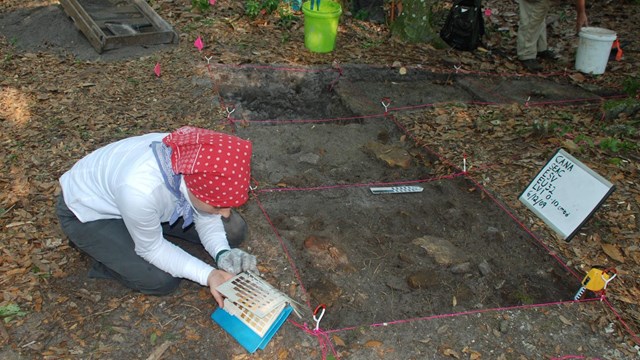
traveled into the Russell Reservoir area Archeologists, directed by Beverly Bastian, uncovered the remnants of the fort during the Russell studies and also researched its role in the period. Located about 300 yards from the Rocky River in Abbeville County, Fort Independence was not the stalwart bastion that the term implies, but was most probably a small homestead enclosed by a stockade fence as an afterthought. Robert Anderson chose the site, presumably for his residence, about four-and-a-half miles from where the Rocky River flows into the Savannah River, a setting where prehistoric people also spent time. Documents were unclear when Anderson built the house, but it was probably after 1767, although a 1761 date is also possible. The date the stockade fence was erected around the house is also unclear. Archeologists think the stockade enclosure was not built at the same time as the house, but came later, possibly in 1774 when the Creeks were raiding settlers in the region. Chronicles from the era revealed that 12 forts were built along the Savannah River during the Creek assaults. By 1776, when hostilities with the British heated up, many of these forts were strengthened, possibly including Fort Independence. The fort was different from many others of the era in the weakness of its stockade, a defect detected by studying postmolds in the soil. Other forts of the time were protected by fences of closely-spaced posts anchored firmly in the ground, reminiscent of those built by Mississippian Indians. But at Fort Independence, big gaps up to 16 and one-half feet wide were left between the posts. The posts were formed from stout tree trunks up to a foot and one-half in diameter. While these big posts were fitted firmly into the soil, other wood pieces that filled the gaps between them apparently were merely nailed onto a series of horizontal boards attached to the posts. The result was a barrier that appeared deceptively substantial, like the strong fences around other forts. But while those fences could withstand heavy assault, the one at Fort Independence was much more susceptible to being breached. Then why erect the fence at all? From all accounts, Robert Anderson, a militia captain, was a knowledgeable builder. He was even responsible for construction of one of the more substantial defenses of the time, Fort Rutledge, in Lower Cherokee country. Possibly he built the Fort Independence stockade to fool the Indians, a temporary structure that he intended to strengthen later. Indians, who were most likely to make quick, surprise attacks, might be discouraged by the fence's seeming strength. Or, perhaps Anderson simply never had the help or the time to make the fence stronger and devised the best facade of resistance he could manage.
In the center of the stockade, atop a slight knoll, stood the buildingarcheologists think Anderson built originally as his house and which became fort headquarters. Anderson was the first to command troops at Fort Independence. As a captain in the Ninety Six Militia, he and his soldiers apparently spent long months based there, using the place as a base for raids into the wilderness to fight Indians. One of the soldiers later recounted his experiences:
"As soon as I joined the service (October 1776), which was to aid in guarding the frontiers and in repelling the Indians, Captain Anderson stationed himself at one of these forts called Fort Independence... where we remained fourteen months in constant service against these Indians-in scouring the country and protecting the inhabitants."
When South Carolina officials decided to place regular army companies near the Savannah River, Anderson sold them Fort Independence and left for duties elsewhere, but his name was to reappear in chronicles of violent events soon to unfold nearby. Captain John Bowie soon arrived at Fort Independence with a company of soldiers. He assumed command of the fort sometime between May and November 1777. Even though he was with the regular army, Bowie nonetheless took his orders from the militia leaders at Ninety Six. The winter of 1777 passed fairly quietly for Bowie and for most soldiers in Georgia and South Carolina, but further to the north, Rebels in Valley Forge, Pennsylvania, were barely surviving. The effects of a cruel cold were taxing General George Washington's leadership to its limits. Meanwhile, the soldiers at Fort Independence waited for their first test. Aspects of their lives were revealed in letters to Captain Bowie. Written more than 200 years ago, the correspondence provided researchers with important details about what life was like at Fort Independence. They learned, for instance, that Bowie and his wife apparently for a time shared the fort's only substantial building with a physician named Begbie. The letters also included details about the soldiers' spartan diet. Their provisions, supplied by wagon from Ninety Six and another community called White Hall, consisted primarily of two staples-beef and flour. Some of the beef arrived at the fort in the form of live cattle, but most was already butchered and heavily salted for preservation. On average, every soldier received a daily ration of one pound of salted beef and one-and-a-half pounds of flour. Sometimes this was supplemented with sugar and shelled and ground corn, and by animals soldiers hunted and the wild plant foods they gathered. They apparently grew no crops at the fort. Wagons also brought shoes, clothing, sealing wax, hemp, buttons, and rum. Alcohol apparently helped ease the boredom of a life spent waiting. Archeologists found a number of glass sherds from wine bottles in the fort ruins.
An army company consisted of about 60 men, but desertions, leaves, and resignations were notoriously common, leaving many companies undermanned. Still, by the end of 1778, two companies were based at Fort Independence for about a month or two, which must have greatly crowded conditions. It's easy to imagine that on almost any night the soldiers gathered outside the stockade in the open air, with only the dreariest weather driving them inside the damp, cramped earthlodges. They would have sat close to campfires circling the fort, with the flickering light casting shadows back and forth across the ground, the fence, and their faces. Talk probably centered frequently on the question of when the British would finally come, while each man wondered how he would face the enemy. The soldiers likely ate outside as well, but when the weather turned bad, they probably retreated like moles into their bunkers. Researchers found remnants of meals-30 bone pieces and remains from other foods-in the one excavated earthlodge. The soldiers ate pigs, chickens, cattle, and possibly deer, along with peaches, persimmons, and black walnuts. To build an earthlodge, the soldiers dug a rectangular hole in the sloping ground. They then mounded loose dirt on the top edges of the hole, forming supports for a roof that resembled roofs for more ordinary houses, except this one rested on dirt. The soldiers made a front wall of logs and attached a door. They also possibly built a crude chimney for a fireplace near the rear of the earthlodge. The entire structure was only about eight feet long and seven feet wide, so claustrophobia was a likely result if three solders were assigned to the dugouts, as experts think was the case. Life in the fort's headquarters was considerably easier than the circumstances in the dugouts. Items recovered from the headquarters' excavation included food residue similar to those from the soldiers' hut, but also turkey and rabbit bones, corn cobs, a grape seed, and acorn remains. Researchers also discovered a concentration of wheat, barley, and oats, which were apparently stored in a sack or sacks inside the house just before it was burned to the ground by invading British sympathizers. While rank had its privileges, evidence does paint Captain Bowie as dedicated to his post. He actively recruited enlistments and took care of his men. Even some of the cattle consumed by the soldiers were apparently provided by Bowie, perhaps from his farm near Long Canes Creek. But the Bowies did enjoy amenities, besides a house above ground, that the troops didn't. For example, they served food on china, which Mrs. Bowie must have carefully protected in this frontier outpost as a reminder of civilization. Her tableware collection apparently didn't include a complete set of one pattern, however, because a mishmash of pieces from five different motifs emerged in the excavations. None of the patterns were especially exotic or expensive for their time, although Chinese export porcelain was in the lot. A letter Bowie received from his commanding officer provided insight into the political wrangling of the time. The letter contains a list of incumbent candidates the officer favored in a coming election at Ninety Six. Challengers were trying to unseat these representatives to the South Carolina state assembly because they considered them, as Ninety Six Militia members, unwilling to negotiate a peaceful end to the war. The unwritten but implied order to Bowie was to command his soldiers to get to the poll early and to cast ballots for the preferred candidates. Near the end of 1778, the relative quiet in the area ended as the British fleet successfully stormed Savannah, Georgia, which had grown from a small settlement on Yamacraw Bluff to a city of 450 houses. The Crown officers' plan was to capture Augusta, which they soon did, and Charleston, and eventually to gain control of all Georgia and South Carolina. Their strategy for victory included an uprising of support from backcountry Loyalists.
About this time, Bowie requested permission to abandon Fort Independence and establish another garrison. He was probably concerned about the vulnerability of the insubstantial post in the face of the heavy British attacks everyone now assumed were inevitable. But the nod to leave did not come from his commanding officer until the final day of December 1778. Bowie was then directed to use his men to build a fort closer to the Savannah River, and to follow construction advice from the man who had built Fort Independence, Captain Robert Anderson. The site of this second fort, also called Fort Independence, has not been found. When a Loyalist colonel named William Boyd arrived with about 900 men in early 1779, he found the first Fort Independence empty. Boyd's troops were similar to the citizens' army of the Ninety Six Militia, not career soldiers but mostly farmers and merchants who temporarily picked up arms for a cause, in their case the preservation of British rule. Boyd and his band tried in their march across the territory to rouse other Loyalists to join them against the Rebels. They ultimately planned to cross the Savannah River and join the British Red Coats at Augusta. Where Bowie and his soldiers were at this juncture is unknown. Perhaps they were at the new fort or were fighting somewhere else. During the next year, they were to engage in far-flung battles. Nor do we know what Boyd and his Loyalist troops did when they first reached Fort Independence. Maybe they spent the night, sleeping in quarters only recently vacated by their enemies. They probably looted the place of anything useful, a common war-time practice on both sides. Then, in another familiar action of war, they set the entire fort on fire, including the stockade fence. Just about everything burned to the ground. When they departed, Boyd and his force moved toward the Savannah River nearly five miles away. Researchers Richard Taylor and Marion Smith summarized from historical accounts what happened next:
Boyd's soldiers halted near a shallow part of the river called Cherokee Shoals. There, eight Rebels occupied a blockhouse, preventing an unobstructed crossing for the Loyalists. Boyd demanded that the Rebel leader, a lieutenant, surrender and gave him several hours to comply. But the Rebels had no intention of giving in, and while Boyd waited for an answer, several slipped unnoticed out of the blockhouse rear. They hurried across the river to reach Rebel troops nearby, where they secured a cannon. Somehow, they managed to get the cannon back to the blockhouse before Boyd's grace period ended. When the Loyalist commander demanded an answer from the Rebels, it came with a cannon blast.
Boyd did not retaliate, perhaps realizing that a much larger opposing force was close, readying for an assault against him and his soldiers. Instead, he led his troops up river about five miles to find another place to cross. Not long after, Captain Robert Anderson arrived at the blockhouse accompanied by 80 to 100 militiamen, where he learned of Boyd's movements. Anderson decided they should immediately cross the Savannah River in hopes of reaching Georgia on the other side before Boyd, securing a better position in the battle Anderson planned to wage against him. So, while Boyd and his men gathered boats and rafts to cross the river, Anderson and his force forded quickly at Cherokee Shoals and set out northward to meet the Loyalists. The clash between them came where Van Creek flows into the Savannah, not far from Rucker's Bottom where so many prehistoric artifacts were uncovered. Anderson's militia arrived and began to shoot just as the Loyalists were climbing out of the river and up the banks. The Rebels were vastly outnumbered and outgunned, and their assault was further hindered by a thick growth of cane along the water's edge. The fight became a rout. Finally, after 20 of his men were killed and 26 more were captured, Anderson ordered a retreat. Boyd's losses were also heavy, with 100 men either killed or lost through desertion. Even though the Rebels lost the skirmish, their efforts may have paved the way for Boyd's eventual defeat in another battle soon to follow. Not far away, Nancy and Benjamin Hart were now part of the Georgia forces commanded by General Elijah Clark. Accounts say that Nancy Hart served as a spy for Clark by dressing like a man and acting deranged so that no Loyalists would suspect her as she moved close to observe their actions. In one of her exploits, she reportedly made a raft from logs tied together with grape vines to cross the Broad River and then moved in close to spy on Colonel William Boyd's troops. She returned safely with news for General Clark about the opposition's numbers and movements. When General Clark set off to fight Boyd's soldiers, Nancy and Benjamin Hart and their oldest son Morgan accompanied him. The Hart family fought in the battle of Kettle Creek on February 14, 1779, just southwest of the Russell Reservoir area. Andrew Pickens, in command of the Ninety Six Militia, had united with Clark and his troops. Together they soundly defeated the British sympathizers in a surprise attack, despite having about half the number of soldiers, Many men were wounded and some 70 soldiers died, including Colonel Boyd. Ironically, he was killed when he was only hours away from the British Red Coats he had set out to join. On the Rebel side, Clark's horse was killed beneath him, but the general and the Harts survived. Among the Rebel heroes was a black freedman, Austin Dabney. The victors freed the 26 militiamen captured earlier in Anderson's defeat at Van Creek and took 23 Loyalist prisoners of their own. Some of these captives, apparently officers, were later hanged at Ninety Six. After the Rebel victory, there was talk that British attempts to retain control were finished for good in the territory, but those hopes proved premature.
The Ninety Six Militia and Colonel John Bowie reappeared in war annals written about the efforts to reclaim the city of Savannah in September and October 1779. The Ninety Six Militia was part of a force of 5,000 men which included French soldiers and sailors commanded by Admiral Compte d'Estaing. British troops within the city numbered only 2,000, yet they were able to defeat the assault and kill many of the opposing force. The French lost 635 men, while 457 Rebels died, compared to British losses of only 55. This defeat was followed in May 1780, by an even heavier blow to hopes for independence. Rebel General Benjamin Lincoln surrendered his army of 5,500 to the British, turning over Charleston to the Crown's control. Now, even the Continental Congress conceded that all of South Carolina and Georgia was conquered territory. Victorious, the British paroled all militiamen on their solemn word not to fight again. More than half the South Carolina population, according to some estimates, was applauding the war's apparent end, but their relief was premature. Not satisfied with surrender and promises not to fight, the British began to press former militiamen to declare their loyalty to the king. Those who refused faced possible branding as traitors, even execution. Such declarations of allegiance must have stuck in the Rebels' throats. And if many had a hard time accepting defeat, the urge to keep fighting was further fueled by the inflammatory actions of a British cavalry officer named Banastre Tarleton. Tarleton and his men cornered a regiment of Virginians who had traveled into South Carolina to join the fight against the British. The overpowered Rebels raised a white flag of surrender, but instead of accepting their submission, Tarleton ordered an attack, killing them all. Outraged by news of Tarleton's massacre, other Rebels decided to break their promises of loyalty and fight again. Many joined guerilla bands led by Thomas Sumter, Francis Marion, called the "Swamp Fox," and Andrew Pickens, the leader at the Battle of Kettle Creek.
The Ninety Six Militia that Pickens commanded resurfaced to fight in decisive battles that helped push the British towards the sea. They fought, for example, at Cowpens, South Carolina, where in 1781, Banastre Tarleton lost, through death or capture, more than 900 soldiers. The militia also attempted to recapture their old headquarters at the outpost of Ninety Six from the Loyalists. General Nathanael Greene and Lighthorse Harry Lee, father of Robert E. Lee, participated in the Rebel assault. The militia tried to retake the town's stockades by firing flaming arrows and tunneling underground, but their efforts eventually failed. They had to retreat when 2,000 Irish troops arrived to help the British sympathizers. The Loyalists, however, willingly abandoned the post soon thereafter and headed for safer ground as they saw British chances for success begin to crumble. The Crown's forces' turn to admit irrevocable defeat finally came in October 1781, when General Charles Cornwallis surrendered to General George Washington at Yorktown, Virginia. But in South Carolina, skirmishes erupted for another year while diplomats haggled over terms. The British army finally evacuated in December 1782, and set sail for home from Charleston harbor. They took with them 4,000 Loyalists who feared Rebel retaliation. Five-thousand of the colonists' slaves also went with them. The American Revolutionary War was over, but in the South Carolina backcountry, which encompassed the Russell Reservoir land, 1,400 orphans and widows were left to remember. Chapter 13: Ghost Towns and a King Return to the Table of Contents
|