A Publication for the Public 
The Richard B. Russell Cultural Investigations Popular Volume
Online article dated April 20, 1994

Sharyn Kane, Richard Keeton, and John H. Jameson, Jr.


1994 Bibliography     1994 Volume Index

2000 Web Version 

 
Book title: Beneath These Waters, Archeological and Historical Studies of 11,500 Years Along the Savannah River, by Sharyn Kane and Richard Keeton. Hardbound and softbound, 291 pp., 207 figures, 32 maps, 22 color illustrations including two fold-outs of original oil paintings depicting prehistoric lifeways in the project area. Funded by U.S. Army Corps of Engineers, Savannah District. Published by the Interagency Archeological Services Division [Southeast Archeological Center], National Park Service, Atlanta, Georgia, USA, 1993. Second Edition: 1994.

Purpose for the Volume

Beneath These Waters presents the interpretation for a general audience of archeological and historical research conducted in the Richard B. Russell Multiple Resource Area from 1969 through 1985. This research preceded building of the Richard B. Russell Dam and Lake by the U.S. Army Corps of Engineers. Archeologists and others investigated prehistoric and historic sites in Elbert and Hart Counties in Georgia, and Abbeville and Anderson Counties in South Carolina, spanning 11,500 years of human occupation. Emphasis in the public volume is placed on explaining the information so that it will be entertaining and easily understood, while retaining accuracy (Kane and Keeton 1991).

Background

There is a 28-mile stretch of land along the Savannah River in Georgia and South Carolina that received some of the most intense scrutiny from archeologists and historians that any piece of property has ever undergone. For about 20 years, experts pored over the landscape searching for the secrets of the past.

There was urgency in their work, a pressure that intensified as those 20 years dwindled down to just a few. The Richard B. Russell dam was being built, and would soon create a lake that would submerge much of the area. Whatever researchers didn't find before the dam opened would be lost forever.

Sponsored by the U.S. Army Corps of Engineers, Savannah District, and administered by the Interagency Archeological Services Division of the National Park Service in Atlanta, the investigations were called the Richard B. Russell Cultural Resources Mitigation Program.

Hundreds of experts from many different fields participated, accumulating knowledge about the environment as well as the people who lived there over the past 11,000 years. Besides the time-honored archeological practice of digging and sifting dirt to find artifacts, the researchers used the latest technology to analyze ancient plant and bone remains. The sciences of geology, geography, paleontology, biology, botany, and zooarcheology were all represented in the probe of the distant past, while the social sciences were prominent in research into more recent history. Countless hours were spent reading old tax and census records, as well as old newspapers, to track the lives of people long gone. But the effort to document human life in the 52,000 acres of the study area also included those still living. Collecting oral history from the elderly of the black majority population was one of the final components of the project.

Such a wealth of knowledge was gained over the years that the results fill thousands of pages in more than 20 extensive reports and many other monographs comprising the Russell Papers. These are technical writings designed for a target audience of scientists and historians already familiar with the argot of serious research and already sold on the importance of the endeavors.

Authors' Challenge

The authors' task was to take the results of these two decades of research, strip them down to the essentials, and reclothe them in a fashion readily acceptable to a general audience without losing the fundamental integrity of the original material.

The challenge of writing the book was enormous. How should the authors choose what to include and what to omit? Kane and Keeton had no real conception of just how long 11,000 years is and how much can happen in those years until they started to count them down. Unless they did some ruthless cutting, the book would be as thick as the New York telephone directory and about as interesting to read.

A saving grace, however, was a two-volume technical synthesis of the Russell Papers, whose authors, David Anderson and J. W. Joseph, did an admirable job of condensing the information. The writers relied often on their judgment of what was especially significant in the many individual reports. But, again, their intended readers were scientists and the already converted, so their vocabulary would leave most of the audience scratching their heads.

Capturing the Reader

Encouraged by the scope of work written by John Jameson of the National Park Service, the authors chose to take as creative an approach to the task as they could muster, beginning with the title and cover photograph, because, like it or not, many people do judge a book solely by its cover. They wanted a title with a bit of intrigue, and a photograph that would further grab attention and stir curiosity. They picked BENEATH THESE WATERS, and a crisp, color shot of the Savannah River winding away from the camera, all blue and inviting, like a path beckoning to be followed.

Once the reader's interest was snared in opening the book, an attempt was made to maintain it through every single page. The best way to do that was to use the methods that storytellers have always relied on, to focus on the universal human elements first and foremost. The intention was to write the story in such a way that the reader would grasp and appreciate the unfolding stages of human progress that are our shared national heritage. The authors strove to take the first people in the area, the PaleoIndians of the late Ice Age, and bring them alive amid the wonders and terrors of a wild, unfamiliar land, and to do the same for all those who followed them, to make them real, as individualistic and important as any of us.

Setting the Scene

At the same time, selected information was interwoven from the Russell Papers, as well as additional research conducted by the authors on their own. Kane and Keeton wanted to highlight and explain the methods the experts used, to showcase their efforts, to give them deserved credit, and to build the case for the importance of those efforts. But if they were going to try to teach the reader something, and they intended to teach a good deal, they better be entertaining in the process, a maxim writers from Jim Henson to Herman Wouk, James Michener to Barbara Tuchman, have followed. Again, the authors relied on the storyteller's art, using the technique of scene setting to create a visual backdrop.

Here is an example from a chapter about the Late Archaic period of 3000 to 2000 B.C.:

"On a clear morning in early spring, a hawk soared over a dense forest. His sharp eyes scoured the world below, searching for a small, careless animal that would provide his first meal of the day. Only the wind disturbed the quiet until the hawk reached an unexpected clearing in the trees. Loud, unfamiliar sounds erupted, and disturbing swirls of gray smoke curled into the sky. Sensing danger, the hunter beat his powerful wings and was soon miles away.

"There was too much to do along the river that morning for anyone to notice the retreating hawk. People involved in various activities were scattered across the quarter mile of the gap in the woods. They cleared the land themselves, up to 80 yards wide, by cutting away underbrush and small trees. Bigger trees that could not be felled were stripped of bark as far a man's arms could reach with stone knives. They cut away big swaths of the trees' skin, leaving the tender wood exposed and soon killing them. Upper limbs remained, but their reach was now permanently devoid of leaves, and allowed the sun's full strength to reach the ground."

The stage set, the authors then explain how food was cooked in pits, how stone tools were made, and how some of the first houses in the southeast were built at this setting called Sara's Ridge in Anderson County, South Carolina. Then they time travel into the 1980's to explain how all of this came to light:

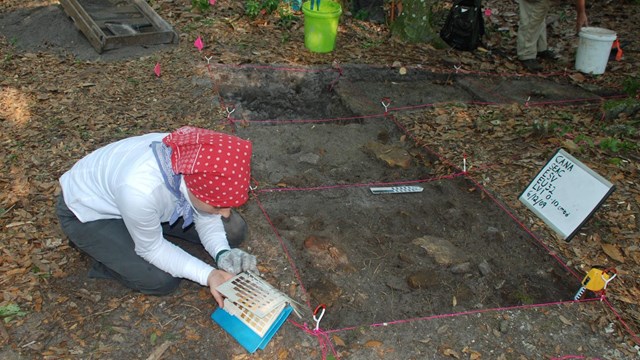
"A bulldozer equipped with a sharp blade first cleared the site and pushed back surface soil. Then the crew marked the area into precise meter squares about a yard wide by inserting stakes, creating a grid for pinpointing exactly which spot might later yield a discovery. Patiently, workers dug with sharp, flat shovels inside the squares, scooping out about four inches of dirt, then sifting the soil through a screen stretched across a wood frame suspended from saplings. Dirt could pass through the quarter-inch mesh, but any stone artifacts would remain on the screen.

"They labored methodically, square by square, without any startling results, then repeated the cycle, starting at the first square and digging down four more inches in a tedious procedure that could not be rushed or avoided. Finally, when they reached between two and three feet below the surface, darkened circles in the soil appeared.

"Analyzing their findings, the archeologists speculated that most of the stains represented benches, drying racks for fish and meat, and baffles to block the wind. But the most exciting discovery was a distinct oval of postmolds about seven-and-a-half yards long and five-and-a-half yards wide. This had to be the outline of a shelter."

Adding the Action

Besides using scene setting, Kane and Keeton added action whenever possible to move the story ahead. What they most wanted to avoid was a dull recitation of facts. So many people resist or even hate reading history because what they recall from their school experience was an endless stream of boring dates, battles, and one-dimensional characters.

Not that the authors avoided dates and battles. One of the more interesting discoveries in the Russell studies came with the excavation of a Revolutionary War stockade called Ft. Independence in Abbeville County, South Carolina.

Archeologists learned a good deal about the fort, how the headquarters' cellar was built, the unusual placement of the chimney, even the sorts of china used in the building, which was also the commander's residence. They accumulated so much information that in the retelling the authors risked slipping into list making.

Enter Nancy Hart, and another technique that proved invaluable-character development. Just as a movie director sometimes focuses the camera on a single object in a room, then gradually widens the scope to take in the rest of the setting, the authors sometimes picked out an individual for close scrutiny, then elaborated on that person's era.

Few were as colorful for this purpose as Nancy Hart, for whom Hart County, Georgia, one of the four counties in the Russell study area, is named. Her involvement with the Revolutionary War coincided perfectly with the details about Ft. Independence and kept the archeological information from becoming too ponderous. Reportedly six-feet tall, her bellicosity and prowess with a rifle led the Indians to call her Warwoman and to name Warwoman Creek near her home in her honor.

"Married to Benjamin Hart and mother of six, she favored the revolution, and her support of the rebels was apparently known to loyalist soldiers patrolling the area. When six of them stopped at her secluded house in her husband's absence and demanded she feed them, Nancy Hart refused, saying she had only one turkey left. One of the soldiers then shot the bird and again demanded that she prepare them a meal. Outnumbered and goaded by the men's taunts, Hart complied, but she also hatched a scheme to foil the intruders.

"Plying them with alcohol, and by some accounts joining in the tippling, she sent a daughter into the woods, ostensibly to fetch water, but really to alert Benjamin Hart of the danger. The family used blasts on a conch shell to communicate over distances, and when the girl gave three blows on the makeshift horn, Benjamin Hart knew he should return and bring help because there was trouble at home.

"Meanwhile, Nancy Hart used the soldiers' inattentiveness while they noisily drank and ate to sneak two of their rifles out of reach and through a gap in the wall. She was pushing a third gun through the crack when one of the soldiers noticed and alarmed the others. Quickly, Hart raised the gun to stop them from disarming her and warned them not to move. When one man ignored her order and attempted to take the weapon, she shot him dead. Her daughter returned just then and handed her another of the rifles, which Hart used to hold the soldiers at bay. But again, one or more of the men charged her, she fired, and another loyalist slumped to the floor, wounded.

"The soldiers next attempted to reconcile with the formidable frontierwoman, but she was implacable and kept them at gunpoint until her husband appeared with several compatriots. They wanted to take the prisoners outside and shoot them, but Nancy preferred hanging them instead. One by one, the five men, including the wounded one, were fitted with nooses, and strung up from trees. Some reports say that the rebels, including Nancy Hart, whistled or sang 'Yankee Doodle Dandy' while the nooses tightened and strangled the soldiers to death."

Nancy Hart didn't stop her efforts with that one brush with the enemy. Accounts say she was a spy, that she dressed like a man and acted deranged so she could move close to loyalists and observe their actions, then report them to General Elijah Clark. And she participated, with her husband and oldest son, in the battle of Kettle Creek on Valentine's Day, 1779, just south of land now part of the Russell Reservoir.

Taking Out the Jargon

One of the biggest difficulties the authors faced was translating hundreds of highly technical terms. While the Russell Papers show an admirable display of brain power, and even in some cases, sparkling prose style, most of the writing would be unintelligible to people outside the fields being discussed.

Whenever possible, the authors substituted short words for needlessly long ones, common terms for obscure ones. Their aim was to use strong, simple language, readily accessible to an intelligent and interested reader who was prepared to think, but not inclined to scrounge through the dictionary after every sentence.

This by no means implies a deliberate effort to "dumb down" the information-quite the contrary. BENEATH THESE WATERS challenges the imagination, and opens new vistas to an audience that may be reading about some of the eras described for the first time. But a cardinal rule of nonfiction writing is never to assume knowledge on the part of the reader, and the authors tried always to remember that as they wrote. While it would have been much easier many times merely to lift entire passages from the technical reports and plop them down in the manuscript, they resisted, and labored over translations until they were sure they were both clear and accurate.

Being specific was another component of the same quest. For example, rather than just say that trade seemed to increase during the Late Archaic period, they pointed out that within about a thousand years, fiber-tempered pottery spread from the Savannah River to north Alabama, Tennessee, and along the Mississippi River. Red jasper beads from Louisiana showed up in Florida, and soapstone was used in Louisiana far from any source of the rock.

Putting the information from the Georgia and South Carolina research into a broader context was also a recurring theme. If the story was to have universal appeal, then the scope should be much broader than just a 28-mile stretch along a particular river. While the primary emphasis of this public volume was always on the investigations in the target area, they roamed far beyond those boundaries. The authors read widely, seeking out background sources for the different periods and events. If a report referred to another source, they read the original material, whenever possible.

Stories of Flesh and Blood

For example, when a technical report mentioned that a man from the area lost a leg in the Civil War battle at Sharpsburg, they found out about the battle, learning that the Union victory resulted from a stroke of fate when a Union soldier found Confederate General Robert E. Lee's battle plans wrapped around three cigars and gave them to his superior officers. That tidbit is the sort of human interest detail that keeps a reader turning pages, looking for more. The authors wanted to convey the stories of flesh and blood individuals, not faceless masses, to portray the drama of real-life existence that exceeds any fiction writer's imagination.

Towards that end, where appropriate, the authors recounted the tales of individual lives, especially those with elements of a good story--hopes, fears, conflicts, triumphs, and defeats. In the chapter about industrial development, for instance, they highlighted a man named William Mattox. The Russell studies included research about seven mills, with fairly technical details about the differences between a breast wheel, a paddle wheel, and metal-encased turbines. The information was important, but might put off the casual reader. William Mattox was tailor-made to add interest because he started as a wealthy investor, achieved great success, then suffered a disastrous setback when lightning struck his uninsured mill. From the pinnacle of wealth and achievement, he sunk to poverty, and was eventually murdered.

Helping to explain difficult concepts was a collection of photographs accumulated by the archeologists and others in their research. Considerable time and energy was spent culling through these photos, searching for the clearest depictions of techniques and artifacts possible, helped again by John Jameson. Many of the photos were picked out of the individual technical reports and reused just as they originally appeared. They add a dimension to the book that is invaluable.

Yet, the authors strove to write descriptions that would stand alone, knowing that while most of us look at a book's photographs and read the captions, some readers skip over them altogether. They didn't rely on the illustrations to take the place of thorough explanations. For example, here is how they described one group of spearpoints, again, keeping in mind that what was most important was the people who made them:

"The Russell studies revealed that small groups, possibly even lone travelers from eastern Tennessee or the North Carolina piedmont, ventured into the area about 8,000 years ago. They used metamorphic rocks and poor-quality chert found near the river to fashion a spearpoint with a notched stem at the base. Called a Stanly Stemmed, the projectile often appears to have two awkward elbows jutting out from each side.

"Perhaps the explorers met others already long established along the river, and were welcomed and treated as honored guests. But they could have been viewed hostilely as interlopers and subjected to attack. Or maybe they passed through unnoticed altogether. Only nine Stanly Stemmed points were found, and their owners left few other clues about themselves, suggesting that they did not linger and may simply have chanced into the territory on an extended hunting trip."

Besides the Russell Papers photographs, the authors also included original paintings commissioned from an artist, and photographs collected from many other sources, such as the Georgia Department of Archives and History, the National Park Service at Ocmulgee National Monument, the Smithsonian Institution, and the Charleston Chamber of Commerce.

Kane and Keeton strove to make BENEATH THESE WATERS as visually interesting as they intended the text to be, but without requiring the reader to puzzle out which caption went with which illustration or where the text jumped to on the following page. And, again, while it would have been simpler and much faster to use fewer illustrations, and to settle for some slightly out-of-focus photos instead of holding out for those of the best quality possible, they held firm. The result is a book with well over 100 photographs, maps, and drawings, in most cases coupled on the same pages with the writing they help support.

References Cited

Kane, Sharyn and Richard Keeton 1991. Time and the River: Backdrop to the Human Story. Paper presented at a concurrent session entitled "Interpreting Archeological Sites," 1990 National Interpreters' Workshop, Charleston, South Carolina. Copy on file at Southeast Archeological Center, National Park Service, Tallahassee, Florida.


1994 Bibliography     1994 Volume Index

2000 Web Version 


to SEAC Popular Histories
to SEAC Slide Show Images