History and Archeology at the
Robert Stafford Plantation, Cumberland Island
[Adapted from the 1981 SEAC report by  John E. Ehrenhard and Mary R. Bullard entitled  Stafford Plantation
Cumberland Island National Seashore, Georgia: Archeological Investigations of a Slave Cabin]

Growth of the Plantation | The Stafford Family | Stafford the Planter
Slavery | Archeology and Opera: "Zabette"
 

Front cover photo from 'Stafford Plantation Cumberland Island National Seashore, Georgia: Archeological Investigations of a Slave Cabin,' by John E. Ehrenhard and Mary R. Bullard, SEAC, 1981.Archeological Investigations
[under construction]

All that remains of the the early 19th century Cumberland Island plantation of  Robert Stafford, once famous for its production of Sea Island cotton, is a set of ruins known as "The Chimneys." The chimneys are the remains of a associated slave quarter complex located one kilometer east of the plantation main house. The chimneys, numbering 24, stand as vestiges of the complex that deteriorated after the American Civil War.  Constructed as exterior end-wall chimneys utilizing tabby brick masonry and wood lintels, they stand as three parallel rows along a north-south axis terminating at the north with an intersecting double row running east-west.

The chimney remains of the slave quarters are standing only because of superficial effort through the years to do so.  The chimneys have a tabby brick footing sunk into the surrounding sand, and herein lies a major problem with their construction.  Tabby brick is soft and is subject to reslaking due to heat from the firebox and from capillary attraction.  Over the years tabby subjected to these forces softens. Further deterioration results because the tremendous weight of the structure will cause it to list.  As the structure pivots the footing is simultaneously expanded and compressed in direct relation to the direction of tilt.  The structural failure of the chimneys is inherent in their construction.
 

The Stafford Plantation slave cabin chimneys are in various stages of deterioration and are in need of preservation caused by differential settlement of their foundations, deterioration of masonry and wood, and exposure to the elements.

Excavation Techniques

Archeological investigations were conducted in 1979 specifically to recover as much data as possible concerning a slave cabin within the fiscal and legislative guidelines.  The chimneys are privately owned by Mr. and Mrs. Franklin Foster and are located in the front yard of their residence. Archeologists respected the wishes of the landowners and selected a cabin site that would not encourage casual observers.  Our selection was based on (1) the condition of chimney--was it complete or a pile of rubble; was there a danger of it collapsing on excavators; (2) environmental factors--were there too many large trees within the excavation area whose roots would have destroyed cultural remains or would do so if removal was attempted; (3) had the area been subjected to recent or ongoing traffic, either vehicular or pedestrian; (4) had the area been cultivated in the past.  After considering these factors it was determined that Cabin 15 would provide the most complete data base.

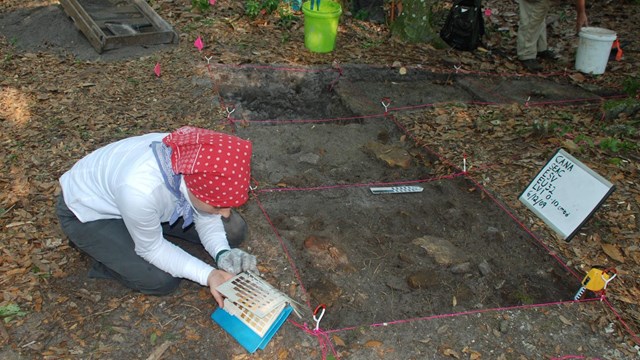
Initially a contour map and grid system were produced.  For the purposes of this excavation the grid consisted of one meter squares and notation was figured from the northeast corner of each unit.  Soil samples for chemical analysis were gathered at 50 centimeter intervals along north-south/east-west transects.

The stratigraphy of the site was thought to consist of three layers: 1) topsoil, 2) cabin debris, and 3) sterile sands.  As the excavations were initiated it became apparent that the soft sands revealed some stratigraphy only in the immediate vicinity of the fireplace.  The outline of the cabin was visible only by the closest scrutiny of weak color differences in the early morning light and by the accurate location of artifact concentrations.  Vertical control was established to fit individual situations.  Single and multiple features were marked until it was possible to determine their association with the structure or each other.  All excavated material was removed from the excavation and screened through 1/4 inch mesh.

Excavation Results

Excavation revealed only meager remnants of the cabin itself.  Salvagers and time have successfully removed all indications of the walls and roof.  No sole plates or stud butts of vertical members were found suggesting that the cabin was raised on old wooden footings or foundation piers.  This is supported to some extent by the two square rectangular soil stains found under the cabin debris.  Additionally there is a square concentration of plaster and shell at the northwest corner of the cabin.  Light changes in soil color, noticeable variations in soil matrix and artifact concentrations, and evidence of wall siding molded in plaster fragments attached to the chimney were the primary evidence used to locate the north wall of the cabin.  The north end wall plated on top of the chimney mantle, 
suggesting the cabin walls were approximately 6.5 feet in height.  Plotting of all features and artifacts in conjunction with the chemical soils analysis and color variations provided the necessary data to determine the location of the remaining sides. 

It was determined that the cabin interior was approximately 16 by 21 feet for a total interior living area of 336 square feet.  These dimensions are consistent with work reported on Rayfield by Ascher and Fairbanks (1971:8) and with dimensions given by Flanders (1967:153).  No evidence was noticed which would indicate interior divisions of the structure, so it is assumed that it is a single pen construction (Wilson 1975:25).  It was not possible to determine the existence of a loft.  In Cabin 15 the front and back door are in line with each other approximately four feet back from the fireplace. Concentrations of broken window glass suggest that the cabin had three small windows approximately 20 inches wide.  One of these was located in the south wall while the other two were opposite each other on the east and west walls.  Nail distribution and pattern suggest that the cabin had a wood floor supported by sills and joists. Plaster markings on the interior face of the hearth show that the floor boards fitted up to the top of these feature.

The chimney was the most durable portion of Cabin 15 and probably was the most time consuming portion to build.  Today the chimney is upright to the mantle, the rest falling away at an earlier date.  A builders trench was discovered that was excavated to a depth of 50 cm in order to construct the chimney footing.  The footing is constructed of tabby bricks (91/2"x 4" x 3").  A firebox was constructed in the top of the footing and abuts but does not tie into a tabby hearth.  The hearth is a 'single pour' and would appear to have had a frame constructed around it until the matrix cured.  The interior side walls and back of the fireplace up to the lintel were faced with a clay brick (9 1/2" x 4 1/2" x 2 1/2") which was not tied into the tabby.

The ceramics found fit the pattern for slave quarters as defined by Otto (1977:91-118).  The ceramics show a high percentage of tableware, especially serving bowls, and a low percentage of storage vessels.  The ceramics also show a low percentage of transfer printed wares, with a corresponding high percentage of banded, edged, and undecorated wares. Otto feels the most elementary explanation for this phenomenon would be the cost, such as the relative cheapness of banded and undecorated wares as opposed to the relative cost of transfer-printed wares.  This explanation would be difficult to test.  Another possibility was described by Otto:  that of correlations between ceramic types and ceramic shapes at plantation sites (Otto 1977:101).  This hypothesis was supported by the ceramic evidence at Couper Plantation, a site on St. Simons Island, Georgia, a nearby and economically similar environment.  The ceramic evidence from Cabin 15 fits this model.  Those ceramics displaying formal attributes were examined, and the results were tabulated. Surface design was closely studied to determine those sherds belonging to the same vessel; the results can be seen in Table 5.  Otto divided his classification into serving bowls and serving flatware.  Cabin 15 ceramics were divided into bowls, mugs, plates and other flat pieces, and chamber pots, with the following results:
 

Table 4: Ceramics by Number and Percent Total
      Type

Pearl ware, plain
Pearlware, plain, rim 
Pearlware, plain, base 
Pearlware, early hand-paint
Pearlware, late hand-paint
Whiteware

Pearlware, transfer print (Willow) Pearlware, transfer print
 

Pearlware, shell edge, green
Shell edge, blue, early
Shell edge, blue, late

Annular ware
Mocha ware
Wormy fingerpaint
Creamware, plain
Lusterware
Porcelain, plain
Ironstone

Gray saltglaze stoneware
Stoneware crockery
 

Total 

  #

157
  8 
 13 
  6 
  8 
  9 

  1
 36
 

 12
 59 
 49 

 82 
 19 
 19 
  3 
  1 
  3
  3

  7
  9 
 

504

    %

31.15
 1.58
 2.57
 1.19
 1.58
 1.78

  .19
 7.14
 

 2.38
11.70
 9.72 

16.26
 3.76
 3.76
  .59
  .19
  .59
  .59

 1.38
 1.78
 

99.88


_
 |
 |37.08
 |
 |
 |
_|
_
 |7.33
_|

_
 |
 |23.8
_|


_
 |3.16
_| 


Table 5: Ceramics Classification
 Type

 Bowls
 Flatware
 Mugs 
 Chamber pot

 Frequency

     17 
     41
      2
      1

  Percentage

     27.8
     67.2
      3.27
      1.63

The formal classification attributes divide more or less along typological lines (Table 6). Classification of bowls reveals that the majority of serving bowls are annular ware, with all of the annular ware vessels being bowls.  Several undecorated bowls are also noted.  Diameter was measured when possible, and the diameters of bowls cluster at 4.6" and 6.0."  The one variance to these diameters belongs to the one porcelain vessel, which may be explained as a difference in function.  The majority of wares are represented by pearlware, either plain body sherds or blue and green shell-edged sherds.  These are all in flatware items except for seven undecorated bowl forms.  Utilitarian or storage vessels of stoneware composed only 3.16% of the sample.  Otto sees the high percentage of serving bowls and the corresponding low percentage of flatware as reflecting the dietary habits of slaves.  Historical data on the dietary habits of slaves shows that they possessed few cooking vessels, and lacked the time needed for elaborate food preparation. As a consequence the slaves probably cooked vegetables, grains, and any available meat in the same kettle (Otto 1977:104).  Pottages, meat and vegetable stews, and rice pilaus could be left simmering for hours while they engaged in other tasks (Genovese 1974:543; Hillard 1972:49). The slaves apparently ate the liquid based stews from banded serving bowls (Otto 1977:104).  With some variation as to percentage, this pattern is followed at Stafford.  Though the percentage of bowls is lower than Otto predicts (27% as opposed to 40%), the percentage of shell-edged ware is slightly high, being 23.8% (Otto predicts less than 20%). The percentage of transfer-print ware is extremely low, well in keeping with Otto's prediction.

The acquisition of these wares by the slaves is another problem studied by Otto, who presents several possible hypotheses as to their source.  It is our opinion that Otto's second hypothesis, that the slaves used the ceramics the planter family formerly used and then discarded, is supported at Cabin 15 by application of South's Mean Ceramic Date Formula to the ceramic material (Table 7).  The formula developed (South 1974) yields median dates for the time span of site occupation by use of the mean dates of manufacture of ceramics found in the 
site contexts. 
 

Table 6: Vessel Forms by Types
(where discernible)
Annular ware 
     bowl
     flatware 
     mug 
     chamber pot

Mocha ware
     bowl
     flatware 
     mug 
     chamber pot

Wormy fingerpaint
     bowl
     flatware 
     mug 
     chamber pot

Pearlware, plain
     bowl
     flatware 
     mug 
     chamber pot 


0
0
0
 

0
0
1
0
 

1
0
0
1
 

7
0
0
0

   Pearlware, shell edge
      bowl
      flatware 
      mug 
      chamber pot

 Pearlware, transfer print
      bowl
      flatware 
      mug 
      chamber pot

 Porcelain
      bowl
      flatware 
      mug 
      chamber pot


0
41

0
 

1
1
1
0
 

1
0
0


 Table 7:  Dates for Ceramics*
  Pearl ware, plain 
Pearl ware, shell edge
Pearl ware, blue hand-paint
Pearl ware, transfer print
Pearl ware, polychrome hand-paint
Mocha ware
Wormy fingerpaint
Annular ware
Creamware, plain (lighter yellow)
Ironstone
Lusterware
Whiteware
Porcelain, Canton (plain)
Gray saltglaze stoneware
Brown stoneware crockery

*(South 1977; Noel-Hume 1976)

1780-1830
1780-1830
1780-1820
1795-1840
1820-1840
1795-1890
1790-1820
1790-1820
1780-1815
1813-1900
1790-1840
1820-1900
1800-1830
1700-1775
1820-1900
 

Using South's Mean Ceramic Date Formula, a mean ceramic date of 1807.0807 was obtained for the slave cabin, slightly earlier than expected from documentary research.  Deetz feels that what might at first appear as an erroneous date from the Mean Ceramic Date Formula could also be viewed as a potentially useful technique for the interpretation of archeological remains.  He states:

We have seen that where there is not a comfortable fit between archaeological and 
documentary materials, further questions are called for.  It follows that if the Mean 
Ceramic Date Formula were applied to sites for which the dates are independently 
determined, any major disagreement between these dates would require an explanation. 
The search for the explanation might well result in a better understanding of the materials 
in cultural or behavioral terms (Deetz 1977:18).
It is felt that this slightly early date tends to support the idea that at least part of the ceramics from the slave cabin were formerly used by the planter family and then given to the slave family when chipped or no longer of value.  It is hypothesized that excavation at Stafford's residence and subsequent analysis of ceramic artifacts would 
reveal a later median date.  Thus the date obtained would actually be the median date of use by the planter family, and not the date of use by the slaves after discard, this date actually being several years later. For example, at Parting Ways, a site occupied by four families of freed slaves from circa 1785-1900, Deetz obtained a mean ceramic date of 1794, where the actual documented median date was 1822.  Deetz explained this phenomenon as a result of the owners having kept older pottery for a longer period of time, or having received "hand-me-downs" from their more affluent neighbors (Deetz 1977:18)   Certainly this phenomenon can also occur in a plantation system, with the slave receiving cast off materials from the more affluent planter.  Otto rejected this hypothesis for the Couper Plantation site, and the dates he received for slave, overseer, and planter sites are more or less contemporaneous.  Though Otto rejected the "hand-me-down" hypothesis for the Couper site, this hypothesis was not completely rejected for all plantation sites, and it is felt to be applicable here.

In addition to the more common pearlwares, whitewares, and utilitarian stonewares, a few more expensive, rarer items were found during excavation. The first is the aforementioned bowl fragment of plain white porcelain. The other is a small sherd of lusterware, a refined earthenware of British manufacture, an expensive and often prized 
possession.  It is possible that these served a socio-technic, rather than technomic function as defined by Lewis Binford (1962a:219); that is, they were a status object, to be displayed and treasured rather than used in a utilitarian manner.

In conclusion, analysis of the ceramic artifacts from Cabin 15 revealed the typical range of British export wares for the time period.  Percentages of various wares and their formal attributes revealed that the ceramics, with some variation, fit the model proposed by John Otto for slave dwellings.  An early date for the median occupation of 
the site through South's Mean Ceramic Date Formula tends to support the hypothesis that the ceramics used by the slaves were those formerly used by the planter family and then discarded.  Thus the ceramic artifacts from the slave cabin fit well to the model proposed by John Otto, supporting his hypothesis that status can be revealed through 
quantification of ceramic materials.

Faunal Remains

Seven hundred eighty vertebrate specimens are included in the assemblage from the Cabin 15 excavations, and they were analyzed as a single provenience.  The medium to large mammal bones are highly fragmented and

exhibit signs of chopping and sawing as well as post-depositional breakage. The sample is too small (17 MNI) to constitute a complete representation of the meat ingested by the occupants.  Nonetheless, the data added to our knowledge of the foods in the diets of Stafford Plantation slaves.

Otto in his excavations of slave, overseer, and planter house sites from Cannon's Point (1975) confirmed the test hypothesis that because of differences in leisure time for hunting the percentage of wild animal specimens would be greater in the food remains sample from the planter's residence with decreasing percentages at the overseer and 
slave sites. Of the total MNI possible food animals, Otto found that non-domestic animals constituted 90% of the sample from the planter site, 88% of the overseer's site, and 82% of the slave site (1975:308).

The sample from Cabin 15, a documented slave cabin, contains 59% non-domestic animals.  The two possible domestic MNI are mallard, a wild species which is easily and commonly domesticated (Hausman 1946:137), and the remains of at least one rabbit which is too young to identify as a species.  If these two MNI were included with 
the non-domestic MNI, the total non-domestic MNI would be 71%.  The data are presented in Table 9 for comparison with Otto's results.
 

Table 9: Minimum Number of Individual
  Possible Food Animals at Cabin 15 
Category

Domestic
Possible Domestic
Non-Domestic 

No.

 5
 2
10

  Percentage

      29
      12
      59

The bone weights for each identified and unidentified species are given in Tables 10, 11, and 12.  Thebone weights are a more reliable indicator of the edible meat than the MNI and together with the fragment counts give an idea of the importance of each species in the diet.  Remains of small cricetid rodent were not considered among the 
food animal bones.

The two wild mammal species, raccoon and deer, present in the material are frequent visitors on farms where they forage on crops (Martin et al 1951:221). Therefore, the slaves need not have hunted them in their natural Pabitat. Another hypothesis suggested by the two deer elements from the sample, one tooth and one metapodial fragment, is that the slaves may have procured less-than-choice leftovers after a deer was killed and butchered elsewhere.

[Tables 10-15 under construction]

Twenty-eight small ovicaprine bovid bones (sheep or goat) were found in close association.  They are from an immature animal and are presumed to have come from one individual based on size, age, and paired elements. One surviving post cranial element serves to separate sheep from goat. In goat the ulna becomes 
fused to the radius quite early in life, whereas in sheep it may fuse only with advanced age, if at all (Boessneck 1969). Because the radius associated with the young Capra/Ovis individual evidences a broken off ulna shaft, these bones are designated goat in the analysis.

The Bos astragalus and phalanges exhibit saw and cut marks.  Most of the Sus bones are chopped.  This may be evidence that the pigs were butchered on the plantation.  Many of the epiphyses are missing from the long bones and metapodials of all the medium to large mammals species, and they exhibit occasional spalling that would indicate dog activity.  This may explain the locus of this refuse under the house.

A breakdown of the identified domestic species bones into skeletal elements represented in the material (Table 13) reveals that the slaves were consuming a large amount of cranial mandible and lower extremities which bear little meat. The hind limb bones, which represent the choicest cuts of meat, occur less frequently than the forelimb elements.

Personal Items

The excavations did not produce many items of this nature.  Only ten artifacts were found including beads, and it is difficult to gauge how representative they may be.  While small in quantity the variety is wide.  A pocket knife blade was collected.  It is badly corroded and no evidence of a casing was found.  Two suspender buckles (Plate 1-h) and two iron belt buckles were found.  A brass hook and eye, perhaps from a dress, were recovered as well as a small brass grommet, perhaps from a woman's shoe.  A small thin brass buckle was recovered near the 
rear door.  It is best described as what one would find as a buckle on a galosh.  A fragment of a brass comb is also included in the assemblage (Plate 1-i).

Buttons

Sixty-six buttons were recovered from the excavation of Cabin 15.  All were recovered within the cabin interior.  In analyzing this material the previous work done by South (1964:113-138) detailing a button typology was used as a primary guide.  This typology consists of 32 different types describing buttons from 1726-1865.  For a complete description of the typology the reader is referred to South (Ibid.); only those classes and categories of buttons found at Cabin 15 will be listed below.

Bone Buttons

Type 15
One bone disc was recovered (Plate 2-h).  It has no tooled rim for receiving a crimped metal front and has only one central hole.  Size: 16 mm; context, 1726-1865.

Type 19
Twelve bone buttons, each with five holes, the center hole being the largest, were recovered (Plate 2).  The central area of the button face on all the specimens is depressed, surrounded by a thicker rim. All five holes are drilled in the depression. Four of the buttons show parallel saw marks on the back while the remaining eight have been polished.  The button faces all show evidence of concentric cutting rings. Sizes:  12 mm - 21 mm; context, 1800-1865.

Type 20
Four bone buttons with four holes.  The central area of the button face on all specimens is depressed, leaving a thicker rim.  The backs are all polished and have a slight dome.  The faces all show evidence of concentric cutting rings.  Size:  10 mm - 17 mm; context, 1800-1865.

Metal Buttons

Type 9
Two flat circular copper discs.  An eye, no longer attached, was fastened to the back with a drop of solder.  The front of one button is stamped with an elaborate design which appears to be a poinsettia.  The other button, in a poor state of preservation, also has an elaborate stamped design on the front but it is not 
possible to determine what it is. Size:  33 mm - 35 mm; context, 1726-1776 (Plate 4).

Type 30
One flat, cast white metal button with four holes.  Conical shape toward the back with faint mold seam.  Size:  14 mm; context, 1837-1865.

Type 18
One flat brass disc with a brass wire eye soldered to the back. Slightly concave and thickened rim on the back with wreath motif under the word "GILT. Front is plain.  Size:  20 mm; context, 1800-1830.

A similar button which is also a flat brass disc with a brass wire eye soldered to the back was found.  In this case the back is flat and the word "PLATED" is stamped along the outer rim.  The front is plain. Size:  21 mm; context, 1837-1865.

Another button of similar manufacture and style has the following stamped in the back, "TREBLE.GILT STANDD COLOUR."  The front is plain. Size:  21 mm, context, 1837-1865.

Type 32
Two stamped brass four hole buttons with a depressed center area (Plate 3).  One is stamped on the back with the words "SHERMAN BRONSON." The other is stamped on the face with "IMPROVED SUSPENDER BUTTON." Size: 16 mm; context, 1837-1865.

Undetermined
Four buttons are not represented in South's chronology.  One of these is a brass front crimped over a brass backing disc with a soldered brass wire eye.  The back has a circular groove surrounding the eye. Bordering the crimped edge are the stamped words "W WALLIS.EXTRA RICH." The front has a background of thin parallel lines over the entire face. Impressed on this is an 18 spoke "pinwheel" surrounded by a circle composed of 19 dots (Plate 3).  Size:  13 mm; context, not determined.

A stamped brass four hole button with a depressed center area.  A thin circle of raised dots borders the outer rim of the depressed area. There is no eye.  On the outer rim of the back is stamped "WARRANTED NOT
TO CUT."  Size: 15 mm; context, not determined.

One cast brass button with a raised Tudor Rose motif on the face.  Face is domed.  Eye appears to have been fastened in place at the time of casting.  Back is concave and is stamped with "W.D. ONES & CO. EXTRA." Size:  18 mm; context, not determined.

One white metal button with a soldered eye.  Motif on the face is of an eagle facing to the left with a shield on its breast.  The bird is gripping an olive branch in its left talons and three short arrows in the right.  Size:  20 mm; context, a discussion provided by Robert M. Herskovitz (1978:39-41) makes it possible to suggest that this button was in use between 1854-1884.

Porcelain Buttons

Type 23
Thirty-six porcelain buttons were recovered.  These are white, four holed, with a convex face and back (Plate 4).  The central portion of the face is depressed.  All four holes lie within this depression.  All are plain except for one which has a checked pattern molded in the face (Plate 4).  Size:  11 mm - 13 mm; context, 1800-1865.

Shell Buttons

Type 22
One button handmade from mother-of-pearl (Plate 4-c).  It is flat with four holes that appear to have been hand-drilled.  The rim is bordered by small notches; ten arcs radiate away from the holes.  Size:
10 mm; context, 1800-1865.

Door and Window Hardware

Three complete strap hinges were recovered measuring 21 cm, 31 cm, and 38 cm respectively.  Also one incomplete strap hinge was recovered which would measure between 21 cm and 31 cm if complete (compared to complete specimens).  Three door and shutter pintles were found.  All have a rounded vertical shaft and a square 
horizontal shaft tapered to a point. This horizontal shaft was driven into the door or window frame where hinges would fit over the rounded vertical portion to support a door or shutters.

Two heart shaped padlocks of iron were recovered.  One measuring 8.9 cm in height, 6.5 cm in width, and 2 cm in thickness has a brass escutcheon cover and brass surrounding the key hold.  The other specimen, with no attached escutcheon, measures 9.3 cm in height, 6.1 cm in width, and 2.1 cm in thickness (Plate 5-d).  A brass 
escutcheon found in close association with the lock bears the word "PATENT" etched into the outer face.

A doorknob shank and spindle was found in close context with the strap hinges and one of the padlocks (Figure 4).

Utility Hardware

A short chain, 15 cm in length, was recovered with a hook at each end. This may have been used to hang meat to be smoked or weighed.  A hook and ring which was originally part of a block and tackle (wooden housing) was recovered.  Also found was an 8 cm length of chain (2 links) with a strap band at one end.

A chisel 16 cm in length was recovered along with an Ohio pattern ax head (Herskovitz 1978:80).

The head of a gig, (commonly used along the coast of Georgia, North Carolina and South Carolina to "strike for flounder") was recovered. Also found was a net maker's needle measuring 27.5 cm.

Household Hardware

A soup spoon measuring 18.8 cm and one spoon handle were recovered. Also found  was one bone handle from a knife, 9.5 cm long (Plate 5-b).

Fifteen fragments from a kettle, all possibly the same vessel, were recovered.  Also  found was one half of a pair of scissors.  A small brush band was also found.  A copper rod, square in section and measuring 27 cm, was recovered.  It is split approximately 2 cm at one end and is perforated.  This could have possibly been part of a clock mechanism.  A variety of lengths of bent wire were found.

Nails

It is unfortunate that the sandy soil and salt air of Cumberland Island are not conducive to the preservation of metals.  Because of this, the large majority of nails recovered from the Stafford slave cabin are too corroded for accurate identification. About all that can be said is that the nails, with few exceptions, are of the square cut 
variety.

One can usually estimate the age of some nails by certain diagnostic features.  These features include the characteristic of the nail head, the characteristic of the nail shank, and an indication of how the nail was cut by the arrangement of burrs and shear marks on the shank. Because of the poor condition of the nails, few of these 
characteristics can be observed.  Nails that do have identifiable characteristics include those that are hand wrought with "rose" heads, hand wrought copper roofing nails, "T" headed nails, and nails with "roof peak" shaped heads.

Bottles

As a category, 47 fragments of glass bottles were recovered.  The majority of this material can be associated with 11 individual glass artifacts. This small number prohibits any useful division by type, i.e., beverage, medicine, foodstuffs; and the discussion of this material is limited to very general descriptions.

Fifteen fragments of Schnapps bottle were recovered.  Relief molded letters on three sides read "UDOLPHOWOLFE'S / AROMATIC SCHNAPPS / SCHIEDAM." Switzer (1974:36) describes such a bottle found in the cargo of the Bertrand.  He indicates that this type of bottle was a 14-ounce bottle with an alcohol content averaging 21 percent by volume.  They are considered to be French Squares of the Hostetter type.  Dimensions:  height, 8 1/16"; base, 2 3/8"; diameter of neck (outside), 1", inside, 3/4".  The bottle was cork-stoppered.  In 1867 this liquor sold for $3/bottle (Switzer 1974:82).

Three complete bases and four base fragments could be classified as liquor containers.  The kick-up suggests that they may be wine bottles. They are dark green in color and the diameter varies from 77 mm to 95 mm.  Discussions (Switzer 1974:7-30; Jones 1911:70) suggest that these bottles were common in the middle to late 
1800's.

One complete neck and shoulder fragment of thin light green glass was recovered. The neck is hand finished by the addition of a band of glass.  The shoulder is at right angles to the neck and in form appears to be similar to the Eclipse olive oil bottle illustrated by Herskovitz (1978:4 Figure "aa").  Neck:  height, 88 mm; diameter of neck (outside), 33 mm; inside, 17 mm.  Bottle was cork-stoppered. One complete base and 21 fragments of a probable mason Glass is sun colored amethyst brought on by the action on the manganese in the glass.  Base appears as a foot and 5 mm high.  No identifying marks were noticed with a mold seam running up the body.

Three base fragments from three separate containers were recovered but they are not large enough to determine positively what they contained. One base is 50 mm in diameter and had a kick-up common in the middle 1800's.  It is a clear glass with a patina.  Its general form and size suggest that it is a culinary bottle holding something like brandied peaches (Switzer 1974:44, Figure 61).  Another fragment is a pale aqua colored base fragment which appears to have had six sides.  The base is slightly concave.  A similar base in Switzer (1974:60, Figure 81) is that of a pepper sauce container.  A third base fragment of clear glass with one small base appears to be from a vial.  It is 23 mm in diameter and flat bottomed.  This container may have been used for perfume (Switzer 1974:43, Figure 58).  One vial fragment is a slightly constricted neck with a flared lip.  It is of clear thin glass and was cork-stoppered. Dimensions:  neck height, 16 mm; diameter of lip (outside), 21 mm; diameter of neck (inside), 13 mm.

Three fragments of light green glass make up what appears to be a small medicine or prescription bottle.

Five fragments of medium brown glass were recovered.  Two fragments of blue-green glass were found.  This glass is quite thick (7 mm) and one fragment has a "K" embossed on the outer body surface.

Prehistoric Material

Four Deptford Check Stamped and two plain body sherds were recovered. A basal notched portion of a projectile point and a bifacial worked core showing considerable battering along the lateral edges made up the rest of the prehistoric material located in the excavations.  It is interesting that a similar amount and type of aboriginal material was recovered by Ascher and Fairbanks in their work at Rayfield (1971:6).

Lithic Material

Stone artifacts were scarce.  One fragment and one complete gun flint were recovered.  The fragment is a blond chert while the complete specimen, measuring 17.9 mm in length, 21 mm in width, and 8.15 mm in height, is a 
smoky-gray color.

Three fragments of a circular grindstone (gray-black sandstone) were found along the east side of the chimney (Figure 4).

Fifteen large fragments of gray slate averaging 6 mm in thickness and numerous small flakes were found in the fill excavated from the fireplace hearth and the chimney building trench.  These appear to be portions of discarded slate shingles.  Portions of slate shingle can still be seen in the chimney base of Cabin 15 as well as other chimneys at Stafford Plantation.  It is suggested that it was used as shims between some courses of brick and in some cases to align the oak lintel.

Beads

A total of six glass beads were recovered; they were blue, green, or clear and are summarized in Table 15.  The specific shape, color, and type designations utilized are those presented by Kidd and Kidd (1970). All but one are faceted and appear to have been formed by grinding, as each facet, which is well defined, exhibits faint parallel striations (Plate 1).  None shows visible mold seams.  The remaining bead is fragmented but is made of thin glass.

Twenty-nine fragments of window glass were recovered; none show evidence of melting or warping by heat.  All fragments are from flat sheet glass which ranges from clear to light blue-green in color and from .5 mm to 1.1 mm in thickness.  All are patinated.  Though some of the fragments have trimmed edges or corners, no restorable panes were found.  None of the pieces show any traces of putty or other means of keeping panes tight in their frames and no glazier's points were found.

The glass fragments are thinner than the thinnest sheet glass made today (Walker 1979: personal communication)   A comparison of glass thickness from numerous historical sites shows an increase through time in the thickness of the thinnest glass used (Walker 1971:78).  Walker states that glass 2/64" in thickness occurs only at sites occupied by 1820 and no longer occupied by 1840; glass of 3/64" thickness occurs only on sites built or occupied prior to 1845 (Walker 1971:78).

Based on the above pattern the window glass from Cabin 15 would date between 1820 and 1845.  Such a date is consistent with the early period of the Stafford Plantation land acquisitions.  The area of the cabins is located in a tract of land purchased by Stafford in 1813.

Lamp Chimneys

Forty-eight fragments of flint glass lamp chimney were recovered.  This identification is based solely on the thickness of the glass and its curvature.  The actual shape or style of the chimneys is not known.

Unidentified Glass

Twenty-eight fragments of glass were recovered that could not be identified other than that they are from a variety of small bottles.

Clay Pipes

The excavations produced four white clay pipe bowls, 22 bowl fragments, and 74 stem fragments.  All of the specimens are of the type with a nondetachable stem.  The small number of specimens are described below and no attempt will be made to compare them with other localities.

Varieties of Pipes

"TD" Pipes (Plate 6)
Form:  Conical bowl at right angle to stem, heeled, bore diameter -6/64" 
Markings: Raised "TD" on back of bowl surrounded by 13--six pointed stars.  This motif is enclosed by a raised oval line which separates it from the raised cross-hatching on the rest of the bowl row of stars encircles the lip.

"Ribbed" Pipes
Form:  Conical bowl at obtuse angle to stem, heeled, bore diameter -6/64" 
Markings:  Bowl has raised ribs on the front and back.  Sides of bowl have a raised flower with stem and leaf motif running the height of the bowl.  Raised leaves are on the front and back mold lines.
Form: Conical bowl at right angle to stem, heeled, bore diameter - 6/64" Markings: Plain except for leaves on front and back mold lines.

Other Form: Pipes
Conical bowl at right angle to stem, heeled, bore diameter- 7/64" 
Markings: Plain except for leaves on front and back mold lines. In addition to the four bowls described above were 22 bowl fragments. Thirteen of these fragments showed no markings, with the remaining nine showing some 
evidence of a motif.  Two fragments had vertical ribbing. One had vertical ribbing with a leaf motif on the back mold line.  Two fragments had small square punctations running around the bowl rim. Another specimen had five-
pointed stars and hatch marks running the vertical length of the bowl mold marks.  A frontal bowl fragment showed a  TD" impressed into it but no other motif was seen.  Two specimens showed a raised motif which is not complete enough to identify.

Seventy-four stem fragments were recovered; 71 were plain.  Two were marked with the location of manufacture.  One of the stems word "GLASGOW" impressed in the stem (Plate 6-c); bore diameter 6/64."  Another stem shows "GLASGOW" on one side and "MURRY" on other; bore diameter is 5/64."  One stem fragment is unusual in entire fragment (25 mm) is lacquered.

Pipe stem dating techniques using bore diameters were applied even though dating samples of white clay pipe stems is not reliable.  Both the formulas by Binford (1962b:19) and Heighton and Deagan (1972:221) produced erroneous dates in the early 1730's.

SUMMARY

This report has discussed the results of archival and archeological investigations at a slave cabin site located on Stafford Plantation. effort has been made not to overextend the data, and the research raised more questions than answers.  Robert Stafford was the major planter, exporter, and importer on Cumberland Island, and his involvement in island activities covered an uninterrupted period of more than 60 years. His extensive holdings and subsequent land use decisions should have been a major determining and regulatory factor in local island policies. The management, economic, and investment designs of the plantation would have affected considerable socioeconomic and political impact in the surrounding portions of Camden County.  Carefully constructed research strategies for future study will provide tremendous insight into ante-bellum life on Stafford Plantation and its chattel support system.

The limited number of artifacts found at Cabin 15 suggests a pattern of mixed bag hand-me-down elements covering a period of use from approximately 1820 to 1865.  It is concluded by the authors that most items of chattel material culture were supplied by the plantation owner; the exception to this might be the wild food sources that have obviously been exploited.  Documentary evidence concerning the establishment of the slave settlement, its operation, and day to day concerns has not been found.  It will be necessary to undertake further archival and archeological research to provide answers to these general topics.  The excavations to date suggest that the slave cabins site is relatively intact; there may be some vertical mixing of archeological materials, but the horizontal distribution appears to be largely intact.  No known post Civil War activity can account for the lack of structural remains of the cabins.  We suggest that they may have been cannibalized through time, but it is doubtful that 
Stafford had them burned after emancipation.

It must be remembered that the stabilization and exhibition of historic fabric should not subsume the history that it represents.  The chimneys are a vestige of an almost unknown cultural group.  Traditional written records offer little insight into the day to day lives of Black Americans, particularly in their role as chattel.  Only archeology can substantially supplement this situation in this instance.  The Service has in the chimneys a unique opportunity to provide substantive data about chattel culture on the Sea Islands of South Georgia in the first half of the 19th century.  The island location of Stafford Plantation is a major element in its value as a research unit.  Here one has the chance to clearly delineate varying cultural components in time and space from the surrounding area.

The relative geographical isolation of the plantation has aided in the overall continuity of the area.  This factor will enhance future research in the areas of site interpretation, overall village layout, developmental sequence, chattel behavioral patterns, and intra-cabin/village variability. It is our recommendation that prior to any preservation/stabilization operations archeological excavations and study be undertaken for the entire Stafford chattel complex.  Such research is directly related to current significant anthropological concerns and is essential to park visitor understanding of the integral role of slavery in the economic structure of the Sea Island plantations.  The nature of such work is relevant and propitious as the nation awakens to the needs of her minorities and recognizes the often vital role they played in American history.

References [under construction]

Bullard, Mary R.
1986   Robert Stafford of Cumberland Island: Growth of a Planter. E.O. Painter Printing Co., Deleon 
           Springs, Florida.

Floyd, Charles Rinaldo
n.d.     Charles Rinaldo Floyd Papers, 1816-1845. Manuscript on file, Georgia Historical Society, Savannah, 
           Georgia.: January 11, 1836)

John E. Ehrenhard and Mary R. Bullard
1981   Stafford Plantation Cumberland Island National Seashore, Georgia: Archeological Investigations
           of a Slave Cabin. Southeast Archeological Center, National Park Service, U. S. Department of the
           Interior, Tallahassee, Florida.


Growth of the Plantation | The Stafford Family | Stafford the Planter
Slavery | Archeology and Opera: "Zabette"

to 1999 Fieldwork at Cumberland Island