History
of Investigations
Between 1987 and 1990, archeologists at the NPS Southeast
Archeological Center conducted three field seasons of work as background
to the interpretive programs at the park. The objectives of this research
were to determine the precise nature and locations of the prison's stockade
walls and gates, add to our understanding of prison conditions, and provide
other historical details that had heretofore escaped documentation. This
information was vital to park interpretative programs in allowing for partial
recontruction of the stockade walls and the installation of associated
exhibits that provide a sense of scale and spacial orientation to the visitor.
This work also revealed important historical information about the different
techniques used in constructing the original stockade, the main gates,
and later expansions.
Archeological
Fieldwork
In January 1987, the National Park Service proposed that certain portions
of the inner prison stockade at Andersonville National Historical Site
be reconstructed to "enhance visitor understanding of the prison and prison
conditions" of the infamous Civil War prison camp (National Park Service
1987:1). Three of those portions of the prison slated for reconstruction,
the northeast corner, the southeast corner, and the North Gate, have been
investigated and are the subjects of this report.
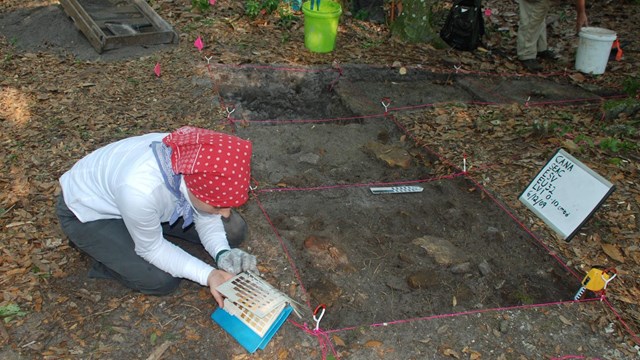
Excavations
In the spring of 1987, John W. Walker undertook the first phase of pre-reconstruction
work by excavating 66 meters of stockade line at the northeast corner of
the prison (Walker 1990). Guy Prentice directed the second and third phases
of pre-reconstruction work by excavating the North Gate in 1989 (Prentice
and Mathison 1989) and 70 meters of stockade line at the southeast corner
of the prison in 1990 (Prentice and Prentice 1990). The primary method
of investigation during all three field seasons consisted of first exposing
the stockade wall trenches and other features by stripping away the plowzone
a few inches at a time with a six foot wide box blade pulled by a tractor.
Cross-section trenches were then placed at several locations along and
across the exposed wall trenches to reveal details in wall trench construction
and pole placement.

Northeast Corner
The northeast corner of the prison was part of the northern extension
built by the Union prisoners after it was decided to enlarge the original
prison. During the course of his excavations, Walker was able to determine
that this portion of the stockade was constructed by digging a trench roughly
five feet deep and two feet wide, then setting the posts in the center
of the trench and backfilling around the posts. Longitudinal cross-section
trenches placed along the stockade wall showed the spacing of the posts
and diagonal bands of fill running west to east in the northern wall and
north to south in the eastern wall. These diagonal fill zones indicated
that when the prisoners set the posts, they proceeded from the west, backfilling
as they went along, working their way to the northeast corner then turned
and continued in the same manner toward the south.
Preservation of the stockade posts in this portion of the site was very
good, so Walker was able to determine the placement and sizes of the posts
in the wall trench. Walker's work at the northeast stockade corner indicated
that the construction of the stockade did not correspond, however, with
the "tight" squared pole placement described in the historic accounts.
Slave
Labor Used
The posts set into the stockade wall trench at the northeast corner
of the prison had not been hewn square, and there were often sizable gaps
between posts. This pattern was also identified when a portion of the northern
prison extension was examined during the North Gate excavations in 1989.
The reason for this apparent contradiction between the historical accounts
and the archeological record is that the historical accounts referred to
the construction of the original stockade built by the African American
slave gangs, while the later northern extension was constructed by the
Union prisoners in the same manner as the later middle and outer stockade
walls -- without squaring the poles and with less emphasis on tight construction
due to time limitations and manpower constraints.

North Gate
In the spring of 1989, the second phase of pre-reconstructive archeological
investigations were conducted at the prison site. The primary objective
of these investigations focused on identifying the location and nature
of the North Gate along the western stockade wall. Again, the primary method
of investigation consisted of stripping away the plowzone with a tractor
and box blade followed by the cross-sectioning of features.
The search for the North Gate was initiated near two stone monuments
that had been erected in the 1930s to mark its approximate location. As
the western stockade wall trench was initially exposed with the box blade,
a consistent pattern of trench fill soon became apparent. This pattern
consisted of a band of orange colored soil running along the western half
of the trench, and a band of dark red colored soil along the eastern half
of the trench. The two bands were often separated by a band of gray soil
and the remains of wooden posts running down the center of the trench.
The soil color banding observed in the West Stockade wall trench in
plan view was duplicated in the cross-section trench profiles. These profiles
made it readily apparent that the banding was the result of the manner
in which the soils had been removed from the wall trench and backfilled
around the posts. The soils in this portion of the site naturally grade
from an orange color at the ground surface to a dark red color at a depth
of 1.5 meters.
The banding in the wall trenches indicates that, when the wall trench
was excavated, the uppermost orange soils were thrown toward the exterior
of the prison, while the deeper red soils were thrown toward the interior
of the prison. When these soils were backfilled into the wall trench, the
posts placed in the center of the trench prevented the two soil colors
from mixing, thereby creating the banding effect noted near the surface.
The North Gate,
like the stockade wall was exposed by stripping away the plowzone with
the tractor and box blade. After the North Gate was photographed and mapped
in plan view, a series of cross-section trenches were placed along and
across the wall trenches to reveal details in wall trench construction
and pole placement.
In general, the archeological remains of the North Gate were found to
coincide with the historical descriptions, but diverged in some specific
details. The North Gate consisted of a boxlike enclosure projecting westward
from the main stockade. The walls of the Gate were constructed in the same
manner as the original stockade with squared posts set in a wall trench
roughly five feet deep. The gateways into and out of the gate were centered
on the east and west walls of the enclosure. The dimensions of the North
Gate were actually 27.6 ft by 34.8 ft however, not the 30 by 30 feet that
was reported in the historical accounts. The doorways of the gate were
also roughly 2.9 meters wide (9.5 ft) rather than the reported 12 feet.
The western gateway was evidenced by a gap between wall trenches. The eastern
gateway was evidenced by several pine poles placed horizontally within
the stockade wall trench.
Artifacts
recovered during the North Gate investigations included one iron axe head
and an axe head fragment, a brass and iron buckle, cut nails, a brass utensil
fragment, probably part of a spoon handle, stamped with a crown symbol
and the letters GR (or GB), and an alkaline glazed stoneware sherd. The
ax heads were probably the remains of tools used in the construction of
the original prison stockade by the African American slaves encumbered
with the task. The cut nails were also probably used in the construction
of the prison.
During
the 1989 investigations, we also found the location of the original north
wall of the prison, which appears as a whitish (inner central) fill zone.
The original north wall had been torn down by the prisoners following the
building of the northern prison extension in July, 1864. Trench #3 was
excavated to examine the original north wall. The west profile of Trench
#3 exhibited the same wall trench shape and form as the western stockade
trench, having a flat bottom with slightly inwardly sloping sides. No posts
were found in the trench and the sides of the wall trench showed no signs
of distortion or collapse. This suggested that when the prisoners pulled
the post from this section of the original northern stockade wall trench
on July 1, 1864, they pulled it to the east, thereby preserving the original
trench shape. This is in contrast to the opposite or east profile in Trench
#3 where the northern side of the wall trench flairs outward near the ground
surface. This flairing at this point in the trench suggests that when the
posts were removed by the prisoners they were pulled towards the north.
This flairing was probably the result of digging along the north side of
the wall to loosen the poles so that they could be tipped or pulled out.
The profiles in Trench #3 also provided enough evidence to conclude
that the method used to dig and backfill the wall trench of the original
north stockade was the same as that used for the original west stockade.
In other words, during the digging of the wall trench, the uppermost soils
were piled toward the exterior of the prison and the deeper red soils were
piled toward the interior of the prison. When the soils were backfilled
around the posts, the posts prevented the two soils from mixing, thereby
creating a banding effect. Although the trench fills were later disturbed
when the prisoners pulled out the posts on July 1, 1864, portions of the
original fill zones were preserved at the bottom of each profile.
Numerous animal
bones that were recovered during the excavation of the stockade wall trenches
were probably the remains of meals consumed by the African American slaves
who built the original prison. The identifiable animal remains have been
classified as pig and cow bones. Some of these items exhibit butchering
marks.
Trench #5 was placed parallel with the west stockade line at the point
where the northern stockade extension intersected with the original northwest
corner of the stockade. The excavation unit was placed here to reveal the
method in which the stockade extension was added to the original corner
of the prison. The point of intersection between the northern extension
and the original stockade was evidenced in the west profile of Trench #5
by a vertical zone of red soil roughly 30 cm wide. South of the point of
intersection, the remains of several posts showed that they had been hewn
square before being placed in the trench. North of the point of intersection,
the remains of several posts indicated that those posts that had been used
in the construction of the extension had not been hewn square, as was noted
by Walker during his 1987 investigations of the northeast corner.
Southeast Corner
In 1990, excavations were conducted at the southeast corner of the
stockade. Like before, a box blade and tractor were used to expose the
stockade wall trench. As the stockade wall trench was exposed first with
the box blade and then by hand excavation, a consistent pattern of trench
fill appeared. This pattern consisted of a band of soil colors with a yellowish
brown sand strip running along one side of the stockade wall trench, and
a band of whitish sand along the other side of the trench. The two bands
were often separated by a band of grayish brown soil resulting from the
decomposed posts located in the center of the trench. A similar banded
pattern of stockade wall trench fills had been noted during the 1989 North
Gate investigations.
Meaning
of Banded Soils
The banded pattern of wall trench fills found at both the Southeast
Corner and the North Gate reflects the consistent manner in which the stockade
wall was constructed by the slave gangs. While digging the wall trench,
the uppermost soils were consistently thrown to the outside of what would
be the prison enclosure, while the deeper subsoils were thrown to the inside.
The posts were then set in the middle of the trench and the fill on both
sides of the trench was then packed around them. In the area of the Southeast
Corner, where the deeper soils are naturally whiter than the light brown
soils near the ground surface, this resulted in a white band on the interior
side of the stockade posts and a light brown band of soil bordering the
exterior of the posts. In the area of the northwest gate where the natural
soil colors grade from orange to red, this resulted in an inner red band
and an outer orange band of soil separated by posts.
Escape Tunnel
During the 1990 excavations, a failed prisoner's escape tunnel was
discovered along the southern stockade wall. These excavations currently
provide the only archeological data collected to date regarding prisoner
escape tunnel construction at Andersonville. Within our excavation units,
the widest section of the escape tunnel was about 90 cm. Based on profile
map reconstructions, the height of the tunnel was approximately 40 to 50
cm; just big enough for a man to crawl through.
This corner
of the prison was apparently chosen as a tunnel location because of the
soft, easily dug, sandy soils. Unfortunately for the attempted escapees,
the soft soils also caused the downfall of the escape attempt. Digging
just deep enough to pass beneath the bottoms of the stockade posts, the
sandy soil and several stockade posts collapsed into the tunnel before
the tunnel could be extended more than one meter past the stockade line.
Locating
the "Deadline" Posts
During the southeast corner investigations, an attempt was made to
locate some of the deadline posts by excavating six one-by-one meter units
within the stockade enclosure. Two post locations were found and were given
the designations of Post Mold #1 and Feature #4. Both post locations were
cross-sectioned and flotation samples were collected for analysis. During
the excavation of Post Mold #1 several artifacts were recovered, including
a metal button, some bone fragments, some unidentifiable metal fragments,
and a silver filigreed writing instrument. Artifacts recovered from Feature
4 included a metal button, a cut nail, cloth fragments, carbonized floral
remains, and two pieces of bone. One of the bone fragments exhibited evidence
of butchering. The carbonized floral materials consisted of pine straw,
pine bark, beans (Phaseolus sp.), and unidentified plant remains. These
items were probably contemporaneous with the prison's occupation.
Reconstructions
Reconstruction of the northeast corner of the prison has been completed
and has duplicated, as much as possible, the construction techniques revealed
by Walker's 1987 investigations and historic documentation. Note that the
poles are rough and unhewn with gaps between the posts. The park has also
reconstructed the southeast corner and the North Gate using squared posts.
Future Work
Investigations of the southwest corner of the prison have also been proposed,
and may be conducted in the near future. This portion of the site was
used to tend to the sick prisoners held within the prison. Excavations
here would provide us with interesting insights into medical practices
at the prison.
to Archeology at Andersonville main page
|