Go to Recommendations

Go to Bibliography

RESEARCH DESIGN

Context

The research design presented below was developed to comply with Federal mandates and guidelines for 
identifying cultural resources, as well as preparing the foundation for evaluating those cultural resources 
for eligibility to the National Register of Historic Places (NRHP) (36 CFR 60.4). Cultural resources that are 
evaluated eligible for the NRHP are most likely significant per Appendix K of the California Environmental 
Quality Act (CEQA). 

Historic Context

An initial part of that process involves the development of a "historic context," organized by theme, place, 
and time. A theme may be the equivalent of a research problem, and an historic context is developed by 
placing the study in an appropriate setting in time and space.  A broad historic context for the present project 
can be identified as "Western U.S. Expansion mid 19th Through 20 Centuries- Pacific Coast." A more 
focused historic context is "the mid 19 to mid-20th Century Urban Development of the South of Market District, 
City of San Francisco." 

Property Types

A "historic context" is associated with identified cultural resources through the concept of a "Property Type." 
A property type is a group of individual historic properties (e.g., archaeological sites) that share physical and 
associative characteristics. Site types, including archaeological sites, are interpreted and evaluated within the 
realm of the "historic context." Generally, architectural sites are evaluated for eligibility under NRHP Criterion C, 
while archaeological sites are assessed for their potential "to yield information" with respect to the historic context 
when considering eligibility under Criterion D. In the same vein, Appendix K of CEQA states that an "... important 
archaeological resource is one which... Can provide information which is both of demonstrable public interest 
and useful in addressing scientifically consequential and reasonable or archaeological research questions."

Property Types established for the Tar Flats, Rincon Hill, and Mission Bay have been established by Praetzellis 
and Praetzellis et al. (1992:4-18-4-21). A condensed version of their Property Types is presented below: 

Prehistoric Archaeological Property Types by Susan Alvarez (1993):

- Human Burial Sites
- Occupation Sites
- "Shellmound" of Dietary Debris Sites
- Lithics Only Sites

Historic Archaeological Property Types:

- Domestic Occupation Sites
- Commercial Sites
- Industrial Sites
- Landfills
- Buried Ships

Themes and Research Domains As stated above, themes are equated with "research problems" (Altschul et al. 1990) or "research domains" (Alexandrowicz et al. 1988, 1991, 1992, 1993; Greenwood and Foster 1990; Praetzellis and Praetzellis 1992). Major research domains have evolved during a decade of cultural resources investigations at various 19th to 20th century sites in California. Several site specific research themes proposed for the Project Area are included in Table 3. It should be noted that the research themes that are presented in Table 3 have been adopted from the "Areas of Significance" and "Functions and Uses" for eligibility evaluations for the NRHP, as contained in National Register Bulletin NO. 36: Guidelines for Evaluating and Registering Historical Archaeological Sites and Districts (McClelland 1986; Townsend and Knoerl 1991).


Table. Examples of Potential Research Domains. 
_________________________________________________________________
- Agriculture;			- Exploration/Settlement;
- Architecture;			- Funerary; 
- Archaeology: Prehistoric,	- Government;
     Historic Aboriginal,     	- Health/Medicine;
     Historic Non-Aboriginal;	- Industry/Processing/Extraction;
- Art;				- Landscape Architecture;
- Commerce/Trade;		- Law;
- Communications;		- Literature;
- Community Planning 		- Maritime History; 
- Conservation;			- Maritime Industry; 
- Defense;			- Military;
- Com. Development;		- Other (i.e., invention)	
- Domestic;			- Philosophy;
- Economics;			- Politics/Government;
- Education;			- Preforming Arts;
- Engineering;			- Religion;
- Entertainment/Recreation;	- Science;
- Ethnic Heritage:		- Social History;
     Asian;			- Transportation; 			
     Black; 			  
     European; 
     Hispanic; 
     Native American; 
     Pacific Islander; 
     Other;
________________________________________________________________                                                       

Other germane "Research Themes" for this project are:

- Chronology;
- Environmental Adaptation;
- Irrigation;
- Technology;
- Land Use;
- Subsistence;
- Material Culture;
- Settlement Patterns; 
- Demography; and
- Economics.

Praetzellis and Praetzellis (1992) have produced a historic preservation report that has a research 
design tailored for work within the City of San Francisco, particularly in the vicinity of Tar Flat, Rincon Hill 
and Mission Bay. The prehistoric and historic archaeological research themes are presented below in an 
abstracted form.

Prehistoric Research Themes by Susan Alvarez (Praetzellis and Praetzellis 1992):

Theme A- Environmental Change
Theme B- Temporal and Spatial Affiliations
Theme C- Prehistoric Peninsula Site-Specific Adaptation
Theme D- Regional Exchange

Historical Archaeology (Praetzellis and Praetzellis 1992):

Theme A- Consumer Behavior/Social and Economic Status
Theme B- Urban Households
Theme C- Urban Geography
Theme D- Ethnicity/Urban Subcultures
Theme E- Industrialization and Technological Innovation
Theme F- Interpretive Potential

It should be noted that many of these research themes are contained within a reference, Urban Archaeology in America: A Search for Pattern and Process, edited by Roy S. Dickens (1982). Many of these research themes are applicable to the present investigation. Further research within and adjacent to the Project Area should build on these research domains and use them in the refinement of historic contexts that characterize the cultural development of the Project Area. In turn, this will accentuate the eligibility evaluations and interpretation of the cultural resources within the Project Area.

Research Questions

Research Questions pertaining to the research domains for the current project were developed prior to and during the course of the archival research and archaeological reconnaissance of the Project Area. Other research questions arose during the subsequent analysis of the research data and are included herein.

Within the succeeding paragraphs Statements are presented on the basis of historic research, oral history interviews, and on-site reconnaissance of the Project Area. Research Domains or Themes are presented after the statements. Immediately following are the relevant Research Questions. A section on Data Requirements needed to answer the research questions precedes the Summary.

Statements

Prehistoric occupations in the general vicinity of the Project Area are not well documented as only one burial, a ca. 5000 year old female was identified two blocks northwest at the BART O station on Market Street. In general, Spanish and Mexican occupations within the immediate vicinity of the Project Area were sparse, albeit they did maintain the Presidio and Mission Delores in the general vicinity of the Project Area. Following the Gold Rush, the City of San Francisco boomed in population and growth. Ships were sunk and fill was graded from hillsides to fill in the shores and marshlands to increase the size of the peninsula. Urban growth was rapid with diverse ethnic communities. During the 3rd quarter 19th through the early 20th century, the Project Area situated within the South of Market Area, contained occupations of various ethnic backgrounds. Americans, Irish, Germans, Swedish, and Japanese were noted within the census data for the Project Area. Domestic residences were interspersed with commercial and business enterprises during the mid-late 19th century. During the early 20th century, especially after the 1906 earthquake, the urban core assumed a brick and concrete building appearance. Commercial, business, and industrial enterprises during the early to mid 20th century displaced the large inner-city populations that were characteristic of the late 19th century occupations.

Theme- Architecture

Questions: What types of architecture are represented within the Project Area? How old are the buildings/structures within the Project Area? Does the architecture reflect local and/or national styles? Are architectural components at this site representative of other architecture within the immediate vicinity of the Project Area? Can functional activities, such as residential and/or commercial, and/or industrial be defined at this site on the basis of extant architecture and/or on the basis of archaeological components (e.g., building foundations, privies)? Do the architectural components at the Project Area represent a vanishing and/or rare Site Type within the vicinity of the Project Area? Does the architecture possess integrity of location, design, setting, materials, workmanship, feeling, association, distinctive characteristics of a type, period, or method of construction? Can local building techniques be uncovered through examination of the existing buildings and relic foundations and/or other existing structural elements? Are ethnic heritage and/or building techniques (i.e., European or Asian versus American) evident? What types of construction materials were used for the buildings? What were the functions of the respective rooms and/or additions? What types of foundation remnants represent additions and/or outbuildings? Is there evidence of different episodes of building modifica-tions or additions on the structures and/or archeological features (e.g., foundations).

Theme- Chronology

Are prehistoric occupations at this site demonstrable on the basis of material culture and/or cultural features (i.e., fire pits, burials)? What are the occupation dates at each parcel within the Project Area based on architectural analysis, artifact data, historic documents and/or maps? Do the extant structures and/or relic foundations represent the first historic occupation at this site? Does artifact evidence suggest earlier, ephemeral occupations within the Project Area? Can discrete occupations associated within the Project Area be defined on the basis of architectural data, archaeological data, historic and/or oral history data?

Theme- Economics

Does the site contain material culture indicative of local and regional socio-economic patterns? Are State and National economic trends evident in the historical and/or archaeological records? Do the sites contain evidence of changing economic pursuits by their respective owners/occupants? Does the archaeological record support the historic data relevant to the l ower economic status of the occupants within each lot from the mid to late 19th century and/or the 20th century? Does the cultural material (e.g., ceramic types, meat cuts, personal objects, bottled products) reflect the vacillating socioeconom-ic status of the occupants? Is there evidence of acculturation and assimilation into mainstream American culture by the late early to mid 20th century? What are the networks of exchange and commodity distribution? Were there well developed trade networks on the local, re-gional, national, and international level evident in the vicinity of the Project Area as reflected in the material culture? How did it evolve over time?

Theme- Ethnicity

Do prehistoric cultural remains exist on this site, do they share similar traits with later ethnographic cultures? Are ethnographic artifacts representative of the Ramaytush Castonoan protohistoric and/or ethnographic cultures? Does the cultural material reveal the ethnic makeup or a diversity of ethnic traits of the occupants within the Project Area for the prehistoric and/or historic periods? Is assimilation into the Anglo-American Culture evident in the material culture of the occupants in the individual house lots from the early through the mid 20th centuries? Do artifacts recov-ered from the site represent the presence of ethnic laborers on the eastern or western parcels? Do butchering techniques and patterns indicate ethnic occupations from each respective site?

Theme- Material Culture

Are prehistoric, ethnographic, and/or historic material culture present at this site? Can we attribute these artifacts to Key Time Periods and/or ethnic groups? What are the interpreted functional classes of artifacts recovered from the site? Can we attribute residential, agricultural, and/or ranching activities to specific architectural and/or archaeological features on the basis of artifact analysis? Are patterns of procurement or consumption evident? Do Local, Regional, State, or National consumption patterns change over time? Is socio-economic status reflected over time and/or occupations at this site? What types of material culture represents the initial family occupation and/or successive occupations at the site? Does the material culture represent the composition of the family structure (e.g., gender, elderly, adults, children, and infants)? Did it change over time? Does the material culture represent an ethnic affiliation of the occupants, as well as assimilation within the American milieu? Is there evidence for pets in various family occupations at these sites? Is technological evolution and change, such as horse and buggy to automo-bile, kerosene/oil lamps to electricity, etc., noticeable in the artifacts dating from certain time periods?

Theme- Patterns of Land Use

Were drainage, soils, high water table, or other natural factors important in the occupation and development of this Project Area? When was "fill" introduced into the Project Area and how did if affect the previous and subsequent patterns of land use? Are residential, ranching, agricultural, animal husbandry, commercial, and/or other patterns of land use evident in the historical and/or archaeological records? Do clusters of architectural features suggest specific functions associated with portions of the Project Area? Are landscape features suggestive of changing land use patterns? Can the distribution of subsurface features at each individual site provide data on spatial patterning and locational behavior of refuse/waste disposal methods? Do the waste and/or refuse patterns change over time? How are the needs for water met at this site? Are wells evident at the site? When does a public water system get connected to this site? When were institutionalized sewer systems established and when did the various occupants abandon privies for water closets (i.e., toilets).

Theme- Subsistence

Can palynological (i.e., pollen) and/or macro- and/or micro-floral/faunal information pro-vide evidence of indigenous plants on-site before human occupation and during succeeding prehistoric and/or historic period occupations? Were indigenous plants used in the subsistence strategies of the prehistoric and/or historic occupants? Are horticulture, agriculture, ranching and/or animal husbandry activities demonstrable on the respective parcels within the Project Area during the early through the 19th and 20th centuries? Does the faunal assemblage recovered from the respective lots within the Project Area show preference for certain types of meat (e.g., beef, deer, chicken/fowl, pork, mutton) and meat cuts? Does this preference for certain meats and/or cuts of meat continue through different occupations over time? Does the faunal assemblage and associated subsistence patterns reflect the respective family's economic pursuits (i.e., agriculture, animal husbandry, business) during the 19th and/or 20th centuries? Is there a noticeable pattern in meat procured and processed on-site versus local butchers/markets? Are ethnic techniques of butchering evident in the faunal assemblage? Are prepared foods (i.e., canned foods) consumed in increasing proportion over "home made" foods through time? Do national trends in marketing or packaging appear in the archaeological record? What was the role of wild game in the subsistence patterns of the respective occupants within the Project Area?

Data Requirements

Archival materials should be available to reconstruct a complete history of the Project Area. Documentation for the residential and commercial occupations within the Project Area should be referenced. A Historic Context must be established for evaluating and interpreting the cultural resources within the Project Area.

Informants with primary and/or secondary oral history of the Project Area and the surrounding environs should be interviewed.

Archaeological components, or in other words subsurface features (i.e., building foundations, privies, wells, trash pits, graves, etc.) should be sufficiently preserved (i.e., good integrity) to contain data for research and site interpretation. Ideally, the archaeological components or features should be identifiable as discrete cultural activities associated with a temporally defined occupation or occupations within the property. Archaeological features should represent identifiable functional association.

Material culture must be present and in association with cultural features for providing archaeological analysis and interpretation of the cultural activities at the respective sites.

Architectural components of extant or relic buildings, structures, and/or objects within the Project Area should be sufficiently preserved to contain data for research and interpretation. Ideally, the architecture should be identifiable as discrete occupational episodes associated with a temporally defined occupation. Architecture should represent identifiable functional association. Archival materials should be available to reconstruct a partial or complete history of the Project Area.

Summary

Many of the proposed research domains proposed for this study are interrelated. The analysis of architectural, archaeological, archival, and oral history data for one research domain will simultaneously address several other research domains. For instance, the study of historic material culture (i.e., artifacts) provides a wealth of information concerning subsistence patterns, household composition (e.g., gender, adults, children, infants), socioeconomic status, trade networks and commodity flows (local, regional, national, and internation-al), historical site use and activity, spatial interrelationships of features and buildings, chronology, site evolution, and other themes. The types and quantity of research questions presented above suggests that the documentary record by itself does not contain sufficient data to provide answers for the research questions. Other data generated through architectural, archaeological, oral history and specialized analyses may provide complementary information which will enable us to answer these and other research questions.

RECOMMENDATIONS

Archaeological Resources

In order to properly evaluate the potentially significant and eligible cultural resources within the Project Area a sub-surface archaeological testing program is recommended for the archaeological resources, prior to any proposed construction.

Praetzellis and Praetzellis (1991:36) citing Schulz (1979) suggest a model for evaluating areas with high potential for archaeological resources that will be incorporated herein.

Criteria For Test Trench Locations

Statements 1-5 have been adopted verbatim from Praetzellis and Praetzellis (1991:36), citing Schulz (1979).

1. Is there evidence that the parcel in question was occupied before or during a transitional event, either regulatory (e.g., city/sewer installation) or natural (e.g., fire or flood)? Is there evidence that the parcel contains feature or layer interfaces?

2. Is there evidence that these interfaces may have survived to the present (i.e., absence of deep basements, presence of concrete surface)?

3. Can potentially significant archaeological property types be reliably linked to a particular household or activity whose economic and demographic characteristics may be constructed from the documentary record?

4. Can potentially significant archaeological property types be reliably linked to a particular household or activity that is

representative of a type whose specifics are often very difficult to trace through the documentary record (e.g., Chinese boardinghouse or laundry)?

5. Was the parcel occupied during the Gold Rush Era (pre circa 1861)?

Historic residential occupations and to a lesser extent commercial occupations, within the Project Area are documented from the ca. 1870s through the early 20th century. Several of the early residential dwellings had basements with outbuildings in the backyards (Sanborn Map Co. 1887, 1899). Discrete occupations in this predominately Irish neighborhood [see pages 121-122] were traced back to ca. 1869 through the documents research. Several of these occupations within the Project Area spanned from 1870 to 1909 for the Gendar, Creegan, Ames, McMenomy, McGary and Somers families. Thus, these families most likely used privies and trashpits for refuse disposal prior to the adoption of public institutionized facilities.

Following the 1906 Earthquake and Fire, two and four story brick buildings that functioned as the Sterling Furniture Company's Warehouse were built, ca. 1910, between Jessie and Stevenson Streets. The Sterling Furniture Company's buildings remained there until they were razed in 1959. The foundations for these building may not have been excavated to depths that erased all traces of earlier historic and/or prehistoric resources. We can hypothesize that the original land/marshlands interface is buried ca. 30 ft. below ground surface.

The two story brick building at 1068 Mission Street has been standing in that location from sometime in the ca. 1910s-1920s until the present. A concrete building at 599 Jessie Street was constructed there in 1931 after remaining vacant since ca. 1906. That building was razed by 1959. A two story reinforced concrete building was constructed to the east of the above two buildings between Jessie and Mission Streets during the ca. 1920s-1930. This building was razed prior to 1959. Therefore, there is a strong possibility that the foundations for this former structure does not exceed sufficiently deep below the ground surface to have eradicated all traces of previous prehistoric and/or historic archaeological resources.

Proposed Testing Strategy

Trench locations are based on the archaeological research potential of the predicted archaeological deposits, as well as their survival in the archaeological record within the respective lots or sites. The ultimate goal of the testing program is to ascertain the presence/absence of the features (i.e., house foundations, privy/outhouses, trash pits, sheet refuse deposits, etc.) within the 24 archaeological sites that were identified on the basis of this archival research within the Project Area (Figure 47). In addition, the integrity of the archaeological deposits and their potential to answer important research questions will be addressed.

Therefore the backyards of all properties identified on the 1887 and 1899 Sanborn Map Company Maps, as well as through other historic documents will be archaeologically tested. The backyards were specifically chosen as they have been demonstrated to be less disturbed than the front yards and areas under the buildings (Alexandrowicz and Alexandrowicz 1988). Privy, trash, landscape, and sheet-refuse features are known to exist in the backyards in other urban contexts and are postulated to exist here. Therefore, the backyards usually contain the highest number of archaeological features and concomitantly the highest archaeological research potential. Research themes and questions

Figure 47. Proposed Trench Locations within the Project Area

(Sanborn Map Company 1899).

relevant to the occupations within the Project Area were presented in CHAPTER 5. As such, ACS proposes that 20 ft. wide trenches be excavated in an east/west direction along the estimated backyard boundaries of the lots between Stevenson and Jessie Streets, as well as between Jessie and Mission Streets (Figure 47: Trenches A and B). These trenches should provide a linear sample of the archaeological features within each lot in the backyard areas with the highest archaeological research potential.

In addition, we proposed three foot wide trenches in the side yards of the following "old" addresses: the Gendar residence at 545, and the Ames residence at 541 Stevenson Street; the Burchan residence at 5401/2 Jessie Street; the Borle (aka Borie) residence at 599 Jessie Street, and the Somers residence at 1034 Mission Street. These excavations are designed to ascertain discrete sheet refuse deposits associated with the occupations of the dwellings, as well as to identify the remnants of any prehistoric and/or early historic occupations preceding the documented occupations.

Another three foot wide trench is suggested for the southern berm of Jessie Street. This trench is designed to produce data on the sheet refuse associated with the known occupations along Jessie Street. In addition, the trench will determine the presence absence of any unknown prehistoric and/or early historic occupations. The southern portions of Jessie Street was chosen as it has remained intact based on the archival research to date, as well as was abandoned for the past three decades within the Project Area.

Finally, ACS recommends that Trenches A and B be extended westward into the "alley" situated east of the U.S. Court of Appeals building. The 1887 Sanborn map depicts several structures and outbuildings in this area. In addition, the 1889 map and the 1900 census suggest that the residence at 551 Stevenson was actually entered from the "alley." Figure 40 shows the alley relatively undisturbed during the construction of the 1933 addition to the U.S. Court of Appeals building. Thus, there is a high potential for buried archaeological resources in that area.

Archaeological Methods

Datums for the site will be established from the corners of the extant structure at 1068 Mission Street, as well as from City Surveyors hubs. A horizontal grid will be established across the Project Area from these datums. Measurements for the trench locations that will be excavated to uncover the predicted cultural resources will be measured from these datums to insure accuracy in reconstructing the former property or lot lines.

Measurements will be taken in tenth's of feet (i.e., Engineers Scale) to insure accuracy in the reconstruction of these lots, since they were formerly measured in feet. In addition, tenths of feet measurements are easily correlated to centimeters for those who prefer metric measurements.

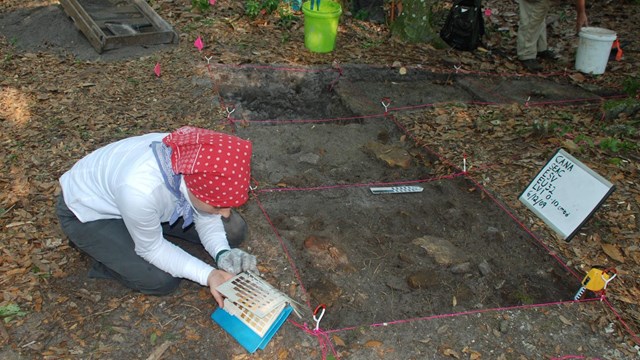
Trench excavations will initiate at the eastern edge of the Project Area and proceed westward. Excavations will be accomplished with a backhoe with a flat blade and/or a machine with a telescoping arm, sometimes referred to as a Gradeall (c). Gradeall machines are effective in producing "clean" trench floors and side walls. The machine will be equipped with a 24 in. to 36 in. wide, toothed bucket to remove the asphalt and rubble. A 36 in. wide flat-edged bucket will be used to excavate through soil matrices. Following the removal of the 1959 building rubble, the backhoe will machine-excavate the trench down to the interface or the upper portion of the archaeological layers and/or features, such as privies, outhouses and so forth. Machine excavation will cease in those areas and proceed down the trench. The intent of the machine excavations are to quickly remove any fill that seals underlying, intact archaeological features/sites. ACS uses the "open area or block" excavation technique to uncover large areas of the sites in order to properly assess the archaeological components in horizontal, as well as vertical contexts.

Once the archeological layers and/or features are exposed, they will be tested through hand excavation of a portion of each layer/feature to produce stratigraphic (i..e, horizontal and vertical) and contextual information (i.e., types of artifacts, age, etc.) Integrity of the features will be documented as part of the evaluation process. Archaeological hand excavation will use standard archaeological methods (Alexandrowicz et al. 1991, 1992, 1993), as well as other methods, such as Rapid Projected Mapping (Alexandrowicz 1985) that are specifically designed to enhance and expedite the recordation process in an urban setting. All feature fill and associated soils will be screened through 1/8 in. and/or 1/4 in. hardware mesh screens. Constant Volume Samples of soils and feature fill will be kept for future laboratory analysis (i.e., palynology, phytolith, micro-macro floral/faunal, etc.).

Laboratory processing and initial analysis will be conducted on-site. Final analysis, curation, and exhibits preparation will be conducted at the contractor' s laboratory facility.

All archaeological sites will be evaluated for eligibility for the NRHP. The results of the archaeological testing and evaluation program will be presented in a professional technical report. Public displays and brochures will be prepared at the discretion of the U.S. Government. All archaeological sites evaluated as eligible for the NRHP will be temporarily covered and/or reburied to protect them until the initiation of any data recovery program.

Data Recovery Plan

Following the eligibility evaluations of the archaeological resources or sites for the NRHP, an Assessment of Effects caused by the planned project within the APE is made on those archaeological resources that are evaluated eligible for the NRHP. Since the planned U.S. Court of Appeals expansion project requires extensive excavations and footings, many NRHP eligible sites will probably not be avoided. Hence, they will be destroyed, which constitutes a Direct Adverse Effect.

In order to expedite the Section 106 Process, ACS suggests that the GSA consider the Exceptions to the Criteria of Adverse Effect (36 CFR800.9) for those NRHP eligible archaeological resources within the APE. Nevertheless, a Data Recovery Plan will be required through the Section 106 Process to mitigate the damage/destruction of the NRHP eligible sites.

The Data Recovery Plan will include, but not limited to :

- Introduction

- Description and NRHP Evaluations of the Historic Properties

- Research Design

- Research Methods

- Personnel

- Schedule

- References

- Appendices - Lead Agency Determination of Eligibility

- SHPO's Letter of Concurrence or Dispute

- Memorandum of Agreement for Artifact Curation

A report of the data recovery excavations must be prepared in accordance with Federal, State, Local and Society of Professional Archaeology standards.

Public education programs, including displays, should be prepared as interpretation of the project's results for the general public.

Architectural Resources

In a similar vein, Section 106 of the NRHP requires that the historic architecture at 1068 Mission Street should be evaluated for eligibility for the NRHP prior to any proposed construction. This evaluation must be conducted by an architectural historian that meets Federal Qualifications Standards. The architectural report should be appended to the archaeological report.

In addition, the GSA should consider salvaging the dressed granite wall that separates the U.S. Court of Appeals building from the current Project Area. These granite blocks could be re-used in the planned expansion project.

Monitoring

ACS suggests that an archaeological monitor, with experience in urban historic archaeology, be present during the removal of the lower layers of building debris-fill that covers the underlying strata. A monitor should also be present to monitor any boring within or directly adjacent (i.e., U.S. Court of Appeals) to the Project Area. Monitoring is especially critical where any type of ground disturbance may disturb the hypothesized, buried marshlands. If prehistoric remains are found, a qualified prehistoric archaeologist should be summoned to assess and evaluate the discovery(ies) and conduct any mitigation work.

BIBLIOGRAPHY

Advisory Council on Historic Preservation and the National Park Service, 
Department of the Interior
	1986	Working with Section 106: 36 CFR Part 800: Protection of Historic 
		Properties: Regulations of the Advisory Council on Historic
		Preservation Governing the Section 106 Review Process. Advisory
		Council on Historic Preservation. Washington, D.C.

	1988	Working with Section 106: Identification of Historic Properties:
		A Decisionmaking Guide for Managers. Primary Author, Thomas F. King,
		National Park Service, Department of the Interior, Washington, D.C.

Alexandrowicz, J.S.
	1985	Rapid Projected Mapping: An Alternative Mapping Technique for
		the Archaeologist. Historical Archaeology 19(1):79-75.

Alexandrowicz, J.S. and S.R. Alexandrowicz
	1988	Phase I and II Archaeological Investigations Along Howard Street.
        		Volumes 6a and 6b, Series on Historical and Archaeological
       		Investigations, I-279/I-579 Expressway Project, Allegheny County,
       		Pennsylvania.

Alexandrowicz, J. Stephen, with contributions by Peter Carr
	1991	Interim Report: Cultural Resource Management Investigations of the
		Hunters Ridge Community Development, Fontana, CA, Volumes 1 and 2.
		Prepared for First City Properties. Prepared by Chambers Group,
		Inc., Santa Ana.

Alexandrowicz, J. Stephen, Susan R. Alexandrowicz, Arthur Kuhner, and 
Anne Duffield-Stoll
	1991	Historic Archaeology at the Hunter's Hill Residential Development,
		Chino Hills, San Bernardino County, CA. Archaeological Consulting 
		Services Technical Series No. 1., Tustin. 

Alexandrowicz, J.S., A.Q. Duffield-Stoll, J.A. McKenna, S. R.Alexandrowicz,
A. Kuhner, and E. Scott
	1992a	Cultural and Paleontologic Resources Within the North Fontana
		Infrastructure Area, City of Fontana, County of San Bernardino,
		California. Archaeological Consulting Services Technical Series 
		No. 2. Prepared for the City of Fontana. Prepared by Archaeological
		Consulting Services, Tustin.

Alexandrowicz, J.Stephen, Susan R. Alexandrowicz, and Arthur A. Kuhner
	1992b	A Cultural Resources Investigation for the Proposed Construction
		Site of the Kaiser Permanente Medical Facility, 9310 Sierra Avenue
		and Adjacent Western Parcel, City of Fontana, County of San
		Bernardino, California. Archaeological Consulting Services 
		Technical Series No. 3. Prepared by Archaeological Consulting
		Services, Tustin.

Alexandrowicz, J.S., William H. Sawyer, Anne Q. Duffield-Stoll, Susan R. Alexandrowicz, 
Arthur A. Kuhner, Meg Perry, and Kham Slater
	1992c	Historical Archaeology at the Vicente Lugo Adobe, City of Bell
		Gardens, County of Los Angeles, California. Archaeological 
		Consulting Services Technical Series No. 6. Prepared for Community
		Dynamics. Prepared by Archaeological Consulting Services, Tustin.

Alexandrowicz, J.S., Anne Duffield-Stoll, and Susan R. Alexandrowicz
	1993	Urban Historic Archaeological and Architectural Investigations At
		Foothill Boulevard and Vineyard Avenue, City of Rancho Cucamonga,
		County of San Bernardino, California. Archaeological Consulting
		Services Technical Series No. 11. Prepared for the City of Rancho
		Cucamonga. Prepared by Archaeological Consulting Services, 
		Lytle Creek.

Altschul, Jeffrey H., M. R. Rose, and M. K. Lerch
	1984	Man and Settlement in the Upper Santa Ana River Drainage: A
		Cultural Resources Overview.  Prepared for the U.S. Army Corps of 
		Engineers, Los Angeles District. Statistical Research Technical
		Series No. 1, Tucson.

Altschul, Jeffrey H., Richard Ctoick-Torello, Jeffrey A. Hamberg, and 
Mark T. Swanson
	1990	Playa Vista Archaeological Project. Statistical Research Technical 
		Series, No. 29, Part 1, Tucson.

Alvarez, Susan
	1992	Prehistoric Overview. In Tar Flat, Rincon Hill and the Shore of
		Mission Bay: Archaeological Research Design and Treatment Plan for
		SF-480 Terminal Separation Rebuild, Mary and Adrian Praetzellis,
		eds. Prepared for CALTRANS. Prepared by the Anthropological Studies
		Center, Sonoma State University, Rohnert Park.

Ambro, Richard D.
	1991	Report of Findings During Archaeological Backhoe Testing for
		Cultural Resources Evaluation at the 111 Jones Street Project
		Parcel, San Francisco, California. Ms. on file, California
		Archaeological Inventory, Northwest Information Center, 
		Rohnert Park, California.

Anonymous
	n.d.	The Devastated Area of San Francisco. Bird'seye view of the portion
		destroyed by earthquake and fire. Map on file, San Fancisco Public
		Library, History Room.

Anonymous
    n.d.	The Burned District From the June 22, 1851 Fire. Map on file, 
		San Francisco Public Library, History Room, San Francisco,
		California.

Bartell, M.J.
	1913	Report on the Underground Water Supply of San Francisco County.
		Prepared for the City of San Francisco. Prepared by M.M.
		O'Shaughnessy. Department of Public Works, 5:173.

Baker, S.
	1978	Report on the Fort Mason Archaeological Test Excavations. Prepared
		by Archaeological Consultants, San Francisco. Submitted to the
		United States Department of the Interior, National Park Service, San
		Francisco, California. Ms on file, S-3179, California Archaeological
		Inventory, Northwest Information Center, Rohnert Park, California.	

Baker, S. L. Horvath, and A. Carlson
	1978a	Archaeological Site Record for CA-SFR-29. Ms. on file, California
		Archaeological Inventory, Northwest Information Center, Rohnert
		Park, California.

	1978b Archaeological Site Record for CA-SFR-30. Ms. on file, California
		Archaeological Inventory, Northwest Information Center, Rohnert
		Park, California.

	1978c Archaeological Site Record for CA-SFR-31. Ms. on file, California
		Archaeological Inventory, Northwest Information Center, Rohnert
		Park, California.

Bancroft, Hubert Howe
	1884  History of California. Vol II 1801-1824. A. L. Bancroft, 
	1890b San Francisco.

Bancroft Library
	1864  Bird'seye View of San Francisco, California. Plate on file,
		Bancroft Library.

Barber, Brian, Alan Trynorn, and Eva Vanek
	1993	Site Characterization 1064/1068 Mission Street, San Francisco,
		California. Prepared for the GSA. Prepared by Geo/Resource
		Consultants, San Francisco.

Beardsley, R. K.
	1948	Cultural Sequences in Central California Archaeology. American
		Antiquity 14:1-28. 
    
	1954	Temporal and Areal Relationships in Central California Archaeology.
		University of California Archaeological Survey Reports Nos. 24 and
		25. Berkeley.

Beck, Warren and Ynez Haase
	1974	Historical Atlas of California. University of Oklahoma Press,
		Norman.

Bickle, Polly McW.
	1978a	Changing Sea Levels along the California Coast: Anthropological
		Implications. The Journal of California Anthropology 5(1):6-20.

	1978b	Corrections to Sea Level Article. The Journal of California
		Anthropology 5(2):296-297.

Blake, M.C., Jr., D.G. Howell and A.S. Jayko
    1984		Tectonostratigraphic Terranes of the San Francisco Bay Region. In
		Franciscan Geology of Northern California, Pacific Section, Social,
		Economic, Paleontologic, and Mineral.43:5-22.

B.L.M. R.G. 49
    1853		Township Tract Books, Box 707, Series 67. National Archives, 
		San Bruno.

Bronson, William
	1959	The Earth Shook, The Sky Burned. Doubleday and Company Inc., 
		Garden City, New York.

Brown
	1857  Map of the North Eastern Part of San Francisco County, California.

Burchell, R.A.
	1980	The San Francisco Irish: 1848-1880.
		University of California Press, Berkeley.

California Office of Historic Preservation, Department of Parks and Recreation
	1986	Archaeological Site Record, DPR 422. California Office of Historic
		Preservation, Department of Parks and Recreation, Sacramento.

	1989	California Archaeological Site Inventory, Information Procedural
		Manual. California Office of Historic Preservation, Department of 
		Parks and Recreation, Sacramento.

California State University
	n.d.	Map of California Showing Major Rock Units and Their Significance to
		Exploration for Oil and Gas, Geography May Library, Northridge.

California State University
	n.d.	Map of California, Geography Map Library.

Census Records
	1880-	Census of the United States. Ms. on file, National Archives,
	1920	San Bruno.

Cherney, Robert
	1986	San Francisco, 1865-1932 Politics, Power, and Development.
		University of California Press.

City of San Francisco, City Assessors Office, Technical Division
	1920-	Lots Merged, Vol. 25, Blocks 3701-3899, Revised, Microfisch 
		date  Records.

City of San Francisco Board of Supervisors, Clerk's Office
	n.d.	Book 7, Resolution 6794.

City of San Francisco Board of Supervisors, Clerk's Office
	n.d.	Map 314

City of San Francisco Board of Supervisors, Clerk's Office
	1892	Resolution 7252, 27 June 1892; Resolution 7465, 2 August 1892.

City of San Francisco, Department of City Planning
	1992	Preservation: An Element of the Master Plan of the City and County
		of San Francisco, October 1992 (Proposal for Citizen Review,
		Supplied by Vincent Marsh).

City of San Francisco, Department of Public Works
	n.d.	Building Permit Applications, Los 40 and 84.

City of San Francisco, Department of Public Works          
	n.d.	Maps and Surveys: Resolution Book 7:107.

City of San Francisco, Planning Department
	1935	Assessors Block Books.
	1947	Assessors Block Books.

City of San Francisco, Recorders Office
	n.d.	Title, Deeds and Sales Index, Book D070:050; Book D392:1071.

Cook, Sherburne F.
	1943a	The Conflict Between the California Indian and White Civilization,
		I: The Indian Versus the Spanish Mission. Ibero-Americana 21.
		Berkeley.

	1943b	The Conflict Between the California Indian and White Civilization,
		II:The Physical and Demographic Reaction of the Non-mission Indian
		in Colonial and Provincial California. Ibero-Americana 22. Berkeley.

	1943c	The Conflict Between the California Indian and White Civilization,
		III:The American Invasion. Ibero-Americana 23. Berkeley.

Cooper, J.
	1979	Site Form for CA-SFR-83H; San Francisco Civic Center. Ms. on file,
		Northwest Information Center, Sonoma State University.

Corbett, Michael R.
	1976	San Francisco Civic Center. National Resister of Historic Places
		Inventory - Nomination Form. Ms. on file, California Archaeological
		Inventory, Northwest Information Center, Rohnert Park, California.

	1985	Splendid Survivors. Heritage Foundation, San Francisco.
		
Cowan, Robert G.
	1977	Ranchos of California.  Historical Society of
		Southern California, Los Angeles, California.

Cressey, P. & Stephens, J.F.
	1982	The City-Site Approach to Urban Archaeology in Alexandria, Virginia.
		In Archaeology of Urban America: A Search for Pattern and Process,
		edited by R.S. Dickens, Jr., pp. 41-62. Academic Press, New York.

Cutts, R.D.
	1852	United States Coast Survey Map, City of San Francisco and Its
		Vicinity.

	1853	United States Coast Survey Map, City of San Francisco and Its
		Vicinity.

Davis, J. T.
	1961	Trade Routes and Economic Exchange Among the Indians of California.
		University of California Archaeological Survey Reports No. 54.

Egan, John, et al. 
	1992	Geotechnical and Environmental Study: 1064 and 1068 Mission Street
		Properties, California. Prepared for Tectonics, San Francisco,
		California. Prepared by Geometries Consultants, San Francisco,
		California.

Engelhardt, Fr. Zephyrin
	1924	The Missions and Missionaries of California: San Francisco or
		Mission Dolores. Franciscan Herald Press, Chicago.

Farneth, Stephen J., and Bruce D. Judd
	1984	U.S. Court of Appeals and Post Office Seventh and Mission Streets,
		San Francisco, California, Historic Structure Report. Prepared for
		General Services Administration, San Francisco, California. Project
		No. RCA 72131B. Prepared by Architectural Resources Group, San
		Francisco, California.

Federal Register
	1983	Archaeology and Historic Preservation; Secretary of the 
		Interior's Standards and Guidelines. U.S. Department of the 
		Interior, Vol 48, No. 190: 44716-42.

Fredrickson, David A
	1973	Early Cultures of the North Coast Ranges, California. Ph.D.
		dissertation, Department of Anthropology, University of California,
		Davis. University Microfilms, Ann Arbor.


	1974	Cultural Diversity in Early Central California: A View from the
		North Coast Ranges. The Journal of California Anthropology 
		1(1):41-54.

Garaventa, Donna M., and Stuart A. Guedon with David G. Brittin, Steven J. Rossa, and John Yelding-Sloan
	1992	Cultural Resources Evaluation Assessment of The Golden Gate Bridge
		Seismic Retrofit Project, San Francisco and Marin Counties,
		California (Draft). Prepared for T. Y. LIN International, Inc., 
		San Francisco.

General Services Administration and the U.S. Court of Appeals
	1897	General View of the Construction Site for the U.S. Post Office and
		Courthouse. Photograph on file, GSA.

General Services Administration and the U.S. Court of Appeals
	1933	General view of the Excavations for the 1933 Eastern Addition to the
		U.S. Post Office and Courthouse. Photograph on file, GSA.

Geo/Resource Consultants (Barber et al.)
	1993	Site Characterization 1064 and 1068 Mission Street Project, 
		San Francisco. Prepared for the GSA. Prepared by Geo/Resource
		Consultants, Inc., San Francisco.

Gerow, Bert A.
	1968	An Analysis of the University Village Complex, with a Reappraisal of
		Central California Archaeology. Stanford University Press, Stanford,
		California.

Gifford, E. W.
	1912	Notes Appended to Archaeological Site Record for CA-SFR-6. Ms. on
		file, California Archaeological Inventory, Northwest Information
		Center, Rohnert Park, California.

	1916	Composition of California Shellmounds. University of California
		Publications in American Archaeology and Ethnology 12(1):1-29.

	1940	Californian Bone Artifacts. University of California Anthropological
		Records 3:153-257.

	1947	Californian Shell Artifacts. University of California
		Anthropological Records 9(1).

Goldberg, S. K., and J. E. Arnold
	1988  Prehistoric Sites in the Prado Basin, California: Regional Context
		and Significance Evaluation. INFOTEC Research, Inc. Prepared for the
		Los Angeles District, U.S. Army Corps of Engineers, Los Angeles, CA.

Great Register
	1869	Great Register of 1869. Ms. on file, History Room, San Francisco
		Public Library, San Francisco.

Greenwood, Roberta
	1977	Archaeological Resources Survey; West Coast Mid-Continent Pipeline
		Project, Long Beach to Colorado River. Prepared by Greenwood and
 		Associates, Pacific Palisades.

Greenwood, Roberta and John Foster
	1990	Context Evaluation of Historical Sites in the Prado Basin.
		Prepared for the U.S. Army Corps of Engineers, L.A. District.
		Prepared by INFOTEC Research, Inc., and Greenwood and Associates.
	
Hagel, L.
	1993	Records Search for the U.S. Court of Appeals Expansion Project.
		Ms. on file, Archaeological Consulting Services, Lytle Creek.


Handy Block Books
	1894-	Handy Block Books for the City of San Francisco. Ms. on file,
	1909	History Room, San Francisco Public Library, San Francisco.

Harbert, W. and A. Cox
	1989	Late Neogene Motion of the Pacific Plate. In Journal of Geophysical
		Research. 94:B-3:3052-3064.

Hart, J. D.
	1987	A Companion to California (revised and expanded). Oxford University
		Press, New York.

Hegler, R., and Michael J. Moratto
	1973	A Deeply Buried Aboriginal Skeleton from the U.S. Army Presidio, San
		Francisco, California. Robert E. Schenk Memorial Archives of
		California Archaeology No. 38. San Francisco.

Henn, Winfield, Tom Jackson, and Julius Schlocker
	1972	Burial of Human Bones at the "BART" Site, San Francisco, California.
		Geology 25:208-209.

Henn, W. G. and  R.E. Schenk
	1970a	An Archaeological Analysis of Skeletal Material Excavated from
		the Civic Center Station of BART. Archives of California Archaeology
		No. 11. 

	1970b	An Archaeological Analysis of Skeletal Material Excavated from
		the Civic Center Station of BART. Ms. on file, Northwest
		Information Center, Sonoma State University.

Heimann, Jim and Rip Georges
	1980	California Crazy: Roadside Vernacular Architecture
		Chronicle Books, San Francisco, California.

Heizer, R. F. (editor)
	1978	Handbook of North American Indians Vol. 8: California. W.C.
 		Sturtevant, gen. ed. Smithsonian Institution, Washington, D.C.

Holman, M. P., L. R. Barker, L. Reynolds, and J. Miller
	1977	The Sutro Bath Sites: A Preliminary Archaeological Investigation.
		Western Region, United States Department of the Interior, National
		Park Service, San Francisco. Ms. on file, S-5349, California
		Archaeological Inventory, Northwest Information Center, Rohnert
		Park, California.

Howard, H.
	1929	Avifauna of Emeryville. University of California Publications in
		Zoology 32:301-394.

Isometric Map Publishing Company
	1910	The Restoration of "The City Loved Around the World", San Francisco,
		1910. Framed Picture on display, History Room, San Francisco
		Public Library, San Francisco.

King, Thomas F.
	1978	The Archaeological Survey: Methods and Uses.
		National Park Service, Washington, D.C.

Kroeber, A. L.
	1925	Handbook of California Indians.  Bureau of American Ethnology
		Bulletin 78, Smithsonian Institution, Washington, D.C.  

	1976	Handbook of California Indians. Bureau of American Ethnology
		Bulletin 78, Smithsonian Institution, Washington, D.C. Reprinted
		by Dover Publications, New York.

Lang, Kathryn M.
	1979	Golden Gate National Recreation Area: The Indian and Hispanic
		Heritage of a Modern Urban Park. United States Department of the
		Interior, National Park Service, Golden Gate National Recreation
		Area, Fort Mason, San Francisco. Ms. on file, United States
		Department of the Interior, National Park Service, Interagency
		Resources Division, National Register Programs, San Francisco.

Levy, R.
	1978	Costanoan, In California, edited by R.F. Heizer, pp.485-495.
		Handbook of North American Indians, Vol. 8. Smithsonian Institution,
		Washington, D. C.

Lewis, Oscar
	1966	San Francisco: Mission to Metropolis. Howell-North, Berkeley, CA.

Lotchin, Roger W.
	1974	San Francisco: 1846-1856. From Hamlet to City. Oxford University
		Press, New York.

Loud, L. L. 
	1912a	Field notes on the Presidio Mound #417. Ms. on file, Archaeological
		Research Facility, Department of Anthropology, University of
		California, Berkeley, and on file, S-3250, California Archaeological
		Inventory, Northwest Information Center, Rohnert Park.

	1912b	Archaeological Site Record for CA-SFR-6. Ms. on file,
		Northwest Information Center, Rohnert Park.

Martin M. Ron Associates, Inc.
	1992	Architectural Site Survey of a Portion of Assessors Block 3703 For
		General Services Administration.

McClelland, Linda , Carol D. Schuull, John Knoerl, Yvonne Stewart, and 
Alice Crampton
	1986	Guidelines for Completing National Register of Historic Places
		Forms. National Register Bulletin 16. National Park Service,
		Washington.

Mead, Ralph A.
	1970	Main Post Office, United States Port Office and Court House.
		National Register of Historic Places Inventory-Nomination Form. Ms.
		on file, Northwest Information Center, Rohnert Park.

Mendenhall, Mark and Chet Orloff
	1992	A History and Guide to the United States Courts for the Ninth
		Circuit. Ninth Judicial Circuit Historical Society, San Francisco,
		California.

Milliken, R. T.
	1983	The Spatial Organization of Human Population on Central California's
		San Francisco Peninsula at the Spanish Arrival. Unpublished Master's
		thesis, Sonoma State University, Ms. on file, S-9580, Northwest
		Information Center, Rohnert Park, California.

Morrato, Michael J.
	1984	California Archaeology. Academic Press, Orlando.

Moratto, Michael J., and R. Hegler
	1972	Archaeological Site Record for CA-SFR-26. Ms. on file, California
		Archaeological Inventory, Northwest Information Center, Rohnert
		Park, California.

Nelson, N. C.
	n.d.	Series of Quads Around San Francisco Bay - probably used by 
		N. C. Nelson (9 maps). Manuscript Map #105, University of California
		Archaeological Survey Files, Berkeley.

	1909	Shellmounds of the San Francisco Bay Region. University of
		California Publication in American Archaeology and Ethnology
		7(4):309-356.

	1910a	Field Notes on the Bayshore Mound #387. Ms. #355 on file,
		Archaeological Research Facility, Department of Anthropology,
		University of California, Berkeley.

	1910b Ellis Landing. University of California Publications in American
		Archaeology and Ethnology 7:357-426.

O'Farrell, Jasper 
	1847	The Original and Authentic Plan of San Francisco Enlarged and Drawn
		from the Latest Actual Surveys.

Olmsted, Roger, Nancy Olmsted, David A. Fredrickson, and V. Bente'
	1982	San Francisco Bayside: Historical Cultural Resource Survey. Prepared
		for the San Francisco Clean Water Program by Resource Consultants.
		Ms. on file, S-6157, California Archaeological Inventory, Northwest
		Information Center, Rohnert Park.

Olmsted, Roger, and T.H. Watkins
	1986	Here Today: San Francisco's Architectural Heritage. Chronicle Books,
		San Francisco.

Parker, Particia
	1985	Guidelines For Local Surveys: A Basis For Preservation Planning.
		National Register Bulletin 24. National Park Service,
		Washington, D.C.

Pastron, Allen G., and Michael R. Walsh
	1988a	The Stevenson Street Shellmound, CA-SFR-112: A Prehistoric
		Archaeological Site in Downtown San Francisco. Prepared by 
		Archeo-Tec, Oakland. Ms. on file Lowie Museum of Anthropology,
		Berkeley.

	1988b	Archaeological Excavations at CA-SFR-112, The Stevenson Street
		Shellmound, San Francisco, California. Archives of California
		Prehistory 21. Coyote Press, Salinas.

Photographs of the Past Office and Courthouse Building
	1991	Unbound Notebook holding Copies of Photography held in U. S. Court
		of Appeals, Court House Library, San Francisco.

Praetzellis, Mary and A. Praetzellis (Editors)
	1992	Tar Flat, Rincon Hill and the Shore of Mission Bay: Archaeological
		Research Design and Treatment Plan for SF-480 Terminal Separation
		Rebuild, Volumes I and II. Prepared for The California Department of
		Transportation, San Francisco. Prepared by Anthropological Studies
		Center, Sonoma State University Academic Foundation, Inc., Rohnert
		Park.

Records of the Bureau of Census
	1889	1880 Census: Ward 10, All Enumeration Districts National Archives
		Microfilm Publication, National Archives, San Bruno, .
	
	1900	1900 Census: Enumeration Districts 32 and 33 National Archives
		Microfilm Publication, National Archives, San Bruno.

	1910	1910 Census: Enumeration District 13 National Archives Microfilm
		Publication, National Archives, San Bruno.

	1920	1920 Census: Enumeration Districts 5, 8, and 15 National Archives
		Microfilm Publication, National Archives, San Bruno. Record
		Group 29, City of San Francisco, Census of Population.

Robinson, W.W.
	1979	Land in California. University of California Press, Los Angeles.

Rogers, A.F.
	1857	United States Coast Survey Map, City of San Francisco and Its
		Vicinity. Map on file, ACS, Lytle Creek.

Roper, Kristina C., Adrian Praetzellis, and David Fredrickson
	1985	Results of Archival Research for the Proposed California State
		Building, Corner of Golden Gate Avenue and Larkin Street, San
		Francisco, California. Ms. on file, California Archaeological
		Inventory, Northwest Information Center, Rohnert Park.

Rudo, Mark Ogden
	1982	The Prehistory of San Francisco. Unpublished Master's thesis,
		Department of Anthropology, San Francisco State University. Ms. on
		file, S-6160, Northwest Information Center, Rohnert Park.

Sanborn Map Company
	1887-	San Francisco, California. Geography Map Library, California State
	1959	University, Northridge.

San Francisco City Directories
	1870-	City Directories. On file, History Room, San Francisco Public
	1905	Library, San Francisco.	

Sherfey, Marcella and W. Ray Luce
	1979	Guidelines for Evaluating and Nominating Properties that have
		Achieved Significance within the Last Fifty Years.
		National Register Bulletin No. 22, U. S. Department of the Interior,
		National Park Service, Washington, D.C.
	
Schiffer, M.B.
	1976	Behavioral Archaeology. 
		Academic Press, New York, NY.

Schlocker,J. et al. 
	1968	Geologic Map of the San Francisco North Quadrangle, 
		U.S. Geological Survey, Washington D.C.

Schlocker, J.
	1974	Geology of the San Francisco North Quadrangle, California,
		U.S. Geological Survey, Professional Paper 782:109, Washington D.C.

Schulz, Peter D.
	1979	Research Design for Historical Archaeology on the J/K/6/7 Block,
		Sacramento. Ms on file, Sacramento Museum and History Department,
		Sacramento. 

South, Stanley
	1977	Method and Theory in Historical Archaeology.
		Academic Press, New York. 

Sprague, R.
	1981	A Functional Classification for Artifacts from 19th and 20th Century
		Sites. North American Archaeologist 2(#):251-262.

TerraSoft, Inc.
	1993	Geophysical Survey Interpretation Results: Site Characterization
		1064 and 1068 Mission Street, San Francisco. Prepared for the GSA.
		Prepared by TerraSoft, Inc., San Francisco.
		
Thomas Brothers Atlas of Cities and Towns in the Western States
	1930	San Francisco. Thomas Brothers, Oakland.

Title Insurance Company of Minnesota - Litigation Guarantee 
	1992	Adapted from the County of San Francisco Assessors Map for Block
		3703. Ms. on file, GSA.

Townsend, Janet and John Knoerl
	1991	Evaluating and Registering Historical Archaeology Sites and
		Districts. National Register Bulletin 36, U.S. Department of the
		Interior, National Park Service, Washington

U.S. Court of Appeals
	1898	View of the Paved Seventh Street during ca. 1898. Photograph on file
		at the Library/Facilities Manager, U.S. Court of Appeals, San
		Francisco, California.

U.S. Court of Appeals
	n.d.	Photograph # 6. On file at the Library/Facilities Manager, 
		U.S. Court of Appeals, San Francisco.

    1898  Photograph # 13 and #5. On file at the Library/Facilities Manager, 
		U.S. Court of Appeals, San Francisco. 

    1897	Photograph #4 and 24. On file at the Library/Facilities Manager, 
		U.S. Court of Appeals, San Francisco.

	n.d.	Photograph # 62. On file at the Library/Facilities Manager, 
		U.S. Court of Appeals, San Francisco.

U.S.G.S.
	1973	San Francisco North. USGS, Denver.

Vioget, Jean J.
	1839	Yerba Buena: 1839 Survey of Jean Jacques Vioget. Ms. on file,
		History Room, San Francisco Public Library, San Francisco.

Wahrftig, C. and D. Sloan 
	1989	Geology of San Francisco and Vicinity: 28th International Geology
		Congress, Field Trip Guidebook T105, San Francisco Bay Region,
		California, July 1-7, American Geophysical Union, Washington, D.C.

Walsh, Michael R.
	1986b	Archaeological Site Record for CA-SFR-113 (Market Street Shell
		Midden). Ms. on file, California Archaeological Inventory, Northwest
		Information Center, Rohnert Park.

	1986c	Archaeological Site Record for CA-SFR-114 (Moscone or the Yerba
		Buena Shellmound). Ms. on file, California Archaeological Inventory,
		Northwest Information Center, Rohnert Park.

Wirth Associates, Inc.
	1979a	Potrero 7: Phase I Cultural Resources Overview and Inventory.
		Prepared for Pacific Gas and Electric Company. Ms. on file, S-3244,
		California Archaeological Inventory, Northwest Information Center,
		Rohnert Park, California.

Woodward, Thomas P.
	n.d.	Map of the Burned District Resulting from the Fire of April 18, 19 &
		20, 1906. San Francisco Chronicle.

Zakreski
	1853	The Only Correst and Fully Complete Map of San Francisco. 
		Map on file, History Room, San Francisco Public Library,
		San Francisco.