NPS ParkNet Home National Park Service, U.S. Department of the Interior
ACIM at the Southeast Archeological Center
HomeprocessPersonnelFacilitiesTechnical Assistance
 

Backlog Cataloging at the Southeast Archeological Center


In 1985, the Office of the Inspector General (OIG) identified critical deficiencies in National Park Service (NPS) museum collections management. In their "Audit of Museum Collection Management," the OIG focused on two areas:

  • security procedures
  • museum facilities

An important component of security procedures is tracking National Park Service acquisitions and holdings. In response to the Audit and other factors, the Park Service submitted a plan for museum collections management with the Service's 1988 budget request. The plan called for dedicated funds over a twelve-year period to reduce the backlog of uncataloged museum objects in the Park Service's possession. In response, Congress has allocated money annually to Backlog Catalog projects in most park units, including the Southeast Archeological Center. Backlog Catalog items are those collected by the Park Service prior to 1988.

Cataloging artifacts involves a series of steps, the goal of which is the accurate characterization of a physical object in written, electronic form and in the form of a Museum Catalog record.

Note: Move cursor over drawings to view images

Photograph of woman sitting in library, reading, with several open books in front of her.


Step One: Curation Lab staff research the collection.

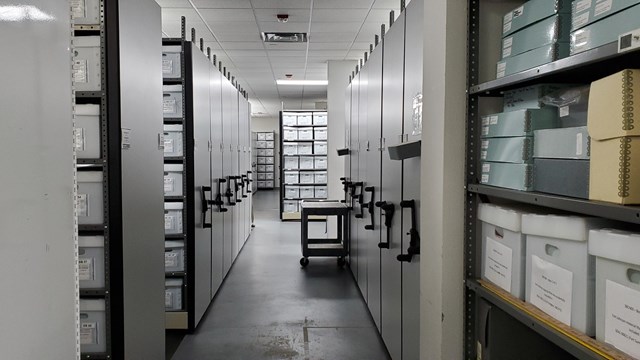
Photograph of a woman removing a storage box from a bank of shelves in the Collections area.


Step Two: Lab employees pull artifacts from the SEAC collection or request artifacts are recalled from individual park units or outside repositories.

Photograph of a bearded man arranging bags filled with artifacts in sequence.


Step Three: Once the artifacts are together in the SEAC Curation laboratory, staff arrange bags according to their project provenience.

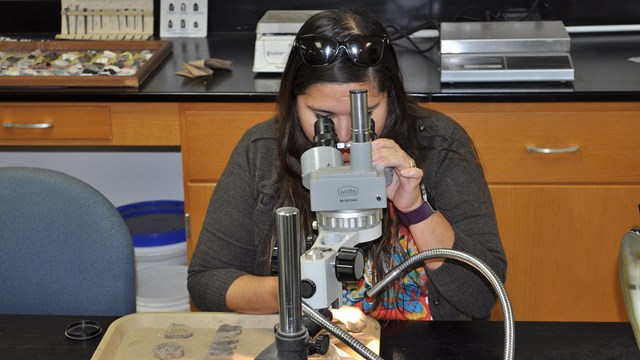
Photograph of a man sitting in front of trays of artifacts examining one under a table lamp.


Step Four: Lab staff sort artifacts into separate lots according to unique attributes that describe their physical characteristics.

Photograph of a man using a keyboard to enter information into a computer terminal.


Step Five: Staff member enters artifact lot information into the computer. Unique lot information, such as lot counts and weights is recorded. For more information on lot cataloging, see the NPS Museum Handbook Part II, Chapter 3. (PDF)

Photograph of two men sitting at a table discussing an artifact.


Step Six: NPS supervisory personnel check all lots for accuracy. Identification errors are corrected and additional information is added at this stage. A unique catalog number is requested for each lot from park staff.

A photograph showing a bag tag and a labeled plastic artifact bag with an arrow pointing from the bagtag to the bag.


Step Seven: The catalog numbers are assigned to the lots and bag tags are generated and incorporated into the artifact bags.

Photograph of a woman sitting at a fume hood using a pen to label an artifact.


Step Eight: NPS Staff label artifacts with their catalog numbers, as well. After proofing and correction, the data itself is reviewed again for accuracy.

Photograph of the United States Capitol Building.


Step Nine: After final proofing, the data is submitted to Washington, where Museum Catalog Records are generated.

Photograph of a man returning a box of artifacts to storage on its shelf.


Step Ten: NPS staff return the artifacts to the collection storage area.