Introductory title image for the National Park Service, U.S. Department of Interior and the National Center for Cultural Resources to include the official arrowhead of the National Park ServiceImage of the official National Park Service arrowhead and a link to ParkNet The National NAGPRA title image on a green background with an historic image of native baskets next to water and reed-type river grass - image by Edward S. Curtis, courtesy of NPS Resources for navigation image bar including tribes, museums, agencies, public and press linksimage for tribes linkimage for museums linkimage for agencies linkimage for public linkimage for press link

Native American Graves Protection and

Repatriation Review Committee

Meeting Minutes


Twenty-second Meeting


MINUTES
NATIVE AMERICAN GRAVES PROTECTION AND REPATRIATION
REVIEW COMMITTEE
TWENTY-SECOND MEETING: NOVEMBER 17, 18, AND 19, 2001
HARVARD LAW SCHOOL CAMBRIDGE, MASSACHUSETTS


Background

The Native American Graves Protection and Repatriation Review Committee was
established under the Native American Graves Protection and Repatriation Act
(NAGPRA) (25 U.S.C 3001), which was signed into law by President George Bush
on November 16, 1990.

NAGPRA authorizes the Committee to monitor and review the implementation of
the inventory and identification process and repatriation activities. Its
specific responsibilities include the following:
"1. Monitoring and reviewing the implementation of the inventory and
identification processes and repatriation activities required under sections
5, 6, and 7 of Public Law 101-601 to ensure a fair and objective
consideration and assessment of all available relevant information and
evidence;
"2. Reviewing and making findings relating to the identity or cultural
affiliation of human remains, funerary objects, sacred objects, and objects
of cultural patrimony, or the repatriation of such items, upon the request of
any affected party;
"3. Facilitating the resolution of any disputes among Indian tribes, Native
Hawaiian organizations, or lineal descendants, and Federal agencies or
museums relating to the repatriation of human remains, funerary objects,
sacred objects, and objects of cultural patrimony, including convening the
parties to the dispute, if deemed desirable;
"4. Compiling an inventory of culturally unidentifiable human remains that
are in the possession or control of each Federal agency and museum and
recommending specific actions for disposition of such remains;
"5. Consulting with Indian tribes, Native Hawaiian organizations, and
museums on matters pertaining to the work of the Committee affecting such
tribes or organizations;
"6. Consulting with the Secretary [of the Interior] in the development of
regulations to carry out Public Law 101-601;
"7. Performing such other related functions as the Secretary [of the
Interior] may assign to the Committee;
"8. Making recommendations, if appropriate, regarding future care of human
remains, funerary objects, sacred objects, and objects of cultural patrimony
which are to be repatriated; and
"9. Submitting an annual report to Congress on the progress and any barriers
encountered in carrying out the Committee responsibilities during the year."

Review committee members are appointed by the Secretary of the Interior from
nominations by Indian tribes, Native Hawaiian organizations, traditional
Native American religious leaders, national museum organizations, and
scientific organizations.

The review committee reports to the Secretary of the Interior. The Assistant
Director, Cultural Resources Stewardship and Partnerships, National Park
Service (NPS) or, in the absence of the Assistant Director, a designee will
serve as the Designated Federal Official (DFO) required by section 10 of the
Federal Advisory Committee Act, 5 U.S.C. Appendix (1994), and as provided in
the review committee's charter, to oversee the management of the review
committee. Through the Assistant Director, NPS provides administrative and
staff support to the review committee on behalf of the Secretary of the
Interior.

Additional information about the review committee - including the review
committee's charter, membership, meeting protocol, and dispute procedures -
is available at the National NAGPRA program Website,
http://www.cr.nps.gov/nagpra/ (click on "Review Committee").


The 22nd Meeting of the Review Committee

The 22nd meeting of the Native American Graves Protection and Repatriation
Review Committee was called to order by Mr. Armand Minthorn at 8:30 a.m.,
Saturday, November 17, 2001, at Pound Hall, Harvard Law School, Cambridge,
MA. The following review committee members and National Park Service (NPS)
staff were in attendance:

Members of the review committee:
Mr. Armand Minthorn, Chair
Mr. Garrick Bailey
Mr. James Bradley
Mr. Lawrence Hart
Ms. Vera Metcalf
Mr. John O'Shea
Ms. Rosita Worl

National Park Service staff:
Mr. John Robbins, Assistant Director, Cultural Resources Stewardship and
Partnerships (CRSP), NPS, Washington, DC, and DFO for the review committee
Mr. Robert Stearns, Manager, National NAGPRA program, NPS, Washington, DC
Ms. Carla Mattix, Solicitor's Office, U.S. Department of the Interior (DOI),
Washington, DC
Ms. Mary Downs, Coordinator, National NAGPRA Program, NPS, Washington, DC
Ms. Karen Mudar, Coordinator, National NAGPRA Program, NPS, Washington, DC
Ms. Lesa Hagel, Consultant, National NAGPRA Program, NPS, Rapid City, SD

The following persons were in attendance during part or all of the meeting
(names and affiliations are shown as provided at the meeting by attendees.):
Ms. Donna Augustine, Aroostook Band of Micmacs, Wabanaki Tribes of Maine
Ms. Christina Breault, George W. Brown, Jr., Ojibwa Museum, Lac du Flambeau,
WI
Ms. Lisa Bresette, Red Cliff Band of Lake Superior Chippewa, Bayfield, WI
Ms. Patricia Capone, Peabody Museum of Archaeology and Ethnology, Harvard
University, Cambridge, MA
Ms. Tracy Carrier, American Museum of Natural History, New York, NY
Ms. Shara Chase, Roger Williams Museum of Natural History, Providence, RI
Mr. Brian Chestnut, Ziontz, Chestnut Law Firm, Seattle, WA
Mr. Roger Colten, Peabody Museum of Natural History, New Haven, CA
Ms. Donna Cossette, Fallon Paiute-Shoshone Tribe, Fallon, NV
Ms. Barbara Crandell, Native American Alliance of Ohio, Thornville, OH
Ms. Suzanne Day, Harvard University, Washington, DC
Ms. Kay DeKuiper, Harvard University, Washington, DC
Ms. Rochanne Downs, Fallon Paiute-Shoshone Tribe, Fallon, NV
Ms. Penelope Drooker, New York State Museum, Albany, NY
Ms. Irene Dundas, Cape Fox Corporation, Ketchikan, AK
Mr. Alfred Foster, U.S. Army Headquarters, Washington, DC
Mr. Ashley George, Fallon Paiute-Shoshone Tribe, Fallon, NV
Ms. Myra Giesen, Bureau of Reclamation, Lawrence, KS
Mr. Robert Goodby, Department of Anthropology, Franklin Pierce College,
Rindge, NH
Mr. Alan Goodman, Hampshire College, Amherst, MA
Ms. Martha Graham, American Museum of Natural History, New York, NY
Mr. Wendell Greek, U.S. Army Reserve Command, Fort McCoy, WI
Ms. Priscilla Grew, University of Nebraska-Lincoln, Lincoln, NE
Ms. Elaine Guthrie, American Museum of Natural History, New York, NY
Mr. John Harkey, Providence, RI
Ms. Roberta Hayworth, U.S. Army Corps of Engineers, St. Louis, MO
Mr. Brent Hicks, Confederated Tribes of the Colville Reservation, Nespelem,
WA
Mr. R. Eric Hollinger, National Museum of the American Indian, Smithsonian
Institution, Washington, DC
Mr. Audie Huber, Confederated Tribes of the Umatilla, Pendleton, OR
Ms. Barbara Isaac, Cambridge, MA
Ms. Kelly Jackson, Lac du Flambeau Band of Lake Superior Chippewa Indians,
Lac du Flambeau, WI
Mr. Willard Jackson, Tlingit, AK
Ms. D. Bambi Kraus, National Association of Tribal Historic Preservation
Officers, Washington, DC
Mr. Russell Leighty, American Museum of Natural History, New York, NY
Ms. Angela Linn, University of Alaska Museum, Fairbanks, AK
Ms. Diana Loren, Peabody Museum of Archaeology and Ethnology, Harvard
University, Cambridge, MA
Ms. Rhonda Lueck, U.S. Army Corps of Engineers, St. Louis, MO
Ms. Stephanie Makseyn-Kelley, National Museum of the American Indian,
Smithsonian Institution, Suitland, MD
Ms. Carol Mandrick, Department of Anthropology, Harvard University,
Washington, DC
Ms. Desiree Martinez, Cambridge, MA
Ms. Carolyn J. McClellan, Bureau of Indian Affairs, Reston, VA
Ms. Jean McCoard, Native American Alliance of Ohio, Lucasville, OH
Mr. Robert McLaughlin, Department of Anthropology, University of Chicago,
Chicago, IL
Mr. Bryan Mitchell, Tribal Historic Preservation Program, NPS, Washington, DC
Ms. Pilar Montalvo, American Indian Ritual Object Repatriation Foundation,
New York, NY
Mr. John Moody, White River Junction, VT
Ms. Michele Morgan, Peabody Museum of Archaeology and Ethnology, Harvard
University, Cambridge, MA
Mr. Alvin Moyle, Fallon Paiute-Shoshone Tribe, Fallon, NV
Ms. Nell Murphy, American Museum of Natural History, New York, NY
Ms. Diane Palmer, Cape Fox Corporation, Ketchikan, AK
Mr. James Pepper Henry, National Museum of the American Indian, Smithsonian
Institution, Suitland, MD
Mr. Morgan Perkins, State University of New York, Potsdam, NY
Mr. John Peters, Jr., Massachusetts Commission on Indian Affairs, Boston, MA
Ms. Ramona Peters, Wampanoag Confederation
Mr. William Reed, USDA Forest Service, Boise National Forest, Boise, ID
Ms. Donna Roberts-Moody, White River Junction, VT
Mr. Ernie Seckinger, U.S. Army Corps of Engineers, Mobile, AL
Ms. Esther Shea, Tlingit, Ketchikan, AK
Mr. Martin Skrydstrup, Columbia University in the City of New York, New York,
NY
Mr. Marc Slonim, Ziontz, Chestnut Law Firm, Seattle, WA
Mr. Chuck Smythe, NPS, Boston, MA
Mr. Terry Snowball, Smithsonian Institution, Suitland, MD
Mr. Roderick Sprague, University of Idaho, Moscow, ID
Ms. Melissa Wagner, University of Pennsylvania Museum, Philadelphia, PA
Ms. Rubie Watson, Peabody Museum of Archaeology and Ethnology, Harvard
University, Cambridge, MA
Ms. Heather Whitemanrunshim, Lodge Grass, MT
Mr. James Whitney, University of Alaska Museum, Fairbanks, AK
Mr. Frederick York, NPS, Seattle, WA
Ms. Melinda Young, Lac de Flambeau Band of Lake Superior Chippewa Indians,
Lac du Flambeau, WI
Ms. Amanda Zeman, Cornell University, Ithaca, NY

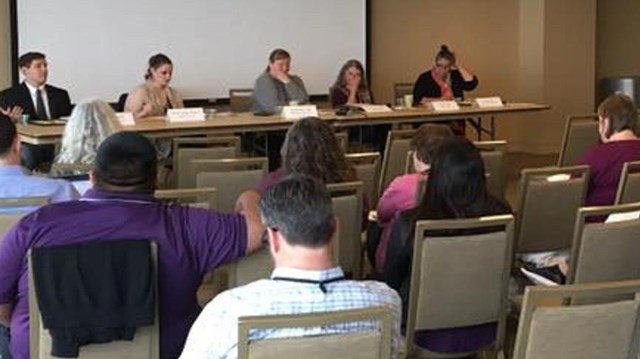
Mr. Minthorn welcomed review committee members and members of the audience
and stressed the importance of review committee meetings as a forum for
addressing NAGPRA implementation issues. Mr. Minthorn acknowledged and
recognized the local Indian tribes. Ms. Donna Roberts-Moody, Abenaki Nation,
White River Junction, VT, gave the opening invocation. Review committee
members and NPS staff introduced themselves.

Mr. Robbins asked the audience members to register as part of the meeting
record. He explained that due to U.S. Mail delays, the National NAGPRA
program may not have received written submissions for the meeting, which may
be submitted at the meeting. Mr. Robbins thanked the Peabody Museum of
Archaeology and Ethnology and Harvard Law School for hosting the meeting.

During the meeting, Ms. Worl, according to Tlingit cultural protocols,
introduced Ms. Esther Shea, clan mother of the Teikweidi, from Ketchikan, AK.


Review of the Agenda

Mr. Minthorn gave a brief review of the agenda.


Review/Approval of Kelseyville, CA, Meeting Minutes

Ms. Worl asked that the implementation update be described on a quarterly,
biannual, or year-to-year basis instead of a cumulative basis. Regarding the
review committee's request for an analysis of the grants program, Ms. Worl
said that the review committee wanted the analysis to document the increasing
need for grant support and to characterize the types of needs, such as the
contamination issue. The review committee decided to adopt the Mr./Ms. mode
of address instead of Dr., and requested that the minutes consistently use
this format.

The review committee members unanimously approved the minutes subject to Ms.
Worl's proposed changes. Revised minutes were prepared for the chair's
signature later in the meeting.


National NAGPRA Reports

Mr. Robbins reviewed the National NAGPRA reports, which were provided to the
review committee at the meeting.

NAGPRA Update
The NAGPRA update was a statistical overview of issues addressed in further
detail in later reports.

Status of Notices
The notices report was divided into two sections: Notices of Inventory
Completion and Notices of Intent to Repatriate, and Notices of Intended
Disposition.

The cumulative total of all notices of inventory completion and notices of
intent to repatriate progressed as follows:

630
Total logged as of January 1, 2000
731
Total logged as of June 30, 2000 (end of second quarter CY2000)
903
Total logged as of October 31, 2000 (end of third quarter CY2000)
949
Total logged as of January 1, 2001
1,010
Total logged as of April 30, 2001
1,096
Total logged as of November 1, 2001

Of the 1,096 total notices logged, 781 have been published in the Federal
Register, at an average publication rate of 98 notices per year since 1995,
the deadline for museum inventory submissions. In CY2000, 152 notices were
published. Between January 1 and November 7, 2001, 178 notices were
published, an average of 18 notices per month. The 178 notices included 139
notices of inventory completion and 39 notices of intent to repatriate. Of
the published notices, 99 were considered priority due to formal repatriation
claims. Between May 1 and November 1, 2001, 81 notices were published, of
which 62 were notices of inventory completion and 19 were notices of intent
to repatriate. Approximately half of the 81 published notices were priority
notices. Between May 1 and November 1, 2001, 81 notices were logged, of
which 40 were received during this period and 41 were found as a result of
records management improvement.

As of November 1, 2001, the backlog was 315 unpublished notices,
approximately 29 percent of the total 1,096 notices logged. The backlog
includes 52 priority notices. Of the priority notices, 16 are on hold at the
request of the museum or Federal agency, 4 have been sent to the Federal
Register but are not yet published, 1 has been withdrawn, 27 are in process
towards Federal Register publication, and 4 have not yet been assigned to
staff. To improve notice processing efficiency, National NAGPRA asked
museums and Federal agencies to identify notices that are not ready to be
published, resulting in a total of 87 on-hold notices identified in the
backlog. In addition, nine nonpriority notices have been sent to the Federal
Register. Of the remaining 219 unpublished notices, 147 currently are being
processed by National NAGPRA staff.

Since 1994, 30 notices of intended disposition have been published in local
newspapers-of-record. In CY2001, three pairs of notices of intended
disposition have been published.

In response to a question by Mr. O'Shea, Mr. Robbins explained the current
Federal Register publication process. Mr. Robbins said that since January
2001, the notice review process includes additional review within the
Department of the Interior and NPS. Mr. Robbins explained that at this point
it is difficult to predict the time frame for future notice publication and
added that delays in the U.S. Mail and intraoffice and interoffice mail could
cause further delay.

In response to a question by Mr. Minthorn, Mr. Robbins explained that the
periods of forbearance for the six institutions were completed, with each
institution's meeting its required inventory deadline. Those institutions
included American Museum of Natural History; New York State Museum; Ohio
Historical Society; Peabody Museum of Archaeology and Ethnology, Harvard
University; Phoebe A. Hearst Museum of Anthropology, University of
California, Berkley; and Texas Archeological Research Laboratory, University
of Texas, Austin.

In response to a question by Mr. Bradley, Mr. Robbins explained that at the
current rate the backlog might be completed in approximately three years, not
taking into consideration new notices received in the interim. Mr. Bradley
requested information on the average length of time to process notices and on
the rate of notices returned due to incomplete or insufficient information.

Status of Grants
The grants report consisted of a brief overview, a list of FY2001 grants
awards, a NAGPRA grants awards summary, and a NAGPRA grants proposal summary.

In FY2001, the National NAGPRA program awarded 44 grants totaling $2,438,000.
Of the 44 grants, 40 were awarded through the competitive process and 4 were
noncompetitive repatriation grants. The National NAGPRA program received 69
competitive grant applications, from 49 Indian tribes, Alaska Native
villages, and corporations, and Native Hawaiian organizations, and 17
museums. The 69 applications represent a total request of $4.1 million.
Between the first year of the grants program (FY1994) and FY2001, NPS has
received 846 applications (requesting approximately $58 million) and has
awarded 338 grants (approximately $18 million). Information about FY2002
grants will be available in December 2001 on the NAGPRA Website and will be
distributed via the National NAGPRA mailing list.

Ms. Worl expressed concern that grants appropriations are reduced to
partially fund the administration of the National NAGPRA program, and asked
whether the $400,000 base funding increase reported in FY2001 was available
for FY2002. Mr. Robbins explained that funding for National NAGPRA
activities comes from four sources: a line-item appropriation for NAGPRA
grants, a line-item appropriation for the administration of the NAGPRA grants
program, a reprogramming of NAGPRA grants funds for the operation of the
National NAGPRA program, and an allocation for NAGPRA activities from base
funding for cultural resources. Funding available for NAGPRA program
administration and for NAGPRA grants was level for many years and, as
administrative costs rose, differences between available funds and actual
costs were supplemented from grants funds. In FY2001, the reprogrammed
amount was $29,000 - unusually low for a number of reasons, including low
staff numbers. In FY2002, in spite of a $400,000 base increase,
reprogramming from the grants funds continues to be necessary to fully fund
the operation of the National NAGPRA program.

Ms. Worl asked if additional funding could be requested to reduce the
reprogrammed amount. Mr. Robbins explained that now that the cost of the
National NAGPRA program has been determined, it would be reasonable to find
additional funding for NAGPRA activities. Ms. Worl reiterated her concern
about the use of grants funds for operational expenses due to the present
inadequacy of grants monies. She suggested including this topic in the
report to Congress.

Mr. Bailey expressed concern over Indian tribes that have not received any
grant money in the history of NAGPRA activities and suggested an analysis of
grants distribution - geographically, by Indian tribal populations, and by
needs of different communities. He explained that the competitive process is
problematic given the different resources and abilities of Indian tribes to
compete for grants. Mr. Bailey suggested that the National NAGPRA program
could work with Indian tribes to develop fundable grant applications and
identify resources to help define their needs and concerns. Mr. Robbins
explained that one of the new staff positions of the National NAGPRA program
is the education and development position, which will include developing the
capacity of the NAGPRA community to compete for NAGPRA grants. Mr. Bradley
stated that although the funding sources for the grants program and NAGPRA
administration may seem complicated, the National NAGPRA program has made
substantial progress in establishing a fiscal and staffing foundation over
the last two years.

Ms. Worl suggested including the total number of grant applicants and the
total amount requested in the review committee's report to Congress in order
to highlight unmet grants needs. Mr. Minthorn added that the reports have
always indicated the need for increased funds, although not the specific
information suggested by Ms. Worl. Mr. Bailey expressed concern that only 40
percent of Indian tribes requesting grants have ever received grants. He
suggested that this statistic emphasizes the need for Indian tribes' being
able to identify their concerns and the critical need for additional grants
funding. Mr. Minthorn raised the idea of prioritizing the grants awards.
Mr. O'Shea reminded review committee members of discussions at the
Kelseyville meeting to offer priority for first-time proposals. Mr. Robbins
suggested that the pre-application assistance currently offered by the
National NAGPRA staff could be improved. In addition, the education and
development staff could work to increase the Native American community's
capacity to apply for grants. Ms. Worl suggested adding specific funding
recommendations in the report to Congress for specific areas of need such as
contamination and future care of objects. She suggested that National NAGPRA
staff draft the appropriate language for the report to Congress.

Status of Staffing
In FY2001 appropriations, the National NAGPRA program had a $400,000 base
funding increase for operations, including staffing. Work on hiring
permanent NPS employees to staff the National NAGPRA program began in fall
2000. After delays due to Federal hiring restrictions in January and
February 2001, four types of new staff positions were advertised in late
March 2001, and applications for all positions were due in early May 2001. A
recruiting plan was developed with a goal of reaching diverse candidates.
Towards implementing the plan, paper copies of the job announcements were
distributed to a mailing list of more than 1,500 entries that included all
NAGPRA contacts and NAGPRA grant applicants and grantees. The positions also
were advertised on the Web, at meetings, and via electronic distribution,
including electronic distribution to NAGPRA review committee members. More
than 200 applications were received for the four types of new staff
positions. By mid-October 2001, six National NAGPRA positions were filled
through the competitive process. The program manager and secretary positions
were filled through reassignment within NPS. All staff will have reported
for duty by December 2, 2001.

The National NAGPRA program is staffed as follows:
Manager
Robert Stearns, Ph.D., Education-Anthropology and Education, Stanford
University
Advisory Committees and Notices
Martha Graham, Ph.D., Anthropology, University of New Mexico
Education and Development
Paula Molloy, Ph.D., Archeology, Harvard University
Databases and Notices
Mary Downs, Ph.D., Archeology, Indiana University
Cynthia Murdock, B.A., English and Education, Hillsdale College
Regulations and Notices
Timothy McKeown, Ph.D., Applied Cultural Anthropology, Northwestern
University
Karen Mudar, Ph.D., Anthropology, University of Michigan
Secretary
Robin Coates

Mr. Robbins also reviewed organizational charts for the U.S. Department of
the Interior and NPS to show the National NAGPRA program in departmental and
NPS context.

Status of Information Management Systems
Between May and November 2001, the NAGPRA data management system was improved
and refined. By December 2000, most of the data that had previously been
recorded in a DOS-based system and in text lists had been transferred to an
Access database. The new, user-friendly Access database allows for
systematic entry, retrieval, and tracking of data, and provides a
comprehensive and accurate record of files and information related to NAGPRA.
Between May and November 2001, the system was refined to include additional
data fields, and a number of search capabilities were added. During this
period, the data continued to be controlled, reviewed, and verified towards
improving records accuracy.

The National NAGPRA Website (http://www.cr.nps.gov/nagpra) provides
information to the public on grants, text of the Act and regulations,
guidance, published notices, documents relating to the review committee, and
contact information for National NAGPRA program staff. Regular updates to
the Website reflect publication of notices of inventory completion and
notices of intent to repatriate in the Federal Register. Two lists,
Inventories Submitted by Museums and Agencies and Summaries Submitted by
Museums and Agencies, were removed in May 2001 because the information was no
longer accurate or valid and created confusion for users. Lists that
accurately reflect the administrative status of inventories and summaries
will be placed on the Website in the future.

Also accessible through the National NAGPRA Website is NACD, the Native
American Consultation Database (http://www.cr.nps.gov/nagpra/NACD/INDEX.HTM).
Users can search various fields in this database, including Indian tribes,
contact names, and reservations, to yield individualized reports. In
December 2000, the database was updated to reflect current information
available from the Bureau of Indian Affairs on the status and names of Indian
tribes, as well as from contact information maintained by the National NAGPRA
program. Between May and November 2001, records for tribal names and contact
information continued to be updated internally in the database. An update of
these same records for public access via the Website is expected in December
2001. Mr. Robbins provided a chart detailing the main modules of the Access
database system, including some sections still in development.

Mr. O'Shea asked about the future Web accessibility of the database. Ms.
Downs explained that the National NAGPRA program will consider how the
database can be made available via the Internet. Mr. O'Shea emphasized the
importance of public access to information about culturally unidentifiable
human remains. He anticipated that this access would be important during
discussions of the procedures regarding the disposition of these human
remains, based on the review committee's recommendations. In response to Mr.
Robbins' statement that Web access to inventory data was a new topic for the
National NAGPRA program, Mr. O'Shea explained that the regulations required
inventories to be submitted in an electronic format and clearly anticipated
electronic access.

FY2002 Work Plan
The FY2002 work plan of the National NAGPRA program has six areas of
emphasis: notices, regulations, NAGPRA review committee coordination, grants,
public information dissemination, and education and technical assistance.

Notices. The core duties of five of the National NAGPRA staff include
assistance to museums and Federal agencies in preparing notices of inventory
completion and notices of intent to repatriate for publication in the Federal
Register. The program also monitors the publication of notices of intended
disposition.

Regulations. The following five sections await promulgation.
* 43 CFR 10.7, Disposition of unclaimed human remains, funerary objects,
sacred objects, or objects of cultural patrimony. Portions of this draft
have been initiated. The draft rule needs to be finalized for examination by
the review committee and publication in the Federal Register.
* 43 CFR 10.11, Disposition of culturally unidentifiable human remains.
Recommendations of the review committee were published in the Federal
Register on June 8, 2000. A proposed rule needs to be drafted for further
consideration by the review committee and publication in the Federal
Register.
* 43 CFR 10.12, Civil penalties. There is an interim regulation on civil
penalties. A final rule currently is in process in NPS and in the department
towards review and publication.
* 43 CFR 10.13, Future applicability. A draft has been completed and is
under review towards publication.
* 43 CFR 10.15 (b), Failure to claim where no repatriation or disposition has
occurred. A proposed rule needs to be drafted for consideration by the
review committee and publication in the Federal Register.

Also, existing regulations need to be reviewed for technical amendments that
reflect the current administration of NAGPRA responsibilities.

Mr. O'Shea asked whether review committee members have seen the drafted
future applicability regulations. Ms. Mattix explained that a previous
review committee reviewed those regulations and the regulations are now in
the final stages of departmental review before being published as a proposed
rule. Once published as a proposed rule, the regulations will be available
for public comment and then a final rule will follow. Any further review by
the review committee could result in further delay of the process; however,
once the regulations are out for public comment, review committee members
could review them individually or in the context of a meeting if a meeting
falls within the public comment period. Mr. Robbins noted that, given the
time required to develop regulations, review committee membership might
change during regulation development. Mr. O'Shea pointed out that no review
committee member has seen the draft future applicability regulations, making
it difficult to claim that the current review committee members had any role
in this regulation. He explained that over the years he has requested
information on this regulation many times, which he has not received. Mr.
Bradley stated that, within the necessary constraints of the process, review
committee members would like to see the draft regulations as soon as
possible. He asked for an update at the next meeting of how the staff will
be allocated to deal with regulations and other assignments. Mr. Robbins
explained that no work has been done on regulations since he began with the
National NAGPRA program nearly two years ago, and now two of the National
NAGPRA staff positions will deal with regulations.

Mr. Minthorn asked Mr. Robbins to provide a timeframe for completing
departmental review of the civil penalties regulations. Mr. Hart asked that
the review committee be allowed to see the draft of the regulations for
disposition of culturally unidentifiable human remains and whether there
would be a public comment period. Mr. Robbins confirmed that review
committee members would see the draft and explained that there is a public
comment period following publication of the proposed regulation in the
Federal Register. Mr. O'Shea reminded review committee members of their
request to see the original draft of those regulations at the time that they
circulate in the department.

NAGPRA Review Committee. Two review committee meetings will be held in
FY2002. The first meeting will be held in Cambridge, MA, from November 17-
19, 2001. The second meeting is tentatively scheduled to be held in Tulsa,
OK, from May 31 through June 2, 2002. A newly hired National NAGPRA staff
member is assigned to provide the review committee with administrative
support in addition to processing notices.

Grants. All available FY2002 grant funds will be awarded. A newly hired
National NAGPRA staff member is assigned to oversee programmatic and public
outreach components of the National NAGPRA grants program.

Information Dissemination. National NAGPRA information dissemination will be
enhanced through implementing a user-friendly Website, accessible databases
via the Internet, and NAGPRA training and technical assistance to inform a
variety of interested parties. Two newly hired staff members will develop
the usability features to be incorporated in NAGPRA's online databases. A
third National NAGPRA staff member's duties include developing information
materials for the general public, Indian tribes, museums, Federal agencies,
and other interested parties.

Education and Technical Assistance. National NAGPRA staff members are
responsible for providing technical assistance to Indian tribes, museums, and
Federal agencies. Additionally, one staff person, as education and
development program coordinator, will provide Indian tribes, museum
personnel, and Federal agency staff with educational opportunities and
training courses on topics related to implementing NAGPRA.

Budget. The National NAGPRA program operates with four accounts: the general
operation of the program, grants, grants administration, and funds
reprogrammed from the grants appropriation for program operation. Mr.
Minthorn asked if the $400,000 base funding increase reported for FY2001
would occur in FY2002. Mr. Robbins stated that the $400,000 was included in
the funding detailed in the budget reports. Mr. Robbins explained that
although funds must be reprogrammed from the grants appropriation to finance
overall program operations, as has occurred in prior years, the amount for
FY2002 is less than most recent years prior to FY2001. The $29,000
reprogrammed in FY2001 was lower than usual due to the low number of staff.

Culturally Unidentifiable Human Remains
The authority for the National NAGPRA program's work on culturally
unidentifiable human remains is cited in 43 CFR 10.10, Repatriation, (g)
Culturally unidentifiable human remains: "If the cultural affiliation of
human remains cannot be established pursuant to these regulations, the human
remains must be considered culturally unidentifiable. Museum and Federal
agency officials must report the inventory information regarding such human
remains in their holdings to the Departmental Consulting Archeologist who
will transmit this information to the review committee. The review committee
is responsible for compiling an inventory of culturally unidentifiable human
remains in the possession or control of each museum and Federal agency and
for recommending to the Secretary specific actions for disposition of such
human remains."

Between May and November 2001, culturally unidentifiable inventory data from
five institutions were added to the National NAGPRA database. This
represents a minimum number of 5,573 individuals (an MNI of 5,573) and 12,906
associated funerary objects (AFO) added to the database. The database now
contains approximately 40 percent of the total universe of culturally
unidentifiable human remains and associated funerary objects, totaling an MNI
of 35,651 and 253,620 AFOs from 176 institutions. The culturally
unidentifiable human remains report included a list of inventories catalogued
by institution and a summary of repatriation requests to the review committee
for culturally unidentifiable human remains.

In response to questions by the review committee, Mr. Robbins said that the
Access database is a work in progress. The information presented in the
report showed inventories entered into the database. Institutions and
Federal agencies not listed on the report may have submitted inventories. Mr.
Robbins expects that increased staffing will accelerate completion of the
culturally unidentifiable database. The majority of the culturally
unidentifiable data entry has been completed by Ms. Hagel on a consulting
basis.

Mr. Minthorn and other review committee members expressed concern at the lack
of Federal agency compliance with NAGPRA. In response to a question by Mr.
Bailey, Mr. Robbins stated that the intention of the database is to list
information for culturally unidentifiable human remains and associated
funerary objects in the control of a specific institution or Federal agency,
although occasionally institutions and Federal agencies do submit mixed
information. Mr. Hart pointed out that some of the listed human remains have
actually been repatriated. Mr. Robbins explained that data currently in the
database are from the inventories and eventually the database would need to
be compared with review committee actions and subsequent repatriations of
culturally unidentifiable human remains. Mr. Bradley expressed appreciation
for the organized record of culturally unidentifiable human remains
information. Mr. Hart asked for consistency in reporting and cited the use
of "MNI" in some instances and "HR" (human remains) in others.

Status of Disputes
At the review committee's request, the National NAGPRA program has refined
the report on the status of disputes initially presented at the Kelseyville
meeting. The report contains information on five finished disputes, one
dispute under consideration which will be heard at the Cambridge meeting, and
eight pending disputes. The review committee has three possible disputes
that could be reclassified to disputes under consideration, PEN009, PEN010
and PEN015.

* FIN001 - Phoebe A. Hearst Museum of Anthropology, University of California,
Berkeley, and Hui Malama I Na Kupuna O Hawai'i Nei: Review committee findings
published in the Federal Register (April 15, 1993, vol. 58, no. 71, pp.
19688-19689).
* FIN002 - City of Providence, RI, and Office of Hawaiian Affairs and Hui
Malama I Na Kupuna O Hawai'i Nei: Review committee findings published in the
Federal Register (May 1, 1997, vol. 62, no. 84, pp. 23794-23795).
* FIN003 - Hopi Tribe and U.S. Department of the Interior, NPS, Chaco Culture
National Historical Park: Review committee findings published in the Federal
Register (February 10, 2000, vol. 65, no. 28, pp. 6621-6622).
* FIN004 - U. S. Department of Defense, U.S. Marine Corps, and Ka 'Ohana Nui
o Na Iwi Kupuna o Mokapu, Nahoa Olelo o Kamahameha, Temple of Lono, and Eric
Poohina (individual claimant): The U.S. Marine Corps requested the review
committee's assistance concerning multiple claims for human remains and
associated funerary objects from KaneOhe Navel Air Station, Oahu, HI. The 15
claimants were unable to make a unified claim within 30 days of publication
of notice. The review committee declined to consider the cultural
affiliation claims and recommended that the U.S. Marine Corps retain
possession of the human remains and associated funerary objects until the
claimants agree upon the proper recipient(s). (For additional information
regarding the dispute, refer to the minutes of the eighth meeting of the
review committee, November 17-19, 1994. See section entitled Dispute
Regarding Human Remains from Mokapu, Hawaii.)
* FIN005 - Field Museum and Oneida Nation of New York and Oneida Tribe of
Wisconsin: The Field Museum requested the review committee's assistance
concerning competing claims from the Oneida Nation of New York and Oneida
Tribe of Wisconsin for an object of cultural patrimony. The review committee
decided that a formal finding regarding the dispute was not necessary, and
recommended that the tribes reach agreement on arrangements for custody of
the wampum belt. (For additional information regarding the dispute, refer to
the minutes of the 12th meeting of the review committee, November 1-3, 1996.
See section entitled Dispute Over an Oneida Wampum Belt.)
* FIN007 - Pechanga Band of Luiseno Mission Indians and U.S. Department of
Defense, U.S. Army Corps of Engineers: California Indian Legal Services sent
a letter dated November 24, 1997, on behalf of the Pechanga Band of Luiseno
Mission Indians, to the review committee requesting the review committee's
assistance in a dispute regarding the disposition of human remains and
cultural items excavated by U.S. Army Corps of Engineers from a site near
Lake Elsinore, CA. On November 7, 2001, legal representation for the
Pechanga Band of Luiseno Mission Indians informed the National NAGPRA program
by telephone that the band and U.S. Army Corps of Engineers had reached an
agreement over the disposition of human remains and cultural items. The
National NAGPRA program will confirm the resolution of this matter in writing
to the band.
* CON006 - Fallon Paiute-Shoshone Tribe and U.S. Department of the Interior,
Bureau of Land Management, Nevada State Office: A dispute between the Fallon
Paiute-Shoshone Tribe and the Bureau of Land Management concerning the
disposition of human remains will be considered at the 22nd review committee
meeting, November 17-19, 2001.
* PEN008 - Hopi Tribe and U.S. Department of the Interior, NPS, Mesa Verde
National Park: The Hopi Tribe sent a letter dated September 24, 1999, to the
review committee requesting the review committee's assistance in a dispute
regarding the cultural affiliation of human remains and associated funerary
objects in the possession of NPS, Mesa Verde National Park. The notice of
inventory completion for the cultural items that are the subject of this
proposed dispute has been published in the Federal Register. No further
review committee action currently is suggested until the completion of the
National Park Service Advisory Board's review of NPS determinations of
cultural affiliation. On behalf of the review committee chair, the DFO sent
a letter to the tribe regarding the status of this dispute on March 9, 2001.
Mr. Robbins explained that the subcommittee of the advisory board met in
October 2001 in Santa Fe, NM, to prepare the final version of its report.
The NPS Office of Policy, which provides administrative support to the
National Park System Advisory Board, is in the process of arranging a meeting
of the advisory board for the purpose of presenting this report.
* PEN009 - Ho-Chunk Nation and Field Museum: The Ho-Chunk Nation sent a
letter dated October 29, 1999, to the review committee requesting the review
committee's assistance in a dispute regarding the disposition of a cultural
item in the possession of the Field Museum. No Federal Register notice for
this proposed dispute has been published because the Field Museum asserts
right of possession of this cultural object. On behalf of the review
committee chair, the DFO sent a letter dated December 13, 1999, to the Field
Museum requesting additional information. The Field Museum responded in a
letter dated April 7, 2000, asserting that an object of cultural patrimony
can be alienated despite group ownership if the group authorizes the
transfer. The Field Museum contends that Ho-Chunk Nation has failed to
demonstrate that the museum does not have right of possession since the Ho-
Chunk Nation has not demonstrated that the Winnebago Tribe of Nebraska
objected to alienation of the object of cultural patrimony. The National
NAGPRA program recommends, pending submission of further documentation,
scheduling this dispute for consideration at a review committee meeting. Ms.
Worl requested additional information on evidence that the Ho-Chunk Nation
authorized the transfer.
* PEN010 - American Indian Intertribal Association (AIIA) and University of
Toledo: Toledo Legal Aid Society sent a letter dated April 4, 2000, to the
review committee on behalf of the American Indian Intertribal Association
requesting the review committee's assistance in a dispute regarding cultural
affiliation of human remains and cultural items in the possession of the
University of Toledo. No Federal Register notice has been published for the
cultural items because the cultural items have been determined by the
University of Toledo to be culturally unidentifiable. AIIA is a membership
nonprofit organization of tribes located throughout the United States. The
DFO requested clarification from Advisor Carla Mattix regarding who may be an
affected party in a proposed dispute. Ms. Mattix responded that there is no
definitive legal requirement identifying who constitutes an affected party
for the purposes of NAGPRA and the review committee may determine whether a
person, tribe, institution, et cetera, is an affected party regarding
disputes. AIIA has provided information to the National NAGPRA program
detailing inconsistencies in cultural affiliation in the inventory submitted
to NPS by the University of Toledo when compared to recent archeological
publications. A telephone conversation with AIIA legal counsel on November
5, 2001, indicated that the association has repeatedly tried to initiate
consultation with the University of Toledo but that the university has not
responded. Copies of the letters to the University of Toledo have been
requested by the National NAGPRA program. The National NAGPRA program
recommends that - 1) the review committee decide whether AIIA is an affected
party, and 2) if AIIA is considered an affected party then this dispute
should be scheduled for consideration at a review committee meeting. Mr.
Minthorn indicated that the university's refusal to initiate the consultation
process was a problem, regardless of AIIA's status as an affected party. Mr.
O'Shea suggested that, in identifying who could be an affected party for a
dispute, the principals should have standing under the law, but that other
interested parties should not be precluded from participating. Mr. Bailey
agreed and suggested that organizations could work with federally recognized
Indian tribes to facilitate repatriation. Mr. Robbins reminded the review
committee that there are consortia groups that are authorized to represent
federally recognized tribes for purposes of repatriation. Mr. Bradley stated
that in addition to not knowing whether federally recognized Indian tribes
are represented by AIIA in this case, the review committee does not have any
information regarding the nature of the culturally unidentifiable human
remains at issue or the basis for the university's determination of
culturally unidentifiable. Mr. Robbins explained that he does not have
information on whether AIIA is authorized to represent federally recognized
Indian tribes. Regarding the culturally unidentifiable inventory, the
information is divided into three categories: 1) human remains and associated
funerary objects in the control of the University of Toledo (an MNI of 74 and
4,000 AFO), 2) human remains and associated funerary objects on loan (an MNI
of 243 and 3,000 AFO), and 3) human remains and associated funerary objects
for which there is a question of control (an MNI of 6). The culturally
unidentifiable collection is from Ohio (which has no federally recognized
Indian tribes) and Michigan (which has federally recognized Indian tribes).
Ms. Worl suggested developing a standard that clarifies when a person or
organization is authorized to act on behalf of Indian tribes.
* PEN011 - Narragansett Indian Tribe and Peabody Museum of Archaeology and
Ethnology: The Narragansett Indian Tribe sent a letter dated September 14,
2000, to the review committee requesting assistance in a dispute regarding
the cultural affiliation of human remains and associated funerary objects in
the possession of the Peabody Museum. The notice of inventory completion for
the cultural items has been published in the Federal Register (August 15,
2000, vol. 65, no. 158, pp. 49833-39835). The museum sent a letter to the
DFO requesting comment on the preeminence of the evidence as a basis for this
particular claim. The DFO responded to this inquiry by letter October 13,
2000. The National NAGPRA program responded to the museum that there is no
single preeminence of evidence such as geography, but that the totality of
evidence must be considered in cultural affiliation. The National NAGPRA
program recommends that the review committee chair and the DFO consult
further on this matter towards determining whether the review committee
should consider this dispute. Mr. Bradley requested a copy of the October 31
letter, which Mr. Robbins stated he had at the meeting.
* PEN012 - Piro-Manso-Tewa and U.S. Department of the Interior, NPS, Salinas
Pueblo Missions National Monument: The Piro-Manso-Tewa sent a letter dated
November 5, 2000, to the review committee regarding a dispute with Salinas
Pueblo Missions National Monument because the superintendent had not reburied
repatriated human remains from the park in the same location from which the
remains were excavated. The National NAGPRA program recommends that this
matter not be considered a dispute because reburial location is outside of
NAGPRA and proposes sending a letter of explanation to the Piro-Manso-Tewa.
Mr. Minthorn asked the reason for the reburial in a different location. Mr.
O'Shea stated that it would be critical to know whether reburial location and
details were part of the negotiated disposition. If it were part of the
negotiated disposition, then it falls under the review committee's purview.
Ms. Worl stated her understanding that the review committee does have a
responsibility for the disposition of remains or the future care of human
remains. Mr. Robbins added that the Piro-Manso-Tewa is not a federally
recognized Indian tribe and therefore may not be an affected party under the
dispute process. Mr. Robbins agreed to gather further information on the
matter.
* PEN013 - Sand Creek Massacre Descendant's Trust and Cheyenne Tribal
Governments: The U.S. Department of Interior, Bureau of Indian Affairs,
Southern Plains Regional Office sent a letter and attachments to the National
NAGPRA program dated December 1, 2000, regarding a request to investigate the
claims of the Sand Creek Massacre Descendant's Trust to all human remains,
artifacts, sacred objects, and objects of cultural patrimony originating from
the 1864 Sand Creek Massacre in the possession or control of any private,
State, or Federal agencies and museums. Documentation attached to the
letter, which the National NAGPRA program did not receive, discussed a
potential dispute between the Sand Creek Descendant's Trust and the Cheyenne
Tribal governments regarding who has the right to claim the remains for
repatriation. The DFO sent a letter dated January 22, 2001, to BIA
requesting the attachments to the December 1, 2000, letter. To date, BIA has
not responded to the DFO's letter. The National NAGPRA program recommends
that this matter not be considered a dispute until further information is
available. Mr. Hart expressed concern that the Sand Creek Descendant's Trust
does not have standing as an affected party for disputes. Tribal governments
would have standing for disputes; in this case the Northern Cheyenne Tribal
Government and the Cheyenne-Arapaho Tribes of Oklahoma would have standing
regarding the cultural items from the Sand Creek Massacre. Mr. Bailey asked
about the standing of direct lineal descendants. Ms. Mattix explained that
the regulations state exactly how to show lineal descendancy. Mr. Hart
stated that in this case there is no record of the identity of the victims,
just that they are Cheyenne. Mr. Bailey suggested that the review committee
might want to have a formal clarification on when the rights of lineal
descendants are recognized as opposed to the rights of tribal entities. Mr.
Hart explained that if this case were heard as a dispute before the review
committee he would recuse himself from the discussions. Ms. McClellan
provided the National NAGPRA program with a copy of the missing attachment to
the December 1, 2000, letter at the Cambridge meeting.
* PEN014 - Hopi Tribe and U.S. Department of the Interior, NPS, Aztec Ruins
National Monument: The Hopi Tribe sent a letter dated January 8, 2001, to the
review committee requesting the review committee's assistance in a dispute
regarding the cultural affiliation of human remains and associated funerary
objects in the possession of Aztec Ruins National Monument. The notice of
inventory completion for these cultural items has been published in the
Federal Register (October 2, 1998, vol. 63, no. 191, pp. 53098-53100). No
further review committee action is suggested pending completion of the
National Park System Advisory Board's review of NPS determinations of
cultural affiliation. On behalf of the review committee chair, the DFO sent
a letter on March 9, 2001, to the Hopi Tribe regarding the status of this
dispute. In response to a question by Mr. O'Shea, Mr. Robbins stated that
Aztec Ruins National Monument was not taking any action in this issue pending
the review.
* PEN015 - Western Apache NAGPRA Working Group and Denver Art Museum: Western
Apache NAGPRA Working Group sent a letter dated January 23, 2001, to the
review committee requesting the review committee's assistance in a dispute
regarding a claim for cultural items in the possession of the Denver Art
Museum. No Federal Register notice for this proposed dispute has been
published because the Denver Art Museum does not consider these items to be
either objects of cultural patrimony or sacred objects as defined by NAGPRA.
Both parties have provided documentation stating their positions. Neither
has altered their position, although communication has continued between the
Western Apache NAGPRA Working Group and the Denver Art Museum. The National
NAGPRA program recommends that this dispute be scheduled for consideration at
a review committee meeting. Mr. Robbins stated that he would confirm whether
the Western Apache NAGPRA Working Group is authorized to represent federally
recognized Indian tribes for the purposes of repatriation. Mr. Minthorn
asked for details on which groups the Denver Art Museum consulted in making
its determination.

Ms. Worl asked about the civil penalty process for the alleged selling of
objects after the passage of NAGPRA. Ms. Mattix explained that the
regulations outline the process following an allegation of a violation. If a
preliminary investigation reveals substantial evidence of a violation, the
department will proceed with a hearing at the Office of Hearing and Appeals.
A statute of limitations issue may need to be considered before the hearing
process. Ms. Worl requested a report on the status of the issue brought by
the Central Council of Tlingit and Haida Indians of Alaska (CCTHIA)
concerning the sale of objects by the Taylor Museum for Southwestern Studies
of the Colorado Springs Fine Arts Museum after NAGPRA was enacted. She
stated that discussions occurred with both the National NAGPRA program and
the Attorney General's office in Denver about the sale but CCTHIA has
received no response. Ms. Mattix explained that this is a Federal case and
the criminal portion is being handled by the Denver U.S. Attorney's office.
The department would consider the appropriateness of invoking the civil
penalty process for the case. Ms. Worl repeated her request for a report on
the status of this issue.

Ms. Worl stated that the National NAGPRA update was well developed. She
requested that review committee members receive the update for the next
meeting a week prior to the meeting to allow time to review the information.
This review would expedite the discussions at the meeting and promote better
understanding of the contents. In response to a question by Ms. Metcalf, Mr.
Robbins explained that there is no time limit for a dispute to remain
inactive.

Action List
Mr. Robbins explained that the action list was in four sections: review
committee requests for updates, review committee long-term requests, review
committee short-term requests, and discussion points from the Kelseyville
meeting. The action list reflects the current status of each item. Mr.
Bradley expressed appreciation for the action list, and requested that an
update on the Kennewick case be added as an action item for the next meeting.


Dispute: Fallon Paiute-Shoshone Tribe and U.S. Department of the Interior,
Bureau of Land Management, Nevada State Office

[Note: Although this dispute was between the Fallon Paiute-Shoshone Tribe and
the Department of the Interior, Bureau of Land Management (BLM), Nevada State
Office, the terms "BLM" and "Nevada State Office" were used interchangeably
during the presentation and discussion. For clarity in these minutes, the
phrase "Nevada State Office" has replaced "BLM" unless it is clear that the
speaker intended to reference the agency rather than the office.]

Introduction
Ms. Worl chaired the dispute between the Fallon Paiute-Shoshone Tribe and the
U.S. Department of Interior, BLM, Nevada State Office. Ms. Worl first
outlined the procedure for the dispute. She explained that she would ask Mr.
Robbins to summarize the background of the dispute, review committee members'
responsibilities, and the documentation provided by the parties. Then the
review committee would confirm whether both parties would make oral
presentations, and invite the two parties to make their presentations. Ms.
Worl continued that, after both parties had an opportunity to present their
case, review committee members may ask questions of, or make comments to, the
parties. After this period of comments and questions, the review committee
would have its discussion of the dispute. Ms. Worl said that the review
committee could decide whether it needed additional time to consider the
dispute after it had begun its discussions.

Mr. Robbins then summarized the background of the dispute. He explained that
the dispute was proposed by the Fallon Paiute-Shoshone Tribe in a
presentation at the Nashville review committee meeting, and was subsequently
confirmed in a letter from the Fallon Paiute-Shoshone Tribe to the National
NAGPRA program. The review committee chair and DFO reviewed the materials
presented at that time and concurred that the dispute was a matter that fell
within the responsibilities of the review committee. In discussions with
both sides, the National NAGPRA program confirmed that the parties involved
had sought to resolve the issue prior to the review committee's consideration
of this dispute. The dispute was accepted for consideration and scheduled
for the Cambridge, MA, meeting.

Mr. Robbins stated that the review committee's authority in the law is
Section 8, Review Committee, paragraph (c), Responsibilities, item (4), "The
review committee shall be involved in facilitating the resolution of any
dispute among Indian tribes, Native Hawaiian organizations, or lineal
descendants and Federal agencies or museums relating to the return of such
cultural items including convening the parties to the dispute if deemed
desirable." In the regulations, the review committee's authority is under
Section 10.17, Formal and informal resolutions of disputes, "The work of the
review committee may include convening meetings between parties to the
dispute, making advisory findings as to the contested facts, and making
recommendations to the disputing parties or to the Secretary of the Interior
as to the proper resolution of the disputes, consistent with these
regulations and the Act."

Mr. Robbins said that both parties submitted documents for the review
committee's consideration, which were summarized as an attachment to an
October 31, 2001, memo and sent to review committee members prior to the
meeting. Transmitted documents included 17 documents submitted by or on
behalf of the Fallon Paiute-Shoshone Tribe and 2 documents submitted by the
Nevada State Office.

Mr. Robbins reminded the review committee that, after presentations by the
parties, review committee members can question the parties. Review committee
members apply the laws and regulations to the matter at hand and can then
make findings and recommendations, if desired. All discussions, findings,
and recommendations are to be completed in the public meeting setting. Mr.
Robbins said that review committee members are being asked to weigh the
evidence from their various personal perspectives and areas of expertise and
to make findings and recommendations towards resolving the dispute. The
findings and the recommendations are advisory. Ms. Mattix, as legal advisor,
is available to assist in citing relevant aspects of the law and regulations
but will not provide interpretations of the laws or regulations or on-the-
spot legal rulings.

Fallon Paiute-Shoshone Tribe
Ms. Donna Cossette, chairwoman of the Fallon Paiute-Shoshone Tribe,
introduced Mr. Ashley George, spiritual leader for the Fallon Paiute-Shoshone
Tribe. Mr. George presented a prayer in native Paiute language. Ms.
Cossette explained that Mr. George is the son of Shaman Jimmy George and
teacher Wuzzie George. Mr. George is a spiritual leader who is responsible
for reburials. He is dedicated to preserving Paiute culture by educating
younger generations in oral histories and teachings. Ms. Cossette introduced
the representatives of the Fallon Paiute-Shoshone Tribe and experts present
at the meeting. She explained details of the history of the Spirit Cave
human remains and the dispute. The Fallon Paiute-Shoshone Tribe has
testified at seven NAGPRA review committee meetings about its ongoing efforts
to repatriate the Spirit Cave human remains. These remains were unearthed in
1940 by two amateur archeologists working for the Nevada State Park
Commission. The area where Spirit Cave is located today is under the Nevada
State Office's jurisdiction and is located within the aboriginal territory of
the Paiute people, the Toidikadi, Cattail Eaters. Oral tradition has taught
that Paiute people have occupied this land since the beginning of time.
According to Ms. Cossette, the Fallon Paiute-Shoshone Tribe has the support
of all Great Basin Indian tribes, as well as support throughout Indian
Country, and there are no competing claims. She said that in July 2000, the
Nevada State Office issued its decision that the Spirit Cave remains were
culturally unidentifiable despite strong evidence supporting repatriation to
the Fallon Paiute-Shoshone Tribe. The Fallon Paiute-Shoshone Tribe is
requesting that the review committee consider information presented by the
Fallon Paiute-Shoshone Tribe and the Nevada State Office. Ms. Cossette
expressed confidence that the tribal submissions and testimonies presented at
the meeting will provide more than sufficient evidence to support the
repatriation of the Spirit Cave remains.

Mr. Marc Slonim, Ziontz, Chestnut law firm in Seattle, WA, identified himself
as an attorney for the Fallon Paiute-Shoshone Tribe. He first presented an
overview of the upcoming presentations. He then presented the interpretation
that the Fallon Paiute-Shoshone Tribe has of the review committee's role
under the statute and the term cultural affiliation under the Act. Mr.
Slonim said that under Section 8, Review Committee, paragraph (c)
Responsibilities, item (2) of the statute, "the review committee has a
responsibility to monitor the inventory and identification process carried
out under the statute to ensure a fair, objective consideration and
assessment of all relevant evidence." He said that such monitoring did not
occur in this case; this situation is a compelling case for the review
committee to exercise that responsibility and make findings about the Nevada
State Office's identification process. Further, under the statute the review
committee has a responsibility upon the request of any affected party to
review and make findings related to cultural affiliation and return of
cultural items. Mr. Slonim said that the Fallon Paiute-Shoshone Tribe is
clearly an affected party with standing under NAGPRA and is making a request
for the review committee to make findings regarding the cultural affiliation
and return of the Spirit Cave human remains and funerary objects. Further,
the review committee has a responsibility to facilitate the resolution of
disputes among Indian tribes and Federal agencies. The Fallon Paiute-
Shoshone Tribe has a dispute with a Federal agency and would appreciate the
review committee's assistance in resolving that dispute. Finally, the review
committee has a responsibility to recommend actions for developing a process
for the disposition of culturally unidentifiable remains. If the Nevada
State Office persists in its view that these remains are culturally
unidentifiable, Mr. Slonim said that it is appropriate for the review
committee to recommend actions for the Nevada State Office to take regarding
the disposition of these particular remains.

According to Mr. Slonim, the Nevada State Office never specifically states
its definition of the terms cultural affiliation or shared group identity
under the Act. Its determination appears to be based on a narrow definition
of cultural affiliation, requiring knowledge of Spirit Cave man's religious
views, the social and political organization of his contemporaries, his
material culture practices, and proof that these are the same as the
contemporary Fallon Paiute-Shoshone Tribe. The Fallon Paiute-Shoshone Tribe
does not believe that this is what NAGPRA requires. Several considerations
lead the Fallon Paiute-Shoshone Tribe to that conclusion. First, the purpose
of NAGPRA is to provide for the repatriation of Native American human
remains. The purpose of requiring cultural affiliation, as explained in the
legislative history of the Act, was to ensure that there was a reasonable
connection between the claiming Indian tribe and the human remains. In the
legislative history, Congress anticipated that there would be gaps in the
record and said that those gaps should not block repatriation. The focus
should be on the totality of the evidence and in particular on evidence
pertaining to the connection between the claimant and the materials claimed.
NAGPRA defines cultural affiliation as a relationship of shared group
identity with an identifiable earlier group. Mr. Slonim said that "group" is
an extremely broad term that can include any group of individuals with some
unifying relationship.

In this case, Mr. Slonim said, the Spirit Cave human remains can be
identified as part of a group of early Holocene occupants of the western
Great Basin, with substantial connections between that group and the
ethnographic Toidikadi, the people that were present at the time of contact
in the western Great Basin and in the area where the Fallon Paiute-Shoshone
Tribe lives today. That interpretation is reinforced by the special rules of
construction that apply to legislation passed for the benefit of Native
Americans. The courts have consistently and repeatedly said that statutes
passed for the benefit of Native Americans should be construed broadly and
ambiguous terms should be construed in favor of the Indian tribes. Mr.
Slonim said that, based on considerations of geography and environment,
subsistence economy and diet, material culture, burial patterns, biology,
linguistics, and oral tradition, the evidence shows shared group identity
between the early Holocene occupants of the Great Basin, including between
the Spirit Cave remains and the Fallon Paiute-Shoshone Tribe. He said that
the case for affiliation is quite strong. According to Mr. Slonim, the
approach to the case that the Nevada State Office used involved a very narrow
and technical view of cultural affiliation. He said that the Nevada State
Office never explicitly acknowledged this approach. Mr. Slonim said this
approach was wrong.

Mr. Ashley George explained that he lived with the Fallon Paiute-Shoshone
Tribe until moving to Sacramento in 1958 after being drafted into the Army.
He did not hear about the Spirit Cave human remains until four or five years
ago. Mr. George gave an overview of the Paiute people, where they live, what
they do, and how they came to live in Stillwater. The Paiutes of Stillwater
have always lived in and around Stillwater marshland in the Great Basin,
according to Mr. George. They were created by the Creator just east of
Stillwater Marsh on Fox Peak, part of the Stillwater Mountain Range. Mr.
George said that the old people have passed on this story from generation to
generation. The Paiute were put here with the skills of survival, wisdom,
and knowledge. They lived among plants, animals, birds, and fish. These
things were important for food and medicine. Mr. George explained that the
Indian way of life is very sacred and all things are respected. Paiute words
and language are used in everyday life. Paiute words come from within, which
is why they have a lot of feeling. The Paiute language does not have a word
for "caveman." Mr. George explained that the Paiute do not disturb graves or
gravesites. Permission cannot be obtained to do so. The Creator takes
people and if someone disturbs and breaks that cycle there will be
consequences to others close to the person and finally that person. Mr.
George said that the Paiute now have to explain what they are doing so no
harm will come to them when they are returning ancestors back to continue
their cycle. The Paiute have names for other people who arrived in the Great
Basin, and the Great Basin area Indians were identified by what they ate.
Mr. George explained that the Paiute belief is that the Creator created them.
After life is over, He comes for them and leads them away by the hand. When
they are buried, they are put back in Mother Earth's womb. When they are
removed, Mother's womb was opened and robbed of what belongs to her. The
cycle of life is disrupted.

Mr. Alvin Moyle, former chairman of the Fallon Paiute-Shoshone Tribe,
explained that he has been before the review committee on numerous occasions
and was pleased to be able to submit testimony regarding Spirit Cave remains
at the Cambridge meeting. Mr. Moyle presented maps to the review committee
detailing the Great Basin. This area is comprised of Nevada, the lower part
of Oregon, the eastern and western side of Idaho, and parts of California.
One map showed the range of the Paiute people and the specific area inhabited
by the Fallon Paiute-Shoshone Tribe (Toidikadi). Another map showed a
detailed view of Paiute traditional homelands, which includes the Stillwater
Mountains, Carson Sink, and the city of Fallon. Another map illustrated the
present-day reservation of the Fallon Paiute-Shoshone Tribe. Mr. Moyle
pointed out the location of sacred places and explained why these places are
important to the Paiute people. Fox Peak, or Jobs Peak, is where Paiute
people were created and Table Mountain is also sacred. Seehoa (phonetic)
Mountain and Grimes Point are burial places, Mr. Moyle explained, and Spirit
Cave is located in this area. Mr. Moyle explained that to use the name
"Spirit Cave" bothered him, and that there is no such thing as a "spirit
cave." He said that the cave was a place where a person was laid to rest and
would be considered a cemetery today.

Mr. Moyle then described different food sources that the Paiute people have
utilized throughout time. He also described the areas where these important
resources were found, and said that these areas have been and are still
utilized by the Paiute people. He named the Carson Sink, the Stillwater
Marsh, and Carson Lake as some of these areas. Mr. Moyle described how
rabbit skins, tule plants, and willows were utilized for food and other
purposes. He said that Paiute creation stories explain how Paiute people
were created from Jobs Peak, which is located about 10 miles from the current
reservation. The Paiute have been taught that they are all a part of a cycle
that when disrupted creates disharmony. Mr. Moyle explained that the earth
and everything on it is sacred. Each time people disrupt the earth and
continuously take without giving back, the Paiute community is adversely
affected. He said that this is evident through the removal of ancestors from
their burial sites, which created discontent in the Paiute communities.

Mr. Moyle stated that he has read what the Nevada State Office has submitted
and he does not find the Nevada State Office's conclusion to the Spirit Cave
human remains as evidence that the remains are not culturally affiliated with
the Paiute people. Mr. Moyle thanked the review committee.

Ms. Donna Cossette referred to the maps provided to the review committee.
She pointed out the location within the small mountain range from which the
Spirit Cave human remains had come. She said that there are other burial
caves in that area that are well known to the Paiute people. The Paiute
people avoid these areas out of fear of getting ghost sickness. In response
to questions by Mr. O'Shea and Mr. Hart, Ms. Cossette explained that the
distance across the map is approximately 30 miles; Fallon is 12 miles from
the reservation and the marsh is approximately 7 miles from the reservation.

Ms. Cossette said that the Nevada State Office disputes the Fallon Paiute-
Shoshone Tribe's willingness and eagerness and has continued to fail to
conduct meaningful consultation. Since the process began in 1995, the Fallon
Paiute-Shoshone Tribe has only consulted with the Nevada State Office
regarding the repatriation of the Spirit Cave remains three times, according
to Ms. Cossette. She stated that the Nevada State Office has misinterpreted
the oral tradition stories of Paiute elders. By refusing to allow the Fallon
Paiute-Shoshone Tribe to refute the Nevada State Office's determination, Ms.
Cossette said that the Nevada State Office was disregarding its government-
to-government relations and its fiduciary responsibility. Ms. Cossette
maintained that the Nevada State Office had ignored the efforts of the Fallon
Paiute-Shoshone Tribe and that this was also evidenced by the lack of
representation by the Nevada State Office at this meeting. Ms. Cossette
concluded by stating that the Spirit Cave human remains have been disputed
long enough and deserve, just as every other United States citizen, the right
to complete his journey to the paradise in the clouds.

Mr. Mark Plew, Boise State University, provided a brief introduction to the
concept of the Desert Archaic culture area, summarized continuity in the
material record from prehistoric times to the ethnographic period, and
addressed what the Fallon Paiute-Shoshone Tribe considers to be
inconsistencies and biases in the Nevada State Office's determination. Mr.
Plew explained that the culture area concept shows a relationship between
culture and the use of resources in a given environment. The distribution of
languages is another important relationship that is recognized between and
within culture areas. He explained that in the culture area of the Great
Basin, cultural groups share several similarities. First, they have a common
use of seeds and plants and a common technology, particularly basketry and
textiles, which is associated with that exploitation. Second, their use of
small mammals as both food and clothing is very similar. Finally they share
similarities in how they use varied environments. Mr. Plew described how
these similarities led Mr. Jesse Jennings, an archeologist in the 1950s, to
describe the Desert Archaic or the desert cultural lifeway, which he believed
remained relatively unchanged for perhaps as much as 10,000 years in the
American Great Basin. Mr. David Thomas also demonstrated the varied use of
environments by aboriginal peoples in the Great Basin. While Great Basin
archeologists recognize regional variation, they also talk about continuity
in the archeological record for the last 10,000 to 11,000 years.

Mr. Plew said that the record of archeological continuity covers 10,000 to
12,000 years in the Great Basin. In the northern Great Basin in particular,
archeological evidence of use of the region exists during the Middle
Holocene, approximately 4,500 to 7,500 years ago. Mr. Plew explained that
there is twining was present at Spirit Cave and also occurs during the
ethnographic period. Mr. Donald Tuouy and Ms. Amy Dansie have noted that
twine mats such as those found at Spirit Cave date from as early as 9400 BP
to recent times. Mr. Plew said that he thought that some of the strongest
evidence for continuity derived from the relationship between Lovelock
culture and Northern Paiute culture, and specifically in material from
Lovelock Cave. Lovelock Cave is one of several archeological sites located
in the vicinity of the Carson Sink. Material from this site date to as early
as 2500 BC. Mr. Plew described how Mr. Gordon Grosscup's work draws
connections between the archeological evidence of Lovelock Cave and that of
the Northern Paiute. According to Mr. Plew, Mr. Grosscup examined 92
individual traits and determined that over 50 of those traits are found both
in the prehistoric context of Lovelock Cave and the present time. Mr. Plew
also noted that the human remains and associated funerary objects from
Lovelock Cave that National Museum of the American Indian repatriated to the
Lovelock Paiute Colony dated to about 3400 BP. He said that the report on
that particular repatriation, while uncertain about certain aspects of Mr.
Grosscup's analysis, stated very specifically that the Northern Paiute
Indians have a stronger cultural relationship to the human remains and
associated grave goods from Lovelock Cave than do any other Native American
group.

Mr. Plew addressed some of the deficiencies in the Nevada State Office's
determination. He said that, first, the Nevada State Office asserts that
there is no evidence for cultural affiliation and that the determination does
not consider the extensive evidence of material culture, some of which Mr.
Plew had described. He stated that continuity between prehistoric and
ethnographic material cultures has been demonstrated by other archeologists,
including Fowler, Grosscup, Grayson, Connolly, and Sprague, and at
archeological sites other than Spirit Cave. Second, according to Mr. Plew,
the Nevada State Office cites Mr. Grayson's work as documenting significant
population declines and area abandonments during the Middle Holocene, but it
ignores other work by Mr. Grayson, which includes over 23 sites for that
period. It also ignores a separate report by Mr. Grayson to the Fallon
Paiute-Shoshone Tribe. That report argues against the Nevada State Office's
interpretation of Mr. Grayson's work in favor of the Nevada State Office's
position that the area was abandoned and population declined. Mr. Plew's
third point was that, in his view, the Nevada State Office relies almost
exclusively on textiles as the primary hallmark for determining culture
change and uses discontinuities in basketry forms as the basis for the
argument that the area was periodically abandoned. He stated that the Nevada
State Office failed to represent the archeological record adequately and Mr.
Plew pointed out that basketry is found over the entirety of the Great Basin
for some 9,000 years. Mr. Plew's fourth point was that the Nevada State
Office argues that there are discontinuities in three basketry technologies
or styles (Lovelock wickerware, coiled basketry, and warp faced plain weave)
and ignores the appearance of these styles in the prehistoric record, which
noted Great Basin ethnographers and archeologists have documented.
Apparently there have been instances in which these same types of basketry
have been repatriated to Paiute peoples.

Mr. Plew concluded by characterizing the Nevada State Office's determination
as inaccurate and incomplete. He indicated that the determination was
representative of a perspective that many archeologists presently hold
regarding the ability to establish ethnicity on the basis of changes in
material culture, and that he considered this perspective to be nave. Mr.
Plew said that the Nevada State Office's determination does not appreciate
and makes no case for the dynamic nature of the archeological record of
aboriginal peoples. In Mr. Plew's view, this record clearly demonstrates
that Paiute peoples were present and utilized the environment in many ways
and maintained much of the same material culture for literally thousands of
years.

Mr. Roderick Sprague, University of Idaho, thanked the review committee for
the opportunity to speak. Mr. Sprague explained that he reviewed information
on the burial practices of the Great Basin from archeological, ethnographic,
and ethnohistoric sources, including various documents of the military,
missionaries, and early settlers. Mr. Sprague found a distinct pattern of
inhumation among and under rocks, in the earth, in rock crevices, and in
caves. He reported that a general association with rock seemed important.
He also noted that cremations sometimes had been practiced. According to Mr.
Sprague, burial practices were quite different in the Great Basin when
compared to other geographical areas. He characterized Great Basin area
burials as hidden and not revisited, and contrasted them to platform burials
in the Plains, and midden or cremation burials in the Southwest. In
developing a pattern for Spirit Cave, Mr. Sprague found the pattern of
contemporaneous cremation and inhumation or covering with rocks to be from
the very earliest time period, a pattern noted by Mr. Fowler and others. Mr.
Sprague disagreed with the Nevada State Office's contention that Spirit Cave
had not been used for 4,300 years. He explained that people knew about the
remains in the cave and left them alone; by protecting these individuals,
people were using the cave. Mr. Sprague stated that the Nevada State
Office's report tended to confuse specific traits with patterns. While Mr.
Sprague looked for and found a general pattern of inhumation and cremation,
the Nevada State Office saw differences of orientation, position, or
deposition as being significant and interpreted this variation as
representative of different people.

According to Mr. Sprague, the Nevada State Office supports its theory of
Numic expansion by citing examples of change in burial practices such as at
the Elephant Mountain site where the burials were flexed. Mr. Sprague
reported that in some situations changes in burial patterns can occur almost
overnight in response to outside influences. Mr. Sprague said that a second
reason the Nevada State Office contends that a new population had come in is
based on the presence of extremely wealthy infant and child burials, which
points to parental wealth and higher status and suggests social
stratification. Mr. Sprague stated this is not a valid reason and cited
instances of infants and children with very rich burials from egalitarian
Indian tribes. The Nevada State Office's third reason was that new basketry
types had appeared; Mr. Sprague said that Mr. Plew had discussed this matter.
Regarding burials from Stillwater Marsh, Mr. Sprague said that the Nevada
State Office did not consider his pattern to be valid because these
individuals were buried in sandy soil. He explained that the burials had
been made when the water level was low and the sandy soil was available and
offered easier digging than rocky soil. He also noted that the survey from
which he derived his information had been limited to sandy areas; burials
could exist in the rocky areas of Stillwater Marsh that were not discovered
during the survey. Finally, the Nevada State Office largely ignored the
ethnographic evidence, according to Mr. Sprague, and it had used a biased
sample instead of considering the whole record as Mr. Sprague did. Mr.
Sprague added that the Paiute people today still know where these burials
are, watch them, and take care of them. He concluded that the evidence from
burial practices indicates continuity from 9,000 years ago to the present
time.

Mr. Alan Goodman, Hampshire College, thanked the review committee for the
opportunity to speak. He explained that, while he has not worked in the
Great Basin, he has 25 years of experience working on bones, teeth, and
questions of ethnicity and continuity throughout North American and other
parts of the world. Mr. Goodman stated that the Nevada State Office made
mistakes in its report regarding biological data. The first is the inability
of the Nevada State Office to rank order the data and to consider which data
can resolve questions and which cannot. The second is the Nevada State
Office's assertions of what the data do not prove, instead of indicating what
the data do prove. Mr. Goodman discussed five aspects of the data: DNA,
craniometrics, paleopathology and lifestyle, hair, and dentition.

According to Mr. Goodman, there is no evidence in either the DNA or the
protein polymorphism studies that have been done in the area to argue against
any sort of continuity to the present. He said that the Nevada State
Office's report suggests that DNA does not indicate particular affiliation,
but Mr. Goodman said that DNA would never support affiliation, anyway.

Mr. Goodman said that the craniometric study of the Spirit Cave human remains
completed by Mr. Douglas Owsley and Mr. Richard Jantz in 1997 showed no
craniometric relationship between Spirit Cave remains and any Native American
group. The report went on to say that the remains showed no relationship to
any contemporary group in the world in their sample. Mr. Goodman explained
that this means that Mr. Owsley and Mr. Jantz were not able to find any
relationship between the Spirit Cave human remains and any contemporary
individual. The remains from Spirit Cave are 9,000 years old and are
different from contemporary individuals, and Mr. Goodman attributes the lack
of relationship to evolution through time. He pointed out that craniometrics
also can change due to diet.

The aspects of paleopathology and lifestyle discussed by Mr. Plew and Mr.
Sprague can be supported biologically through the bones and teeth, according
to Mr. Goodman. He said that the arthritis present in the Spirit Cave human
remains is suggestive of working in a rough-terrained environment, and string
grooving on anterior teeth of Spirit Cave man could be attributed to working
material through the teeth perhaps for netting or fish line. Both of these
biological findings suggest lifestyle continuities.

Mr. Goodman said that the hair of the Spirit Cave human remains is reported
at various times as brown in the Nevada State Office report, while in the
original work discovery the hair is reported as black and straight. The
Nevada State Office concludes no affiliation with a particular Indian tribe
in their summary about the hair. While hair cannot indicate specifically
where an individual is from, the hair from the Spirit Cave human remains is
consistent with that of Native Americans from the Great Basin area.

Study of the teeth does indicate without a doubt biological affiliation with
Native Americans and specifically with Paiute, according to Mr. Goodman.
Teeth are influenced by strong genetic control. Mr. Goodman said that Mr.
Christy Turner's study of 25,000 individuals demonstrated patterns in teeth,
including a clear pattern from Native Americans. Mr. Goodman reported on
five dental traits identified in a book by Mr. Richard Scott and Mr. Turner
and a comparison of the Spirit Cave human remains to worldwide variation in
the dental traits. The teeth of the Spirit Cave human remains were
consistent with those of Native Americans for the following dental traits:
molar enamel extensions, Carabelli's trait, upper central incisor
interruption grooves, upper central incisor winging, and upper central
incisor shoveling. Mr. Goodman said that the presence, or lack thereof, of
five out of five dental traits in the Spirit Cave human remains is
statistically very high and about as close to scientific proof as is
possible. According to Mr. Goodman, a comparison of a variety of other
groups to the Spirit Cave and Wizard's Beach human remains by Mr. Turner
shows that the teeth of the Spirit Cave human remains look most closely like
contemporary Paiute individuals of Nevada.

Mr. Marc Slonim stated that in addition to the lifestyle indicators shown
from the skeletal remains that were explained by Mr. Goodman, additional
information was published by the Nevada State Museum based on diet,
environment, and other information. Mr. Slonim reported that those studies
show that Spirit Cave man's diet included food that was both part of the diet
of the archeological peoples in the area and the contemporary Northern
Paiute. The environmental factors also prove to be similar from the
archeological period into the ethnographic times. According to Mr. Slonim,
Mr. Tuouy and Ms. Dansie, two opponents of repatriation of the Spirit Cave
human remains, concluded that the people represented by the remains at Spirit
Cave from 9,400 years ago were subsisting on the same basic food stuffs as
their successors and bore many similarities to cultures in the region
thousands of years later. Mr. Slonim reported on a study by Mr. O'Rourke of
the distribution of DNA haplogroups among ancient and modern populations. He
said that the study showed that the distribution of haplogroups in different
populations shows a geographic pattern, present in both ancient and modern
samples. The Stillwater Marsh and Pyramid Lake groups are ancient samples
that date from 300 to 6,000 years ago, and are similar to the modern Paiute-
Shoshone sample. Mr. Slonim said that Mr. O'Rourke did note some differences
and that he had a very limited sample for Paiute-Shoshone. However, a
comparison of data developed by Ms. Frederika Kaestle with a much larger
sample of modern Uto-Aztecan speakers confirmed the similarities. Mr. Slonim
concluded that these data demonstrate stability and continuity and show a
connection at the level of resolution needed for the purposes of NAGPRA and
for purposes of repatriation.

Mr. Brian Chestnut, attorney with Ziontz, Chestnut Law Firm, discussed the
linguistic and oral evidence, both of which provide positive evidence in
favor of shared group identity between the modern Fallon Paiute-Shoshone and
the human remains from Spirit Cave. According to Mr. Chestnut, at the time
of contact, the Northern Paiute language was Paviotso, which is a Numic
language and part of the Uto-Aztecan stock of languages. Mr. Chestnut said
that Mr. James Goss and later Mr. Melvin Aikens, both well-known Great Basin
scholars in linguistics, have found that the way in which Uto-Aztecan
language groups are dispersed from Mexico to Idaho shows that the original
Uto-Aztecan speakers were centered in the Great Basin. Both Mr. Goss and Mr.
Aikens estimate that these speakers were centered in the Great Basin 10,000
or 11,000 years ago. Regarding the oral tradition evidence, Mr. Chestnut
reported that Mr. Goss and Mr. Deward Walker both submitted a fair amount of
evidence that Uto-Aztecan people were created in their present homeland based
on their origin stories. They contrasted these origin stories to many other
Native American stories in which migration was discussed. They also noted
that the Paiute are referred to as the People of the Lakes, referring to the
time of Spirit Cave man and beyond, when there were large bodies of water in
the Great Basin. Mr. Chestnut said that in using oral tradition evidence,
the Nevada State Office only recognized one story. He said that this story
is about redheaded giants and is not an origin story. The Nevada State
Office discussed this legend at length, according to Mr. Chestnut, and it
concluded that the Fallon Paiute-Shoshone Tribe's claim was not supported by
the oral tradition because there were at least two groups in the area. Mr.
Chestnut said that since the only two groups mentioned by the Nevada State
Office were the redheaded giants and the Northern Paiute, that should have
been considered supportive of the Fallon Paiute-Shoshone Tribe's claim.

Mr. Chestnut also said that the Nevada State Office discusses the Numic
expansion hypothesis, based on Lamb's model of 1958. He said that the model
hypothesizes that there were three Numic languages spoken in the far
southwestern Great Basin until approximately 1,000 years ago. At that time,
there was a dramatic movement northward and eastward of thousands of people
within a relatively short time frame. Mr. Chestnut explained that references
show controversy over where and when the expansion originated and also
exactly what occurred. He said that the evidence showed that there is
continuity, and so it directly contradicts the Numic expansion hypothesis.
Archeological evidence, including the material culture and the burial
practices, shows continuity back 10,000 years. He added that the biological
evidence presented in this case also contradicts the Numic expansion theory,
as shown by the work of Mr. Turner, Mr. O'Rourke and Ms. Kaestle.

Mr. Chestnut stated that the Nevada State Office relied on the Numic
expansion hypothesis in order to prevent repatriation of Spirit Cave human
remains once the Nevada State Office had learned that the remains dated to
9,400 years ago. He referred to the report provided by the Fallon Paiute-
Shoshone Tribe and stated that it contained written and public statements and
other evidence in the record that indicate that the Nevada State Museum
officials, Ms. Dansie and Mr. Tuouy, were predisposed against Native
Americans generally and predisposed against repatriation specifically in this
case. He said that they had called it a crime against humanity. According
to Mr. Chestnut, key players at the Nevada State Office, including Mr. Pat
Barker, have put in writing their attitudes about NAGPRA, especially the
responsibilities that apply to Native American remains, and have called it an
anti-science social trend.

Mr. Chestnut then summarized the events of the case. He said that once the
Spirit Cave human remains were dated to 9,400 years ago, Mr. Barker and Ms.
Dansie attempted to stop or delay repatriation. Mr. Chestnut reported that
the record contains a memo that Mr. Barker said, quote, any remains over
3,000 years, unquote, definitely should be listed as unaffiliated and
affiliation should not be assumed unless explicit in the record. Mr. Barker
instructed the museum how to do its inventory when no claim had been
submitted and no evidence had been reviewed from the Fallon Paiute-Shoshone
Tribe, according to Mr. Chestnut. He said that Mr. Barker encouraged delay
of repatriation by making sure that as many Native American groups as
possible received information about the Spirit Cave human remains, in an
effort to increase conflicting claims. According to Mr. Chestnut, the Nevada
State Office was not fair to the Fallon Paiute-Shoshone Tribe in the process
and misrepresented its position by claiming that no decision had been made
when it had. When the Fallon Paiute-Shoshone Tribe submitted a claim, it was
done on behalf of all Northern Paiute people and was endorsed by the National
Conference of American Indians (NCAI). Mr. Chestnut said that the Nevada
State Office's determination followed the lead of the Nevada State Museum and
adopted various controversial theories of craniometric measurements, the
Numic expansion hypothesis, basketry technologies, and the redheaded giant
myth.

Mr. Chestnut then turned to a discussion of consultation. He said that the
Fallon Paiute-Shoshone Tribe requested to consult with Mr. Robert Abbey,
director of the Nevada State Office, in a series of three consultations so
that it could better understand the Nevada State Office's assessment of the
evidence and to present research. The Nevada State Office refused to
consult, according to Mr. Chestnut. He next described how the review
committee asked the Nevada State Office to consult and Mr. Abbey maintained
his position that there was no need to consult. After the Fallon Paiute-
Shoshone Tribe submitted its materials, Mr. Chestnut said, Mr. Abbey wrote
that until the tribal submissions had been received and reviewed, the only
information that the Nevada State Office had about the Spirit Cave human
remains was that they were culturally unidentifiable. Mr. Chestnut said that
instead of consulting with the Fallon Paiute-Shoshone Tribe, Mr. Abbey
provided the tribal materials to the Nevada State Museum for its review and
comment. Eight months after the tribal materials were submitted, the Nevada
State Office submitted its determination to the Fallon Paiute-Shoshone Tribe
that according to the Nevada State Office, the remains are culturally
unidentifiable. Mr. Chestnut said that the Fallon Paiute-Shoshone Tribe
asked for more time to respond because the Nevada State Office's decision was
preliminary. The Nevada State Office refused and made its decision final.
According to Mr. Chestnut, the Fallon Paiute-Shoshone Tribe came to the
review committee, which is clearly appropriate under the statute. He said
that the Nevada State Office took the position that the review committee was
not the right place to come and that the Fallon Paiute-Shoshone Tribe was not
supposed to come before it. The Nevada State Office's absence at the meeting
is consistent with the way that the Nevada State Office has handled this
process, especially since the Fallon Paiute-Shoshone Tribe has had the
benefit of consultants on its side, according to Mr. Chestnut. He said that
the Nevada State Office does not want to be questioned or subject its invalid
theories to any scrutiny.

Review Committee Discussion
Ms. Worl asked for representatives of the BLM or Nevada State Office to
identify themselves. She explained that letters had been sent to both the
Fallon Paiute-Shoshone Tribe and the Nevada State Office informing them that
the review committee would be considering the dispute on this date. Ms. Worl
invited representatives from the Nevada State Office to come forward twice
more. No representatives from the Nevada State Office came forward.

Mr. Robbins explained that in correspondence from the National NAGPRA
program, the Nevada State Office was asked to identify who would be its
representative at the review committee meeting, but the Nevada State Office
did not identify an individual. Ms. Worl asked that the record show that an
invitation was extended, that the Nevada State Office was advised of this
dispute hearing, that the review committee invited the Nevada State Office
again at this meeting to come forward, and that the Nevada State Office had
not responded when questioned about its representative.

Mr. Minthorn asked what kind of relationship or commonalties are present
between Spirit Cave, Wizard's Beach and Lovelock Cave. Mr. Goodman explained
that while he is unaware of any systematic study of biological relatedness
between human remains from the three caves, genetic relationships and similar
dental patterns have been shown. Mr. Moyle added that tribal beliefs and
oral tradition indicate a relationship between the human remains and
materials from Spirit Cave, Lovelock Cave, and Wizard's Beach. The material
and the human remains that are found in these other locales prove that there
were also Paiute people in that area, according to Mr. Moyle. He added that
this conclusion is supported both by expert testimony and tribal beliefs. In
response to a question by Mr. Minthorn, Ms. Cossette explained that there are
23 Great Basin Indian tribes, all of which support this request. She said
that the Indian tribes in Nevada are in the process of coordinating the Great
Basin NAGPRA Coalition. Mr. Bailey asked about the graph attached to the
report from Mr. O'Rourke and explained that he had questions regarding
inconsistencies, which cause him to question the validity of the data. Mr.
Goodman explained that there are a couple of reasons why one could expect
inconsistencies. One is that there is no absolute relationship between any
biological or genetic data and culturally distinct groups; another reason
involves understanding the information in the data set. Mr. Bailey explained
that he had questions on the validity of the approach; otherwise the
information is intriguing support for the Fallon Paiute-Shoshone Tribe's
position.

Mr. Bradley thanked the members of the Fallon Paiute-Shoshone Tribe and the
experts for their presentations and work together. He asked Mr. Plew about
his level of comfort that the Spirit Cave human remains are part of an
earlier identifiable group that is connected to the present-day Northern
Paiute people over a span of 400 generations. Mr. Plew responded that while
there are gaps in the record, he thought that the preponderance of the data
presented to the review committee, including evidence relating to material
culture, demonstrates continuity over time. He said that the body of data is
from numerous different sources. There are different ways to consider the
matter of a common existence of shared identity and the material record can
be used in conjunction with other data to make that argument. Mr. Plew
concluded that there is substantial evidence of continuity over the past
several thousands of years.

Mr. Bailey expressed concern that after 400 generations, there is a very
large number of ancestral positions. While he has no doubt that the Spirit
Cave human remains are Native American, Mr. Bailey explained that on the
basis of antiquity alone the Spirit Cave human remains are ancestral to
virtually everyone of American Indian ancestry living today. He questioned
whether the Spirit Cave human remains could be more closely related to one
community than another. Mr. Slonim pointed out that much more is known about
the Spirit Cave human remains than just age, including details about where he
lived, and his diet, lifestyle, environment, and material culture. He
related that the people had utilized sophisticated textile technology, the
foods were similar to those in the area over time, and that people in
ethnographic times knew of burials that are thousands of years old. Mr.
Bailey pointed out that the lifestyle in the Great Basin area is roughly the
same throughout time, so continuity in those areas neither proves nor
disproves affiliation. He suggested that affiliation should be to a larger
group and that a larger group should be making this request. Mr. Slonim
explained that in this case there has been no claim of direct lineal descent.
He said that one Indian tribe has submitted a claim on behalf of all of the
Indian tribes in Nevada, and it is supported by NCAI. The Fallon Paiute-
Shoshone Tribe has come forward with a variety of evidence showing a
connection to the people that lived in the Great Basin 10,000 years ago. He
said that NAGPRA directs consideration of evidence to determine whether there
is a reasonable connection to support repatriation, which has been done in
this case. Mr. Bailey expressed concern that some Indian tribes who are not
proactive can be left out of the process; all Indian tribes need to have an
opportunity to define their interests under NAGPRA. Mr. Slonim pointed out
that this repatriation effort has been very widely reported and is very well
known, and that the Fallon Paiute-Shoshone Tribe has put tremendous resources
into this effort. He said that other Indian tribes do not have the same
connection to this area as the Fallon Paiute-Shoshone Tribe. Ms. Metcalf
asked about the resources expended by the Fallon Paiute-Shoshone Tribe. Mr.
Moyle responded that he would try to get that information to the review
committee and added that the Fallon Paiute-Shoshone Tribe would go to the
same efforts for any ancestral remains. He explained that when the council
first heard of the Spirit Cave human remains, there was no hesitation or
discussion of the costs.

Mr. O'Shea expressed respect and admiration for Ms. Cossette and Mr. Moyle
and their efforts over the years with respect to this issue. He expressed
concern that the Nevada State Office was not represented at the meeting, and
stated that it was difficult to weigh evidence if one side is not present.
Mr. O'Shea cited the Nevada State Office's letter of October 26, 2001, in
which the Nevada State Office was quite clear that it would not be present at
the meeting. He said that the expanse of 9,400 years makes it difficult to
imagine what would constitute convincing evidence of cultural affiliation
over that period of time. Mr. O'Shea summarized the different types of
evidence. The evidence of shared lifestyle was not conclusive, since
virtually anyone living in the Great Basin is going to basically have the
same lifestyle, resources, seasonal stresses, food sources, and skeletal
stress and disease markings. Biological evidence did not provide strong or
conclusive proof either for or against a claim of cultural affiliation.
However, since much of the Nevada State Office's case rests on the Numic
expansion theory and a discontinuity in population, proof of biological
continuity would support the argument of the Fallon Paiute-Shoshone Tribe.
Although there is no doubt that the Spirit Cave human remains are Native
American, beyond that, the evidence for cultural affiliation is inconclusive.
The burial evidence was ambiguous when considering 9,000 years. Burial
practices can be good indicators of ethnicity, but can change quite abruptly
and are subject to environmental influences. Linguistics provide very little
direct evidence. Some critical elements that both underpin the Nevada State
Office's case and are central to the Fallon Paiute-Shoshone Tribe's argument
against the Nevada State Office come down to issues like the Numic expansion
and are difficult to evaluate on the evidence at hand.

Mr. O'Shea concluded his comments by saying he felt that the evidence
supported the Native American origin of the Spirit Cave human remains and a
common existence in terms of lifestyle, technology, and subsistence. He said
that the Fallon Paiute-Shoshone Tribe shares a cultural relationship with the
place and the prior inhabitants of Spirit Cave, but that does not equate with
cultural affiliation as expressed and defined in NAGPRA. This issue comes
down to a consideration of group, and that cultural affiliation is more
specific than a technocomplex, as demonstrated by the Desert Archaic. Mr.
O'Shea offered two suggestions. One, since much of the Nevada State Office's
argument seems based on continuity or discontinuity, a demonstration of a
biological relationship between the Spirit Cave human remains and modern
Paiute populations would diminish an argument of discontinuity. Two, the
Great Basin NAGPRA Coalition could move forward under the developing
regulations on culturally unidentifiable human remains. Mr. O'Shea said that
the Fallon Paiute-Shoshone Tribe could do this without relinquishing its
position that this is really an ancestor but still acknowledging that there
are different standards of proof for establishing cultural affiliation than
cultural relationship.

Mr. Slonim responded by saying that NAGPRA defines cultural affiliation as a
relationship of shared group identity between a present-day Indian tribe and
an identifiable earlier group. He said that NAGPRA was designed to provide
for the repatriation of Native American human remains. Mr. Slonim stated
that there seems to be agreement that the Spirit Cave human remains are
Native American and the statute should be construed in a way that promotes
their repatriation. He said that there is substantial evidence of similarity
between the human remains from Spirit Cave and his successors in the Great
Basin up to and including the Fallon Paiute-Shoshone Tribe today. The point
that everybody that lived in the Great Basin would have lived in similar ways
distinguishes people of the Great Basin from other areas. Anthropologists
designated the Great Basin as a unique culture area, and this could be
considered the beginnings of a broad group with subgroups. Mr. Slonim
reviewed evidence presented in the case that supports cultural affiliation.
He said that the Fallon Paiute-Shoshone Tribe continues to believe that it
has a very compelling claim under the Act and that the review committee has a
responsibility to review the Nevada State Office's process and objectivity.
Mr. Slonim said that the review committee should make findings about cultural
affiliation and should recommend that the Nevada State Office discuss the
possibility of returning these human remains no matter what the Nevada State
Office ultimately concludes about affiliation.

Mr. Goodman expanded on the fact that DNA testing would not be a very
powerful method of determining biological or cultural continuity. Mr. Slonim
added that population flows used to be viewed as new groups' completely
displacing other groups, but now archeologists know that change rarely
happened in that manner. For the most part, human populations have merged
and left biological and cultural remnants. If there was a Numic expansion,
it would have had little impact on cultural continuity through 9,000 years
from Spirit Cave to the contemporary Numic descendants of Spirit Cave.
According to Mr. Slonim, the biological evidence, specifically the dental
traits, suggests biological continuity in a broad sense through 9,000 years.
Mr. Slonim said that the experts discussed cultural, linguistic,
archeological, material culture, and lifestyle evidence, and all of this
suggests the possibility of groups merging and sharing lifestyles and
cultures from 9,000 years ago to the present.

Mr. O'Shea pointed out the inconsistency of arguing that some sets of
biological traits can be observed from a single individual as a valid
comparison to a population and others cannot. The problem with the
assimilation model and Numic expansion was serious, because if the entire
language of the cultures occupying the region changes, it is very difficult
to argue that that is still the same culture, regardless of whether there is
certain biological inheritance in that population. Ms. Cossette explained
that her family stayed in the Stillwater area, despite efforts to make them
move, because of their responsibility to protect the human remains of those
who had passed on. Mr. Slonim pointed out that language change does not
always mean culture change. He said that the persistence of Native cultures
in the face of massive change brought about by European settlement of North
America is proof of Mr. Goodman's position that people have the ability to
adapt and preserve cultures despite enormous change and influence.

Mr. Minthorn asked whether the three meetings between the Fallon Paiute-
Shoshone Tribe and the Nevada State Office were considered consultation. Mr.
Chestnut explained that there was some contact before the Fallon Paiute-
Shoshone Tribe had the benefit of scientific and legal advice, although since
that time there has been no consultation under NAGPRA. He said that the
Fallon Paiute-Shoshone Tribe proposed a series of three consultation meetings
to understand the evidence compiled by the Nevada State Office, to give a
preliminary analysis from the point of view of the Fallon Paiute-Shoshone
Tribe and get feedback, and then finally to present the finished tribal
projects. Mr. Chestnut stated that the Nevada State Office would not agree
to the meeting, saying that it was not prudent to hold predecisional
consultations. Despite a request from the review committee at that point,
the Nevada State Office still refused to meet with the Fallon Paiute-Shoshone
Tribe, according to Mr. Chestnut. The final version of the tribal materials
was submitted in 1999, and included a request for consultation and the review
committee's recommendation. According to Mr. Chestnut, Mr. Abbey responded
that there was no need for consultation. Further protest from the Fallon
Paiute-Shoshone Tribe resulted in a consultation meeting in March 2000. The
Fallon Paiute-Shoshone Tribe brought Mr. Walker, an expert scientist, as well
as tribal representatives. However, the only the Nevada State Office
representatives were Mr. Abbey and his assistant. Mr. Chestnut said that
after the Fallon Paiute-Shoshone Tribe presented its evidence, the Nevada
State Office did not provide any feedback. Five months later the Nevada
State Office provided its decision to the Fallon Paiute-Shoshone Tribe. Mr.
Minthorn stressed the importance of the consultation process. He then asked
about the Indian Claims Commission citings referenced in the tribal
presentation. Mr. Slonim explained that the Court of Claims decision is
reported at 393 Fed2nd 786, pages 791 and 792. The Indian Claims Commission
decision is reported at 7 Indian Claims Commission 322, pages 334 and 335.
An earlier decision involving the Indians of California was reported at 22
Court of Claims 348. Mr. Minthorn stated that the area of scientific study
continues to be a struggle. He said that although NAGPRA acknowledges
science and science does have a role, NAGPRA does not require scientific
certainty. Tribal histories cannot be underestimated in comparison with
scientific evidence, but should be weighed equally.

Ms. Metcalf agreed with Mr. Minthorn that consultation did not occur in this
case. She stated that if the Nevada State Office claimed that there is
insufficient evidence of the existence of an identifiable earlier group for
the Spirit Cave human remains, perhaps consultations between the Fallon
Paiute-Shoshone Tribe and the Nevada State Office could identify an earlier
group. Ms. Metcalf added that the review committee has recommended the
repatriation of culturally unidentifiable human remains when it had much less
evidence to consider than was presented in this case. Mr. Bailey asked
whether the Nevada State Office responded directly to issues raised by the
Fallon Paiute-Shoshone Tribe. Mr. Slonim explained that the Nevada State
Office's determination was the only response and a lot of tribal materials
were ignored. Mr. Hart explained that he has been in the area described by
Ms. Cossette and understood the efforts made by these people to survive in
this area. He commended the representatives of the Fallon Paiute-Shoshone
Tribe for their presentations.

Mr. O'Shea asked about correspondence from the Nevada State Office dated
August 15 and October 17, 2000, in which the Nevada State Office references
the Fallon Paiute-Shoshone Tribe's bringing this case before the review
committee. He asked whether there were verbal recommendations by the Nevada
State Office to bring this issue to the review committee and why the Nevada
State Office would recommend this action and then not attend the meeting.
Mr. Slonim explained that he recalled some references to the review committee
at the meetings between the Nevada State Office and the Fallon Paiute-
Shoshone Tribe. He said that a section in the Nevada State Office's
determination discusses the responsibility of the review committee and
suggests that the Fallon Paiute-Shoshone Tribe bring the issue before the
review committee if it has concerns about the determination.

Mr. Moyle said that in his review of the scientific evidence, there was not
enough evidence to prove the Numic expansion theory. He explained that oral
history tells that the Paiute people have been in the valley since their
beginning and also shows the location of graves going back in time. Mr.
George gave examples of the way Indians were treated by the government in the
past with roll numbers and not being allowed in certain businesses. He added
that the Spirit Cave human remains had nothing to do with a cave or a
caveman; these human remains were buried in a burial ground.

Mr. Minthorn asked review committee members how they wanted to proceed with
this issue. Mr. Bailey stated that the Fallon Paiute-Shoshone Tribe acted in
good faith and followed procedure but have some legitimate concerns with the
Nevada State Office, including that the Nevada State Office has not acted in
good faith. Mr. O'Shea stated that he was prepared to make a decision about
the consultation and procedural process at this time, but not on the factual
issues regarding cultural affiliation. Ms. Worl explained her understanding
that the regulations call for a demonstration of reasonably traced historical
or prehistorical information between a present-day Indian tribe and an
earlier group, and a determination based on a preponderance of the evidence
presented in a case. Based on these requirements, Ms. Worl thought that
review committee members could make a decision on this issue. She expressed
her distress that the Nevada State Office chose not to attend the meeting and
suggested that the review committee could work to strengthen the weakness in
the law that allows for Federal agencies to ignore a Federal law.

Mr. Bradley said that the review committee is charged with making a decision
within the context of the law. He suggested that the finding could be made
in two parts: first, has the Nevada State Office consulted in good faith and
followed its statutory responsibilities; and second, was the Nevada State
Office's determination of culturally unidentifiable human remains consistent
with the evidence. Mr. Bradley said that the issue of lineal descent and its
very specific meaning was raised during the discussions of this issue but is
not relevant in this case. He then reviewed portions of Subpart D, 10.14 of
the regulations, which gives the criteria for determining cultural
affiliation, and explained that he felt that the requirements have been met
and the review committee could proceed with a determination. Mr. Minthorn
agreed that review committee members could make a decision regarding the
request. Mr. O'Shea expressed concern about the review committee's
exercising its dispute resolution responsibilities when one of the parties
does not attend the dispute proceedings. He suggested postponing a decision
until the Nevada State Office could make a presentation to the review
committee. Mr. Bailey asked what potential impact a decision by the review
committee could have. Mr. Bradley pointed out that the review committee was
strictly advisory. Ms. Mattix added that under Section 15 of the Act,
Federal courts have jurisdiction over any person alleging a violation of the
Act. If this issue were to go to court at a later date, the findings of the
review committee could be used as evidence in such a case.

Mr. Bradley disagreed with Mr. O'Shea's suggestion to wait until the Nevada
State Office can make a presentation to the review committee. He said that
this issue has been before the review committee for four years. The Nevada
State Office knew about the dispute hearing and chose not to attend. He then
summarized the duties and responsibilities of the review committee, including
reviewing and making findings relating to the identity or cultural
affiliation of human remains, funerary objects, sacred objects, and objects
of cultural patrimony for the repatriation of such cultural items upon the
request of any affected party. Ms. Worl said that she agreed with Mr.
Bradley, and added that even if the review committee extended another
invitation for the Nevada State Office to make a presentation, the review
committee cannot compel attendance and the Nevada State Office might choose
again not to attend. Review committee members reached consensus to make a
decision regarding the request.

After discussion, review committee members, with the exception of Mr. O'Shea,
agreed upon the following finding, "Upon reviewing the written record and the
information presented at this meeting, the review committee does not believe
the Nevada State Office has given fair and objective consideration and
assessment of all available information and evidence in this case." Mr.
O'Shea explained that in his opinion the Nevada State Office made a
reasonable determination based on all the evidence presented but did not
continue with the consultation process once it had made its initial
determination. Mr. Minthorn stated that the Nevada State Office made its
determination without adequate consultation, and that he considered this a
failure because the Nevada State Office made a decision without including the
other entities involved. Mr. O'Shea added that consultation does not
necessarily result in agreement. He said that the Nevada State Office had
obtained the entire set of tribal evidence before it made its determination.
The agency is required by law to do a good faith evaluation of the evidence
and make a determination. Mr. O'Shea concluded by saying that the Nevada
State Office did not meet the requirement for continued consultation, which
is important because a finding of culturally unidentifiable is not a
permanent status.

For the second part of the finding, regarding whether cultural affiliation
could be determined in this case, Mr. Bailey expressed concern about limiting
the cultural affiliation to one Indian tribe and requested that the cultural
affiliation be to a larger group. Mr. Bradley stated that in his opinion
cultural affiliation could be determined in this case based on the connection
shown by the scientific and traditional evidence. He added that the statute
and the regulations allow for gaps in the record as long as a preponderance
of the evidence could be shown. Ms. Worl agreed with Mr. Bradley and
emphasized that the people of the Fallon Paiute-Shoshone Tribe demonstrate a
sense of shared identity with the Spirit Cave human remains, a concept
familiar to her as a Native person. Mr. Hart stated that based on a
preponderance of the evidence, shared group identity and cultural affiliation
have been established. Mr. O'Shea agreed that there has been a demonstration
of a shared cultural relationship and a custodial or curatorial
responsibility of the present-day inhabitants to the previous people, but
stated that the evidence does not support a determination of cultural
affiliation. Mr. Minthorn stated that cultural affiliation has been
established between the Fallon Paiute-Shoshone Tribe and the Spirit Cave
human remains. Review committee members discussed Mr. Bailey's suggestion to
expand cultural affiliation to a larger group. After discussion, review
committee members agreed with Mr. Hart's suggestion to respond specifically
to the request presented by the Fallon Paiute-Shoshone Tribe. Mr. Moyle
explained that both the Intertribal Council of Nevada and NCAI passed a
resolution supporting this repatriation. With reassurance by Ms. Mattix that
the finding was not exclusive to the Fallon Paiute-Shoshone Tribe, Mr. Bailey
agreed to the finding. At Mr. Robbins' suggestion, the review committee
agreed to make the finding specific to this repatriation.

The review committee, with the exception of Mr. O'Shea, agreed to the
following finding, "In accordance with the review committee's responsibility
to review and make determinations of cultural affiliation, the review
committee believes that cultural affiliation can be determined between the
Spirit Cave human remains and the Fallon Paiute-Shoshone Tribe for the
purposes of this repatriation."

Mr. Bradley suggested wording for a recommendation of the review committee
that the DFO communicate the review committee's findings on this dispute with
the representatives of the two affected parties, the Nevada State Office and
the Fallon Paiute-Shoshone Tribe, as well as other appropriate officials
within the Department of the Interior. Mr. Robbins suggested that the
appropriate process would be for the review committee to direct the DFO to
prepare correspondence to the Secretary for signature by the chair
transmitting its findings and recommendations. Ms. Mattix agreed and added
that the Secretary could then determine how she will communicate those
findings and recommendations and to whom. In response to a question by Mr.
O'Shea, Mr. Robbins explained that the findings and recommendations are not
automatically published in the Federal Register. Mr. Hart stated that the
proposed wording was an action, not a recommendation. He was in favor of
recommending repatriation of the Spirit Cave human remains and associated
funerary objects to the Fallon Paiute-Shoshone Tribe. Ms. Worl agreed.

After discussion, review committee members agreed, with the exception of Mr.
O'Shea, to the following recommendation, "The review committee recommends to
the Secretary of the Interior that the Nevada State Office, Nevada State
Office, repatriate the Spirit Cave human remains and associated funerary
objects to the Fallon Paiute-Shoshone Tribe." Mr. Robbins stated that the
National NAGPRA program would prepare the necessary correspondence for the
chair's signature following the meeting. Ms. Worl suggested that language be
included with the recommendation expressing compliance and consultation
problems, such as those demonstrated in this case. She provided an example
of open consultation in Alaska that resulted in good relationships and open
dialogue between Federal agencies and Indian tribes. She also explained that
in the part of Alaska from which she comes, native peoples are not adverse to
scientific research, because they view it as a way for the ancestors to give
them additional information. Ms. Worl suggested a time frame of 30 days for
completion of the correspondence related to the dispute findings and
recommendation.


Discussion of Federal Agency Compliance

Bureau of Indian Affairs (BIA)
Ms. Carolyn McClellan, Cherokee Nation, chief curator and NAGPRA coordinator,
BIA, provided the review committee with an update on repatriation activities
within BIA. BIA's mission includes a responsibility to protect and improve
the trust assets of American Indians, Indian tribes and Alaska Natives. BIA
is committed to complying with NAGPRA regarding museum property collections
under its control. Although much work remains to be done, Ms. McClellan
reported that BIA has made significant progress since she last reported to
the review committee. BIA's NAGPRA-related collections were obtained through
excavations on American Indian trust lands and reservations through permits
issued by the Department of the Interior. BIA does not have a museum to
house its collections and is therefore dependent on a number of Federal and
nonfederal repositories. BIA has gone to considerable expense to identify
repositories with BIA collections subject to NAGPRA. To date, 15
repositories have been identified as having NAGPRA materials under the
control of BIA, with 4,185 sets of human remains and 272,839 other cultural
items subject to NAGPRA. Of these, 3,890 sets of human remains are
considered culturally unidentifiable until consultation can help determine
cultural affiliation.

Since the FY2000 annual report was issued, and in conjunction with the
repository housing the collection, BIA has issued has issued five notices of
inventory completion and one notice of intent to repatriate. The notices of
inventory completion cover 204 sets of human remains and 26,814 associated
funerary objects. An additional notice of inventory completion was issued by
a repository without acknowledging that BIA had control of the collection.
That notice covered 1 set of human remains and 21 associated funerary
objects, bringing the total covered by all notices to 205 sets of human
remains and 26,835 funerary objects. Currently 10 notices are pending
publication, covering 126 sets of human remains and 2,223 funerary objects.
Ms. McClellan provided the review committee with a table detailing the status
of BIA Federal Register notices. She described BIA's repatriation of Snake
Town materials, which had been located at Arizona State Museum, Tucson, AZ,
to the Gila River Indian Community. This transfer included 191 sets of human
remains and over 26,000 associated funerary objects, and was the largest
transfer to date of BIA collections. Ms. McClellan reported that the Field
Museum, Chicago, IL, has not responded to numerous requests for the return of
Snake Town materials, stating that it was prohibited from doing so by
Illinois State law. BIA is pursuing this issue through its solicitor's
office. Ms. McClellan has prepared a briefing paper for the solicitor to aid
in making a determination on the status of those collections.

BIA reached an agreement with the American Museum of Natural History, New
York, NY, for that institution to complete NAGPRA inventories of BIA
collections housed there by December 31, 2001. BIA has contracted with
Nevada State Museum, Carson City, NV, to complete inventories of items
inadvertently omitted from previous work, and the notice is currently
awaiting Federal Register publication. The Museum of Northern Arizona,
Flagstaff, AZ, has begun consultation for BIA collections in its possession.
These collections included 574 sets of human remains, 889 associated funerary
objects, and 33 unassociated funerary objects. The museum property program
that oversees NAGPRA compliance for BIA's museum collections is constantly
challenged by the limited resources provided for its mission. Ms. McClellan
said that funding has not been specifically allocated for NAGPRA activities
within BIA, but that approximately $200,000 were spent to complete NAGPRA
work.

Ms. McClellan informed the review committee that, on November 15, 2001, the
Secretary of the Interior announced the establishment of the Bureau of Indian
Trust Asset Management. All trust responsibilities from BIA will be moved to
this new bureau. Senate confirmation of the person designated as Assistant
Secretary is required. Ms. McClellan is uncertain of the impact the new
bureau will have on her program. She is hopeful that the change will result
in increased funding. Since her last report to the review committee, Ms.
McClellan has added two staff members. Ms. McClellan supports the review
committee's efforts in encouraging Federal agency compliance. While she is
committed to doing the best she can with the resources available, Ms.
McClellan stated she would appreciate any efforts by the review committee to
help increase funding.

Ms. McClellan reported that in many Federal agencies, BIA included, the
people active in NAGPRA are not receiving information about meetings and
other NAGPRA information in a timely manner. The Federal Preservation
Officer in each agency is not necessarily the correct contact, according to
Ms. McClellan. Ms. McClellan monitors the Federal Register to get NAGPRA
information but suggested that a letter of invitation to the appropriate
representatives from Federal agencies would be more helpful to them in
getting authorization to participate in these types of activities. Ms.
McClellan said that there are a number of Federal agencies represented at the
review committee meeting whose representatives will not be making
presentations as they are currently in good standing regarding NAGPRA
implementation. Ms. McClellan thanked the review committee for the
opportunity to speak.

Review Committee Discussion
Ms. Worl thanked Ms. McClellan for her presentation and asked about the
situation with the Field Museum. Ms. McClellan clarified that the Snake Town
collection currently at the Field Museum is a BIA collection. In response to
questions from Mr. Minthorn, Ms. McClellan explained that as additional BIA
inventories are completed by the U.S. Army Corps of Engineers, BIA collection
numbers would probably increase. She explained that at the current level of
funding, BIA may not be in compliance with NAGPRA until after 2007. In
response to a question from Mr. O'Shea, Ms. McClellan explained that BIA has
contracted the U.S. Army Corps of Engineers to complete an assessment and
inventory of BIA collections. This multiphase project is at the expense of
BIA. Mr. Hart asked about the status of BIA collections in the database.
Mr. Robbins explained that information is listed in the database under the
institution or agency that has control of the collection, and that detailed
database information is maintained only for culturally unidentifiable
inventories. Ms. Worl asked for clarification of collections in Juneau, AK.
Ms. McClellan explained that she hopes to undertake that project in April or
May 2002. Ms. Metcalf asked whether BIA has collections on an international
level. Ms. McClellan reported that BIA has Snake Town collections and Tohono
O'odham items at the national anthropology museum in Mexico City.

Mr. Minthorn reiterated his concern about lack of Federal agency compliance.
The review committee discussed the need to continue to maintain pressure on
Federal agencies. Ms. Metcalf again raised the possibility of requesting an
oversight hearing with the House Resources Committee for problems with
Federal agency compliance. Ms. Worl recommended as an action item that the
National NAGPRA program prepare a report on the past activities of Federal
agencies to document instances of noncompliance or nonresponsiveness to
review committee requests.


Discussion of Reburial on Federal Lands

Mr. Robbins explained that at the Kelseyville meeting the review committee
requested more information on Federal agency policies for reburial. A
disposition policy from the Nevada State Office regarding NAGPRA repatriated
museum collections was included in the review committee binders. Mr. Bradley
urged the other review committee members to carefully read the BLM memo, and
indicated he had found some points distressing. Mr. Bailey agreed. Mr.
Minthorn emphasized that this is a major issue to which the review committee
needs to return at a later meeting. Ms. Metcalf asked about NPS policies
discussed at the Kelseyville meeting. Ms. Mattix explained that each bureau
within the Department of the Interior makes its own policies. While reburial
is permitted on NPS lands, BLM has established a different policy. Mr.
Bailey inquired about the legal status of human remains reburied on BLM
lands. Mr. Bradley said that since BLM prohibits the reburial of NAGPRA
materials on public lands, it is a moot point. Mr. Hart stressed the
importance of Indian tribes' finding secure burial places, although the issue
is outside the scope of the review committee.


Repatriation Report, University of Nebraska-Lincoln

Ms. Priscilla Grew, NAGPRA coordinator for the University of Nebraska in
Lincoln, NE, reported on the recent repatriation that took place at the
University of Nebraska on November 2, 2001. She thanked the review committee
and the staff of NPS for helping make possible the repatriation of 821
individuals and 2,896 associated funerary objects to a coalition of 16 Native
American tribes of the Great Plains. Ms. Grew said that the university was
fortunate to be able to benefit from the leadership of the representatives of
the tribal coalition and the assistance of the Nebraska Commission on Indian
Affairs. Many of the representatives of the tribal coalition have extensive
experience with NAGPRA and repatriation issues, and its partnership with the
university greatly facilitated the successful return of the human remains and
funerary objects to the Indian tribes. She also acknowledged the technical
assistance that Mr. McKeown of the NPS had provided at the meetings in 1998
and during the notice publication process in 1998 to 2000. On December 10,
1998, in Santa Fe, NM, Ms. Grew and tribal representatives appeared before
the review committee with a request for a recommendation for repatriation of
culturally unidentifiable human remains in the university's collections.

Ms. Grew reported that to the best of its knowledge, the University of
Nebraska-Lincoln was the first university in the U.S. to attempt to
accomplish repatriation of an entire archeological collection of culturally
unidentifiable human remains. This was accomplished in partnership with a
large number of Indian tribes with historic and/or prehistoric presence in
the State of Nebraska. Ms. Grew explained that a letter of invitation was
sent in the summer of 1998, inviting approximately 30 Indian tribes to travel
to the university at university expense to consult on NAGPRA. The first
meeting resulted in a signed agreement in Lincoln on September 1, 1998 with
representatives of 17 Great Plains Indian tribes. Since that time, 1 Indian
tribe has withdrawn, resulting in a group of 16 Indian tribes referred to as
the signatory Indian tribes. Ms. Grew said that this group has worked
together since 1998 and has claimed all the previously culturally
unidentifiable remains in the collection as of the 1995 Federal inventory.
The 16 signatory Indian tribes are the Cheyenne River Sioux Tribe, Iowa Tribe
of Oklahoma, Kickapoo Tribe in Kansas, Oglala Sioux Tribe, Omaha Tribe of
Nebraska, Pawnee Nation of Oklahoma, Ponca Tribe of Nebraska, Ponca Tribe of
Oklahoma, Rosebud Sioux Tribe, Santee Sioux Tribe, Winnebago Tribe of
Nebraska, Yankton Sioux Tribe of South Dakota, and North Dakota Intertribal
Reinterment Committee, including the Standing Rock Sioux Tribe, Spirit Lake
Tribe, Three Affiliated Tribes of the Fort Berthold Reservation, and Turtle
Mountain Band of Chippewa Indians of North Dakota.

Ms. Grew said that two draft Federal Register notices of inventory completion
were submitted to NPS on September 30, 1998. One notice was for the group of
culturally unidentifiable human remains that had been presented to the review
committee at the December 1998 meeting; the second notice was for the group
of culturally unidentifiable human remains whose status was changed to
culturally affiliated with the assertion of shared group affiliation with the
16 signatory Indian tribes. The draft notices were returned to the
university with comments in March 2000. Between March and October 2000, the
university worked on revisions to the notices with the National NAGPRA
program. The notices were published October 2, 2000. In April 2000, the
president of the university wrote to the Nebraska Congressional delegation,
with copies to the review committee, the Department of the Interior, and the
National NAGPRA program, saying that the university very much agreed with the
review committee that delays in processing repatriation notices in the
Federal Register must be reduced, the NAGPRA program must be kept free of
administrative conflicts of interest, and the Department of the Interior
should expedite the rulemaking process for the disposition of culturally
unidentifiable remains. On behalf of the university, Ms. Grew thanked the
chair and members of the review committee and all who helped with the
repatriation of the 821 individuals to the 16 Indian tribes of the Great
Plains.

Review Committee Discussion
In response to a question by Mr. Bailey, Ms. Grew explained that the Crow
Creek Sioux Tribe withdrew from the signatory Indian tribes due to a change
in administration. A subsequent invitation to rejoin the signatory tribal
group was declined. Mr. Bailey expressed his opinion that the university
should have had a formal disclaimer from the Indian tribes who chose not to
participate in the process. Ms. Grew explained that the 30-day waiting
period following the Federal Register publication of notices was developed to
preserve the rights of Indian tribes, and added that the university received
no protests to the repatriation in the 30-day waiting period. Mr. Bailey
emphasized the rights of Indian tribes to treat their ancestors as they wish
and to have adequate information to form their positions. Mr. O'Shea
emphasized the importance of having regulations for dealing with culturally
unidentifiable human remains for the public's use and guidance. He explained
that the original request by the University of Nebraska might not have met
the standard that the review committee applied in the Chaco Canyon case.
This standard included evaluation on a site-by-site basis and the idea that
cultural association to place is different from cultural affiliation. Mr.
O'Shea continued that the University of Nebraska case seems to be very
similar to regional solutions envisioned by the review committee regarding
culturally unidentifiable human remains when it is not possible to meet the
higher standard of cultural affiliation. This approach would address Mr.
Bailey's concerns regarding many potential descendants deriving from a single
ancestor. Mr. Minthorn emphasized the importance of following a process
where determinations are made by Federal agencies, museums, and universities
in consultation with Indian tribes. Mr. Minthorn commended the University of
Nebraska for its efforts regarding this repatriation and expressed the hope
that other Indian tribes and institutions could learn from this repatriation.
Mr. Hart expressed his appreciation for the repatriation report.


NAGPRA Implementation in the Northeastern U.S.

Aroostook Band of Micmac/Wabanaki Tribes of Maine
Ms. Donna Augustine, NAGPRA representative for the Aroostook Band of Micmacs
with the Wabanaki Tribes of Maine, introduced herself as Thunderbird Tribal
Woman. She explained that she has been working at the forefront of
reburials, a spiritual responsibility given to her by her ancestors. Ms.
Augustine attended one of the first NAGPRA review committee meetings in
Washington, DC. She stressed the difficulty of having to listen to
discussions where ancestors were called specimens in labs and of not being
allowed to speak until the public comment period at the end of the three-day
meeting. Since that time, she has noted a greater respect and better
appreciation on both sides. Ms. Augustine explained that historically the
Abenaki group was part of the Wabanaki Confederacy, comprised of the Micmac,
Maliseet, Passamaquoddy, Penobscot, and Abenaki tribes. While the Abenaki
are not federally recognized, the Wabanaki Tribes of Maine recognizes them as
part of its group and assists the Abenaki in repatriation efforts. She
expressed verbal support for the Abenaki's repatriation request before the
review committee.

Ms. Augustine described her efforts to repatriate human remains held at the
Peabody Museum of Archaeology and Ethnology, Harvard University. She
initially became aware of the human remains while at a meeting at the Maine
State Museum and made a commitment on February 28, 1994, to bring them home.
The human remains were from the Nevins site in Blue Hill, ME. Ms. Augustine
explained that the ancestors came to her to let her know that the human
remains were there. The human remains are approximately 6,500 years old.
Ms. Augustine promised those human remains that she never would stop trying
to get them back. She is aware of the review committee's responsibility and
need to follow the law, but she reminded them that Native Americans have a
spiritual responsibility and connection to their ancestors. She expressed
fear that she will make mistakes that will result in the ancestors' being
held in museums forever.

Ms. Augustine stated her confusion at a civilized nation that has laws to
make decisions about ancestors who were here long before the Europeans landed
on the shores. These laws require Native Americans to prove that they are
connected to their ancestors or they cannot be returned. Ms. Augustine said
that there is no similar law for non-Native people. The Wabanaki
repatriation team is united because of their shared group identity and to
prevent delays in the repatriation process. Ms. Augustine explained that
this topic is beyond politics and manmade law. As a reminder for the intent
of this law, Ms. Augustine stated that she believes that the U.S. finally
realized that a major injustice was done to Native American people as a whole
by digging up their dead, putting them in museums, and studying them. The
way the ancestors speak spiritually, they want to come home and be set free.
She expressed support for any Indian tribe requesting its ancestors. Ms.
Augustine stated on behalf of the Wabanaki Tribes of Maine that if any human
remains are left in museums that no one requests, they will be willing to
repatriate and rebury those ancestors. She explained that her message today
was to remind people of their spiritual responsibility and that the paperwork
will not follow them into the next world. She will pray for the review
committee to make the right decisions for the ancestors. She offered to sing
a song at the end of the day.

Wampanoag Confederation
Ms. Ramona Peters, Wampanoag Confederation, welcomed everyone to the
Massachusetts area. She explained that she coordinates repatriation matters
for the Wampanoag Tribe of Gay Head, from the island of Martha's Vineyard,
and the Mashpee Tribe of Wampanoag from Cape Cod. Ms. Peters followed formal
protocol and welcomed Native people that have not been in the area before to
her territory and welcomed back those who are returning. Ms. Peters spoke to
the review committee about the right of Indian tribes to form confederations.
She explained the history of the Wampanoag people who became Christianized,
and of their 14 villages, called praying towns. Only two of the praying
towns survived King Philip's War. Ms. Peters described the Massachusetts
State flag, which signifies oppression of Indian people. Following the war
and until 1870, Mashpee and Aquinnah were reservations, but also petitioned
the State of Massachusetts for the right to become Indian towns without an
Indian agent or overseer. Both were successful in becoming Indian townships
and were independent until 1975, when land was lost due to taxes and was
subsequently developed. Gay Head sought Federal recognition and Mashpee is
now in that process.

Confederations were formed to aid in joint participation for different
issues, including NAGPRA. One confederation was formed in 1995 to
participate in the repatriation process and rebury ancestors, and has been
successful in participating within the Federal law. Ms. Peters explained
that for the past month and a half the confederation has been trying to
repatriate ancestors originally from the island of Nantucket, currently at
the Peabody Museum of Archaeology and Ethnology, and at the University of
Massachusetts. All of the Wampanoag people from Nantucket are gone. The
Town of Nantucket has provided a protected site for reburial. The notices of
inventory completion have been returned from the National NAGPRA program
because the human remains cannot be culturally affiliated to the
confederation, even though the members of the confederation include federally
recognized Indian tribes. Ms. Peters stated that this issue is about Indian
tribes' being allowed to govern themselves and how they choose to be
identified. Requesting each individual group to claim the same sets of human
remains would create extra work and would delay the process. Ms. Peters
added that Cape Cod National Seashore has been very helpful in providing
protectable space for reinterments.

Review Committee Discussion
In response to a question by Mr. O'Shea, Ms. Peters explained that the human
remains are not culturally unidentifiable but have been culturally affiliated
to the Wampanoag Confederation by the museums. This is the same process that
has been followed for seven years. Mr. Robbins explained that in the past
there have been notices published where both the cultural affiliation and the
repatriation were to associations or groups of Indian tribes, such as the
Wampanoag Confederation. In response to questions received by the office, an
effort was made to clarify cultural affiliation and repatriation. Currently,
cultural items must be affiliated to a federally recognized Indian tribe or
tribes. Cultural items are repatriated to the culturally affiliated tribe or
tribes, or, in certain circumstances, to groups or associations. At Mr.
Bradley's request, Mr. Robbins agreed to meet with Ms. Peters and the
National NAGPRA staff to try to work out the technical issues of publishing
notices. Mr. O'Shea clarified that in some instances the federally
recognized Indian tribe technically is receiving the repatriation and then
delegating the authority to the organization or confederacy.


Contamination of Cultural Items

Review Committee Discussion
Mr. Hart suggested that Indian tribes might be encouraged to develop
memorandums of agreement to leave contaminated items with museums until they
can be decontaminated or other disposition arrangements can be made, and that
such a strategy might be more effective than encouraging additional
appropriations from Congress. Mr. Bailey added that the review committee
could recommend to Congress that this be a requirement of museums. Ms.
Mattix clarified that the only requirement in the regulations currently is
that museums disclose potential hazards. Mr. Bradley stated that different
Indian tribes and different institutions have different interests and
abilities. He stated that consultations in good faith will result in the
right solution.

The review committee had contamination reports from the following Indian
tribes and organizations: Hopi Tribe; Denver Museum of Natural History;
Society for the Preservation of Natural History Collections, National Museum
of the American Indian, Smithsonian Institution, and NPS; and San Francisco
State University. Mr. Bailey summarized the contamination report from the
Hopi Tribe, adding that the most interesting aspect of the report to him was
the inability to predict whether objects would be contaminated or not.
Testing was done in cooperation with the Arizona Poison Control Center. Of
the 23 Hopi Katsina Friends tested, 20 had arsenic levels below the limit of
detection and 3 tested positive for arsenic, some at high levels. The report
contains recommendations, but stresses that it is difficult to predict
contamination. Ms. Metcalf asked about current measures to educate the
public. Mr. Robbins explained that the regulations require disclosure of
potential hazards, which could be done during the consultation process.
Other possibilities include the dissemination of information resulting from
NPS NAGPRA grants on the Internet. Mr. Robbins reported that Mr. Leigh
Kuwanwisiwma, Hopi Tribe, has stated that he is available to discuss the
results of the contamination project. Mr. Bailey stressed the danger of
repatriating contaminated objects because many of the objects being
repatriated will be used. Mr. Bailey asked whether any representatives were
present from any of the institutions submitting contamination reports.

Public Participation
Ms. Stephanie Makseyn-Kelley, National Museum of the American Indian,
Smithsonian Institution, explained that in the past couple of years the
National Museum of the American Indian received requests for the repatriation
of objects that were suspected to have been treated with toxic pesticides.
These were sacred objects that were intended for use. She described the
process when a multicomponent bundle was requested by an Indian tribe
specifically for ceremonial use. Most of the bundle is in good condition but
one component was completely destroyed by insects. The remaining components
were assumed to have been treated. The Indian tribe chose to have the bundle
tested, which was done with nondestructive testing methods utilizing swab
tests and a filtration device. The findings were discussed with the Indian
tribe. Ms. Makseyn-Kelley added that full disclosure of potential hazards is
done and each affected Indian tribe is given the choice of testing. In
response to a question by Mr. Bailey, Ms. Makseyn-Kelley agreed that museum
records alone are not always indicative of the amount of contamination.
Despite careful consideration of the documentation, she said that objects at
the museum are assumed to have some treatment. Even objects that were never
treated could have cross contamination if stored next to treated objects.

Ms. Makseyn-Kelley explained that there are currently no standards as to what
level of contaminant will cause reactions in a person handling the object.
Currently museums can offer safe handling techniques that are reasonable,
such as washing the face and hands with hot, soapy water, storing objects
outside of the living area, and not enclosing objects. In the event of major
contamination, which the museum has not encountered to date, Ms. Makseyn-
Kelley explained that it would ask the Indian tribe what actions it would
like to take. Possible actions could include vacuuming the object with a
HEPA vacuum device, exposing it to outside air, or washing or rinsing. In
response to a question by Mr. Minthorn, Ms. Makseyn-Kelley explained that she
was not aware of any destructive tests performed by the museum. Many
pesticides sublimate over time, turning from the solid state to the gaseous
state. Items that are wrapped release vapors when opened, which can be
detected by a tiny vacuum nozzle inserted between layers to gather small
amounts of air. Another test is a moistened swab that is pressed upon the
surface of an object. Mr. Minthorn asked whether the museum had any written
policy regarding contaminated objects, and cited the importance of a guiding
process for museums, universities, and Federal agencies. Ms. Makseyn-Kelley
explained that the museum would be submitting a statement about pesticide
testing and disclosure to the updated edition of the publication Mending the
Circle.

Mr. Bailey pointed out the possibility that contaminated objects could
inadvertently be returned to Indian tribes. Mr. Minthorn asked whether all
museums, universities, and Federal agencies are aware of the regulations
dealing with contamination. Mr. Bradley stated that this is a difficult
problem and there are two possible solutions: broad dissemination of
information; and development of inexpensive, reliable, noninvasive testing
techniques. Mr. O'Shea pointed out the increased awareness and concern of
museum staff, and suggested that more progress could be made if this problem
were treated as a partnership between museums and Native people.

Mr. Bailey raised the possibility of different levels of contamination on one
object. He also pointed out some areas of consideration raised in the Hopi
Tribe's contamination report. These included standard testing before the
return of objects, identifying the party responsible for decontamination, and
the future of objects that cannot be decontaminated. Ms. Makseyn-Kelley
explained that the National Museum of the American Indian tests objects in
multiple places to ensure accurate results. She added that for objects that
cannot be decontaminated, museums could work with Indian tribes to find a way
to preserve the spiritual life of the object. Mr. Minthorn asked how the
National NAGPRA program was educating museums, universities, and Federal
agencies on the contamination issue. Mr. Robbins explained the National
NAGPRA program's initial response of supporting efforts through the grants
program to develop information to educate the public. Mr. Bradley pointed
out that the increased National NAGPRA staff would allow the program to
address some of these issues and allow for further dissemination of
information. Mr. Bradley requested an update of the program's work on this
topic at the next meeting.

Mr. O'Shea asked about commercially available test kits. Ms. Makseyn-Kelley
explained that the National Museum of the American Indian uses supplies
present in its lab, and added that the industry should respond quickly to the
need for this type of test. Mr. O'Shea explained that the Denver Museum of
Natural History report discusses the use of a commercial indicator test for
arsenic. Mr. Bailey pointed out the need for testing standards. Mr. Robbins
explained that the National Institute for Occupational Safety and Health
(NIOSH) would need to set the standards, which would be regulated through the
Occupational Safety and Health Administration (OSHA).

Mr. Chuck Smythe, NPS, Northeast Region, stated that this issue is very
difficult and beyond the ability of any single museum. He described a
research project at the Burke Museum at the University of Washington, in
which organic materials were treated with known concentrations of substances
and then tested to see if specific levels could be determined. Mr. Smythe
explained that test accuracy is extremely important in detecting
contamination. Another project involved material repatriated by the
Haudenosaunee Standing Committee on Repatriation. This project involved
wiping contaminated objects with water, which resulted in drawing out the
contamination from inside the object at a higher degree than existed
previously. The conclusion was that sometimes treatment can make the
contamination problem worse. Mr. Smythe agreed with Mr. O'Shea that a
national level effort between Native people and museum people, perhaps as a
task force, is needed to deal with the many complex problems of this issue.
He listed several of these problems, including how to test, what to test for,
what levels to try to detect, and what levels are dangerous to human health.
Mr. Smythe suggested developing a Website clearinghouse that would provide
information on the different contamination efforts.

Mr. Minthorn agreed with Mr. Smythe and stressed the need to make information
available to the public soon. Mr. Bailey raised the issue of objects that
were repatriated before contamination became a well known issue, and stated
that information dissemination should be a priority due to the serious health
consequences. Mr. Minthorn asked whether contamination is included in the
report to Congress. Mr. Bailey explained that he would update the
information that he drafted for the report to Congress to reflect the views
of the review committee on this issue. Mr. Hart encouraged Indian tribes to
consider retiring sacred objects that are heavily contaminated and provided
an example of how the Cheyenne had to retire objects and replicate them for
ceremonial use.

Ms. Melissa Wagner, repatriation coordinator for the University of
Pennsylvania Museum of Archeology and Anthropology, stated that Fisher
Scientific has a commercially available test kit produced by Merck. The kit
is approximately $80 for 100 test strips. These soil sample tests have been
modified to test objects. She added that NPS has published information about
this issue in some of its Conserve O Grams. The Society for the Preservation
of Natural History Collections annual meeting in Montreal in May is devoted
to the contamination of collections. All chemicals have a Material Safety
Data Sheet (MSDS) that provide information on how to handle these
contaminants. The Burke Museum also has information and guidelines prepared
for those who ask about potentially contaminated collections.

Ms. Pilar Montalvo, repatriation coordinator for the American Indian Ritual
Object Repatriation Foundation, explained that they are currently working on
the second edition of the publication, Mending the Circle, which will include
a section on pesticides. Ms. Alyce Sadongei and Ms. Nancy Odegaard, Arizona
State Museum, will submit a chapter, and Mr. Jim Pepper Henry, National
Museum of the American Indian, Smithsonian Institution, will submit
information. If fundraising allows, the book will be sent free of charge to
all federally recognized Indian tribes.


Disposition of Culturally Unidentifiable Remains

Ms. Donna Roberts-Moody, repatriation and site protection coordinator for the
Abenaki Nation, thanked the Wampanoag Nation for allowing her to speak. She
explained that she will be taking home 30 ancestors from the Peabody Museum
of Archaeology and Ethnology, and thanked Ms. Ruby Watson, Ms. Barbara Isaac,
and Ms. Patricia Capone for their hard work. The Abenaki Nation is before
the review committee seeking to addend five sets of human remains from the
New Hampshire 38-4 Smythe site to a previous request granted by the review
committee at the May 1999 meeting in Silver Springs, MA.

Mr. Robert Goodby, assistant professor of anthropology at Franklin Pierce
College, Rindge, NH, described the history of New Hampshire 38-4 Smythe Site,
located on the east bank of the Merrimack River at Amoskeag Falls, NH. The
site has very uneven documentation. Archeological research at the site
determined that there were artifacts dating as far back as the Paleo-Indian
period, some 11,000 years before present. There were two fluted points found
from the site. Mr. Goodby said that there were also extensive quantities of
artifacts from the Archaic and Woodland periods with, in particular, the
Middle Archaic and Middle Woodland periods very well represented. A number
of burials were excavated at the site, none of which have been described in
any great detail, according to Mr. Goodby. A 1981 publication in the New
Hampshire Archeologist mentions eight individual burials found during the
Franklin Pierce College excavations and one burial found by the New Hampshire
Archeological Society. The more extensive 1980 report submitted to the State
Historic Preservation Office has one paragraph on the material at the site,
which has been provided to the review committee. Mr. Goodby said that the
report describes eight Indian skeletons estimated to be 600 years old: four
males, two females, one infant, and one whose bones were so fragmented that
sex could not be determined. Further analysis showed that most of the
individuals had died between 20 and 30 years of age. Mr. Goodby reported
that to his knowledge, since 1968 the human remains have been at the
laboratory where they continue to reside. In 1999, Mr. Gary Hume, State
archeologist for New Hampshire, submitted a request to the review committee
for repatriation of two sets of the human remains, which was approved.
Franklin Pierce College would like to include the five additional sets of
human remains with the original two sets approved in 1999 for repatriation to
the Abenaki Nation of Missisquoi. Ms. Roberts-Moody explained that the
Federal Register notice for these five sets of human remains is the last
requirement that must be met before the remains can be repatriated. Review
committee members have a copy of the notice.

Review Committee Discussion
In response to a question by Mr. Bailey about whether there would be other
tribes that might be able to submit competing claims for the remains, Ms.
Roberts-Moody explained that the Abenaki Nation is a nonfederally recognized
nation of indigenous people, created where they live today. The nation is
comprised, as it was historically, of small family groups. Its communities
include the Abenaki Nation of New Hampshire, Pennacook Cowasuck Abenaki, and
Abenaki Nation of Missisquoi. Ms. Roberts-Moody explained that she is
certified to represent all Abenaki groups. There is no competing claim and
all Abenaki groups are in consensus. Mr. John Moody reminded the review
committee of statements of support by representatives of the Wampanoag
Confederation and the Confederated Wabanaki Tribes of Maine. In response to
a question by Mr. Minthorn, Ms. Roberts-Moody explained that the notice of
inventory completion for the two previously approved sets of human remains
has been published yet. The New Hampshire Division of Historical Resources
is currently curating the two sets of human remains. The five sets of human
remains requested by the Abenaki are curated at the Franklin Pierce College,
and one set is missing.

Mr. Bradley welcomed his neighbors and friends. He explained that this case
was an example of the difficulty in reassembling the archeological record
that sometimes occurs in New England. Several review committee members were
on the committee when the initial request was heard. Mr. Bradley explained
that he had two issues, which had been addressed for the most part. The
first question was whether the appropriate federally recognized Indian tribes
had been consulted and concurred. He said that, as Ms. Roberts-Moody pointed
out, the Confederated Tribes of Maine and the Wampanoag Confederation have
agreed on paper and orally at the meeting. The second question was about the
institutional requirement to provide information listed in the regulations
under Section 10.9, Inventories, paragraph (c), Required information, items
(1) through (4). Mr. Bradley stated that once that information was
submitted, there would be no reason that the repatriation could not go
forward. Mr. Goodby pointed out that the information required was
substantially more than present in the original request. Mr. O'Shea agreed
with Mr. Bradley that in every instance where there has been a special
recommendation to repatriate culturally unidentifiable human remains,
baseline information has been required. This condition also has been an
element in the letter that the institutions receive from the National NAGPRA
program, that documentation will exist and be part of the public record. Mr.
O'Shea agreed that once the documentation is complete, the five sets of human
remains could be included with the earlier approved request. Mr. Bailey
referred to a missing burial and asked Mr. Goodby whether the missing burial
was mixed with the human remains at Franklin Pierce College. Mr. Goodby
agreed to this possibility. Mr. Robbins offered the assistance of the
National NAGPRA program to help determine the kind of information necessary
for the Federal Register notice.

Mr. Bradley recommended that the review committee approve the request for
repatriation of culturally unidentifiable human remains. He added that the
issue of the amount of information submitted as documentation is the
responsibility of the institution and its view of what constitutes compliance
with the law. Mr. Robbins asked whether the review committee would require
the same written concurrence from the Wampanoag Confederation and the
Confederated Wabanaki Tribes of Maine as it had for the initial request. Mr.
Bradley stated that he felt the oral support expressed at the meeting from
representatives of both groups was sufficient. Mr. Minthorn cited the letter
of support containing six signatures from the initial request. Mr. O'Shea
expressed concern about shortcutting the procedure that the review committee
has developed for handling culturally unidentifiable human remains. The
review committee might consider the original letter sufficient coverage for
this request, but to accept verbal agreement over an official document might
be a mistake. Mr. Bradley agreed, and stated he was considering the letter
with the support of the two authorized representatives. Ms. Mattix advised
the review committee to keep the record clear. The letter in the initial
request covered 17 sets of human remains. The addendum is for the additional
five sets of human remains. Ms. Mattix suggested that the review committee
might want to request an additional letter to clarify the situation. Mr.
O'Shea suggested that the review committee follow the process used in the
past and make the recommendation contingent on completion of an updated
approval letter.

A majority of the review committee members agreed to approve the addition of
five sets of culturally unidentifiable human remains, pending final receipt
of letters of agreement from the affected Indian tribes and the completion of
the documentation of the materials. Ms. Worl abstained from voting,
explaining that she had not been involved with the original determination,
and had not had an opportunity to review the original material. She
recommended that for future cases, review committee members be provided all
relevant background information. Ms. Roberts-Moody explained that it took
one year to get all signatures on the original approval letter. She
expressed concern that reburial of the original two sets of human remains
will be delayed further and she feels the weight personally if her actions
cause further delay. Mr. Minthorn reassured her that she has not failed. He
pointed out that legal constraints have to be followed. He added that others
will learn from this experience, and the efforts of Indian people, museums,
and institutions will create a memory.


Meeting Protocol

Mr. Robbins explained that the meeting protocol is the public's guidance on
the Web for what to expect at a meeting. The National NAGPRA program has
received questions on several aspects of the meeting protocol: first, that
presenters are to be certified that the individual represents an Indian
tribe, Native Hawaiian organization, Federal agency or museum; and second,
that requests must include a summary of intended comments that will be
evaluated to determine the relevance to the review committee's business. Mr.
Robbins explained that the review committee might want to discuss these
issues and determine what requirements are appropriate and practical. Mr.
O'Shea explained that the meeting protocol was developed by the review
committee, and initially drafted by Ms. Metcalf, to help keep the meetings
manageable and civil. He added that he has received questions about the
certification requirement. Mr. O'Shea suggested that the certification
requirement should be eliminated, but the meeting protocol could make a
distinction between formal presentations and public comment. Mr. Minthorn
agreed with Mr. O'Shea. Ms. Metcalf explained that the requirement for
certification had been intended to clarify whether a person was really
representing an Indian tribe. Mr. Bailey suggested adding the word "formal."
Ms. Worl suggested that the DFO rewrite the meeting protocol to distinguish
between formal presentation and public comment. She outlined that formal
presentations would require giving the review committee advance notice of the
presentation and relevant materials, and include a statement to the effect
that they are representing a tribe and their tribal position. Individuals
could speak during the public comment portion, not necessarily representing a
tribe. Mr. Hart asked for wording that would enable the chair to control
personal attacks, as experienced by the review committee in Norman, OK. Ms.
Worl agreed and suggested wording that the chair shall have the discretion to
ensure that comments are appropriate and relevant.


Dispute Procedures

Mr. Robbins had three suggestions for clarifying the dispute procedures.
First, move the information requirements from after a dispute is accepted for
consideration to the paragraph that describes the initial request from the
requesting party. Second, the regulations provide for formal and informal
resolution; since the dispute resolution procedures could be read for formal
resolution, there is currently no document that addresses informal
resolution. Third, currently the dispute resolution procedures state that
the review committee may issue a finding rather than a recommendation. Ms.
Mattix clarified that in the regulations, formal resolutions refer to
judicial actions and informal resolutions include disputes heard by the
review committee. Mr. Robbins explained that the remaining two suggested
changes are detailed in a revised version of the dispute resolution
procedures in review committee members' binders. The review committee agreed
to the proposed changes. Ms. Worl requested an additional requirement for
information initially provided under section III.A.1 of the procedures, to
require a summary of the consultation record. The review committee agreed to
change the wording to allow for a finding and/or recommendation following a
dispute. Mr. Hart suggested adding wording that all contact by the parties
with the review committee would be at review committee meetings. Ms. Worl
requested that the document be gender neutral.


FACA Final Rule

Mr. Robbins explained that on July 19, 2001, the final rule governing Federal
Advisory Committee Management was published in the Federal Register (July 19,
2001, vol. 66, no. 139, pp. 37728-37750 OR 41 CFR Parts 101-6 and 102-3). A
copy of this document was included in review committee members' binders. Mr.
Robbins reviewed the new rule, explaining that the review committee was in
compliance with most sections of the rule. He pointed out that the rule
requires publishing notices for the meeting at least 15 calendar days prior
to the meeting, while the review committee's meeting protocol requires 90-day
advance publication. The one area where the rule requires a change in the
review committee's current process is on page 37746, regarding how advisory
committee meetings are documented. The final rule requires that the DFO
ensures that meeting minutes are certified within 90 calendar days.
Currently the review committee approves the minutes at the following meeting.
Ms. Worl recommended that the draft minutes be distributed to review
committee members 45 days after the meeting. Review committee members could
submit any amendments, corrections, or deletions within a 14-day period. If
substantial changes are noted, the process could be repeated. The chair
would sign the certified minutes as approved by the review committee within
the 90-day requirement. Mr. O'Shea asked Ms. Hagel about the typical time
requirement. Ms. Hagel reported that the minutes are typically prepared
within 10 to 11 weeks of the meeting, but she would make every effort to
finalize the minutes within the 45-day requirement.


Nomination Process

Mr. Hart's term on the review committee expired in September 2001. Mr.
Robbins explained that he prepared a letter to the Assistant Secretary for
Fish and Wildlife and Parks explaining the expiration of Mr. Hart's term and
asking whether the department's decision would be to proceed with a
nomination process or to directly reappoint Mr. Hart. Mr. Robbins explained
that he has had no response, but would continue to pursue this issue.


Upcoming Meetings

The spring 2002 review committee meeting will be held May 31, June 1 and 2,
2002, in Tulsa, OK, at the invitation of the University of Tulsa. The review
committee agreed to tentatively set the fall 2002 meeting for Seattle, WA, in
November or December 2002. Mr. Frederick York, anthropologist, NPS, Seattle,
WA, offered to assist the National NAGPRA program in coordinating meeting
logistics.


1999/2000 and 2001 Report to Congress

Mr. O'Shea stated that the report is in progress.


Introduction - Robert Stearns

At the invitation of Mr. Bradley, Mr. Stearns introduced himself and provided
background information for the review committee. Mr. Stearns has worked for
the Federal Government for 15 years, as well as the University of Alaska-
Fairbanks and the University of New Mexico. His professional work has
involved Indian projects and Indian communities. Mr. Stearns explained that
his mother is an Alaskan Native from the Village of Afognak who worked as an
Alaskan Native educator and his father worked for the BLM. Mr. Stearns
expressed appreciation for observing the review committee meeting and a
commitment to working with the excellent National NAGPRA staff to build a
strong team. He plans to work inclusively with Indian communities, museums,
and professional organizations on NAGPRA issues.

Mr. Bradley stated that he looked forward to working with Mr. Stearns, and
expressed his appreciation for the efforts of Mr. Robbins. Mr. Robbins
stated that he has enjoyed working with the review committee, the NAGPRA
community, and National NAGPRA staff.


Public Comment

Ms. Donna Augustine, Wabanaki Tribe, stated that her spirit name is
Thunderbird Turtle Woman. She explained that there is an unwritten law,
established long before the white man landed on the shores, not to disturb
the dead. She said that the Spirit Cave ancestor wants to come home and be
reburied in the ground. Too much importance is being placed on paperwork,
which is not really Indian law. Indian law is the pipe, tobacco, and the
spirit of the wind, the trees, and water. Ms. Augustine expressed support
for the Fallon Paiute-Shoshone Tribe in its repatriation efforts for the
Spirit Cave human remains.

Ms. Patricia Capone, Peabody Museum of Archaeology and Ethnology, Harvard
University, thanked the review committee for the opportunity to speak and
thanked Harvard Law School for hosting the meeting. She provided the review
committee with an update on the Peabody Museum's repatriation efforts. Since
the Kelseyville review committee meeting in June 2001, the Peabody Museum has
had over 250 communications related to NAGPRA, including ongoing
consultations on cultural affiliation and Federal Register notices, work on
physical repatriations resulting from the notices, and continuing discussions
with Federal agencies regarding control of collections under the Peabody
Museum's care. The Peabody Museum has hosted three consultation visits, two
of which were under NPS NAGPRA consultation grants. Since June 2001, 18
Federal Register notices have been published, accounting for an MNI of 405
human remains, 6,149 associated funerary objects, and one object of cultural
patrimony. Since June 2001, two sets of human remains, three associated
funerary objects, and one object of cultural patrimony have been repatriated.
Currently, the Peabody Museum has under its care 3,136 culturally affiliated
human remains, 2,656 of which have been included in notices of inventory
completion published in the Federal Register. Ms. Capone had calculated that
this represented 11 percent of the approximately 24,000 sets of human remains
across the U.S. for which notices of inventory completion have been published
to date. She said that the museum has had 94 notices published, and that
this is 12 percent of the 781 published notices from across the U.S. Of the
9,388 culturally affiliated associated funerary objects, 3,378 have been
published in the Federal Register and 147 have been physically repatriated.
Of the 4,448 unassociated funerary objects, 3,453 have been published in the
Federal Register and 32 have been repatriated. Finally, 1 sacred object, 55
objects of cultural patrimony, and 18 objects considered both sacred objects
and objects of cultural patrimony have been published and repatriated.

Ms. Capone explained the current staff situation. Until June 2001,
approximately 25 staff members were devoted to meeting the inventory
deadlines during the forbearance period. With the completion of the
inventories, NAGPRA activity has become part of the museum's broad focus with
most staff involved with NAGPRA in some way. Ms. Capone introduced Ms. Diana
Loren and explained that Ms. Capone and Ms. Loren are the primary staff
involved with NAGPRA issues. Approximately eight staff members are
completing a general inventory of the entire collection at the Peabody
Museum, inspired by the NAGPRA inventory project. Ms. Capone added that this
general inventory may provide additional collections relevant to NAGPRA,
necessitating additional inventories. She described efforts at co-curation,
which are being initiated with various groups who have decided not to
physically repatriate items.

Ms. Capone welcomed everyone to celebrate the raising of a new totem pole on
November 19, 2001, to replace a totem pole repatriated to the Cape Fox
Corporation in the summer of 2001. Ms. Worl offered to share a sample
memorandum of agreement dealing with co-curation. Ms. Metcalf suggested
contacting the University of Alaska, Fairbanks for additional co-curation
ideas. Mr. Bradley added that the Robert S. Peabody Museum, Andover, MA,
also has some useful curation models.

Ms. Rochanne Downs, Fallon Paiute-Shoshone Tribe, expressed a strong belief
that ancestors that have been taken from their burial sites are being pulled
back from the paradise of the spirit world. The Spirit Cave human remains
are being punished for being old. She added that she hoped that review
committee members and others would be protected from that fate. Traditional
stories have taught that her people have been in the same area since the
beginning of time. She has been taught not to go to the caves where the
ancestors rest so that they are not disturbed, and to go there is to risk
ghost sickness. She stated that all Indian people are one people.

Ms. Myra Giesen, Bureau of Reclamation, clarified that the Bureau of
Reclamation was not a part of the dispute between the Fallon Paiute-Shoshone
Tribe and BLM, although mentioned in the dispute proceedings.

Ms. Martha Graham, director of the cultural resources office, American Museum
of Natural History, New York, NY, explained that she was leaving AMNH to join
the National NAGPRA program, and introduced members of the museum's cultural
resources office staff: Ms. Tracy Carrier, inventories; Ms. Elaine Guthrie,
acting director; Mr. Russell Leighty, inventories; and Ms. Nell Murphy,
coordinator.

Mr. Brent Hicks, Confederated Tribes of the Colville Reservation, explained
that he was making this presentation on behalf of Adeline Fredin, the Tribal
Historical Preservation Officer for the Confederated Tribes of the Colville
Reservation. Mr. Hicks described a letter from the Smithsonian Institution
to Judge Jelderks, the judge presiding over the Kennewick case in Oregon
District Court. The letter asked Judge Jelderks to select the Smithsonian
Institution as the permanent repository of the Kennewick human remains and to
conduct further study of the human remains should Judge Jelderks decide that
the human remains are not eligible for repatriation or further study is
necessary. Mr. Hicks said that several statements in the letter suggest a
larger purpose regarding the future implementation of NAGPRA. First, the
Smithsonian Institution, as part of the Federal government, interfered with
the Indian tribes' rights to represent their interests. Claims that the
Smithsonian Institution is the repository for materials found on Federal
lands and has the most qualified experts in the country for determining
cultural affiliation are untrue, said Mr. Hicks, adding that they undermine
the Indian tribes' rights to provide professional experts and oral history
evidence. The second point made by Mr. Hicks was that the Smithsonian
Institution claimed in writing early in the case that it did not have a role
in the suit and the plaintiffs who were Smithsonian employees were acting as
individuals. This was done to avoid conflict of interest with the U.S.
Government's position in this case. According to Mr. Hicks, by writing this
letter, the Smithsonian Institution has taken a position and requested a very
specific role in the case and has done so using Government resources. The
position the Smithsonian Institution is now taking is in conflict with and
undermines the Government's position that affiliation already has been
appropriately determined and the human remains should be repatriated. The
Smithsonian Institution is asking Judge Jelderks to bypass the NAGPRA
decision-making process and Archeological Resource Protection Act (ARPA)
permit process and replace them with court determinations, which would
prevent tribal participation in the process. Mr. Hicks concluded by saying
that it is appropriate for the review committee, the National NAGPRA program,
and the Department of the Interior to weigh in on this as the Smithsonian
Institution is asking to remove Federal agencies as decision makers regarding
determinations of cultural affiliation.

Mr. Hicks then proposed that the National NAGPRA program hold regional
workshops with Indian tribes regarding the implementation of NAGPRA. The
meetings could educate Indian tribes on the current implementation of NAGPRA
and their rights and responsibilities under NAGPRA, as well as the
implications of the Kennewick man case. One of the hardest lessons learned
by Indian tribes in that case, Mr. Hicks said, was the realization that oral
history and Indian self-knowledge and self-identity are not enough. He said
that Indian tribes need to know where to find sources of information, how to
track down collections, how to develop action plans for repatriation that are
specific to their interests, and how to develop cultural affiliation
documentation that will withstand the scrutiny of those who do not support
tribal interests. Mr. Hicks also raised a concern regarding the U.S. Army
Corps of Engineers. The Confederated Tribes of the Colville Reservation has
been working with the U.S. Army Corps of Engineers for many years on
collection issues. Following the passage of NAGPRA, the U.S. Army Corps of
Engineers conducted thorough item-by-item inventories of collections that
resulted in the identification of misidentified objects. In 1999, the St.
Louis District of the U.S. Army Corps of Engineers directed the local
district to identify NAGPRA items only from collections records. Mr. Hicks
said that this raises the concern that repatriations of NAGPRA items under
the new inventory requirements might not include all human remains or
associated funerary objects. Missed items will be found only when Federal
agencies curate their collections to meet the requirements of 36 CFR 79
[Curation of Federally-Owned and Administered Archeological Collections].
Mr. Hicks stated that, if a Federal agency knows its inventory efforts has
not identified all NAGPRA items in its collections, then it has not met the
requirements of the law. However, once a Federal agency submits its summary
and inventory to the National NAGPRA program, it has little incentive to
provide information on missing items.

Mr. Bradley asked Mr. Robbins to provide a copy of the Smithsonian
Institution letter to Mr. McManamon. Mr. Bradley asked about the Department
of the Interior's position on the letter. Ms. Mattix explained that Mr.
McManamon is aware of this issue. The Department of Justice has reprimanded
the Smithsonian Institution on the letter and continues to be in discussions
with the Smithsonian Institution about its actions. Mr. Bradley asked the
other review committee members to remember the U.S. Army Corps of Engineers
when considering the issue of Federal agency compliance. Mr. Bradley asked
Mr. Hicks to submit a copy of his statement. Mr. Hicks agreed to send a copy
as a letter to the review committee. Mr. Minthorn asked the National NAGPRA
program to provide an update on the Kennewick case at the next review
committee meeting.

Mr. Audie Huber, member of the Quinault Indian Nation and employee of the
Confederated Tribes of the Umatilla Reservation, explained that he works in
the Department of Natural Resources as an intergovernmental affairs manager
and part-time cultural resources policy analyst. He explained that the
standard of the determination of cultural affiliation adopted by the BLM for
the Spirit Cave human remains, specifically the BLM's claims of lack of
evidence, is disconcerting to cultural resources managers trying to establish
cultural affiliation. He said this was especially disconcerting given the
wealth of information available. He characterized the BLM's definition of
cultural affiliation as one that assumes that cultures are static, and said
that it presents a number of problems to Indian tribes because cultures and
biological characteristics can change over time. Another problem, according
to Mr. Huber, is when the absence of a direct showing of cultural continuity
is used as evidence that there is no cultural continuity. NAGPRA was
intended to work the other way: absent a showing of clear discontinuity,
continuity should be assumed when other evidence is present, including oral
history, geography, folklore, linguistics. He said that the BLM's contention
that the Spirit Cave human remains have scientific significance is
inappropriate. He said that it creates a serious concern to the Indian
tribes that agencies may consider cultural affiliation in the wrong light,
preventing a cultural affiliation determination.

Mr. Huber explained that the policy of the Umatilla Tribe is not to disturb
burials and, in the event that burials have been disturbed, to return those
human remains to their original site. He said that the BLM's policy
prohibiting reburial on Federal land is contrary to NAGPRA, ARPA, the
National Historic Preservation Act (NHPA), and common-law property law. The
BLM has taken the position that human remains and cultural items are not
trust assets, but if the U.S. holds them, NAGPRA establishes that they are
being held in trust for Indian tribes. According to Mr. Huber, this is
consistent with the Department of Justice position taken in the Kennewick
human remains litigation. He said that the BLM gave two reasons for not
allowing reburial on Federal lands. First, public lands are subject to
Federal control and multiple-use mandates. Second, repatriated or
transferred materials are nonfederal, nonarcheological materials, and as such
they are difficult to protect under Federal laws. Mr. Huber said that both
reasons are erroneous, because if you repatriate and rebury Native American
human remains, they retain their protective status under NAGPRA, ARPA, and
NHPA. Mr. Huber expressed his appreciation to the review committee for its
consideration of the issue of the Spirit Cave human remains and making a
determination.

Ms. Kelly Jackson, Lac du Flambeau Tribal Historic Preservation Office in
northern Wisconsin, assured the review committee that the repatriation
efforts of the Fallon Paiute-Shoshone Tribe for the Spirit Cave human remains
are very well known and supported throughout Indian Country. She expressed
support for the review committee and its role in the dispute.

Mr. Willard Jackson, AK, said that the issue of reburial is difficult to
discuss but at the same time is very good because the human remains need to
go back to their proper people to do the proper closure. Closure is very
important to the first nation people of the world.

Ms. Jean McCoard, Native American Alliance of Ohio, stated that she has
addressed the review committee many times on the issued nonfederally
recognized tribes in Ohio. She stated that inadvertent discoveries on State
land often result in the return and reburial of the human remains in secret
places. She expressed her concern that these secret places could be found.
She said that this emphasized the need for protected, permanent locations,
such as the Native American Memorial Park at the Fernald nuclear weapons
facility, described to the review committee at previous meetings. Ms.
McCoard explained that no consultation has occurred regarding the culturally
unidentifiable human remains and associated funerary objects at the
University of Toledo, because according to the university there is no one
with whom to consult.

Ms. Carol Mandrick (phonetic), Department of Anthropology, Harvard
University, asked whether the hesitation expressed over the wording in the
findings was due to the possible precedent setting nature of these cases.

Mr. Alvin Moyle, Fallon Paiute-Shoshone Tribe, expressed appreciation on
behalf of the Fallon Paiute-Shoshone Tribe for the review committee's work
and consideration on the issue of the Spirit Cave human remains over the past
five years. He stated that the Fallon Paiute-Shoshone Tribe would continue
with this issue as long as necessary to have the Spirit Cave human remains
returned.

Mr. John Peters, Jr., executive director for Massachusetts Commission on
Indian Affairs and repatriation officer for the Mashpee Tribe with the
Wampanoag Confederation, expressed support for the repatriation efforts of
the Abenaki Nation for the five human remains from Franklin Pierce College.

Ms. Donna Roberts-Moody, repatriation coordinator for the Abenaki Nation,
explained that she supports an amendment to NAGPRA to include nonfederally
recognized Indian groups and to include a representative from a nonfederally
recognized Indian group on the review committee. The Abenaki Nation has been
waiting seven years to be considered for Federal recognition. She explained
the difficulty of repatriation work, especially for nonfederally recognized
groups, and urged the National NAGPRA program to try to help.

Ms. Melinda Young, Lac de Flambeau Band of Lake Superior Chippewa Indians,
explained that it was an honor to attend the review committee meeting, which
was her first. The tribe had received a NAGPRA documentation award in July
2000 and have created a forum of traditional advisors with 10 Ojibwa bands in
upper Michigan and northern Wisconsin, with the ultimate goal of
repatriation.


Closing Comments

Ms. Metcalf welcomed Mr. Stearns and the new staff to the National NAGPRA
program and thanked Mr. Robbins for his work. Ms. Worl thanked everyone for
being at the meeting. Mr. Hart thanked the Peabody Museum of Archaeology and
Ethnology for hosting the meeting. Mr. Minthorn thanked the review committee
and the National NAGPRA staff for their efforts and the public for its
participation. He thanked Mr. Robbins for his work and appreciation for what
each has learned from the other. He thanked Mr. Stearns and expressed hope
that he will provide continuity in the program. Mr. Robbins thanked the
Peabody Museum of Archaeology and Ethnology and Harvard Law School for
hosting the meeting.

The meeting was adjourned at 12:15 p.m. on Monday, November 19, 2001.

Certified: Mr. John Robbins, Date: March 13, 2002
Assistant Director, Cultural Resources Stewardship and Partnerships
Designated Federal Official, Native American Graves Protection and
Repatriation Review Committee


Approved: Mr. Armand Minthorn Date: March 18, 2002
Chair, Native American Graves Protection and Repatriation Review Committee

NAGPRA REVIEW COMMITTEE MEETING MINUTES
November 17 - 19, 2001; page 9


Home
Frequently Asked Questions
Law and Regulations
Online Databases
Grants
Training
Notices
Documents and Publications
Review Committee
Special Topics
Contact National NAGPRA
navigation bar image with links to ParkNet, Links to the Past, FOIA, Privacy, Disclaimer and FirstGov Image link to ParkNet, the National Park Service websiteimage link to Links to the Past, the National Park Service's Cultural Resources websiteImage link to the National Park Service's Freedom of Information Act Image link to the National Park Service's Privacy PolicyImage link to the National Park Service's Disclaimer, Liability and Ownership notice Image link to the U.S. Government's FirstGov official web portalImage link for First GovImage link for NPS Search EngineImage link for ParknetImage link for Links to the PastImage link for FOIA PrivacyImage link for Disclaimer

PMM