MINUTES
NATIVE AMERICAN GRAVES PROTECTION AND REPATRIATION
REVIEW COMMITTEE
TWENTIETH MEETING DECEMBER 11-13, 2000
NASHVILLE, TENNESSEE
Background
The
Native American Graves Protection and Repatriation Review
Committee was established under the Native American Graves Protection
and Repatriation Act (25 U.S.C 3001), which was signed into law
by
President George Bush on November 16, 1990.
Per
the review committee's charter -- "The duties of the Committee
are
solely advisory. Specifically, the Committee will be responsible
for:
"1. Monitoring and reviewing the implementation of the inventory
and
identification processes and repatriation activities required
under
sections 5, 6, and 7 of Public Law 101-601 to ensure a fair and
objective consideration and assessment of all available relevant
information and evidence;
"2. Reviewing and making findings relating to the identity
or
cultural affiliation of human remains, funerary objects, sacred
objects, and objects of cultural patrimony, or the repatriation
of
such items, upon the request of any affected party;
"3. Facilitating the resolution of any disputes among Indian
tribes,
Native Hawaiian organizations, or lineal descendants, and Federal
agencies or museums relating to the repatriation of human remains,
funerary objects, sacred objects, and objects of cultural patrimony,
including convening the parties to the dispute, if deemed desirable;
"4. Compiling an inventory of culturally unidentifiable human
remains
that are in the possession or control of each Federal agency and
museum and recommending specific actions for disposition of such
remains;
"5. Consulting with Indian tribes, Native Hawaiian organizations,
and
museums on matters pertaining to the work of the Committee affecting
such tribes or organizations;
"6. Consulting with the Secretary [of the Interior] in the
development of regulations to carry out Public Law 101-601;
"7. Performing such other related functions as the Secretary
[of the
Interior] may assign to the Committee;
"8. Making recommendations, if appropriate, regarding future
care of
human remains, funerary objects, sacred objects, and objects of
cultural patrimony which are to be repatriated; and
"9. Submitting an annual report to Congress on the progress
and any
barriers encountered in carrying out the Committee responsibilities
during the year."
Review
committee members are appointed by the Secretary of the
Interior from nominations by Indian tribes, Native Hawaiian
organizations, traditional Native American religious leaders,
national
museum organizations, and scientific organizations.
The
review committee reports to the Secretary of the Interior. The
Assistant Director, Cultural Resources Stewardship and Partnerships,
National Park Service or, in the absence of the Assistant Director,
a
designee will serve as the Designated Federal Official required
by
section 10 of the Federal Advisory Committee Act, 5 U.S.C. Appendix
(1994), to oversee the management of the review committee. Through
the
Assistant Director, the National Park Service provides administrative
and staff support to the review committee on behalf of the Secretary
of the Interior.
Additional
information about the review committee û including the
review committee's charter, membership, meeting protocol, and
dispute
procedures û is available at the National NAGPRA program
Website,
http://www.cr.nps.gov/nagpra/ (click on "Review Committee").
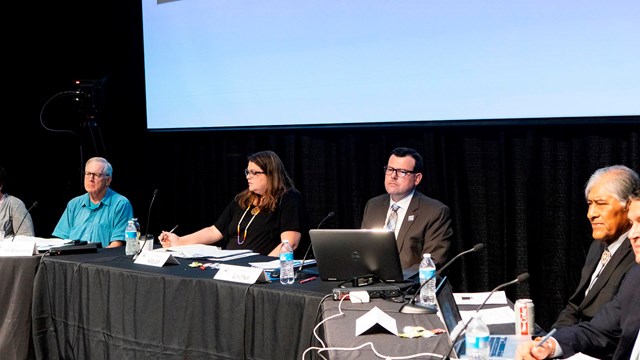
The 20th Meeting of the Review Committee
The
20th meeting of the Native American Graves Protection and
Repatriation Review Committee was called to order by Mr. Armand
Minthorn at 8:30 a.m., Monday, December 11, 2000, at the Sheraton
Music City Hotel, Nashville, TN. The following review committee
members and National Park Service (NPS) staff were in attendance:
Members
of the review committee:
Mr. Armand Minthorn, Chair
Mr. Garrick Bailey
Mr. James Bradley
Mr. Lawrence Hart
Ms. Vera Metcalf
Mr. John OÆShea
Ms. Rosita Worl
National
Park Service staff:
Mr. John Robbins, Assistant Director, Cultural Resources
Stewardship and Partnerships, NPS, Washington, DC
Ms. Carla Mattix, SolicitorÆs Office, U.S. Department of
the
Interior (DOI), Washington, DC
Ms. Andrea Warren, National NAGPRA consultant, NPS, Washington,
DC
Ms. Lesa Hagel, National NAGPRA consultant, NPS, Rapid City, SD
The
following persons were in attendance during some or all of the
meeting:
Ms. Mary Adair, Museum of Anthropology, University of Kansas,
Lawrence, KS
Mr. Lawrence S. Alexander, Department of Defense consultant,
Wildwood, GA
Mr. Arthur Ayala, Bureau of Land Management, Cupeno, UT
Ms. Jennifer Azzarezco, Alexander Archaeological Consultants,
Wildwood, GA
Mr. Kimball Banks, BOR, Bismarck, ND
Ms. Jennifer Bartlett, State Historic Preservation Office,
Nashville, TN
Ms. Ellyn Bigrope, Mescalero Apache Tribe, Mescalero, NM
Mr. Bobby C. Billie, Independent Traditional Seminole Nation of
Florida, Daytona Beach, FL
Mr. Arvel E. Bird, Singing Wolf Records, Native American Spiritual
Alliance, Nashville, TN
Mr. James Bird, Eastern Band of Cherokee, Cherokee, NC
Mr. David Brown, Bureau of Indian Affairs, Woodbridge, VA
Mr. Robert M. Burden, Jr., Alliance for Native American Indian
Rights of Tennessee, La Vergne, TN
Mr. Brian Burgess, Eastern Band of Cherokee, Whittier, NC
Ms. Patricia Capone, Peabody Museum of Archaeology and Ethnography,
Harvard University, Cambridge, MA
Mr. Bill Chada, BOR, Nebraska-Kansas Area Office, Grand Island,
NE
Ms. Yolanda Chavez, Lake County Intertribal NAGPRA Consortium,
Nice, CA
Ms. Vicki Christy, Fallon Paiute-Shoshone Tribe, Fallon, NV
Ms. Barbara Crandell, Native American Alliance of Ohio, Thornville,
OH
Mr. Brad Coutant, BOR, Great Plains Regional Office, Billings,
MT
Mr. Jeff Denny, National Park Service, Carlsbad Caverns National
Park, Carlsbad, NM
Mr. Brian Ewart, Ann Arbor, MI
Ms. Linda Fabbri, University of California, Berkeley, CA
Mr. Nick Fielder, Tennessee State Archeologist, Nashville, TN
Mr. A. Lee Foster, United States Army Environmental Center,
Aberdeen PVG GND, MD
Ms. Myra Giesen, Office of Policy, BOR, Lawrence, KS
Ms. Martha Graham, American Museum of Natural History, New York,
NY
Ms. Priscilla Grew, Department of Geosciences, University of
Nebraska, Lincoln, NE
Mr. David Guldenzopf, Department of the Army, Gunpowder, MD
Ms. Roberta L. Hayworth, Corps of Engineers, St. Louis, MO
Mr. Toye Heape, Tennessee Commission of Indian Affairs, Nashville,
TN
Ms. Susan Hirano, University of California, Berkeley, CA
Mr. Richard Hitchcock, University of California, Berkeley, CA
Mr. Robert J. Hozrd, Kansas State Historical Society, Topeka,
KS
Ms. Andrea A. Hunter, Repatriation Review Committee, Smithsonian
Institution, Northern Arizona University, Flagstaff, AZ
Ms. Barbara Isaac, Peabody Museum of Archaeology and Ethnology,
Harvard University, Cambridge, MA
Ms. Cheryl Johnston, Ohio Historical Society, Columbus, OH
Mr. Daniel Kirby, Alliance for Native American Indian Rights of
Tennessee, Clarksville, TN
Mr. Vernon J. Knight, University of Alabama, Tuscaloosa, AL
Mr. Leigh J. Kuwanwisiwma, Hopi Tribe, Kykotsmovi, AZ
Ms. Shannon Larsen, Ancient Trees, Daytona Beach, FL
Ms. Diana Loren, Peabody Museum of Archaeology and Ethnology,
Harvard University, Cambridge, MA
Mr. Edward Luby, Phoebe A. Hearst Museum of Anthropology,
University of California, Berkeley, CA
Ms. Rhonda Lueck, Corps of Engineers, St. Louis, MO
Ms. Carolyn McClellan, Cherokee Nation, Bureau of Indian Affairs,
Washington, DC
Mr. Larry McKee, TRC Garrow, Nashville, TN
Ms. Jean McCoard, Native American Alliance of Ohio, Lucasville,
OH
Mr. Frank McManamon, National Park Service, Washington, DC
Mr. Ambrose Namoki, Sr., Hopi Tribe, Kykotsmovi, AZ
Mr. John W. OÆHeau, Mississippi State University, Mississippi
State, MS
Mr. Danny Olinger, Tennessee Valley Authority, Norris, TN
Mr. J. Anthony Paredes, National Park Service, Atlanta, GA
Ms. Martha Potter Otto, Ohio Historical Society, Columbus, OH
Mr. Rick Quesada, Ysleta Del Sur Pueblo, El Paso, TX
Mr. David Rabon, Cherokee Nation, Tahlequah, OK
Ms. Karen Rabon, Cherokee Nation, Tahlequah, OK
Ms. Katherine Ramey, Smithsonian Institution, Washington, DC
Chris Redman, Chickasaw Nation, Ada, OK
Mr. Jason C. Roberts, National Park Service, Washington, DC
Ms. Lenora Rogers, Fallon Paiute-Shoshone Tribe, Fallon, NV
Ms. Donna C. Ropar, Kansas State University, Manhattan, KS
Mr. John Schweikart, Ohio Department of Transportation, Columbus,
OH
Ms. Bertie Schweppe, Native American Alliance of Ohio, Cincinnati,
OH
Ms. Lenora Shendo, Mescalero Apache Tribe, Mescalero, NM
Mr. Joe Sierra, Jr., Ysleta Del Sur, El Paso, TX
Mr. Gary Selinger, University of Alaska Museum, Fairbanks, AK
Ms. Sarah Sherwood, Middle Tennessee State University,
Murfreesboro, TN
Mr. Kevin Smith, Middle Tennessee State University, Murfreesboro,
TN
Mr. Vincas P. Steponaitis, Society for American Archaeology,
Research Laboratories of Archaeology, Chapel Hill, NC
Mr. James Strider, Ohio Historical Society, Columbus, OH
Ms. Kim Taylor, Museum of Anthropology, University of Kansas,
Lawrence, KS
Mr. Clark W. Tenakhongva, Hopi Tribe, Kykotsmovi, AZ
Mr. Jay Thomas, Department of the Navy, Washington, DC
Ms. Lori Thompson, Alexander Archaeological Consultants, Wildwood,
GA
Mr. Tim Thompson, Muskogee Creek Nation, Okmulgee, OK
Mr. Phil Walker, American Association of Physical Anthropologists,
Department of Anthropology, University of California, Santa
Barbara, CA
Ms. Pemina Yellow Bird, Three Affiliated Tribes, Belcourt, ND
Mr.
Minthorn welcomed the review committee members and members of
the
audience and stressed the importance of tribal support and assistance
for the efforts of the review committee. Mr. Tim Thompson, Muskogee
Creek Nation, Okmulgee, OK, gave the opening invocation. The review
committee members introduced themselves and welcomed Ms. Worl
and
Mr. Bailey to the review committee.
Mr.
Robbins, Designated Federal Official for the review committee,
welcomed the review committee members and explained that Ms. Worl
and
Mr. Bailey were appointed by the Secretary of the Interior on
November
21, 2000, due to the conclusion of Ms. NaranjoÆs and Mr.
SullivanÆs
terms on the review committee.
Review of the Agenda
Mr.
Robbins gave a brief review of the agenda. Ms. Worl expressed
concern about the number of Federal agencies that had not submitted
reports or scheduled a presentation at the meeting. Ms. Worl
requested that Federal agencies previously noted as having problems
with compliance be asked to provide information. Mr. Minthorn
expressed concern for the low number of Federal agencies making
presentations to the review committee.
Implementation Update
Mr.
Robbins explained that the implementation update in the review
committee membersÆ binders covered a wide variety of topics.
He
explained that a separate binder was provided for press clippings
published since the last meeting.
Summaries:
Mr. Robbins stated that summaries have been received from
1,058 institutions. In response to a concern of Ms. Worl, Mr.
Robbins
explained that reporting institutions are self-identified and
therefore the total universe of institutions having collections
subject to NAGPRA is not known. Mr. Bailey pointed out that a
number
of small museums may infrequently receive Federal funds and therefore
may not be aware of their requirements under NAGPRA. Mr. OÆShea
asked
whether institutions would be retroactively responsible if they
become
subject to NAGPRA at a later time. Ms. Mattix explained that
situation might fall under the future applicability section of
the
law, which is not completed. Mr. Bradley stated that it should
be
possible to determine an estimated total universe of museums through
national museum organizations such as the American Association
of
Museums (AAM) and also to determine the total number of Federal
agencies.
Inventories
Database: Ms. Hagel explained that the minimum number of
individuals (MNI) entered in the culturally unidentifiable portion
of
the inventory database was approximately doubled from the last
meeting, from 11,000 to 23,000, and the number of associated funerary
objects in the database increased from 150,000 to 275,000. In
response to a question from Mr. Bradley, Ms. Hagel estimated that
25
percent of the culturally unidentifiable human remains information
was
in the database and, at the present rate, the database would take
approximately two years to complete. Since the review committee
is
charged with compiling this information, Mr. Bradley suggested
regular
updates on the status of the culturally unidentifiable human remains
database.
Federal
Register Notices: Mr. Robbins explained that as of December
31, 2000, a total of 936 inventories were logged at the National
NAGPRA office. Between January 1 and December 31, 2000, 306 notices
were logged; 141 new notices were received during CY2000, and
165
notices received prior to January 1, 2000, were found as part
of a
records management improvement initiated in June 2000. Of the
936
total notices logged, 587 notices have been published in the Federal
Register, at an average rate of 98 notices per year since the
1995
deadline for inventory submission. As of December 1, 2000, the
notices
backlog was 349 notices, of which 48 were considered priority
due to a
pending repatriation claim. Of the 48 priority notices, 6 are
on hold
at the request of the museum or Federal agency, 38 are in process
towards publication, and 4 have not yet been assigned to staff.
As of
December 1, 2000, the maximum period between receipt of notification
of a claim and assignment to staff for further processing was
six
weeks. In June 2000, 41 notices were active, and as of December
1,
2000, 170 notices were active. The notice publication rate increased
from 94 notices in CY1999 to 133 in CY2000, of which two-thirds
were
published between July 1 and December 1, 2000. Mr. Robbins explained
that following discussions at the Juneau review committee meeting,
the
National NAGPRA office focussed specifically on notices publication,
and he noted the increased number of notices logged and active
that
directly results from these efforts.
Staffing:
Mr. Robbins explained the current staffing situation at the
National NAGPRA office. CY2000 began with approximately one person
devoted to notices and half a person each devoted to grants, database
work, and review committee support, plus work underway on regulations.
Following temporary hires in June-July 2000 with $195,000 additional
FY2000 funding, three people are devoted to notices, two people
to
grants, one person to databases, and one person to review committee
support, plus work underway on regulations. He pointed out that
some
individuals are doing a variety of tasks and that these numbers
reflect the cumulative total of people working on each task.
Mr.
Robbins stated that in FY2001 appropriations, National NAGPRA
has
a $400,000 base funding increase, which has been confirmed with
the
budget office. In FY2001, National NAGPRA has been established
as a
separate program within the National Center for Cultural Resources,
with its own organizational code and account number. Approximately
six or seven NPS hires will be advertised in FY2001. The permanent
positions will be devoted to grants, education, notices, databases,
regulations, and the review committee. The positions will be filled
to the full extent that funding allows, and attracting Native
American
candidates will be emphasized as they were with soliciting candidates
for the temporary positions. Mr. Minthorn asked when the positions
would be filled. Mr. Robbins explained that the personnel office
was
currently reviewing the position descriptions. Then the positions
will be advertised, an application deadline will be set, and the
date
will be determined when the positions will be filled following
receipt
and evaluation of applications.
Ms.
Worl asked about Mr. Tim McKeownÆs (NPS staff) current status
and
asked for an organizational chart of the NAGPRA staffing. Mr.
Robbins
explained that in discussions between DOI and NPS, a decision
was made
to separate Park NAGPRA, which provides assistance for NAGPRA
activities within NPS, from National NAGPRA activities. Park NAGPRA
remained with the Archeology and Ethnography program of NPS and
continues to be the responsibility of the Departmental Consulting
Archeologist. Mr. Robbins explained that in order to prevent loss
of
experience, weekly coordination meetings occur between the staff
of
the National NAGPRA program, the Park NAGPRA program, and people
working on tribal programs, such as the grants managers in the
Heritage Preservation Services program.
Mr.
Minthorn asked why Mr. McKeown and Ms. Kate Stevenson (NPS
Associate Director, Cultural Resources Stewardship and Partnerships)
were not at the meeting. Mr. Robbins explained that Mr. McKeown
was
teaching a NAGPRA course in Hawaii. He is still assigned to the
Archeology and Ethnography program and can apply for the new positions
in the National NAGPRA office. Ms. Stevenson had a scheduling
conflict and was unable to attend. Mr. Minthorn asked about the
current staff of the National NAGPRA program. Mr. Robbins explained
that the current staff included himself, Ms. Andrea Warren, Ms.
Karen
Mudar, Ms. Mary Downs, Ms. Jean Kelley, Ms. Jennifer Schansberg,
Ms. Tiffany McCarthy-Scott, Ms. Robin Coates, Ms. Lesa Hagel,
and
Mr. Stuart Speaker. Mr. Minthorn requested a list of the nominations
for the review committee positions, and Mr. Robbins stated that
he
would check whether that was public information.
Newspaper Notices: Mr. OÆShea stated that he feels the database
list
of newspaper notices for inadvertent discoveries and planned
excavations was very useful, and he expressed hope that the contents
of each notice would be accessible on the Website due to the limited
availability of some of the newspapers. Mr. Robbins explained
that
this project has been underway for quite some time and is heading
in
the direction outlined by Mr. OÆShea.
Hopi
Tribe/Chaco Culture National Historical Park Dispute: Mr. Robbins
explained that NPS is reviewing the process of cultural affiliation
determinations servicewide. This review will be undertaken by
a
subcommittee of the National Park System Advisory Board at the
request
of the NPS director. The subcommittee will review how determinations
of cultural affiliation were made for cultural items included
in
published notices. The subcommittee will then report its findings
to
the director, who may then choose to review the Hopi Tribe/Chaco
Culture National Historical Park (NHP) matter in light of the
servicewide status of cultural affiliation determinations. The
subcommittee consists of two advisory board members, who will
be
assisted by NPS staff. Mr. Bradley expressed appreciation for
the
importance of this issue and a concern for timeliness out of respect
for people awaiting the decision. Mr. Robbins explained that the
subcommitteeÆs report is scheduled for the spring meeting
of the
advisory board in April 2001.
Mr.
OÆShea asked if Chaco Culture NHP was delaying or proceeding
with
their intended repatriation in light of this review process.
Mr. Robbins explained that he would try to confirm what the status
of
the repatriation action was and report back to the review committee
members. Mr. Minthorn stated that the Hopi people have been very
patient in reporting regularly to the review committee, and stressed
that an important precedent was set when a bureau of DOI goes
against
the recommendations of the review committee. Mr. Minthorn asked
the
review committee members to reaffirm their original intent expressed
through previous meetings that activity regarding this issue would
be
put on hold until a decision was made about the dispute. Mr. Bailey
abstained given his recent appointment to the review committee.
The
remaining members agreed with Mr. MinthornÆs request. In
addition,
Ms. Worl suggested as an action item that the review committee
would
develop a process to deal with conflicts between museums or Federal
agencies and the review committee.
Mr.
Minthorn suggested that NPS give an update on this issue to the
review committee members at the next meeting. Mr. Bradley added
that
it was difficult to determine who represented DOI, noting that
Ms. Stevenson was listed on the agenda but was not present at
the
meeting. He added that regional directors and park superintendents
speak for NPS, while at the same time the review committee operates
under the jurisdiction of NPS with counsel from the DOI SolicitorÆs
Office. Mr. Bradley stressed the need for participants in disputes
to
know whether the review committee has standing to make recommendations
that will be followed. Mr. Bailey agreed that when there are
conflicts between the review committee and museums or Federal
agencies
regarding review committee recommendations, the parties should
discuss
the situation. Ms. Worl asked for all background information on
the
dispute between the Hopi Tribe and Chaco Culture NHP, and a summary
review of any pending disputes. For Ms. WorlÆs and Mr. BaileyÆs
benefit, Mr. Bradley explained that disputes are not formally
recognized until that determination is made for each situation
by the
review committee chair and the Designated Federal Official.
Mr. OÆShea agreed with Ms. WorlÆs suggestion to develop
a procedure to
deal with situations where Federal agencies or museums do not
follow
the review committeeÆs recommendations regarding disputes.
Regulations:
Mr. Robbins explained that there are four topics that
were reserved in the regulations that still need to be addressed:
civil penalties, future applicability, disposition of culturally
unidentifiable cultural items, and disposition of unclaimed cultural
items. He added that the sections dealing with culturally
unidentifiable and unclaimed cultural items were linked in many
ways.
The review committee finalized their recommendations on culturally
unidentifiable human remains at the Juneau review committee meeting
in
April 2000. Prior to this, a rough draft of the unclaimed cultural
items regulations had been prepared. Mr. Robbins projected that
work
would resume on those two sets of regulations in February 2001,
and
explained that the National NAGPRA office had focussed on notices
work
since the Juneau meeting. Mr. Bradley asked that a copy of the
recommendations for culturally unidentifiable cultural items developed
at the Juneau meeting be provided to the review committee members,
which would be particularly helpful for Ms. Worl and Mr. Bailey.
Mr.
Minthorn asked about the process for developing regulations on
culturally unidentifiable cultural items. Ms. Mattix explained
that
NPS staff would prepare draft regulations in the proper form,
which
would then be reviewed within DOI by all affected divisions. Once
draft regulations were prepared, the review committee members
could
review the regulations. The draft regulations would then go through
the Federal Register notice and comment process. Ms. Mattix explained
that the staff and timing for each of these steps were unknown
due to
the upcoming administration change and changes in political
appointees. Mr. Bradley expressed concern over the length of time
that developing these regulations was taking and further concerns
over
the priority that the various draft regulations was given,
particularly that civil penalties were given priority over culturally
unidentifiable cultural items regulations. Mr. Robbins explained
that
was due to the fact that work began on the civil penalties regulations
before the review committee finalized their recommendations on
culturally unidentifiable cultural items. Mr. Minthorn expressed
concern over the delay in progress of the culturally unidentifiable
cultural items regulations given the review committeeÆs
expectation to
finalize these regulations at the Nashville meeting. Ms. Worl
added
that the delay gave the appearance of the review committeeÆs
dragging
its feet and recommended that the draft regulations be developed
by
the spring meeting. Mr. Minthorn suggested that the review committee
members communicate to the administration their frustration with
this
process, which is causing delays in repatriations and affecting
relationships between Indian tribes and museums. Mr. Hart added
that
even with the delays in the process, work is continuing. Mr. OÆShea
suggested that review committee members be given the opportunity
to
review the draft regulations at the same time that the draft is
circulated to the various bureaus within DOI, which hopefully
would
speed the process.
Ms.
Mattix explained that the civil penalties regulations have been
in
effect as interim regulations, meaning that the regulations did
not go
through the full Administrative Procedures Act process of notice
and
comment due to time concerns. Some public comments were received
after they were published, and the SolicitorÆs Office advised
NPS that
it would be best to get final regulations in force. Changes warranted
by the comments need to be made and then the regulations would
be
reviewed within DOI and published in the Federal Register as a
final
rule. Ms. Metcalf and Ms. Worl asked that the review committee
members be allowed to review the civil penalties regulations before
they are finalized. Ms. Mattix explained that such review might
not
be possible due to potential ex parte communication issues, but
added
that she would determine what kind of consultation the review
committee members could have at that stage of the process.
Mr.
Robbins explained that a draft of the future applicability
regulations had been circulated to other bureaus in DOI. Comments
need to be incorporated into a proposed version to be reviewed
by DOI
and published in the Federal Register as a proposed rule. At that
point, the review committee members could review the draft of
the
future applicability regulations. Mr. Robbins added that, in light
of
comments by the review committee, the order of priority for the
remaining regulations work would be civil penalties, disposition
of
culturally unidentifiable cultural items, disposition of unclaimed
cultural items, and future applicability. Mr. OÆShea repeated
the
review committee membersÆ desire to review all drafts of
these
regulations.
Budget:
Ms. Worl asked Mr. Robbins for a copy of the National NAGPRA
program budget, which was provided to the review committee members
later in the meeting.
Federal Agency Compliance
U.S.
Department of Defense, Department of the Navy: Mr. Jay Thomas,
head of the Navy Cultural Resources Office, explained that he
represented the Navy and the Marine Corps, both under the Department
of the Navy. He explained that review committee members had a
copy of
the full Department of the Navy report in their binders. Mr. Thomas
summarized the highlights of the NavyÆs report for the review
committee. The NavyÆs identification of archeological and
anthropological collections around the country is substantially
completed, which represents significant progress from their last
report to the review committee. Mr. Thomas reported that some
compliance action has been taken for most of the 19 to 22 outstanding
cases of collections, usually in the form of an inventory.
Approximately 1,600 of the 2,300 individuals in the collections
have
been repatriated, with most of the remaining individuals being
classified as culturally unidentifiable. Cases arising due to
inadvertent discovery or through other means are dealt with at
the
local installation level, although these actions are tracked at
the
headquarters level. The installation commanders are provided the
tools needed to properly comply with NAGPRA, including training
courses and integrated cultural resources management plans. Tribal
consultation occurs routinely on a variety of issues, and the
Navy
continues to work on improving consultation. Navy compliance with
NAGPRA is incorporated better than ever in the day-to-day activity
of
project development, and day-to-day management of archeological
collections and cultural resource management, as well as NAGPRA
complianceÆs receiving better attention at headquarters.
Mr. Thomas
expressed appreciation for the letter from Mr. Robbins asking
for an
update on NAGPRA compliance for the review committee, noting that
the
letter was a useful tool in compiling an up-to-date report on
NAGPRA
compliance.
Review
Committee Discussion: Mr. Bradley commended the efforts of the
Navy regarding NAGPRA compliance, expressed appreciation for the
information provided in the NavyÆs report, and highlighted
a table
detailing compliance status as a useful model for other agencies
and
museums. Mr. Minthorn referenced the past report on Navy NAGPRA
compliance by Ms. Kathleen McLaughlin and asked about agency
compliance at the installation level, the completeness of the
inventory process by the U.S. Army Corps of Engineers, and Navy
policy
dealing with inadvertent discoveries. Mr. Thomas addressed each
of
these issues. Navy headquarters provides the necessary tools for
each
installation to be in compliance but does not have sufficient
resources to oversee compliance at each installation. The U.S.
Army
Corps of Engineers was just completing their latest round of
investigations and believes that they have located the vast majority
of collections for the Navy and other Federal agencies. Navy
personnel receive training on how to deal with inadvertent discoveries
and the Navy has both a Secretary of the Navy policy and a Chief
of
Navel Operations instruction on dealing with inadvertent discoveries.
Mr. Minthorn asked for an update on the compliance status of each
installation at a later date and copies of the NavyÆs policies
on
inadvertent discoveries. Ms. Worl thanked Mr. Thomas for his report
and asked if the University of Alaska Fairbanks or the Navy compiled
the inventory with reference to NAS Adak, as noted on Table 1
in the
Navy report. Mr. Thomas explained that the University of Alaska
Fairbanks completed that consultation. Mr. OÆShea commented
on the
positive effects of sending the letter requesting an update on
Federal
compliance. Mr. Bradley suggested that the review committee members
send a letter to the Department of the Navy commending their progress
in NAGPRA implementation and suggested that Mr. Thomas make the
NavyÆs
report on compliance available to the public.
U.S.
Department of the Interior, NPS: Mr. Frank McManamon, manager
of
the NPS Archeology and Ethnography program, explained that, within
NPS, park superintendents have responsibility for NAGPRA compliance
at
the park level. This includes ensuring that summaries, inventories,
and any necessary updates are completed and correct, following
NAGPRA
regulations in making cultural affiliation determinations and
decisions regarding the appropriateness of repatriations, ensuring
that NAGPRA definitions are properly applied, and ensuring that
appropriate consultation with Indian tribes and Native Hawaiian
organizations is undertaken. Regional and support office expert
staff
provide technical assistance for some of these tasks. The Archeology
and Ethnography program staff provides technical assistance in
drafting and publishing Federal Register notices and developing
national guidance.
Mr.
McManamon reported that 103 NPS units control or possess an
estimated 6,000 sets of Native American human remains and over
80,000
associated funerary objects. Approximately 75 percent, or 4,500,
of
the human remains have been culturally affiliated, with the remaining
25 percent being considered culturally unidentifiable at this
point.
As of the beginning of December 2000, 31 NPS units have published
35
Notices of Inventory Completion, and 41 draft Notices of Inventory
Completion were in process. Seven NPS units have published Notices
of
Intent to Repatriate covering 26 unassociated funerary objects
and 328
sacred objects. NPS summaries indicate that an estimated 80 NPS
units
have or may have unassociated funerary objects, sacred objects,
and
objects of cultural patrimony in their collections. Four NPS units
have published 5 notices in local newspapers related to inadvertent
discoveries that cover approximately 5 sets of human remains and
135
associated funerary objects. Mr. McManamon emphasized that NPS
is
very actively engaged in the implementation of NAGPRA on a number
of
levels.
Review
Committee Discussion: Mr. Minthorn asked about the status of
the guidance to Federal agencies for inadvertent discoveries.
Mr. McManamon explained that since the introduction of the topic
at
the Salt Lake City meeting, no further action has been taken towards
drafting that guidance. He added that his role in developing these
guidelines would not be the same as anticipated at the Salt Lake
City
meeting, although he believes that further guidance on those kinds
of
activities is necessary and he has been contemplating undertaking
that
for NPS. Mr. Robbins agreed to try to determine the status of
the
guidance and when it could be finalized.
Mr.
OÆShea asked if the human remains from Chaco Culture NHP
were
included in the culturally affiliated portion of NPS collections.
Mr. McManamon explained that they were included, but that more
information might be available after the NPS process review described
earlier by Mr. Robbins is completed, perhaps by the next review
committee meeting. Mr. OÆShea commented that the description
of
superintendent responsibilities was very good and actually paralleled
the review committee recommendations on the Hopi Tribe/Chaco Culture
NHP issue. Mr. Bradley asked about the total number of NPS units.
Mr. McManamon stated that NPS has a total of 391 units, of which
the
103 units on the list provided to the review committee have cultural
items covered by NAGPRA. He added that some parks not on the list
might control land on which an inadvertent discovery might occur.
All
NPS units that control or possess collections of cultural items
covered by NAGPRA have reported their collections.
Mr.
Bradley asked about the process for reviewing decisions of
cultural affiliation within NPS. Mr. McManamon explained that
NPS has
three levels at which final administrative decisions are made,
the
superintendent, the regional director, and the director.
Superintendents are delegated the responsibility to make certain
decisions regarding NAGPRA, which typically are final and not
formally
or administratively reviewed by the regional director or director
unless a problem arises. Any disagreements with these decisions
would
be first addressed with the superintendent, then the regional
director, and finally the director. Mr. Robbins added that the
director has asked the National Park System Advisory Board, a
citizens
advisory committee that is separate from the NPS Washington office,
to
review the process of making cultural affiliation determinations
and
provide information to the director. He explained that this review
is
being made on the process servicewide and is not focussed on any
particular cultural affiliation or park.
Mr.
Bailey asked for an explanation of the process used by NPS to
make
determinations of cultural affiliation. Mr. McManamon explained
that
present-day and past entities are identified and then connections
are
identified between the two using a variety of evidence. Mr. Hart
urged the use of the term ôNative Americanö when referencing
culturally unidentifiable human remains.
In
response to a request by the review committee members,
Mr. McManamon gave a brief update on the Kennewick case. The stay
placed by the judge has been lifted and the U.S. Army Corps of
Engineers made a decision about the treatment that they would
propose
for the human remains. The administrative record was delivered
to the
court and all relevant parties on December 1, 2000, which needs
to be
reviewed by all parties. The judge has scheduled various dates
for
written legal arguments to be provided and a court hearing for
June
19, 2001, for presentation of oral arguments. Documentation
concerning the case is posted on the Kennewick Website developed
by
NPS and DOI.
Ms. Worl asked about funds that superintendents or regional directors
are able to provide to Indian tribes relating to cultural resource
studies or NAGPRA-related issues. Mr. McManamon explained that
within
NPS an amount of money is distributed annually for Park NAGPRA,
which
is used for staffing and activities such as those described by
Ms. Worl. Most of the money is distributed to the regional offices.
Each regional director allocates the funding in a different manner,
establishing their own annual priorities for Park NAGPRA monies.
Mr. McManamon stated that each region receives approximately $200,000
per year. The Intermountain Region, for example, has used these
funds
in the past for cultural affiliation studies or conferences to
discuss
cultural affiliation. He suggested contacting the regional offices
to
determine opportunities for funding in a given region. Ms. Worl
expressed concern that the funds would not be distributed equitably
among Indian tribes. Mr. McManamon explained that he was not exactly
sure but believed the funds were mostly used for joint activities
involving both NPS and Indian tribes.
Mr.
Bailey asked if it would be possible or useful for NPS to define
a
process for making determinations of cultural affiliation and
subsequent actions following the determination. Mr. McManamon
stated
he thought it would be possible since all that is currently available
is the law and the regulations. The regulations provide advice
and
suggestions on how to identify earlier groups. Mr. McManamon
suggested that the National Park System Advisory Board review
on
cultural affiliation decisions might serve as a basis for further
guidance on this process. Mr. Bailey commented on the complexity
of
the process given the extensive Federal collections and asked
about
the formality of the process. Mr. McManamon explained that the
process is very localized, with the responsibility given to individual
superintendents who rely upon advice and recommendations from
experts
and utilize information from cultural affiliation studies,
ethnographic, archeological, physical anthropological, and other
types
of information. Mr. Bradley added that the responsibility of Federal
agencies and museums to make determinations of cultural affiliation
is
a requirement of the statute and the regulations, both of which
provide fairly clear guidance for cultural affiliation determinations,
including a dispute process. Mr. OÆShea commented on the
importance
of an acceptable and fair process for dealing with authentically
culturally unidentifiable cultural items. Ms. Mattix reviewed
the
definition of cultural affiliation from Section 2 of the statute,
with
further elaboration on the definition at 10.14 (c) of the regulations.
Mr.
Minthorn explained that the review committee members have cited
their concern with the situation involving Chaco Culture NHP and
the
precedent that could be set. He stressed the importance of the
review
committee membersÆ maintaining their position and continuing
to
question the actions of agencies that go against the review
committeeÆs recommendations. Mr. McManamon responded that
in this
situation the park superintendent made a determination of cultural
affiliation, which was subsequently challenged by the Hopi Tribe,
the
Zuni Tribe, and others. The review committee agreed to consider
this
dispute and made a recommendation after two hearings and reviewing
extensive information. The superintendent decided not to follow
the
advice of the review committee, as was his right or responsibility.
The Hopi Tribe has pursued potential administrative remedies by
asking
the NPS director to review the determinations of the superintendent
and regional director in this case, which is currently in process.
The review committee could certainly discuss potential steps to
take
in this situation, but the review committee is an advisory committee.
Not all parties are going to agree nor are they required to follow
the
review committeeÆs recommendations. Mr. Minthorn suggested
that the
review committee could assist in the National Park System Advisory
Board review. Mr. Hart expressed concern about the review committeeÆs
considering issues that are undergoing a procedural review.
U.S.
Department of the Interior, Bureau of Reclamation (BOR): Ms. Myra
Giesen, NAGPRA Coordinator, BOR, welcomed the members of the review
committee and began with a brief overview of BOR. Since its inception
in 1902, BOR has played a pivotal role in developing water resources
in 17 western States, with jurisdiction over approximately 8.5
million
acres. BOR serves as AmericaÆs second largest wholesale
water
supplier, administering 348 reservoirs with a total storage capacity
of 245 million acre-feet. The responsibility for NAGPRA compliance
has been delegated to the five regional directors or their designees.
Ms. Giesen provided a map of BOR lands, with a list of NAGPRA
contacts. BOR submitted a single summary in 1993. Since that time,
additional information has necessitated revising the summary to
reflect an additional 2 sacred objects and 207 unassociated funerary
objects, of which 74 are culturally affiliated. All of the
unassociated funerary objects are located at BOR-administered
repositories, but the two sacred objects continue to be curated
by a
non-Federal museum. The various offices are working with non-Federal
museums to meet curation standards set forth in 36 CFR 79 and
DM 411.
The affected offices, including the Lower Colorado Region, the
Upper
Colorado Region, and the Mid-Pacific Region, are preparing supplements
to BORÆs summary.
All
five BOR regions submitted an inventory by the statutory deadline.
New information on the recovery of previously unknown archeological
collections has necessitated amendments to the inventory. BOR
currently has control of human remains representing 1,755 individuals,
of which 910 have been assigned cultural affiliation, and 33,034
associated funerary objects, of which 32,027 are affiliated with
modern Indian tribes. Three additional associated funerary objects
have been repatriated. The human remains and associated funerary
objects came from 194 locations across the 17 western states and
are
located at 27 non-Federal museums and two Federal museums. All
regional inventories will be completed by early 2002. The Great
Plains Region will submit part of their revised inventory during
their
presentation to the review committee at this meeting, with the
remainder scheduled to be submitted in January 2002. The Lower
Colorado Region submitted a revised inventory just prior to this
meeting for affiliated objects, along with a Notice of Inventory
Completion for the repatriation of 480 individuals and 2,206
associated funerary objects. The submission included an inventory
for
their culturally unidentifiable cultural items representing 6
individuals and 22 associated funerary objects. The Pacific Northwest
Region is actively consulting with the Confederated Tribes of
the
Colville Reservation and the Shoshone-Bannock Tribes of Fort Hall
Reservation of Idaho and anticipates completing an inventory in
late
2001 or early 2002. The Upper Colorado Region submitted a portion
of
their inventory and a draft Notice of Inventory Completion to
NPS on
November 20, 2000, for the repatriation of three individuals to
the
Southern Paiute, and expect to submit a draft Notice of Inventory
Completion this month for the repatriation of four individuals
to the
Navajo Nation. The Upper Colorado Region is consulting with Indian
tribes in order to reach a cultural affiliation determination
for the
remaining 640 individuals in their control, currently listed as
culturally unidentifiable in their inventory. To date, BOR has
had
one Notice of Inventory Completion published in the Federal Register
and has submitted another four draft notices in the past six months
to
NPS for review and publication.
Regarding
inadvertent discoveries and planned excavations, in the past
year BOR completed an internal directive, Inadvertent Discovery
of
Human Remains on Reclamation Lands, that provides mandatory actions
by
BOR personnel when human remains are discovered on BOR lands.
A
Preservation of Cultural Resources clause also was completed this
year
that must be placed in all solicitations and contracts for
construction that specifically references NAGPRA and the procedures
to
be followed in case of a discovery. Both of these documents were
provided to the review committee members. Between 1990 and 1995,
BOR
had 13 inadvertent discoveries that resulted in 12 planned excavations
with the recovery of 23 individuals and 18 associated funerary
objects. After the regulations were published in 1995, 2 additional
inadvertent discoveries have resulted in 1 planned excavation
with the
recovery of 2 individuals and 11 associated funerary objects.
Disposition has occurred or is in process for all of the excavated
individuals and associated funerary objects. Intentional excavations
of 11 individuals and 4 associated funerary objects have occurred
on
the Rosebud Reservation in 1996, Fort McDowell Indian Community
lands
in 1996, and Tohono OÆodham Nation lands in 1999, and all
human
remains and associated funerary objects were returned to the affected
Indian tribes.
BOR
is consulting with 701 federally recognized Indian tribes on
NAGPRA-related issues, with some Indian tribes consulted by more
than
1 office. To improve government-to-government relationships in
these
multiple office consultations, BOR is developing a better network
for
information exchange between offices and arranging for multiple
office
consultations when possible. BOR is seeing an increase in face-to-
face consultations and information exchange via e-mail. BOR is
working with other Federal agencies and Indian tribes on cultural
affiliation studies of the Freemont Culture and the Anasazi Culture.
The Dakotas Area Office, Great Plains Region, is in the process
of
finalizing a NAGPRA action plan with the Oglala, Rosebud, and
Lower
Brule Sioux Tribes in conjunction with a revised Programmatic
Agreement for the Mni Wiconi project. BOR is working in partnership
with other Federal agencies and museums to facilitate repatriations,
in one instance working with 2 Federal agencies, 14 Indian tribes,
and
4 museums on the disposition of culturally unidentifiable human
remains from the State of Kansas. In addition, NAGPRA-related
documents have been widely distributed to Federal preservation
officers and are available on the BOR Website. Ms. Giesen provided
budget information for NAGPRA-related activities within BOR for
FY1998
through FY2000 and projected dollars for FY2001. Ms. Giesen explained
that these numbers do not reflect all the funds for NAGPRA-related
activities as costs related to inadvertent discoveries are usually
not
charged to a specific NAGPRA project or activity and are difficult
to
track.
Review
Committee Discussion: Mr. Minthorn explained that in 1998, BOR
reported to the review committee that they were working to develop
better coordination between the regions and area offices to improve
accountability on an agency-wide basis. Ms. Giesen explained that
in
her position as NAGPRA coordinator, she works with the regional
and
area offices to communicate the status of NAGPRA implementation.
Training has or will occur for cultural resource personnel at
both the
staff and management levels. Mr. Minthorn then asked about a protocol
that was being developed for tribal consultation. Ms. Giesen
explained that a guidance document has been completed for working
with
Indian tribes. Mr. Bailey pointed out that BOR policy applies
to both
Native American and non-Native American human remains. Mr. Bradley
expressed appreciation for BORÆs aggressive stance on NAGPRA
compliance, and for their representation at this meeting and many
past
meetings. Mr. Hart commended Ms. GiesenÆs leadership in
this issue.
Ms. Worl asked how the determination was made that BOR had two
objects
that were sacred objects and that they were not objects of cultural
patrimony. Ms. Giesen explained that the objects do not fit the
definition of objects of cultural patrimony and the affected office
consulted with many Indian tribes in making that determination.
Mr. Minthorn asked about the process for planned excavations used
by
BOR. Ms. Giesen explained that all planned excavations are planned
in
consultation with Indian tribes on a case-by-case basis, follow
the
standards of ARPA, and usually allow analysis with restrictions
on
destructive analysis.
U.S.
Department of the Interior, Bureau of Indian Affairs (BIA):
Ms. Carolyn McClellan, member of the Cherokee Nation, Chief Curator
and NAGPRA Coordinator for BIA, explained that part of BIAÆs
mission
is to carry out their responsibility to protect and improve the
trust
assets of American Indians, Indian tribes, and Alaska Natives.
BIA is
committed to complying with NAGPRA for collections under its control
and in the possession of various Federal and non-Federal repositories.
Past confusion by BIA over ownership of these collections and
funding
constraints slowed BIAÆs progress in NAGPRA compliance.
In 2000, new
leadership took over the Division of Acquisition and Property
Management, which is responsible for museum property. Ms. McClellan
was hired in July 2000 and an increased level of funding for the
program has been provided. BIA has contracted with the U.S. Army
Corps of Engineers to identify repositories with BIA NAGPRA
collections, and to date 11 repositories have been identified.
Within
these repositories, BIA is responsible for approximately 4,393
human
remains and 35,160 associated and unassociated funerary objects.
In
FY2000, 2 Notices of Inventory Completion were published in the
Federal Register representing 25 individuals and 439 associated
funerary objects. Between October and December 2000, 3 Notices
of
Inventory Completion were published representing 6 individuals
and 25
associated funerary objects. Other notices are pending publication,
including 2 between BIA and the Arizona State Museum for the Snaketown
site: a Notice of Inventory Completion representing 175 human
remains
and 5,912 associated funerary objects, and a Notice of Intent
to
Repatriate representing 20,448 unassociated funerary objects.
Inventories of BIA collections have been completed at the Museum
of
Northern Arizona, Flagstaff, and the Western Archeological and
Conservation Center, Tucson, AZ. Inventories of BIA collections
are
in progress at the Peabody Museum of Archaeology and Ethnology,
Harvard University; the American Museum of Natural History, New
York;
and Nevada State Museum, Carson City. Consultations with Indian
tribes have been planned for 2001 to help determine cultural
affiliation. Ms. McClellan expressed her commitment to bringing
BIA
into compliance with every aspect of NAGPRA with the full support
of
BIA administration. Ms. McClellan added that the Federal Preservation
Officer might not be the appropriate contact for NAGPRA issues
in all
cases, and suggested contacting the Interior Museum Property
committee, which is composed of members of each of the bureaus.
Review
Committee Discussion: Mr. Bradley expressed appreciation for
the report and BIAÆs efforts. Mr. Minthorn thanked Ms. McClellan
for
her report and asked if BIA was in compliance with NAGPRA.
Ms. McClellan stated that BIA was not in compliance at this time
and
added that her goal is to have BIA in compliance by 2007. She
explained that she is currently a staff of one, but that BIA is
looking at hiring additional personnel. Mr. Minthorn asked if
BIA had
a budget specifically for NAGPRA. Ms. McClellan explained that
although there was no line-item budget, in 2000 her office was
given
$247,000, of which approximately $207,000 went to the U.S. Army
Corps
of EngineersÆ contract mentioned earlier. Since then, an
additional
$600,000 has been provided, and Ms. McClellan is currently in
the
process of writing the budget request for the next two-year cycle.
Mr. Minthorn then asked about the status of the studies described
in
the last BIA report to the review committee by Arizona State Museum
and the Museum of Northern Arizona. Ms. McClellan explained that
part
of the Arizona State Museum study related to the Snaketown site
described earlier, and the remaining portion is from the Grasshopper
site, which is in progress and does not appear to significantly
increase the numbers reported earlier as being repositoried at
the
Arizona State Museum. She stated that she did not know the exact
status of the other situation, but an itemization of the human
remains
and associated funerary objects has been completed and the next
step
is the consultation process. Mr. Minthorn asked that the review
committee be kept apprised of the status of BIAÆs NAGPRA
compliance.
Ms. Worl asked about the status of the cultural objects listed
at
BIAÆs Juneau office. Ms. McClellan stated that she did not
know the
status of that inventory and would check on that.
U.S.
Department of Defense, Department of the Army: Mr. David
Guldenzopf, Army Environmental Center, Headquarters, Department
of the
Army, explained that he would be reporting to the review committee
on
the status of NAGPRA compliance for the Department of the Army
military activities but not the U.S. Army Corps of Engineers civil
works activities. The Army is organized basically into three tiers.
Headquarters, Department of the Army, is responsible for Army-wide
policy and programs. Army major commands are divided by function,
such as Army Forces Command for field training soldiers, the Training
and Doctoring Command with Army training schools, and the Army
Material Command for munitions manufacturing and testing.
Installations under the major commands are directly related to
those
functions. The ArmyÆs NAGPRA compliance policy is contained
in Army
Regulation 200-4, Cultural Resources Management, promulgated in
1998.
The ArmyÆs implementing guidelines are Department of the
Army Pamphlet
AR 200-4, Cultural Resources Management, with guidelines for
installation compliance with NAGPRA including Native American
consultation guidelines. In addition, each installation is required
to have integrated cultural resources management plans with standard
operating procedures for compliance with cultural resources laws
and
regulations, including NAGPRA. Each installation is scheduled
to have
their plans completed by September 2001.
The
Army manages approximately 12 million acres. With approximately
one-third of the land surveyed for archeological sites, 54,000
archeological sites have been identified. The Army has over 5,000
cubic feet of archeological artifact collections located at 210
different repositories in 30 States. In 1994, 169 Army installations
were reviewed for NAGPRA compliance as part of a centrally managed
Army-wide NAGPRA Section 5 and Section 6 report effort. The Army
submitted 97 Section 6 summary reports for 97 individual installations
and 20 Section 5 inventory reports. Eighteen installations have
collections located at 27 repositories in 14 States. These
collections include 40 individuals and approximately 10,000 associated
funerary objects, with 102 potentially affiliated Indian tribes.
Consultation with federally recognized Indian tribes is underway
for
all installations with human remains and associated funerary objects
under their control. The Army has concluded consultation,
repatriation, and reburial with Native Hawaiian organizations
for Fort
Kamehameha and Fort DeRussy in Hawaii. Reburial areas have been
established on three Army installations: Fort Benning, GA; Camp
Beauregard, LA; and Fort Hood, TX. The Army report to the review
committee includes details of Army-wide funds programmed for
installation NAGPRA compliance, primarily used to fund consultation
efforts. All installations either have a professional archeologist,
cultural resource manager, or an individual assigned to these
duties,
and installations also have access to professional cultural resource
services to assist in NAGPRA compliance. An assistance program
for
installations needing additional funds for Native American
consultation efforts is available at the Army Headquarters level.
All
NAGPRA Section 5 and Section 6 compliance reports are available
on the
Army Website, aec.army.mil.
Review
Committee Discussion: Mr. OÆShea asked the percentage
completion of the ArmyÆs Section 5 and Section 6 reports.
Mr. Guldenzopf stated that the reporting requirements are 100
percent
completed and consultation efforts are underway. Mr. Bradley
commended the ArmyÆs efforts and its report to the review
committee,
and pointed out the magnitude of work and funding that has gone
into
the ArmyÆs efforts towards NAGPRA compliance. Mr. Guldenzopf
explained that in 1994 the Army committed approximately $1 million
to
locate collections and prepare the Section 5 and Section 6 reports.
He added that cooperative agreements are in place with repositories
that will accept collections, including museums, universities,
Indian
tribes, and other for-profit and nonprofit organizations. Ms.
Worl
asked whether the Army plans to have reburial areas established
on
other installations or to consolidate reburials with the three
installations described earlier. Mr. Guldenzopf explained that
would
be determined on a case-by-case basis through consultation with
the
installation. Mr. Hart asked if reburial of Native American human
remains would be allowed if the remains were from the region but
not
from the military installation. Mr. Guldenzopf explained that
an
agreement was being signed with associated Indian tribes and Fort
Benning the week of the meeting covering that situation. Mr. Hart
commented that such an agreement would be a great model.
Mr. Guldenzopf added that Fort Benning had to appeal for a waiver
to
the Army policy of having no new cemeteries established on
installations, which was granted. Ms. Metcalf asked about the
nature
of cooperative agreements with repositories. Mr. Guldenzopf explained
that the ArmyÆs goal is to eventually house all collections
in a
professional Army museum. The Army has continuous open announcements
for cooperative agreements with stakeholders and federally recognized
Indian tribes for cultural resource services on a reimbursable
basis.
In response to Mr. MulfordÆs public comment [see public
comment
section], Mr. Guldenzopf added that these announcements were sent
to
all federally recognized Indian tribes, State historic preservation
officers, and affected universities. He invited any interested
tribal
representatives to speak with him about these cooperative agreements.
Review Committee Discussion on Federal Agency Compliance
Mr.
OÆShea led the discussion on Federal agency compliance with
NAGPRA. Ms. Worl asked if all Federal agencies received the letter
requesting reports to the review committee, a copy of which was
provided in the review committee member binders. Mr. Robbins
explained that the letter was sent to all Federal Preservation
Officers shown on a list maintained by the Advisory Council on
Historic Preservation, as well as all NAGPRA coordinators included
on
a list maintained by the National NAGPRA office. Mr. Robbins
explained that some agencies responded with a written report and
others scheduled presentations at the meeting. Mr. Robbins then
asked
if any additional Federal agencies were present and would like
to make
a statement, and no Federal agencies responded. Mr. Minthorn
suggested another round of letters to Federal agencies requesting
information on NAGPRA compliance. Review committee members
specifically mentioned U.S. Fish and Wildlife Service, U.S. Department
of Energy, Army Corps of Engineers, BLM, U.S. Air Force, U.S.
Forest
Service, and U.S. Department of Energy as agencies of concern.
Mr. Hart suggested an article in CRM magazine focusing on the
issue of
Federal agency compliance.
Referencing
the NAGPRA inventory report in the meeting binder,
Ms. Worl asked about the statements of no inventories submitted
that
were reported by 219 institutions. Mr. Robbins explained that
those
institutions reported that they did not have collections subject
to
NAGPRA. Ms. Worl expressed the need for the review committee to
know
the total universe of Federal agencies that should be reporting
on
NAGPRA compliance activities and requested that a report on the
total
number of Federal agencies be added to the action list. Mr. Bailey
expressed concern about Federal agency collections in museums
and
other non-Federal repositories that Federal agencies have basically
forgotten. Mr. Bradley expressed great concern that Federal agencies
are not held to the same standard of accountability for NAGPRA
compliance as museums. Many of the institutions under forbearance
repeatedly send representatives to present updates to the review
committee, while some Federal agencies do not report or come to
the
meetings. Ms. Worl stated that members should not emphasize the
advisory nature of the review committee but remember that the
review
committee was created by an act of Congress. The review committee
has
certain responsibilities and should expect a certain level of
accountability. Review committee members agreed unanimously to
send a
stern letter to all Federal agencies mentioned earlier by members
to
be of concern and a letter of appreciation to those agencies reporting
to the review committee and demonstrating progress in NAGPRA
compliance. Following a question by Ms. Worl, Ms. Mattix explained
that the review committee was limited to encouraging or urging
Federal
agency reporting. DOI has no enforcement against other agencies
such
as there is with civil penalties and museums. Mr. Bradley suggested
that the review committee members visit the appropriate committees
during the next meeting in Washington, and Mr. Hart suggested
including noncompliant Federal agencies in the 2001 Report to
Congress.
Discussion of Requests Regarding the Disposition of Culturally
Unidentifiable Human Remains
Carlsbad
Caverns National Park and Guadalupe Mountains National Park
Mr.
Jeff Denny, Curator and Cultural Resource Program Leader, Carlsbad
Caverns National Park, explained that he was also representing
Guadalupe Mountains National Park and speaking on behalf of the
13
American Indian tribes with which the 2 parks have been consulting
during the last 3 years. These 13 Indian tribes include the Mescalero
Apache Tribe, Ysleta Del Sur Pueblo, Hopi Tribe, Pueblo of Zuni,
Pueblo of Zia, Comanche Tribe, Kiowa Tribe, Jicarilla Apache Tribe,
Fort Sill Apache Tribe, White Mountain Apache Tribe, San Carlos
Apache
Tribe, Apache Tribe of Oklahoma, and Pueblo of Isleta. Mr. Denny
introduced the following tribal members present at the meeting:
Ms. Ellyn Bigrope, Mescalero Apache Tribe; Ms. Lenore Shendo,
Mescalero Apache Tribe; Mr. Rick Quesada, Ysleta Del Sur Pueblo;
and
Mr. Joe Sierra, Ysleta Del Sur Pueblo.
At
the Santa Fe meeting in 1998, Mr. Denny appeared before the review
committee on behalf of the 2 parks and 12 Indian tribes seeking
a
recommendation to repatriate culturally unidentifiable cultural
items.
The Pueblo of Isleta joined in the repatriation efforts in 1998
following the meeting. Based upon the evidence presented at that
time, the review committee members recommended repatriation of
the
cultural items. Mr. Denny explained that during a consultation
meeting on the repatriation of these individuals early in 2000,
a
curator from the Academy of Natural Sciences in Philadelphia mentioned
that the academy had 14 fragmentary human remains from the same
site
in their collection. Although documentation is limited, the parks
believe that these human remains were transferred to the academy
in
the 1930s, along with the rest of the paleontological material.
They
were not identified as human remains until after they were at
the
museum and curated in Philadelphia, and have not been included
on any
previous NAGPRA inventory. The academy agreed to transfer the
human
remains to NPS for the express purpose of repatriation to the
Indian
tribes. The human remains have been returned to the park, cataloged
and stored in NPS collections with the rest of the cultural items.
An
updated NAGPRA inventory will be prepared in the near future.
Mr. Denny stated that the parks and 13 Indian tribes were asking
that
these 14 fragmentary human remains be repatriated with the 3
individuals originally discussed at the Santa Fe meeting for the
following reasons: They were removed from the same site as part
of the
same excavations conducted in 1934 and 1935; had the parks been
aware
of their existence, these human remains would have been included
in
the initial request in 1998; and all the criteria outlined in
the
initial request for the repatriation also applied to these human
remains.
Mr.
Denny explained a second issue of concern to the parks and 13
Indian tribes. The 1998 proposal to the review committee included
a
request to repatriate both human remains and associated funerary
objects from the three sites. The discussion and minutes show
that
the review committee considered the associated funerary objects
as
part of the repatriation request. The letter that the parks received
from Mr. McManamonÆs office, dated May 25, 1999, acknowledged
that the
proposal included both the human remains and the associated funerary
objects but the specific recommendations of the review committee
as
written in that letter only addressed the disposition of the human
remains. Regardless of the reason for this omission, the 13 Indian
tribes are adamant that funerary objects cannot and should not
be
separated from the individuals with which they were buried, and
both
parks fully agree with the position of the Indian tribes. The
review
committeeÆs recommendations on the disposition of culturally
unidentifiable Native American human remains published earlier
this
year state that, although the legal standing of funerary objects
associated with culturally unidentifiable human remains is not
addressed in NAGPRA, the statute does not prohibit their voluntary
repatriation by museums or Federal agencies to the extent allowable
by
Federal law. Mr. Denny explained that the two parks would be pursuing
other administrative means outside of NAGPRA for returning the
objects
to the Indian tribes along with the repatriated human remains
as
requested. Fortunately, NPS has deaccession authority for collections
under its control but many other Federal agencies do not have
that
authority. Mr. Denny thanked the review committee members for
listening to his presentation.
Ms.
Ellyn Bigrope, Curator, Mescalero Apache Cultural Center,
Mescalero Apache Tribe, explained that the Mescalero Apache Tribe
is
historically and culturally affiliated with Carlsbad Caverns and
Guadalupe Mountains regions. Oral history shows that the Guadalupe
Mountains are sacred and are the aboriginal homelands of the Mescalero
Apache Tribe. She expressed respect for the other Indian tribes
that
are culturally affiliated with these regions and their desire
to
repatriate the human remains described by Mr. Denny. Ms. Bigrope
stated that funerary objects should never be separated from human
remains and described the cultural belief that the two should
be
returned back to the earth together.
Mr.
Rick Quesada, War Captain, Ysleta Del Sur Pueblo, explained that
Ysleta Del Sur Pueblo was historically and culturally affiliated
with
the Guadalupe Mountain region. He described burial practices,
placing
funerary objects with an individual at the time of their death,
and
the importance of ensuring that these objects remain with the
individual so that they can continue their journey. He stressed
the
importance of including the associated funerary objects with the
human
remains in the repatriations described by Mr. Denny. He asked
for the
review committeeÆs help in repatriating the culturally unidentifiable
human remains along with the associated funerary objects.
Review
Committee Discussion: Mr. Bradley thanked the presenters and
commended NPS for bringing the parties together on this issue
and
thanked the tribal people for traveling to the meetings and for
their
willingness to work together. Mr. OÆShea pointed out that
the
discussion of this issue was very prominent in the review committeeÆs
recommendations signed in Juneau, Alaska. The review committee
viewed
the original presentation as a model for a regional approach to
deal
with this type of repatriation. Ms. Metcalf thanked the presenters
and seconded Mr. OÆSheaÆs comments that this is an
excellent model of
voluntarily complying with NAGPRA. She asked if the Indian tribes
signed a written agreement to this repatriation. Mr. Denny explained
that a written agreement signed by all 12 Indian tribes was included
in the information for the 1998 request provided to the review
committee members, and from all indications the Indian tribes
are
still comfortable with the repatriation. Ms. Worl commended the
Indian tribes for their unified effort and relationship with NPS
and
the good regional model developed in this situation.
Mr.
Minthorn asked about the status of the cultural resources
management plans described during the 1998 presentation. Mr. Denny
explained that in the last year NPS started rewriting their overall
resource management plan, which contains the cultural resource
plan,
and has changed its guidelines on resource management plans. NPS
is
looking to finalize this in the next year. He added that NPS has
had
extensive consultation with Indian tribes regarding security of
reburial sites, and in addition NPS has cultural resource protection
laws and responsibility to monitor archeological sites. Mr. Minthorn
asked if the parks have been working towards establishing or
nominating sites to the National Register of Historic Places.
Speaking on behalf of Carlsbad Caverns National Park, Mr. Denny
explained that, although they do not have an archeologist on staff
due
to lack of funding, one site in the park has been nominated to
and
listed on the National Register. He added that the park is working
to
establish a broader-based cultural resource program. The new
superintendent of the park, Mr. Mick Holm, concurs with and supports
these efforts. Mr. Minthorn asked about the revised inventory,
and
Mr. Denny hoped to start that process after the first of the year.
Mr. Bradley suggested that Mr. Denny speak with Superintendent
Duane
Alire at Pecos National Historical Park about any security concerns.
Mr.
Hart thanked the presenters and commended the efforts of all
parties. He asked if the park felt that these 14 fragmentary human
remains were exhaustive of the remains from these sites. Mr. Denny
explained that all logical institutions were contacted. Mr. Bailey
expressed concern in general that during the historic period Native
American was a biological and social identity. He explained a
situation of a burial containing some of his ancestors that could
have
been misidentified due to its location and the presence of shared
traits. After discussion, the review committee members unanimously
agreed to the repatriation of the additional 14 fragmentary human
remains with the human remains from the 1998 request. The review
committee members also agreed unanimously to include the associated
funerary objects with the remains, although Mr. Bailey expressed
his
opinion that this type of decision should be made on a case-by-case
basis. Mr. OÆShea agreed that the situations should be considered
on
a case-by-case basis and wanted to reaffirm that the review
committeeÆs original recommendation in this repatriation
should
include the associated funerary objects. Ms. Worl stressed the
importance of avoiding this type of misunderstanding in the future.
The review committee members asked Mr. Robbins to draft the letter
and
to explore with the Chair methods to expedite technical changes
to
previous decisions by the review committee.
U.S.
Department of the Interior, BOR, Dakotas Area Office and the
North Dakota Intertribal Reinterment Committee
Ms.
Pemina Yellow Bird, Three Affiliated Tribes of North Dakota
(Mandan, Hidatsa, and Arikara Nations) and the North Dakota
Intertribal Reinterment Committee, explained that 5 years ago
a joint
intertribal claim to 14 culturally unidentifiable individuals
and
their associated funerary objects was made to BOR. Consultation
has
been ongoing for five years between tribal groups and BOR on this
claim. The first joint claim by North Dakota Indian tribes was
made
before NAGPRA was passed and resulted in the reburial of over
2,000
individuals and their associated funerary objects. She explained
the
importance of burial property being reburied with the dead. The
Great
Plains Tribal ChairmanÆs Association, representing 17 upper
Missouri
River Indian tribes, produced a resolution showing the agreement
of
all indigenous nations towards this repatriation of the Native
American human remains and their associated funerary objects.
Mr.
Kimball Banks, BOR, Dakotas Area Office, explained that the
Dakotas Area Office manages lands in North Dakota, South Dakota,
and
Wyoming. On November 9, 2000, the Dakotas Area Office submitted
a
letter of request to repatriate the culturally unidentifiable
human
remains of 14 individuals and 4 associated funerary objects from
9
sites in east-central North Dakota on lands or from projects
administered by BOR. Consultation has occurred with 17 Indian
tribes,
including the 11 Indian tribes in North Dakota and South Dakota.
Mr. Kimball explained that they have complied with the draft
recommendations regarding the disposition of culturally unidentifiable
remains and the North Dakota State statutes in terms of repatriation.
At this point, no negative comments or responses have been received
regarding the repatriation.
Review
Committee Discussion: In response to a question from
Mr. Minthorn, Mr. Banks and Ms. Yellow Bird explained that
consultation was still in progress with two Indian tribes from
Minnesota and one Indian tribe from Montana with favorable results
to
date. Mr. Minthorn asked about BORÆs inadvertent discovery
plans.
Mr. Banks explained that internal BOR instructions are followed
to the
point when inadvertent discoveries become a NAGPRA issue and then
NAGPRA regulations are followed. In addition, resource management
plans for various lands are currently in progress. Mr. OÆShea
asked
about the archeological context of the burials. Mr. Kimball explained
that most were surface finds or from disturbed areas. Mr. OÆShea
asked how determinations were made that these were burial objects
and
not normal site debris. Mr. Banks explained that, since they were
not
able to establish direct association, after consultation with
the
Indian tribes the objects were reasonably believed to have been
associated funerary objects. Ms. Yellow Bird explained burial
traditions that would account for these objectsÆ being considered
burial objects. Ms. Mattix reviewed the definition of associated
funerary objects.
Mr.
Hart asked about BORÆs request to the review committee to
make a
recommendation to the Secretary of the Interior to have the associated
funerary objects deaccessioned from their museum property collection.
Ms. Mattix explained that this request relates to the review
committeeÆs last recommendation with NPS because NPS can
repatriate
the associated funerary objects in the Carlsbad Cavern situation
through a separate statutory deaccessioning authority. She explained
that the review committee could make a recommendation to repatriate
the associated funerary objects in the spirit of NAGPRA, although
BOR
may have a different mechanism to repatriate the objects legally.
The
review committee agreed unanimously that the Native American human
remains should be repatriated as requested. On the repatriation
request for the associated funerary objects, Mr. OÆShea
disagreed,
Mr. Bailey abstained, and the remaining members agreed with the
request.
BOR,
Eastern Colorado Area Office
Ms.
Myra Giesen, BOR, representing the Eastern Colorado Area Office
of
the Great Plains Region, explained a situation in which three
bones of
an individual were recovered in 1982. In consultation with Indian
tribes, BOR subsequently excavated the remainder of the grave
due to
erosion concerns in 1992. The human remains from each excavation
represent one individual. Despite additional information from
the
second excavation, no lineal descendents have been determined.
The
site was not on tribal land, and there is no cultural affiliation.
Under the discovery provision, the Indian tribes with adjudicated
lands in that county in Colorado have the highest priority for
making
a claim. Consultation has occurred or is ongoing with the Cheyenne-
Arapaho, the Northern Cheyenne, and the Northern Arapaho. At the
request of the Northern Arapaho, the lead nation in this process,
consultation will begin with the United Tribe of Colorado. Providing
that there is no objection to the disposition, repatriation of
the
individual will proceed to the four Indian tribes for the 1992
portion
of the excavations. BOR is requesting that the 1982 portion of
the
excavation be allowed to go through disposition with the rest
of the
individual.
Review
Committee Discussion: The review committee members unanimously
agreed to recommend to the Secretary of the Interior that the
Native
American human remains be repatriated as proposed.
Implementation of the Statute in the Southeast
Tennessee
Department of Environment and Conservation: Mr. Nick
Fielder, State archeologist, State of Tennessee, explained that
the
Division of Archeology, part of the Department of Environment
and
Conservation, was established in 1971 and is responsible for all
State-owned lands, municipally owned lands, and the archeological
sites that are contained thereon, including all State highway
projects. Tennessee has laws that apply to cemeteries, which have
applied to prehistoric and historic Native American graves since
1986.
Prior to that time it was not illegal to dig into or remove anything
from Native American graves in Tennessee. Prior to the enactment
of
NAGPRA, the State of Tennessee revised its statutes to include
provisions for notification of Native Americans, including Native
Americans on the State archeology advisory council, and procedures
for
the reinterment of Native American graves. The State law that
was
passed in 1990 required the reinterment of human remains removed
from
any property in the State, including private property, and allowed
for
scientific analysis. The statute did not address associated funerary
objects. After an excavation, human remains had to be reburied
but
the associated funerary objects could not be reburied. In 1998,
the
State convened a meeting with representatives of several southeastern
Indian tribes where a recommendation was made to change the law.
In
1999 the State archeology statutes were revised to require the
reinterment of both human remains and the associated funerary
objects.
This revision was not retroactive, and a sizable collection
representing 78 individuals and 23 burial objects awaits repatriation
pending the resolution of the reinterment of the associated objects,
at the request of the Chickasaw Nation. The Chickasaw Nation sent
a
letter to DOI more than a year ago with no response to date.
Mr. Fielder asked if it would be appropriate for the State of
Tennessee to voluntarily return the associated funerary objects
and
what procedures would need to be followed.
Review
Committee Discussion: Mr. Minthorn asked if all interested
parties are in concurrence on this issue. Mr. Fielder explained
that
much of the discussion has been with the Chickasaw Nation but
all
tribal entities that have an interest in the prehistoric remains
of
Tennessee will be contacted prior to any actions being taken.
Mr. Minthorn asked for a legal opinion on this matter. Mr. Robbins
explained that Ms. Mattix was not present at that point but stated
that a legal opinion could be considered. Mr. Fielder offered
to
submit the question to Mr. Robbins or the review committee for
a legal
interpretation. Mr. OÆShea questioned whether NAGPRA would
apply
given that the cemetery was on municipally owned lands and no
Federal
monies were involved. Mr. Fielder explained that the state cemetery
law is applied to federally funded highway projects. Mr. Robbins
stated that NAGPRA would apply if materials have been accessioned
into
a collection where the institution receives Federal funds.
Mr. Fielder explained that the State of Tennessee does not question
the fact that the materials fall under NAGPRA. However, under
43 CFR
10.9 (e), the State would be precluded from repatriating culturally
unidentifiable human remains pending promulgation of Section 11
of the
regulations unless legally required to do so otherwise. Tennessee
State cemetery law requires the remains to be reinterred.
Mr.
Bradley asked Mr. Robbins to check on the status of the letter
from the Chickasaw Nation and stressed the importance of having
counsel present at the review committee meetings. Mr. Bradley
stated
that he felt the State of Tennessee would be able to proceed with
the
repatriation as long as all parties agree and there was no conflict
with Federal law. Mr. OÆShea expressed concern in this case
about a
lack of broad consultation and in general about situations involving
both NAGPRA and State regulations and when each applies. Mr. Fielder
explained that the State of Tennessee is currently dealing with
a
situation on a federally funded highway project with human remains
where there are both Cherokee and pre-Cherokee occupations of
the
site. In response to a question from Mr. OÆShea, Mr. Fielder
explained that under Tennessee cemetery law, the person who owns
property containing a cemetery could have the cemetery moved.
Next of
kin must be notified through a court process. In response to a
question from Mr. Bailey, Mr. Fielder explained that all cemeteries,
whether Native or non-Native, are treated the same, except that
associated funerary objects on historic or modern cemeteries are
reburied automatically and do not come under any responsibilities
like
NAGPRA.
Mr.
Hart stated that the Chickasaw Nation was probably acting for
the
Intertribal Council. Mr. Fielder felt that that was true.
Mr. Robbins explained that arrangement would need to be documented,
which Mr. Fielder agreed to provide. Mr. OÆShea asked if
Federal
Register notice publication is required for voluntary return of
associated funerary objects for culturally unidentifiable human
remains. Mr. Robbins stated in this case that would be required
because if the objects have been accessioned into a collection
and
were separated from the human remains they would be considered
unassociated funerary objects. The process would have to include
consultation and a cultural affiliation determination. Mr. OÆShea
disagreed and felt that unassociated, unaffiliated funerary objects
would have no NAGPRA requirement. Mr. Minthorn stressed the
importance of having counsel present at the review committee meetings
in order to eliminate this type of discussion. Mr. Fielder again
agreed to formally submit this question for a legal interpretation.
Tennessee
Commission of Indian Affairs: Mr. Toye Heape, Executive
Director, Tennessee Commission of Indian Affairs, welcomed the
review
committee members and public. The Tennessee Commission of Indian
Affairs is a State agency that was created by the Tennessee General
Assembly in 1984 as an advocacy agency for Indian people in Tennessee.
Tennessee has no federally or State-recognized Indian tribes,
although
there is a sizable Indian population composed of members of federally
and State-recognized Indian tribes and unaffiliated groups. One
of
the commissionÆs purposes is to promote the recognition
and right of
Native Americans to pursue religious traditions, which is seen
as an
authorization for the commission to have concern about NAGPRA
implementation. Mr. Heape reported that he is not aware of any
NAGPRA
repatriations in the State of Tennessee, and the commission would
like
to facilitate the process by assisting federally recognized Indian
tribes in the repatriation process. The removal of Indian people
from
the southeastern United States in the 1800s forced many Indian
tribes
to relocate quite a distance away. The commission would like to
work
as a local agency to assist Federal agencies and museums.
The
Tennessee Commission of Indian Affairs recognizes that it does
not
have an official role in NAGPRA implementation and does not wish
to
take over any role of the federally recognized Indian tribes.
Mr. Heape explained that he is the only staff for the commission.
The
policy of the Tennessee Division of Archeology is to turn human
remains excavated under State law over to the Commission of Indian
Affairs after the one-year period of study, and the Commission
of
Indian Affairs arranges the reburial using NAGPRA as a model.
The
commission tries to determine the Indian tribes that are potentially
culturally affiliated with the human remains to give them the
opportunity to participate in the reburial, with the commissionÆs
acting as a facilitator in the process. Mr. Heape commented on
the
State cemetery statute described by Mr. Fielder, and clarified
that
the statute allows termination of a cemetery only if one of three
conditions apply, which are abandonment, neglect, or the cemetery
is
no longer suitable for the resting place of the dead. A judge
can
then terminate the cemetery and order the removal of the remains.
Any
relative or person who has any right in the cemetery is an interested
person and can oppose removal of the cemetery through the court.
The
Commission of Indian Affairs maintains that it is an interested
person
in those situations because of its responsibilities under State
law
and should be allowed to present testimony. He briefly described
a
pending court case dealing with this issue. Mr. Heape stated that
it
was clear that NAGPRA compliance is affected by budgetary restraints,
and he added that a political movement is needed to get support
for
NAGPRA implementation.
Native
American Alliance of Ohio: Ms. Barbara Crandell, thanked the
review committee for the opportunity to speak and extended her
apologies for turning her back on the Native people in the room
in
order to address the review committee. She described a mound in
Ohio
where three graves were found when the mound was destroyed. The
mound
was made of stones which were used to build retaining walls for
the
reservoir of Licking County over 40 years ago. When part of the
reservoir was removed last year, Ms. Crandell requested the stones.
Subsequently, four truckloads of stones were delivered to
Ms. CrandellÆs farm. Ms. Crandell described a proposed project
to
build a memorial park on the Fernald Nuclear Water Management
site,
where hopefully a monument will be built from the stones with
a bronze
plaque detailing the history of the mound. In 1861, Mr. David
Warwick
took a tray of yellow clay from the mound and sent it to the Ohio
Historical Society, which the Native American Alliance of Ohio
would
like to locate and place with the stones. Mr. Warwick also removed
animal and human bones and sent them to the Smithsonian Institution.
Ms. Crandell has asked for their return, but they have not been
located. The Environmental Protection Agency and several federally
recognized Indian tribes have agreed to the burial ground.
Ms.
Jean McCoard explained that, since she last addressed the review
committee, the burial ground of her great-great-great grandfather
was
destroyed by strip mining operations, the human remains crushed,
and
all associated objects disappeared. She described the Native American
Memorial Park proposed at the Fernald Nuclear Waste Management
site in
Hamilton, OH. In addition to the memorial, the park would become
the
sanctuary and final resting place for the ancestors of Native
people.
The park would be a place of honor and dignity. Approximately
170
acres on the western side of the 1,100-acre site are being set
aside
for the Native American Memorial Park. The park has the support
of
grassroots organizations, the Ohio Environmental Protection Agency,
Fernald management personnel, Secretary of Energy Bill Richardson,
various Congressional and Ohio legislative representatives, and
several federally recognized Indian tribes. A number of Oklahoma-
based federally recognized Indian tribes, originally indigenous
to the
Ohio River valley, plan to reinter their loved ones in their ancient
homeland. Certain areas will be dedicated to each of the various
Indian tribes who once inhabited the Ohio River valley.
Thousands
of ancient Indian human remains taken from Ohio mounds are
in Ohio museums and institutions, including approximately 5,000
at the
Ohio Historical Society. An area of the park would be set aside
for
the reinterment of the ancient ones, which not only would allow
them
to be reburied with respect and dignity but would eliminate the
need
for the offensive term ôculturally unidentifiableö
which could be
replaced by ôcommonly shared ancestors.ö At this time,
federally
recognized Indian tribes would need to claim the commonly shared
ancestors for reburial. Hopefully, this proposal could become
a model
for regions of the country where there are no federally recognized
Indian tribes, which includes 15 states. Ms. McCoard explained
that a
curator at the Ohio Historical Society raised the question of
an
underground vault to store their collection. She asked if reburial
with the caveat of future access was an appropriate interpretation
of
the law. She asked for assistance in finding solutions for the
issues
of repatriation in the 15 states that have no federally recognized
Indian tribes.
Review
Committee Discussion: Mr. Minthorn commended the efforts of the
Native American Alliance of Ohio in working with the U.S. Department
of Energy. He explained that this information could be presented
to
the DOE in California when the DOE makes their presentation to
the
review committee. Mr. Bradley expressed appreciation for the
presentation and explained that regional solutions will be different
for many areas of the country. He thanked the Native American
Alliance of Ohio for their efforts. Mr. Hart also expressed
appreciation for the presentation. Ms. Worl recommended tracking
all
Indian tribes that appear before the review committee, as well
as the
major issues brought by the Indian tribes.
Independent:
Ms. Shannon Larsen explained that she was an
environmental and human rights activist interested in the protection
of environmentally sensitive lands, which often contain indigenous
human burials. This work brings her into partnership with Mr.
Bobby
C. Billie on the protection of sites. In Florida, decisions are
often
made without sufficient information on the oral history of the
indigenous people of the area. Language such as ôin control
or
possession ofö should be replaced by ôtemporarily taking
care ofö due
to the sensitive nature of this issue. The criteria used by
archeologists and indigenous traditional people for determining
what
is significant or not significant is vastly different. The indigenous
traditional people that have the necessary knowledge are excluded
from
consultations and the NAGPRA process in Florida. Ms. Larsen described
a situation with the Big Cypress National Preserve where the
Independent Traditional Seminole Nation was not notified of an
archeological survey and was not allowed to participate in the
consultation process due to lack of Federal recognition. The State
historic preservation office makes decisions about the significance
of
ground sacred to indigenous people, which give developers the
right to
remove indigenous human remains. Traditional indigenous people
should
have the right to protect sacred burial sites.
Independent
Traditional Seminole Nation, Mr. Bobby C. Billie expressed
appreciation for being able to make a presentation. He expressed
the
pain for Indian people of watching the actions of non-Indian people
for the past 500 years. When the European people understand the
way
of life that the Creator has given them, then they can do what
they
want on their land. Now they are hearing regulation and law
prohibitive to the indigenous way of life and taking away the
recognition of the indigenous connection to the land, human remains,
and artifacts. Mr. Billie will not consult with Dr. Paredes because
of lack of respect and Dr. Paredes does not allow Mr. Billie to
repatriate his ancestors. Mr. Billie expressed concern about the
repatriation efforts of the Seminole Tribe of Florida and the
Seminole
Nation of Oklahoma. The law has to have respect for the people.
The
Creator gave the way of life and has instructed to protect life
on the
earth. No other law can be accepted. Mr. Billie hoped the review
committee would support his efforts to return these individuals
to the
ground and provide protection from the Florida archeologists who
continue to dig. Mr. Billie stated that memorials are respected,
but
yet there is no respect for indigenous people. There needs to
be
respect for people, cultures, and another way of life. Mr. Billie
explained that he never went to school, but he has 40 years of
education in his way of life going back over six million years.
To
him, there is no such thing as culturally unidentifiable remains.
The
people are known. They still carry that blood and speak the language.
It is the indigenous peopleÆs right to bring the people
back to the
ground. Mr. Billie was before the review committee five years
ago and
nothing has changed. The same things are still being said. During
this time, he has been returning some of the ancient people, which
is
his purpose to protect the people. Mr. Billie would like the review
committee to support his efforts in returning his ancestors to
the
earth.
Remarks û NPS, Southeast Region
Mr.
Anthony Paredes explained that he was speaking on behalf of
Mr. Jerry Belson, Regional Director, Southeast Region, NPS, who
was
unable to attend due to weather. Mr. Paredes presented a prepared
report on behalf of Mr. Belson.
The
Southeast Region of NPS includes North Carolina, South Carolina,
Georgia, Florida, Alabama, Tennessee, Kentucky, Mississippi,
Louisiana, Puerto Rico, and the U.S. Virgin Islands. The region
contains 63 parks, monuments, and other types of NPS units. The
region has many outstanding parks dedicated to history and culture
covering U.S. history from the Revolutionary War to the 1970s,
and
also contains parks representing the Spanish, French, and British
Colonial eras. Several units are dedicated to the struggles for
African American equality, the pioneering spirit and way of life
of
the Appalachian Mountain people, the complex mix of cultures
represented by Creole peoples, as well as the unique contributions
of
jazz to the music world. Many units in the region are devoted
to
American Indian history and culture, including Russell Cave National
Monument, AL; Ocmulgee National Monument, GA; Poverty Point National
Monument, LA; and Horseshoe Bend National Military Park, AL. Some
units in the region have ties to neighboring present-day federally
recognized Indian tribes, such as Great Smokies with the Eastern
Band
of Cherokee Indians, Everglades and Big Cypress with the Seminole
and
Miccosukee Tribes of Florida, and Jean Lafitte National Historical
Park and Preserve with the Chitimacha Tribe in Louisiana. The
Trail
of Tears originates in the Southeast Region. At least nine federally
recognized Indian tribes are located outside the region, principally
in Oklahoma, that are culturally associated with parks in the
region.
Nine federally recognized Indian tribes are still within the
boundaries of the Southeast Region of NPS, and at least another
five
federally recognized Indian tribes are culturally affiliated with
the
Southeast Region.
Effectively
communicating with a wide array of Indian tribes spread
over four states outside of the region and six states within the
region constitutes one of the challenges in the proper implementation
of NAGPRA. The Southeast Region has had a long history of sustained
contact between indigenous American people and people from Europe
and
Asia, as well as an exceptionally rich indigenous artistic culture
that has long been an irresistible lure to treasure hunters and
amateur archeologists. Many extensive government-sponsored
professional archeological undertakings occurred under the Works
Projects Administration in the 1930s, many of the collections
from
which are now held by the NPS archeological center in Tallahassee,
FL.
For all these reasons, the Southeast Region is mindful of the
special
difficulties that NPS faces in the southeastern United States
for
properly implementing NAGPRA.
In
behalf of the regional director, the Southeast Region pledges
to
strive to comply with the spirit as well as the letter of NAGPRA
law
and regulations, and to act in utmost good faith in all dealings
with
the sovereign Indian tribes. In his statement, Mr. Belson thanked
the
review committee for coming to Tennessee and offered to assist
the
review committee in achieving a fair, just, and honorable
implementation of NAGPRA.
Mr.
Minthorn expressed appreciation for hearing from a regional
director through Mr. Paredes. He hoped to establish a regular
communication with the Southeast Region, as well as others, to
be kept
apprised of the activities taking place within each NPS region.
Discussion of the Review CommitteeÆs 1999/2000 Report to
Congress
Mr.
OÆShea explained that review committee members had copies
of the
1998 Report to Congress, which included an attachment discussing
Federal compliance with NAGPRA, a summary compiled by Ms. Warren
of
review committee activities for FY1999, and the recommendations
of the
review committee members signed at the Juneau, AK, meeting. The
review committee members discussed the possibility of producing
a
joint FY1999/2000 Report to Congress. With clarification from
Mr. Robbins and Ms. Mattix, a unanimous decision was made to combine
the two reports with the understanding that the review committee
would
strive to prepare one report per year in the future. Mr. OÆShea
pointed out that this report when finalized would not go through
any
review processes within NPS, with the possible exceptions of
formatting or basic fact review. The report represents the opinion
of
the review committee and not necessarily the opinion of NPS or
DOI.
The
review committee discussed the substance and organization of the
report and assigned specific topics to each member for drafting,
which
are due to Mr. Minthorn by late March 2001. These topics will
then be
organized into a rough draft for review and discussion at the
spring
meeting in May-June 2001. The final report outline and topic
assignments were as follows:
1. Introduction
a. Background
b. Statutory duties of the review committee (Ms. Worl)
2. Committee Activities (National NAGPRA staff)
a. Narrative of activities
b. Statistical breakdown - figures for 1999 and 2000
3. Committee Duties (Ms. Worl)
a. Committee decisions and recommendations
b. Advice relating to inadvertent discovery guidelines
4. Committee Recommendations for Disposition of Culturally
Unidentifiable Human Remains (Mr. Bradley)
5. Specific Observations
a. Staffing and funding (Mr. OÆShea)
b. Statute compliance (Mr. Minthorn)
i. Compliance by Federal agencies
ii. Compliance by non-Federal museums and universities
(1) Institutions under forbearance
c. Contamination of sacred objects with pesticides and
preservatives (Mr. Bailey)
d. Reburial on Federal lands (Ms. Metcalf)
e. Protection of graves on non-Federal lands
(Mr. Bradley/Mr. Hart)
f. Status of review committee review in light of the Hopi/Chaco
Culture NHP dispute (Mr. OÆShea)
6. Conclusions (Mr. Bradley)
7. Specific Recommendations (Mr. OÆShea)
Certain
topics will be separated by year when warranted, such as the
statistical breakdown of inventories received, grants issued,
and
other information provided by the National NAGPRA staff. The
narrative of activities should include meeting dates and locations,
issues discussed at the meeting, public comment, a summary of
the
specific cases that were heard regarding culturally unidentifiable
Native American cultural items, and a brief synopsis of each meeting.
Under the duties and responsibilities section, Ms. Worl suggested
information on resolution facilitation, consultation with Indian
tribes, and a summary of Indian tribes that have expended time
and
money to attend the meetings. Review committee members agreed
that
the topic of guidance for unclaimed human remains, which was initially
discussed at the Salt Lake City meeting, should be included in
the
committee activities section. The review committee members agreed
to
include the Federal Register version of the recommendations for
disposition of culturally unidentifiable human remains in the
report
and to review the recommendations for possible discussion at the
spring 2001 meeting.
Discussion of Changes to Meeting Protocol and Dispute Resolution
Procedures
Mr.
Robbins explained his proposed edits to the dispute resolution
procedures and the meeting protocol, currently available on the
NAGPRA
Website. On the dispute resolution procedures, Designated Federal
Official was substituted for Departmental Consulting Archeologist,
and
Mr. RobbinsÆ address replaced that of the Departmental Consulting
Archeologist. The other changes helped clarify the order of the
different steps that need to be followed in the dispute process.
The
meeting protocol document had two small changes, the addition
of the
word ôthatö in paragraph one, and, in paragraph four,
written comments
received at least 20 days prior to the scheduled meeting date
will be
provided to the review committee members before the meeting rather
than at the meeting.
Mr.
Bradley briefly described the purpose of the two documents for
Ms. Worl and Mr. Bailey. Mr. Minthorn asked what the process is
once
the review committee approves them. Mr. Robbins explained that
once
they are finalized, the Chair will sign them and they will be
posted
on the Website. Ms. Worl suggested at some point the review committee
members might discuss a process to deal with situations where
an
agency disagrees with review committee recommendations and added
that
dialogue between the review committee and the agency might be
effective. Ms. Mattix and Mr. Robbins explained that the review
committee could be available for further discussion but could
not
require that communication. Mr. Bradley explained that the dispute
resolution procedures were a method for outside parties to initiate
a
dispute. In the situation described by Ms. Worl, the review committee
members would initiate the action. He suggested keeping those
two
functions separate.
Mr.
OÆShea suggested that the review committee could address
this
topic at any given meeting and that the members could agree among
themselves that they wish to follow up on these situations, especially
when there is the potential of setting precedent. Mr. Bradley
also
pointed out that once the review committee agrees to hear a dispute
and issues a recommendation, their part in the process is completed.
Regardless of whether the recommendation is followed or not, the
review committee cannot really demand to be part of the process
again.
In the pending case regarding the Hopi Tribe and Chaco Culture
NHP,
Mr. Robbins has explained that an administrative review is in
progress. The review committee could ask Mr. Robbins for updates
on
the status and express a willingness to assist. Ms. Worl explained
that she was trying to address concern expressed by the review
committee members regarding this difference of opinion and lack
of
communication, but if the review committee members are satisfied
that
is fine. She added that she is aware of the perception that the
credibility of the review committee has been questioned because
of
this process.
Mr.
Hart suggested that in paragraph D on the last page, under
conflict of interest the wording should be ôsitutations
may arise in
which an individual review committee memberàö in order
to accurately
reflect the meaning. The review committee members unanimously
agreed
to approve the meeting protocol with the noted changes and, with
the
exception of Ms. Worl, the review committee members agreed to
approve
the dispute resolution procedures with the noted changes.
Federal Advisory Committee Management
Review
committee members were provided copies of the Federal Advisory
Committee Act (FACA) and regulations. Ms. Mattix explained that
the
review committee was formed as an advisory committee as specifically
directed in NAGPRA. The regulations require all business of the
review committee to be conducted in a public forum, minutes of
the
meeting have to be kept, and certain requirements relating to
public
space and publication of the notice of the meeting have to be
met.
The review committee is permitted to establish subcommittees,
with at
least one member from the review committee, in order to complete
fact-
finding tasks. An annual report is required, which is provided
to the
General Services Administration and ultimately to Congress.
Recommended Amendments to NAGPRA
At
the request of the review committee, Ms. Mattix discussed the
amendments proposed by the review committee in the 1998 Report
to
Congress.
The
first amendment was a proposal to protect Native American graves
on State or private lands from grave robbing and other forms of
destruction. Prior discussions among the review committee members
and
congressional staff members have focussed on the difficulty of
this
amendment. Although this amendment is not impossible, Ms. Mattix
agreed that it would be difficult, citing 14th amendment federalism
issues and 5th amendment takings issues.
The
second amendment was a proposal to provide monies collected as
civil penalties under 43 CFR 10.12 to the Secretary of the Interior
to
further NAGPRA enforcement activities. Ms. Mattix stated that
this is
a technical amendment that could happen, and other statutes do
provide
for penalties to be paid to agencies for use in future enforcement
activities.
The
third amendment is a proposal to exempt sensitive cultural
information from the Freedom of Information Act (FOIA). Ms. Mattix
explained that similar exemptions exist in other cultural resource
statutes and this type of amendment could be added to NAGPRA.
The
fourth amendment is a proposal to expand the review committeeÆs
purview to explicitly recognize its role in recommending disposition
of funerary objects associated with culturally unidentifiable
human
remains. Ms. Mattix stated that would be more than a technical
amendment to NAGPRA. She reviewed the legislative history and
felt
that there were specific reasons for that omission but they are
not
clear. This type of an amendment would cause a lot of discussion
and
concern.
The
fifth amendment is a proposal to permit Indian tribes and Native
Hawaiian organizations to carry out reburial of repatriated human
remains on federally managed lands from which those remains were
originally taken. Ms. Mattix felt that this was more than a technical
amendment but it could happen. She pointed out that reburial on
Federal lands is not legally prohibited and some Federal agencies
do
permit reburial. Currently NAGPRA does not deal with what happens
after the transfer-of-ownership aspects of repatriation, but leaves
the details of disposition to the Indian tribes. Ms. Mattix suggested
that the review committee might prioritize the amendments and
added
that they could possibly pursue the proposed fifth amendment
administratively with individual Federal agencies. Mr. Robbins
explained that addressing this issue administratively on a case-by-
case basis is already possible without a change to the law.
Mr. Bradley asked how the review committee members should address
the
Federal agencies of greatest concern, which are probably within
DOI,
specifically citing BLM. Ms. Mattix explained that the review
committee could request BLM to appear and provide an explanation
for
their policy and additional details such as the reason that a
policy
was chosen and how flexible BLM is regarding their policy. After
reviewing the information, if the policy seems unreasonable, the
review committee could make a recommendation to the Secretary
of the
Interior that perhaps a policy should be reconsidered.
Ms.
Metcalf expressed concern that if this issue is not addressed
as
an amendment to NAGPRA and is addressed administratively, problems
regarding this issue with BLM will continue in Alaska. The review
committee members agreed to cite their concern in a letter to
BLM with
a request for an explanation of this policy from BLM at the California
meeting in May-June 2001. The review committee members agreed
to make
reburial on Federal lands a priority at the next meeting and include
a
request for information to be presented at the spring meeting
in
letters to all Federal agencies. Ms. Worl suggested compiling
all
formal and informal Federal agency reburial policies. Mr. Hart
expressed the importance of the amendment dealing with the exemption
of culturally sensitive information, explaining that some Indian
tribes are so concerned about disclosing sensitive information
that
they are reluctant to claim objects.
Discussion of Juneau Minutes
Ms.
Worl raised a concern about the fact that the Juneau minutes were
signed before being approved by the review committee members and
recommended that meeting minutes be considered draft until formally
reviewed and adopted by the review committee members at a subsequent
meeting. She added that the minutes were very thorough. Ms. Worl
suggested that at each meeting review committee members be given
a
status report for all outstanding issues or requests from previous
meetings. Mr. Robbins and Ms. Mattix explained that there is no
formal procedure for review and signature of the minutes and the
review committee can determine the procedure for approving minutes.
Mr. OÆShea expressed concern that Mr. Sullivan signed the
Juneau
minutes in November 2000, after his term expired and while he
was no
longer the Chair of the review committee. Mr. Robbins explained
that
Mr. SullivanÆs and Ms. NaranjoÆs appointments did
not end until two
new members were appointed to the review committee, and added
that
Mr. Sullivan chaired the meeting in question.
Specific
to the Juneau minutes, Ms. Worl noted certain action items
that were not included in the minutes, including a reference to
clarification of the consideration of review committee recommendations
by agencies within DOI. Another action item was an issue raised
by
the University of Alaska at the Juneau meeting that the U.S. Coast
Guard has not responded to requests for repatriation, although
Ms. Worl explained that she understands through informal conversations
that that issue has been resolved. Ms. Worl noted two spelling
clarifications: David Katzeek on page 23 and Mr. John Martin from
the
Tenakee Tribe on page 24. Ms. Worl suggested the action list be
organized to distinguish which issues were raised at each meeting.
Mr. Minthorn stressed the importance of continuing the action
list to
track ongoing issues. After further discussion about the procedure
for approving minutes, the review committee members decided that
they
would like to have draft minutes included in the meeting binders,
to
be discussed and approved by all review committee members and
signed
by the Chair at the meeting. The review committee members agreed
to
let the Juneau minutes stand as signed. Any changes can be discussed
at the following meeting, and the minutes would be amended as
necessary.
Discussion of Review Committee Chair
Mr.
Minthorn expressed his willingness to remain Chair of the review
committee. Mr. Bradley expressed appreciation for Mr. MinthornÆs
accepting this responsibility and his support of Mr. MinthornÆs
continuing as Chair. Ms. Worl, Ms. Metcalf, and Mr. OÆShea
concurred.
Mr. Bailey stressed the importance of a Native American individualÆs
being the chair of this review committee and expressed his acceptance
of Mr. Minthorn as Chair, while expressing his appreciation of
Mr.
BradleyÆs capabilities. Mr. Bradley concurred that a Native
American
should be Chair of the review committee. Mr. Hart concurred with
Mr. MinthornÆs remaining Chair, although he expressed his
belief that
the issue should be revisited at the next meeting in order to
allow
the two new members the opportunity to be Chair.
Upcoming Meetings
The
spring 2001 meeting is scheduled for May 31, June 1, and June
2,
2001, in Kelseyville, California. After discussion, the review
committee tentatively set the fall 2001 meeting for late October
or
early November 2001 in the northeastern United States. Mr. Robbins
suggested that a decision be made in January or February 2001
in order
to give ample notice in the Federal Register. Ms. Barbara Isaac
offered an invitation to hold the fall 2001 meeting at Harvard
University. [The meeting subsequently was set for November 17-19,
2001, at Harvard University, Cambridge, MA.]
Discussion of Agenda for Kelseyville, California Meeting
The
review committee recommended that the agenda for the Kelseyville
meeting should include the following topics: Federal agency compliance
reports, an update on the Spirit Cave human remains, draft regulations
on culturally unidentifiable human remains, 1999/2000 Report to
Congress, reburial on Federal lands, contamination of sacred objects,
and implementation of the statute in the western United States.
After
further discussion, the review committee agreed to leave the final
decisions regarding agenda items to the discretion of the Chair
and
the Designated Federal Official. Ms. Worl explained that she
appreciated the opportunity to comment on the current meeting
agenda
prior to the meeting and felt that the Chair and Designated Federal
Official should have the opportunity to add additional topics
to the
agenda if warranted.
Action List
The
review committee agreed to track items that need to be addressed
or monitored for progress by the review committee. The items will
be
organized into three categories: items of ongoing importance,
items
from past meetings, and items from the current meeting. The review
committee members tried to indicate whether they preferred to
be
updated on the items on a monthly or meeting basis and whether
the
National NAGPRA staff or the review committee would be responsible
for
completing each item. Ms. Worl suggested concentrating on the
oldest
items first. Mr. OÆShea suggested that, as in the past,
the National
NAGPRA staff drafts correspondence from the review committee to
be
sent out under the ChairÆs signature. The review committee
would
provide an indication of the contents. Mr. Bradley explained that
this would require a close working relationship between the Chair
and
the staff, as experienced among Ms. Naranjo, Mr. Sullivan,
Mr. McKeown, and Mr. McManamon.
Several
issues from the past meetings section were incorporated into
the ongoing tasks section, including a response to the Hopi Tribe
regarding notices published by Mesa Verde National Park and Aztec
Ruins National Monument, 1999 Report to Congress, and a request
for
BLMÆs burial policy. The National NAGPRA office has not
officially
received the NCAI resolution PSC-99-128 and so no response can
be
sent. The review committee asked Mr. Robbins to provide an update
on
the remaining items from past meetings. Ms. Worl explained that
situation regarding the Raven rattle that the Attorney General
of
Colorado is waiting for action from NPS. She expressed concern
about
possible statute of limitations issues due to the length of time
involved in this situation to date.
Several
issues from the current meeting were incorporated into the
ongoing tasks section. Specific requests from the current meeting
regarding topics of continuing importance were detailed in the
current
meeting section. Unless otherwise indicated, the review committee
asked the National NAGPRA staff to complete the items.
Ongoing
Tasks
1. Monthly update reporting any significant change in status of
the
following:
a. Personnel û staff, NPS, DOI
b. Budget
c. Regulations
i. Civil penalties
ii. Culturally unidentifiable human remains
iii. Unclaimed cultural items
iv. Future applicability
d. Disputes (six potential)
e. Notices backlog
f. Correspondence
2. Items of continuing interest (report at meeting)
a. Status of publishing Federal Register notices
b. Status of summaries and inventories û total numbers,
reporting
institutions, database progress
c. Current status of institutions under forbearance
d. Incoming correspondence
3. Federal agency compliance (report at meeting)
a. Document Federal agency policies regarding hiring of Native
American religious leaders as experts
b. Document Federal agency policies regarding reburial on Federal
lands, both formal and informal
c. Address issue of Federal agencies that prohibit reburial on
Federal lands
d. Determine if Federal agencies can be required to prepare
discovery plans
4. Contamination of cultural items (report at meeting)
a. Post information on Website with links to other pertinent sites
b. Consider developing guidelines to deal with potentially
contaminated cultural items
c. Request oversight hearings
d. National assessment of problem
e. National resource for testing
f. E-mail potentially affected parties with collections
contamination alert
g. Require documentation of contaminated cultural items in grant
proposals
5. Current status of action list items (report at meeting)
Past
Meetings (report at meeting)
1. Letter to Pechanga and U.S. Army Corps of Engineers regarding
dispute (from Portland meeting)
2. Contact FBI regarding sale of skull in Ohio (from Silver Spring
meeting)
3. Web publication of the newspaper notices (from Juneau meeting)
4. Raven rattle (from Juneau meeting)
Current
Meeting
1. Inventories/Summaries
a. Review of institutions to ensure accurate submissions of
summary/inventories
b. Report on total number of inventories received (by May 2001
meeting)
c. Investigate possible processes to deal with international
collections with Department of State
2. Federal agency compliance
a. Report on Federal agency compliance with total number of Federal
agencies, including those with no collections (by May 2001
meeting)
b. Article in CRM to highlight Federal agencies in compliance
c. Develop recommendations for when Federal agencies do not concur
with review committee findings and recommendations (future
meeting agenda item for review committee consideration)
3. Regulations/Guidelines
a. Update on status of draft regulations for inadvertent discoveries
and planned excavations
b. Provide copies of draft regulations on culturally unidentifiable
human remains to review committee before final review and
adoption by Secretary of the Interior
c. Designated Federal Official and Chair to explore technical
additions to past recommendations of disposition of culturally
unidentifiable human remains
d. Finalize dispute resolution procedures and meeting protocol
for
ChairÆs signature
4. Disputes
a. Check current status of Chaco Culture NHP regarding repatriation
efforts in light of current review of process of cultural
affiliation determinations by National Park System Advisory Board
b. Coordination between Chair and Designated Federal Official
regarding potential disputes
i. Hopi Tribe/Mesa Verde
ii. Fallon Paiute-Shoshone Tribe/BLM
c. Update regarding status of Spirit Cave Native American human
remains at next meeting
5. Staffing
a. Organizational staff chart for both National and Park NAGPRA
b. Estimated hire dates for permanent staff when known
6. Outgoing correspondence
a. Letter expressing appreciation to Federal agencies providing
reports to review committee at the current meeting (review
committee to draft/National NAGPRA office to send)
b. Letter to responsive Federal agencies asking for specific
information detailed in the ongoing tasks section of the action
list
c. Letter of concern to non-responsive Federal agencies, inviting
presentations at upcoming meeting and requesting specific
information detailed in the ongoing tasks section of the action
list (review committee to draft/National NAGPRA office to send)
i. Letter to BLM to include concern about current policies
prohibiting reburial on BLM land
d. Letter to express willingness to provide information to assist
in
National Park System Advisory Board subcommitteeÆs review
(review
committee to draft/National NAGPRA office to send)
e. Letter regarding disposition of culturally unidentifiable
cultural items, Carlsbad Caverns and Guadalupe Mountains National
Parks
f. Letter regarding disposition of culturally unidentifiable
cultural items, BOR, Eastern Colorado Area Office
g. Letter regarding disposition of culturally unidentifiable
cultural items, BOR, Dakotas Area Office and the North Dakota
Intertribal Reinterment Committee û with one negative vote
and
one abstention regarding associated funerary objects
7. 1999/2000 Report to Congress
a. Body of report û Review committee
b. Statistical and factual sections û National NAGPRA staff
8. Review committee administration
a. Nashville
i. Travel expenses
ii. Committee reimbursement
iii. Transcript
iv. Minutes
b. California meeting
i. Binder organization
ii. Agenda
Public Comment
Mr.
James Bird, Cultural Resource Director and Tribal Historic
Preservation Officer, Eastern Band of Cherokee, explained that
there
are no federally recognized Indian tribes in Tennessee. The Cherokee
Nation establishes traditional territorial claims to much of Tennessee
by treaty law. He stated there were problems repatriating Tennessee
Valley Authority (TVA) collections housed at six universities
and
museums. Mr. Bird noted that TVA did not report at the review
committee meeting on their NAGPRA compliance efforts. He discussed
a
conflict between the regulations and the Act that although the
purpose
of the Act is to facilitate repatriation, there are some problems
with
establishing cultural affiliation. He explained numerous problems
with repatriation in Tennessee, such as the Cherokee traditional
territoryÆs involving portions of eight southeastern States,
and
limited staff and resources in Tennessee. He described a situation
with the University of AlabamaÆs identifying human remains
as
culturally unidentifiable due to lack of evidence, even though
the
Cherokee have provided scholarly evidence of occupation in the
area.
The Eastern Band of Cherokee will work on a regional solution
to this
issue and are awaiting publication of the review committeeÆs
recommendations. Although the standard-of-proof section of the
regulations states that claims do not have to establish cultural
affiliation with scientific certainty, the other language in the
section seems to require that. Even Senate subcommittee hearingsÆ
recognizing NAGPRA as Indian law have not helped. Mr. Bird hoped
the
review committee would consider his concerns when trying to develop
regulations to resolve the conflict in cultural affiliation.
Mr.
Bobby C. Billie, Independent Traditional Seminole Nation,
explained he is frustrated with what the Federal government does
to
the indigenous people, robbing their belongings, human remains
and
artifacts, lands, way of life, and language. His people are not
federally recognized and so to the government they do not exist.
Mr. Billie stated that they do exist and will continue to protect
their way of life and people. They know who these people are and
will
return them back to their mother. Mr. Billie stated that the white
people came from another country and have no connection to their
elders so they do not understand. He indicated they have a right
to
protect their ancestors and no laws can take that right away.
He
explained that some people will only work with people from federally
recognized Indian tribes, which hurts the indigenous peopleÆs
way of
life. Mr. Billie added that, even though it is very difficult
to
travel to meetings and participate in this process without the
recognition of the Federal government, he would continue to be
involved as long as human remains and belongings are being disturbed.
Ms.
Myra Giesen, BOR, urged that all correspondence to the review
committee be forwarded immediately rather than on a monthly basis
due
to the great efforts expended in fulfilling requests of the review
committee in a timely fashion.
Ms.
Martha Graham, Director, Cultural Resource Program, American
Museum of Natural History, welcomed the review committee members.
She
explained that the American Museum of Natural History had three
quota
periods in their period of forbearance: 45 percent completion
by
August 31, 1999; 70 percent completion by December 31, 1999; and
100
percent completion by June 30, 2000. The final inventories were
sent
to NPS on June 15, 2000. Ms. Graham stated she would provide the
review committee members with copies of the progress and completion
letter from the provostÆs office of the American Museum
of Natural
History to the Assistant Secretary for Fish and Wildlife and Parks.
She explained that the American Museum of Natural History has
collections from BLM, U.S. Forest Service, BIA, and the Navy.
Discussions with BIA and the Navy are ongoing. BLM has reported
on
their collections with the exception of some individuals from
Nevada.
The American Museum of Natural History completed the inventory
report
on the U.S. Forest Service collections.
Ms.
Barbara Isaac, Peabody Museum of Archaeology and Ethnology,
Harvard University, expressed appreciation for the opportunity
to
address the review committee. Concerning the issue of contamination
of sacred objects, she stated that the regulations require museums
and
institutions to inform recipients of any presently known pesticide
treatment of cultural items during the repatriation process. The
Peabody Museum has provided that information and the first testing
for
contamination was in conjunction with the Hopi Tribe through an
NPS
grant. Ms. Isaac introduced two members of the Peabody Museum
staff,
Ms. Patricia Capone and Ms. Diana Loren.
Ms.
Isaac summarized the progress made by the Peabody Museum in
fulfilling its forbearance requirements. The Peabody Museum was
given
until May 31, 2001, to complete its inventory. This requirement
was
divided into four quota periods with an expected percentage completion
required at the end of each quota period. The 3rd quota period
was
just completed with work being done on collections from 14 States.
Collection information is now complete for 37 out of the 45 states
with collections subject to NAGPRA. Within the fourth and final
quota
period, work will continue on collections from Alaska, Colorado,
New
Mexico, Nevada, Ohio, Oregon, Texas, and Washington. A table was
provided to the review committee members with completion details.
As
of October 31, 2000, the Peabody Museum had identified 3,006
culturally affiliated human remains, 5,426 culturally unidentifiable
human remains, 59 non-Native human remains, and 1,138 items not
subject to NAGPRA representing 83 percent of the estimated total
of
11,587, which is 3 percent above the requirement. In addition,
1,301
culturally affiliated associated funerary objects, 857 unassociated
funerary objects, and approximately 8,293 culturally unidentifiable
associated funerary objects were identified. During the third
quota
period, the Peabody Museum identified 143 culturally affiliated
human
remains, 2,178 culturally unidentifiable human remains, 3 non-Native
human remains, 616 unassociated funerary objects, and 4,818 culturally
unidentifiable associated funerary objects. During the third quota
period, a total of 887 consultation interactions occurred with
155
Indian tribes, an average of 5.7 per Indian tribe. Ms. Isaac
explained that time and funding concerns have lowered the consultation
rate, which will hopefully improve following completion of the
forbearance period. The Peabody Museum has every intention of
meeting
the final quota period requirements on May 31, 2001.
Review
Committee Discussion: Mr. Minthorn thanked Ms. Isaac for her
presentation. In response to a question from Mr. Minthorn,
Mr. Robbins explained that institutions that were late in completing
the statutory requirements for inventories and summaries entered
into
an agreement with the Assistant Secretary for Fish and Wildlife
and
Parks that the Secretary of the Interior would forbear leveling
civil
penalties. As part of the forbearance agreement, the institutions
agreed to complete inventory work according to a schedule set
in the
forbearance agreement. The schedule and requirements were negotiated
individually with each institution. Mr. Bradley expressed concern
about the different standards of implementation of NAGPRA, one
applying to museums and one applying to Federal agencies. Ms.
Isaac
added that the Peabody MuseumÆs initial time request in
discussions
with the Assistant Secretary was cut in half, which had the positive
effect of raising the necessary funding within the institution
and the
negative effect of reducing the number of tribal consultations.
Mr. Hart commended the Peabody Museum for achieving the consultation
results described by Ms. Isaac. Mr. Minthorn asked for information
regarding the other forbearance institutions. Mr. Robbins provided
the following completion dates: New York State Museum, April 30,
2000;
Ohio Historical Society, May 31, 2001; Phoebe Hearst Museum, June
30,
2000; and the Texas Archeological Research Laboratory, February
29,
2000. Mr. Robbins stated that inventories have been received from
those institutions within completed forbearance periods, but added
that the inventories have not been reviewed at this point. He
explained that Ms. Martha Graham would report on the status of
the
American Museum of Natural History [see above].
Mr.
Dan Kirby, Alliance of Native American Rights of Tennessee,
explained that the alliance is a preservation organization that
is
concerned about inventories of approximately 10,000 and 12,000
human
remains from the State of Tennessee. These human remains are from
different archeological contexts and are considered culturally
unidentifiable. Mr. Kirby expressed additional concern that not
all
affected institutions have submitted inventories, citing Vanderbilt
University as an example. Mr. Kirby described the varied tribal
history of the area and expressed the hope that these human remains
can be reburied.
Review
Committee Discussion: Mr. Bradley urged Mr. Kirby to bring any
noncompliance concerns to the attention of NPS and suggested that
Mr. Kirby consider the review committeeÆs recommendations
for
culturally unidentifiable human remains, specifically the section
on
disposition of Native American human remains on a regional basis.
Mr.
Leigh Kuwanwisiwma, director, Cultural Preservation Office, Hopi
Tribe, welcomed the new review committee members and commended
the
efforts of Ms. Naranjo and Mr. Sullivan as former members of the
review committee. Mr. Kuwanwisiwma recognized members of the Hopi
Tribe present at the meeting: Mr. Ambrose Nemoki representing
the Hopi
Tribal Council, and Mr. Clark Tenakhongva representing Vice-Chairman
Philip Quochytewa and Chairman Wayne Taylor. He stated that the
Hopi
Tribe appeared before the review committee twice in 1999 regarding
the
dispute between the Hopi Tribe and Chaco Culture NHP: in May to
present the position of the Hopi Tribe and in November when the
review
committee made its recommendation. The Hopi Tribe acknowledges
that a
subcommittee of the National Park System Advisory Board will convene
to seemingly address cultural affiliation. The Hopi Tribe has
not
received any communications beyond Director StantonÆs letter,
to
provide further information on the review protocols. The Hopi
Tribe
is specifically interested in working with the subcommittee. In
terms
of protocol, the Hopi Tribe would like to know what their role
will be
in the review, if any, and the review committeeÆs role in
the
reassessment of cultural affiliation decisions nationwide, as
well as
the roles of the Departmental Consulting ArcheologistÆs
office and the
Stewardship and Partnerships program. Regarding organization of
the
review, the Hopi Tribe would like to know how the staffing would
be
organized, specifically with respect to NPS employees, given the
concern about potential conflict of interest. The timelines involved
are another concern, and Mr. Kuwanwisiwma specifically noted the
frustration of all parties involved in trying to resolve and determine
finality to the dispute. The Hopi Tribe questions whether the
National Park System nationwide review and assessment of cultural
affiliation decisions will affect specific determinations. The
Hopi
Tribe desires to work within the process identified by Director
Stanton and is interested in how the subcommittee and the review
board
will interpret the recommendations of the review committee in
November
1999 but has continuing concerns about how the assessment will
be used
by NPS.
Review
Committee Discussion: Mr. Minthorn had a question regarding the
correspondence sequence. Mr. Kuwanwisiwma explained that subsequent
to the Federal Register publication of the recommendations of
the
review committee, the Hopi Tribe sent a letter to Director Stanton
to
see if the original decision on behalf of Superintendent Wilson
would
be upheld or reversed. Director Stanton responded by saying that
he
would convene the subcommittee to assess the cultural affiliation
decisions throughout NPS. In response to a question by Mr. Bailey,
Mr. Robbins clarified that he was present as the Designated Federal
Official to the review committee. He would provide information
but
was not participating in dispute proceedings. Within NPS, the
Director is working on this issue in consultation with the American
Indian Liaison Office and the head of NPS policy office, who is
the
Designated Federal Official for the National Park System Advisory
Board. A subcommittee of the National Park System Advisory Board
was
asked to undertake the special topic of assessing determinations
of
cultural affiliation system-wide. The Archeology and Ethnography
and
the National NAGPRA programs will provide information to the
subcommittee through the American Indian Liaison Office. Information
available from the National NAGPRA program includes all determinations
of cultural affiliation described in notices of intent to repatriate,
notices of inventory completion, and notices of disposition published
in newspapers. Information available from the Archeology and
Ethnography program includes files on newspaper notices of
disposition.
Mr.
Bradley asked if Mr. Kuwanwisiwma feels that there should be a
moratorium on repatriation activities. Mr. Kuwanwisiwma explained
that the Hopi Tribe does not want to assume responsibility for
any
ramifications that a moratorium might have relative to the processes
under NAGPRA. He added that activities are ongoing in the
southwestern United States, which is of particular concern since
on
more than one occasion the Hopi Tribe has formally filed a dispute
against Mesa Verde National Park, with no response to date from
either
Mr. McManamon or Mr. Robbins. Mr. Bradley asked Mr. Robbins if
it
would be appropriate to assume that while the internal review
is going
on the specific parks in question would not take unilateral actions.
Mr. Robbins replied that he would find out and report to the review
committee. After discussion, the review committee members agreed
to
send a letter to the National Park System Advisory Board subcommittee
expressing the review committeeÆs willingness as a whole
or
individually to participate or provide information. Mr. Kuwanwisiwma
expressed hope that Director Stanton would present a status report
on
his current decision at the May-June 2001 review committee meeting.
Mr.
Kuwanwisiwma explained the efforts of the Hopi Tribe regarding
pesticide contamination of cultural items. The Hopi Tribe is the
only
Indian tribe that has proceeded with actual laboratory work for
repatriated items and has since declared a moratorium on the physical
return of all objects that may potentially be contaminated. Currently
the Hopi Tribe is working on testing 200 items that have been
returned
to the Hopi people and subsequently have been given to religious
practitioners for ceremonial and custodial purposes. One object
tested was so heavily contaminated with arsenic that the Hopi
Tribe is
very concerned about the family who had custody of the object,
and
hopes to elevate the contamination issue to a national level through
public outreach and educational programs. At this time, the Hopi
Tribe has engaged in a reservation-wide full retrieval program
and the
Museum of Northern Arizona is acting as a temporary repository
while
the items are tested for contaminants or chemicals. Mr. Kuwanwisiwma
stressed the importance of understanding the cultural environment
to
which the objects are being returned and how the items will be
used.
He pointed out potential future concerns such as the possibility
of
cleaning or neutralizing contaminated items, and who will bear
that
cost. Mr. Kuwanwisiwma expressed hope that the review committee
would
support the Hopi Tribe in their efforts to deal with contamination
of
cultural items and expressed appreciation for being on the agenda.
Review
Committee Discussion: Mr. Minthorn stated that this issue needs
to be placed in the action list so the review committee could
be kept
apprised of contamination issues with Indian tribes, museums,
and
Federal agencies. He agreed with Mr. Kuwanwisiwma that this issue
needs to be dealt with at a national level with an aggressive
education campaign. Ms. Worl suggested calling for oversight hearings
to examine the extent of the problem and also having some entity
such
as a national science or museum foundation do an assessment of
the
extent of the problem. Mr. Robbins suggested that any individuals
with knowledge of current activities dealing with the contamination
issue might provide that information to the review committee and
described an upcoming symposium organized by the Society for the
Preservation of Natural History Collections in the spring of 2001.
The goal of the symposium is to bring people involved in this
topic
together towards publishing proceedings that summarize the current
research and literature. Mr. Bailey stressed the danger of handling
contaminated items. Mr. Hart seconded his concern and expressed
appreciation for Mr. KuwanwisiwmaÆs bringing the issue to
the
attention of the review committee again. Mr. Bradley suggested
that
the National NAGPRA Website should create links to informational
sites
dealing with the contamination topic. Mr. OÆShea pointed
out that
this problem is not limited to Native peoples but also affects
museum
personnel. He stressed the importance of maintaining collection
records but added that collections were often obtained from other
institutions. Mr. OÆShea suggested a national resource for
testing,
perhaps utilizing a quick swab test that could indicate when an
item
is potentially seriously contaminated. Mr. Bailey suggested sending
a
nationwide alert, possibly by e-mail, pointing out the potential
for
contamination of repatriated objects. Mr. Minthorn added that
contamination of sacred objects would be in the 1999/2000 Report
to
Congress.
Mr.
Edward Luby, Phoebe A. Hearst Museum of Anthropology, University
of California, Berkeley, explained that he was the former director
of
the NAGPRA unit at the museum. He introduced the interim NAGPRA
director, Mr. Richard Hitchcock. The museum completed their
inventories on June 30, 2000, and is continuing consultations
with
Indian tribes. The NAGPRA program will be incorporated into the
main
functions of the museum.
Mr.
Shawn Mulford, Navajo Nation, explained that he was speaking
individually and not on behalf of the Navajo Nation. He expressed
concern that a lot of Federal agencies provided a great deal of
written information to the review committee members at the meeting,
which did not allow adequate time to review the material. He
expressed frustration with Federal agencies; they are not doing
a good
job when they hire one person and say their NAGPRA compliance
will
take another seven years. The ancient people need to be put to
rest.
He was disturbed by the actions of NPS that seem to say that NPS
will
follow the recommendations of the review committee only when NPS
agrees with them. This leaves the impression that the review
committee is a figurehead with Native American representatives
that
look good to the public. The Army referenced consultants,
archeologists and others experts, but they need to have a Native
voice
represent the indigenous way of life. Mr. Mulford agreed with
Mr. BillieÆs comments that the meeting was not a good place
to discuss
spiritual things. Ancestors are not objects and people need to
realize they are talking about the spirit of the nations, the
spirit
of the people, and the spirit of the human race. Mr. Mulford urged
the review committee to consider tribal culture and practices
when
considering the Chair of the review committee and explained that
in
the Navajo Nation women lead the people. Mr. Mulford added that
people are protecting the government, and NPS structures the process
in such a way that traditional people do not attend the meetings.
He
believes the only way anything will be accomplished is for people
to
look within themselves for their spirit and their connection back
to
the land. Everyone will have to have respect and take responsibility
for his or her actions.
Review
Committee Discussion: Mr. Bradley thanked Mr. Mulford for his
comments and reality check on the Federal agency reports and NAGPRA
compliance progress.
Ms.
Lenora Rodgers, Chairwoman, Fallon Paiute-Shoshone Tribe,
introduced Ms. Vicki Christy, NAGPRA coordinator, Fallon Paiute-
Shoshone Tribe, and expressed appreciation for the opportunity
to
address the review committee. Ms. Rodgers explained that tribal
representatives have testified before the review committee several
times over the past several years on the subject of the Fallon
Paiute-
Shoshone TribeÆs request for repatriation of the human remains
and
associated funerary objects removed from Spirit Cave in 1940.
The
Fallon Paiute-Shoshone Tribe is the only Indian tribe that seeks
repatriation of the human remains and no Indian tribe contests
their
claim to repatriation. Repatriation of cultural items from Spirit
Cave is profoundly important to the Indian tribe. The excavation,
display, and continued retention of the Spirit Cave human remains
violates core religious and spiritual beliefs. According to spiritual
beliefs, graves, human remains, and artifacts are objects that
should
be avoided and left undisturbed, and bad consequences can happen
if
they are disturbed. The Indian tribe has a fundamental responsibility
to protect burials and ensure the return of all their ancestors,
including this ancient one.
The
Fallon Paiute-Shoshone Tribe provided the BLM Nevada State
director with material to substantiate cultural affiliation through
eight reports by experts in the fields of anthropology, biology,
burial practices, ethnology, folklore, linguistics, archeology,
and
DNA. In response to the expert reports provided by the Fallon
Paiute-
Shoshone Tribe, the director of the Department of Museums, Library
and
Arts of the State of Nevada wrote that his staff respects the
opinions
of the scholars retained by the Fallon Paiute-Shoshone Tribe and
recommended that their opinions be given serious consideration.
The
director added that due to changes in the museum staff, the museum
is
no longer assuming a lead in scientific studies of the Spirit
Cave
human remains. On October 15, 2000, eight months after submission
of
the materials, the BLM Nevada State director announced his preliminary
determination that, although Native American for purposes of NAGPRA,
the Spirit Cave human remains are not culturally affiliated with
existing Native American Indian tribes including the Fallon Paiute-
Shoshone Tribe. A 60-page determination was issued explaining
the
decision, which obviously represents a great deal of work. Without
the Fallon Paiute-Shoshone TribeÆs knowledge, BLM engaged
in
additional studies and supplemented the administrative record
in the
eight months leading up to the decision. Despite BLMÆs promise
to
provide copies of all information added to the administrative
record
and BLMÆs legal obligation to consult, BLM forwarded materials
to the
Fallon Paiute-Shoshone Tribe after its decision. BLM provided
a 60-
day comment period upon issuing its preliminary hearing and denied
the
tribal request for an extension. The Nevada State director felt
that
the issues had been debated thoroughly at the Nevada State office
level, and referred the Fallon Paiute-Shoshone Tribe to the review
committee dispute resolution process.
The
Fallon Paiute-Shoshone Tribe strongly disagrees with BLMÆs
decision. Evidence in support of cultural affiliation was either
ignored or mischaracterized, while evidence in opposition was
given
more weight than it deserved. The BLM determination was internally
inconsistent and according to anthropologists was based on weak
analysis and outdated science. It also appeared that BLMÆs
application of NAGPRA in the case of the Spirit Cave human remains
was
inconsistent with the Secretary of the InteriorÆs approach
with
respect to Kennewick man. Pursuant to Section 8 of the Act, the
Fallon Paiute-Shoshone Tribe requests that the review committee
review
and make findings regarding the cultural affiliation and return
of the
Spirit Cave human remains and associated funerary objects. They
also
request the opportunity to present a written and oral response
to the
new materials produced by BLM at the review committeeÆs
second meeting
of 2001 and that the review committee consult with them in determining
the procedures for the review of this matter.
Review
Committee Discussion: Mr. Bradley thanked Ms. Rodgers for her
presentation and expressed regret that this issue has not been
resolved given the many times that the issue has come before the
review committee, and added that he believed this was a dispute
that
the review committee should hear. Mr. Minthorn stated that the
persistence shown and information provided by Mr. Alvin Moyle
in his
numerous appearances before the review committee was very useful
and
stated that tribal communication with the review committee is
very
critical. Mr. Robbins confirmed that the next action would be
for the
Chair and the Designated Federal Official to determine whether
the
review committee would accept this as a dispute. Ms. Rodgers
presented a written version of the Fallon Paiute-Shoshone TribeÆs
request to Mr. Robbins.
Mr.
Gary Selinger, University of Alaska Museum, Fairbanks, raised
the
issue of international repatriation and stated that the University
of
Alaska Museum has collections in Japan, Copenhagen, and Moscow.
Repeated attempts to work out repatriations with these institutions
have been unsuccessful, with no Federal mechanism to deal with
international repatriations. In Alaska, 68 or 69 percent of the
land
is Federal property. This raises another concern since many Native
communities want to rebury in the original burial locations, usually
on Federal property where reburial is not permitted. He added
that
this situation was causing a delay in repatriation for human remains
that were from BLM lands.
Review
Committee Discussion: In response to a question from Ms. Worl,
Mr. Selinger explained that years ago the University of Alaska
Museum
was listed on collecting permits as the repository with the thought
that when research was completed the materials would be returned
to
the museum. Ms. Worl requested that this issue be added to the
concerns under Federal agency compliance. Mr. OÆShea asked
what
percentage of requests to rebury on Federal lands involved locations
that have since involved construction or other types of disturbances.
Mr. Selinger replied that he was not sure. Mr. Bradley requested
that
both issues be placed on the action list and specifically asked
Mr. Robbins if DOI would be able to explore with the Department
of
State how the issue of federally owned collections outside of
the
country might be approached. Mr. Robbins replied that they would
consider the request.
Mr.
Vincas Steponaitis, Society for American Archeology (SAA),
welcomed the new review committee members and expressed appreciation
for their willingness to serve on the review committee, as well
as his
admiration for the review committee as a whole. Mr. Steponaitis
stated that the statutory definition of cultural affiliation is
often
misunderstood and cited the recent decision that was made by Secretary
of the Interior Babbitt in the Kennewick case. The SAA agrees
with
the SecretaryÆs finding that the Kennewick man was Native
American but
did not agree that the Kennewick man was culturally affiliated
with
the five claimant Indian tribes. Enormous amounts of evidence
were
collected in this case. The SAA felt that the Secretary seemed
to
substitute his own definition of cultural affiliation for the
one that
appears in the statute. The law defines cultural affiliation as
a
relationship of shared group identity. In the SecretaryÆs
letter
explaining his finding, the Secretary quotes the law but then
substitutes simply a cultural relationship or cultural continuity
as
being sufficient. The SAA would argue that a cultural relationship
is
not the same thing as a relationship of shared group identity.
Mr. Steponaitis asked the review committee to focus its deliberations
very carefully on the concept and statutory definition of cultural
affiliation, as this concept and its application are key to preserving
the balance and compromise that NAGPRA represents between traditional
Native American interests and interest in scholarly knowledge
of the
past.
Ms.
Pemina Yellow Bird, Three Affiliated Tribes of North Dakota,
explained that she represented the North Dakota Intertribal
Reinterment Committee which represents the Standing Rock Sioux
Tribe,
the Turtle Mountain Band of Ojibwa, the Spirit Lake Sioux, and
the
Three Affiliated Tribes of North Dakota (Mandan, Hidatsa, and
Arikara
Nations). She expressed frustration listening to the Federal agency
reports on compliance status, especially BIAÆs report. In
the year
2000, there is no excuse for not knowing which repositories hold
Native American human remains. She requested that copies of the
Federal agency reports given to the review committee be provided
to
audience members as public documents. Ms. Yellow Bird expressed
concern over the lack of adequate representation by Native Americans
on the National Park System Advisory Board and subcommittee described
earlier by Mr. Robbins and Mr. McManamon. She stated that any
determinations made about the review process should be open to
the
public and reminded the review committee members that NPS is a
Federal
agency that has to simultaneously comply with the requirements
of
NAGPRA while having to administer NAGPRA creating an inherent
conflict
of interest. In response to comments made by the BOR representative
regarding development of an internal policy and guidance for
inadvertent discoveries, Ms. Yellow Bird stated that neither she
nor
anyone from the Indian tribes she represents and works with were
consulted in the development of that policy. Of further concern
is
the fact that the policy was being developed at the same time
that
Indian tribes in North Dakota were asking the regional and area
offices of BOR to negotiate and sign a memorandum of agreement
to
determine the treatment and disposition of all unmarked Native
burials
located on BOR lands or projects. Ms. Yellow Bird asked how many
Indian tribes were funded in the last NAGPRA grants cycle and
explained that her Indian tribe has repeatedly applied for and
been
denied funding. She asked if any grants monies were left at the
end
of the funding cycle.
Review
Committee Discussion: Mr. Robbins explained that there were no
grant monies left. Mr. OÆShea stated that in the FY2000
grant cycle
84 Indian tribes submitted grant requests and 31 Indian tribes
were
awarded grants. In FY2001 the grants total will be $2.433 million.
Mr. Robbins explained that there was a sign-up sheet available
for
audience members who wished to receive copies of the Federal agency
reports submitted to the review committee.
Closing Remarks
Mr.
Robbins thanked the review committee members and the members of
the audience for participating in the meeting. He urged the review
committee members to give the National NAGPRA office feedback
on the
amount of information they are currently receiving in their binders
for future meetings. Mr. Minthorn thanked his fellow review committee
members and members of the audience for their effort in attending
the
meeting. His hope is to use a process that is fair and objective
to
address all items, issues, concerns, and questions. Each voice
and
presence adds to a process that is going to have results.
The
meeting was adjourned at 1:00 p.m. on Wednesday, December 13,
2000.
Approved:
Mr.
Armand Minthorn, Chair Date
Native American Graves Protection
and Repatriation Committee
REVIEW
COMMITTEE MINUTES
December 11-13, 2000; page 24