MINUTES
NATIVE AMERICAN GRAVES PROTECTION AND REPATRIATION
REVIEW COMMITTEE
FOURTH MEETING: FEBRUARY 26 - 28, 1993
HONOLULU, OAHU, HAWAII
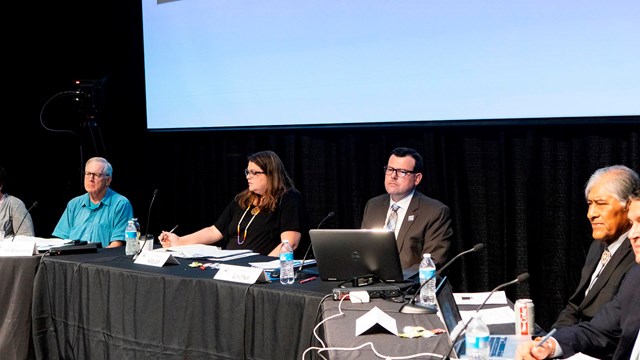
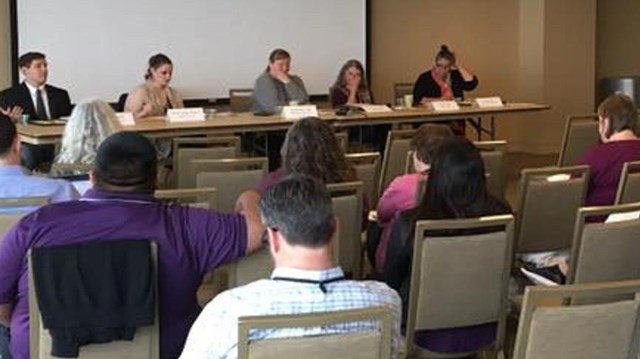
The fourth meeting of the Native American Graves Protection and
Repatriation Review Committee was called to order by Chairperson
Tessie Naranjo at 8:45 a.m., Friday, February 26, 1993, at the
Atherton Halau, Bernice Pauahi Bishop Museum, Honolulu, Oahu,
Hawaii. Saturday and Sunday, February 27 and 28, 1993, the
Review Committee met at the Turtle Bay Hilton Hotel, Oahu,
Hawaii. The following Review Committee members, staff, and
others were in attendance:
Members of the Review Committee:
Ms. Tessie Naranjo, Chair
Ms. Rachel Craig
Dr. Jonathan Haas
Mr. Dan Monroe
Dr. Martin E. Sullivan
Mr. William Tallbull
Dr. Phillip L. Walker
National Park Service staff present:
Dr. Francis P. McManamon, Departmental Consulting
Archeologist, Washington, D.C.
Dr. C. Timothy McKeown, NAGPRA Program Leader, Washington,
D.C.
Mr. Hugh (Sam) Ball, Archeologist, Washington, D.C.
Ms. Mella Lane-Hamasaki, Pacific Area Office
Mr. Earl (Buddy) Neller, Kalaupapa National Historic Site
Dr. Patricia Parker, Coordinator for Tribal Preservation
Programs, Washington, D.C.
Dr. Gary Somers, Pacific Area Office
The following were in attendance during some or all of the
proceedings:
Ms. Melinida Allen, Bishop Museum
Ms. Kalaniana`ole `Apuakehau, Hui M lama I N K puna `O
Hawai`i Nei
Ms. Lisa Armstrong, Research Assistant, Bishop Museum
Mr. Edward Halealoha Ayau, Hui M lama I N K puna `O Hawai`i
Nei and Historic Preservation Division
Mr. Manu Boyd, Cultural Specialist, Office of Hawaiian
Affairs
Ms. Esther Iwalani Campbell, Ha Kekili
Ms. Hinano K. Campton, Daughters of the First People and
Central Coast Indigenous Council of California
__________________________________________
NAGPRA REVIEW COMMITTEE:
2/26 - 28/93 MINUTES: page 1
Dr. Sara Collins, Consulting Physical Anthropologist, Bishop
Museum
Mr. David Cox, Board Member
Ms. Michelle Douglas, Graduate Student
Dr. Donald Duckworth, Bishop Museum
Ms. Deborah Dunn, Student
Ms. Kauwamakani Ellis, Hui M lama I N K puna `O Hawai`i Nei
Ms. Linda Fabri, University of California, Berkeley
Ms. Stephanie Lei Fitzpatrick, Mission House Museum
Ms. Ulunui Kanakaole Gormon, Hui M lama I N K puna `O
Hawai`i Nei
Ms. Annie Griffin, State Historic Preservation Office
Dr. Bion Griffin, University of Hawaii
Mr. Kaiana Haili, Hui M lama I N K puna `O Hawai`i Nei
Ms. Toni Han, Cultural Resource Specialist, Anthropology,
Bishop Museum
Ms. Dana Kananiokilohana Higa, Hui M lama I N K puna `O
Hawai`i Nei
Ms. Susan Hirano, University of California, Berkeley
Ms. Lindas Hoe, Bishop Museum Conservation
Ms. Rebecca J. Hommon, US Navy
Dr. Robert J. Hommon, US Navy
Ms. Elaine Jourdane, Collections Manager, Bishop Museum
Ms. Rhonda Kaivai, Historical Researcher
Mr. Edward Kanahele, Hui M lama I N K puna `O Hawai`i Nei
Ms. Keala Kekina, Hui M lama I N K puna `O Hawai`i Nei
Mr. Glen Kila, Koa Mana
Ms. Nancy King, Bishop Museum
Ms. Lynn Lee, Office of Hawaiian Affairs
Mr. Puna Lerma, Hui M lama I N K puna `O Hawai`i Nei
Mr. Ahi Logan Kekuamanoha, a Senior Member of the Pilikana O
Na Koolauloa
Mr. Bulla Logan, Pilikana O Na Koolauloa
Ms. Leimomi Mookini Lum (Alexis Carva), Mookini Foundation
Ms. Kealakekina Maikai
Mr. Alohawaina Makanani, Hui M lama I N K puna `O Hawai`i
Nei and Ka Lahui Hawai`i and Protect Kahoolawe Ohana
Ms. Malia Makanani, Hui M lama I N K puna `O Hawai`i Nei
Ms. Adrienne Makanani, Hui M lama I N K puna `O Hawai`i Nei
Ms. Joan A. Marks, US Representative
Ms. Holly McEldowney, State Preservation Division
Mr. Rudy Leikaimana Mitchell, Waimea Falls Park
Ms. Gail M. Murakami, Bishop Museum
Mr. Nathan Napoka, Branch Chief for Culture and History,
State Historic Preservation Office
Ms. Janet Ness, Bishop Museum
Ms. Leianuenue Niheu, Hui M lama I N K puna `O Hawai`i Nei
Ms. Ipo Nihipali, Hui M lama I N K puna `O Hawai`i Nei
Mr. K nani Nihipali, Hui M lama I N K puna `O Hawai`i Nei
__________________________________________
NAGPRA REVIEW COMMITTEE:
2/26 - 28/93 MINUTES: page 2
Ms. Nohealani Nihipali, Hui M lama I N K puna `O Hawai`i
Nei
Ms. Kathleen Oshiro, State Historic Preservation Officer
Ms. Lei Parker, private citizen
Ms. Pikake Pelikai, Office of Hawaiian Affairs
Ms. Wendy Reeve, Bishop Museum
Dr. Roger Rose, Bishop Museum
Ms. Laura C. Schuster, Kaloko Honokohau N.H.P.
Mr. Alika Silva, Koa Mana
Mr. H. Kaulana T. Smith, Hui M lama I N K puna `O Hawai`i
Nei
Mr. Mike Smith, Assistant Chancellor at University of
California, Berkeley
Ms. Melelani Spenceer, Hui M lama I N K puna `O Hawai`i Nei
Ms. Angela Steiner-Horton, Bishop Museum
Ms. Ululani Suiso, Mookini Ulkini Foundation
Mr. Keith B. Sunderlin, Private Citizen
Dr. Elizabeth Tatar, Bishop Museum
Ms. Kealohikina Tsukayama, Hui M lama I N K puna `O Hawai`i
Nei
Ms. Debra Ward, Office of Hawaiian Affairs
Mr. George Wheels, US Marine Corps
Dr. Tim White, Professor of Anthropology, University of
California, Berkeley
Mr. Alan Ziegler, Independent Zoological Consultant
Chairperson Tessie Naranjo thanked the Hawaiian people for
inviting the Committee to meet in such a lovely place and called
on Mr. Manu Boyd of the Office of Hawaiian Affairs to give an
invocation. Mr. Boyd sang two mele, or welcoming chants, after
which members of the Office of Hawaiian Affairs presented the
Committee members with leis while more mele were sung.
Chairperson Naranjo then asked Committee members and other
officials at the table to introduce themselves.
Dr. McManamon thanked the Bishop Museum, the Office of Hawaiian
Affairs, Hui M lama I N K puna `O Hawai`i Nei, the P.A. Hearst
Museum of Anthropology, and the Pacific Area Office of the
National Park Service for their help in organizing and
publicizing the meeting. Dr. McManamon noted that the meeting
had been advertised in the Federal Register as well as in Ka Wai
Ola O OHA, the monthly newspaper of the Office of Hawaiian
Affairs, and was open to the public. He requested that all
people who wished to make statements to the Committee sign up
in
advance.
Review of the Agenda
__________________________________________
NAGPRA REVIEW COMMITTEE:
2/26 - 28/93 MINUTES: page 3
Chairperson Naranjo reviewed the meeting agenda. Three items
dominated the agenda: 1) the formal hearing of the dispute
between the P.A. Hearst Museum at the University of California,
Berkeley and Hui M lama I N K puna `O Hawai`i Nei; 2) an open
discussion by members of the public concerning implementation
of
NAGPRA in Hawaii; and 3) review of a draft of the Committee's
Report to Congress. In addition, the Bishop Museum had requested
time to make a formal presentation to the Committee regarding
their efforts to inventory Hawaiian human remains from various
archeological excavations in the vicinity of Mokapu, Oahu.
Dispute Hearing
Dr. McManamon reviewed the history of the Committee and its role
in the dispute resolution process. Chairperson Naranjo outlined
the Committee's procedures for dealing with disputes. "Most
importantly," she stressed, "we want for all of us to
talk to
each other." For this reason, representatives of the two
organizations were asked to sit at the table with the Committee.
The P.A. Hearst Museum was represented by Dr. Timothy White and
Mr. Mike Smith. Hui M lama I N K puna O Hawai i Nei was
represented by Mr. K nani Nihipali, Mr. Edward Ayau, Mr. Edward
Kanahele, and Ms. Ulunui Kanakaole Gormon.
The two groups were allowed to make brief opening statements
after which the Committee members asked questions. Dr. Sullivan
stated he understood that neither party was opposed to
repatriation in general, nor was there a question of the
appropriateness of the organization requesting repatriation.
Thus, he said, the dispute appeared to revolve around the
determination of cultural affiliation. He asked each party to
explain its plans for custody of the remains. Dr. White
responded for the Hearst Museum explaining that the osteological
collections at the museum are used for continuing education and
research. The museum's collection is an important resource for
researchers from around the world because it contains such a
diverse and large number of skeletal remains from modern humans.
Mr. Edward Kanahele responded that Hui M lama I N K puna O
Hawai i Nei intended to rebury the remains in order to return
the
bones to the earth and to right spiritual and moral wrongs.
According to Mr. Kanahele, reburial strengthens the connection
between present day people and the ancestors by allowing the
spiritual power, the mana, of the ancestral bones to flow back
to
the earth.
Mr. Monroe questioned the Hearst representatives regarding their
specific interest in the particular remains in question. Mr.
Smith responded that the Hearst was concerned about certain
ambiguities in the law and did not want to violate the museum's
mission by deaccessioning materials held in the public trust.
__________________________________________
NAGPRA REVIEW COMMITTEE:
2/26 - 28/93 MINUTES: page 4
The museum felt that these particular skeletal remains were
unidentifiable ethnically and, consequently, did not believe they
should be repatriated to a Native Hawaiian organization. Dr.
White stated that the remains were important as a part of the
University's osteological collection. It was not so much that
these specific remains could answer a particular research
question, he continued, but rather that the collection is
important as a whole. He emphasized the need to keep the
collection because research tools are constantly improving and
thus important questions might be answered at a later date. He
added that absolutely no research had been performed on Native
Hawaiian skeletal remains. All human remains in the museum's
possession that had been identified as being culturally
affiliated to Native Hawaiians had previously been repatriated.
Mr. Ayau responded that Hui M lama I N K puna O Hawai i Nei
viewed their ancestors' remains not as osteological resources
or
archeological material but as people. He went on to question the
right of a museum to collect someone's remains without the
consent of their descendants.
Dr. Haas asked if there might be any spiritual consequences if
non-Hawaiian remains were buried with Hawaiian ceremonies in a
Hawaiian burial place. Mr. Kanahele explained the Hawaiian
belief that the spiritual strength, or mana, in one's bones can
be taken away by evil or negative thoughts. Thus, bones need to
be protected so that the mana can flow back into the Earth. The
Earth will then reciprocate and help the living people. "We
see
this spiritual force as something that benefits everyone."
Mr.
Ayau added, "even if these remains are not of our people,
we
would be paying them that equal respect."
Dr. McManamon clarified that there was nothing in the statute
that prohibited scientific research involving Native American
human remains except as an excuse to delay or refuse
repatriation. He also explained that one of the important
aspects of NAGPRA concerned the right of modern Indian tribes
and
Native Hawaiians to determine the future treatment of culturally
affiliated remains.
Mr. Tallbull recounted his experience reburying the remains of
a
man who had lived 1500 years ago. He emphasized the
communication he felt with the man's spirit and the connection
"to the spirit of the Earth, to the spirit of plant life,
and the
spirit of animal life." He explained that the laws we have
in
this country do not always mention the spiritual connection.
Mr. Monroe thanked both sides for acting with diligence and
integrity in supporting their firm convictions. He asked each
party if they saw any way of resolving the conflict between their
respective duties -- the museum's to preserve the integrity of
__________________________________________
NAGPRA REVIEW COMMITTEE:
2/26 - 28/93 MINUTES: page 5
the collection and insure repatriation to the correct group and
the Hui M lama I N K puna O Hawai i Nei's to rebury the bones
of their ancestors. Mr. Ayau responded that NAGPRA "fails
to
recognize the legitimacy of spirituality." He related the
feelings he and his wife received from the bones in question
during a visit to the Hearst Museum. He stated that because the
statute does not address spirituality directly, a conflict arises
between science, with measurement standards, and spirituality,
which must be felt.
Dr. Walker asked why the museum had been unable to reach a
conclusion regarding the ethnicity of the skeletons in question.
Dr. White related the history of the research which had been
conducted by the museum. The records for the first set of
remains stated they had come from the beach at Waimanalo, Oahu,
in the 1800s. Dr. White agreed that there had been, and still
are, Native Hawaiian burial grounds on Waimanalo but added that
there are also non-Hawaiian cemeteries in the area. The added
that the museum records were not specific as to where on
Waimanalo Beach the remains had been found, or even if the
remains had been buried. Without that contextual evidence he
contended that the remains could have come from shipwreck
victims, drowning victims, or forensic cases. He explained that
the bones showed weathering, indicating exposure to the sun, and
were thus probably not from a burial.
Dr. White continued that records for the second set of remains
indicated only that they had come from the Hawaiian Islands. The
curator who originally determined that the remains were
Polynesian had no experience in skeletal biology and, according
to Dr. White, was thus not a reliable source. The biological
characteristics of both sets of remains were not sufficient "to
provide definitive evidence of cultural affiliation."
Mr. Ayau expressed his belief that the Native Hawaiian
organizations had provided evidence, including archeological and
osteological reports, that proved it "is more probable than
not
that these are our ancestors." He added that the museums'
records for the second set of remains contained a determination
that they were "Polynesian." He felt the museum was
attempting
to hold the Committee to a higher, scientific standard of proof
which is not necessary under NAGPRA. "The feelings that we
had
[in the presence of the bones at the museum] . . . that these
are
our people [and] that, to us, is the overriding evidence that
they need to come home." Mr. Ayau concluded that repatriation
would be a win-win situation because the museum would be
following the provisions of the statute, and in doing so, protect
the integrity of its collection, while the spiritual needs of
the
Native Hawaiians would be met.
__________________________________________
NAGPRA REVIEW COMMITTEE:
2/26 - 28/93 MINUTES: page 6
Dr. Haas asked if the remains had been examined by Dr. Patrick
Kirch, a Hawaiian archeological expert at the University of
California at Berkeley. Dr. White responded that Dr. Kirch had
examined the remains, but that he had not been requested to give
the odds of finding remains that were anything other than Native
Hawaiian on Waimanalo Beach in the early 1880s.
Mr. Monroe asked if Hui M lama I N K puna O Hawai i Nei would
permit destructive testing in order to determine the cultural
affiliation of the remains. They replied no.
Mr. Ayau and Mr. Smith summarized the points of Hui M lama I N
K puna `O Hawai`i Nei and the P.A. Hearst Museum at University
of
California at Berkeley, respectively.
Public Comment on the Dispute
The Committee then heard comments from the public concerning the
dispute. Mr. Alan Ziegler, an independent zoological consultant,
spoke about the difficulties discerning cultural relationships
between human remains and contemporary people on Hawaii because
of the mixture of different cultures, ancient and modern. He
suggested the regulations currently being developed should
provide a definite method of determining the cultural affiliation
of human remains, including the possible use of destructive
analysis. Mr. Ziegler approved of the purpose of the Review
Committee to meet and talk out conflicts. He also pointed out
that the regulations do not cover disposition of remains and
suggested records be kept of exactly what happens to human
remains after they are repatriated because if the remains are
reburied secretly they may be disturbed in later years and know
one will know what they are or how they got there. Mr. Ziegler
also spoke against Hui M lama I N K puna O Hawai i Nei's policy
of secret reburial of all remains found in Hawaii. He felt this
policy "suppresses information" that would be of value
to Native
Hawaiians. He did not want the evidence of Hawaiian cultural
history destroyed for people of the future.
Ms. Lynn Lee of the Office of Hawaiian Affairs spoke on behalf
of
Richard Paglinawan, Administrator of the Office of Hawaiian
Affairs, and Ms. Lydia Namahana Maioho, Chairman of Hawaiian
Historic Preservation Council, in support of Hui M lama I N
K puna O Hawai i Nei's
request for the return of human remains from the Hearst Museum.
She identified a central question around which the current
dispute revolved: whether the remains were Hawaiian. In her
opinion, a preponderance of the evidence -- the remains were
found in a place of traditional Hawaiian burials and buried in
a
traditional Hawaiian manner -- supported the identification as
Native Hawaiian. The museum, on the other hand, had not
__________________________________________
NAGPRA REVIEW COMMITTEE:
2/26 - 28/93 MINUTES: page 7
presented any facts to indicate that the bones were not Hawaiian.
She believed the museum was "holding the remains hostage"
while
arguing over "the letter of the law."
Ms. Lei Parker spoke in Hawaiian and Mr. Boyd translated. Ms.
Parker stated that the bones of the ancestors are precious to
Hawaiians. They must be returned to the earth after death so
that the mana will be "increased and inspired." The
fact that
the representatives of Hui M lama I N K puna O Hawai i Nei had
felt the present of their ancestors in the human remains held
at
Berkeley obligated them to manage those remains. The museum
would "spiritually enslave" the Hawaiian people if they
continued
to keep the bones.
Review Committee Discussion of the Dispute
After the public comment period the Review Committee discussed
the dispute among themselves. Mr. Monroe stated everyone
understood that no one can own human remains, "they can at
best
be in someone's stewardship." He concluded that the question
before the Committee was "which is the most appropriate party
to
maintain such stewardship for the remains in question." It
was
clear to him that both physical anthropological evidence and
"evidence of spirituality" must be considered. He indicated
that
the Hearst Museum had asked the Committee to determine what
constitutes a "preponderance of the evidence." Mr. Monroe
responded by reiterating the points which had been made during
the presentations: (1) the beach where the remains were found
at
Waimanalo was traditionally a Hawaiian burial ground; (2) the
remains were found in 1887 and at that time the majority of dead
buried at the beach would have been Native Hawaiians; and (3)
no
determination of cultural affiliation could be reached based on
physical anthropological evidence. He concluded that in his
opinion the preponderance of the evidence pointed to the
conclusion that the Waimanalo remains are Native Hawaiian and
he
proposed a recommendation that the Hearst Museum return the
remains to Hui M lama I N K puna O Hawai i Nei.
Dr. Haas spoke concerning the second set of remains. He
personally was not swayed one way or the other regarding the
cultural affiliation of these human remains. However, he
believed that the general consensus among the Committee was that
these remains were Hawaiian and that Hawaiian remains should come
back to Hawaii. Dr. Haas suggested that the Hearst Museum
transfer the second set of remains to the Bishop Museum in
Hawaii. Thus, these human remains, which everyone agreed were
originally from Hawaii, would come back home. This solution
would allow other ethnic groups living in Hawaii, such as members
of the Chinese and Japanese communities, to have a voice in the
decision about the disposition of these human remains. Dr.
__________________________________________
NAGPRA REVIEW COMMITTEE:
2/26 - 28/93 MINUTES: page 8
Sullivan agreed, although he indicated he would also support a
recommendation to return the remains to Hui M lama I N K puna
O
Hawai i Nei for reburial.
Mr. Tallbull stated that he would need to "go to the spirits
...
for guidance on what he should do" before making his decision.
"That's the only place I can turn to satisfy the spirits
of this
island," he said. Until that time, he reserved judgement.
Dr. Walker described the Committee's difficulty in putting aside
their personal feelings in order to try to follow the intent of
the statute. The Committee was working together "like a family"
to work within both the letter and the spirit of the law. He
agreed with Dr. Sullivan's previous statement that the
preponderance of the evidence supported the contention that the
Waimanalo remains are culturally affiliated with Native Hawaiians
and, thus, should be repatriated. He also agreed with Dr. Haas's
solution with regard to the second set of remains in that it
encouraged the sort of communication between the scientific
community and Native peoples intended by NAGPRA.
Chairperson Naranjo explained that her comments were rooted in
the Pueblo philosophy of balance. She felt that both sets of
human remains should be repatriated. She questioned why the
museum would wish to keep fragments of human bone that it had
agreed were of no scientific interest. She felt the second set
of remains should be repatriated to remove the imbalance created
when "any [human] remain has not been returned to their
homeland." According to Ms. Naranjo, the return of these
bone
fragments would "give balance to the Hawaiian cosmology."
Mr. Monroe reminded the museum community as a whole that the
consultation and repatriation process is an opportunity for them
to "provide leadership in our nation for increasing our
appreciation of cultural diversity, our appreciation of the
richness of the human spirit and its manifestations." In
the
spirit of the law, he asked the Hearst Museum to give a little,
and recognize that there is "a genuine and a deep-felt spiritual
concern, for the return of those particular remains."
Ms. Craig began her recommendation by thanking the people of
Hawaii for their hospitality. She then advised the
representatives of the Hearst museum to look more closely at what
they are doing and "work closely with the Native people and
learn
more ... of what's really important." She was particularly
concerned with the effect continued curation of these remains
might have on the "progress that a person makes in the spirit
world." She explained that "there is really no rest
for that
spirit whose bones are not interred in the ground." She agreed
that both sets of human remains should come back to Hawaii,
__________________________________________
NAGPRA REVIEW COMMITTEE:
2/26 - 28/93 MINUTES: page 9
although she left it to the Hearst Museum to decide whether the
second set of remains should be transferred to the Bishop Museum
or repatriated to the Hawaiian people.
Ms. Lei Parker spoke again from the audience. She apologized for
her earlier comments which might have been taken by the Committee
as insults. She asked the Committee to remember compassion even
as they deal with people who lack compassion.
Discussion of Draft Findings
The Committee agreed to issue separate findings for each of the
two sets of human remains under dispute. Mr. Monroe recommended
that the findings clearly state the types of evidence which the
Committee considered important for the determination of cultural
affiliation: physical anthropological information and contextual
information. Since the physical anthropological information was
inconclusive with regard to the two sets of remains in question,
the findings should clearly explain the contextual information
upon which the Committee based its decisions.
Dr. Haas pointed out that the statute explicitly recognized a
wide variety of types of evidence that could be considered in
determining the cultural affiliation of human remains and
cultural items, including "other expert opinion." He
recommended
the spiritual evidence that had been presented by Hui M lama I
N
K puna `O Hawai`i Nei be explicitly mentioned as "other expert
opinion."
Dr. McManamon distributed drafts of the two findings to the
Committee members and asked that they review them carefully as
several opinions had been expressed during the course of the
hearing.
Regarding the finding on the second set of human remains, Dr.
Haas offered an additional section that noted the Committee had
taken into account the original curator's lack of physical
anthropological qualifications. Mr. Monroe disagreed, saying
that the museum had been inconsistent in evaluating
qualifications. The curator who identified the second set of
human remains as Polynesian was considered unqualified, yet
identification of previously repatriated remains was based solely
on the donor's statement of its ethnicity.
Dr. McManamon also cautioned the Committee about recommending
repatriation of the second set of remains if they were not able
to find the remains to be culturally affiliated to Native
Hawaiians. Such a recommendation would, in effect, circumvent
the language of the law. Dr. Sullivan responded that nothing in
the law precluded a museum from voluntarily repatriating
__________________________________________
NAGPRA REVIEW COMMITTEE:
2/26 - 28/93 MINUTES: page 10
culturally unaffiliated remains. Dr. McManamon agreed, but
commented that the Committee had spent a lot of time working on
the proposed regulations which were about to be published. It
would probably not be a good idea to ignore those regulations
when making the first finding.
Dr. Haas expressed his concern that the findings might
inadvertently convey the message to museums that spiritual
evidence by itself was adequate to determine the cultural
affiliation of human remains and cultural items. The Committee
had agreed that the contextual and physical anthropological
evidence was inconclusive for determining the cultural
affiliation of the second set of remains; thus, the spiritual
evidence could be seen as the deciding factor. "I think that
a
big part of the responsibility of this committee," Dr. Haas
continued, "is to figure out how to make this legislation
work.
If we present this as our starting case, I think we are going
to
create tremendous discontent in [the museum] community."
He was
concerned that the dispute might end up in the California courts
and would start the repatriation process off on an adversarial
note.
Mr. Monroe agreed, stating it was imperative that the findings
be
explicit. "We're willing to make decisions on the basis of
contextual evidence alone," he continued, "and I doubt
if we
would have any problem making decisions on the basis of
osteological evidence alone, if it were clear. However, we're
having a problem making decisions on the basis of spiritual
evidence alone."
Dr. McManamon cautioned the Committee not to overstep its
authority by recommending repatriation of culturally unaffiliated
remains. If remains are unaffiliated, he explained, there is a
possibility that they are not Native American at all. He pointed
out that the draft finding for the second set of remains provided
a compromise by suggesting the remains be transferred to a museum
in Hawaii for future care.
Mr. Monroe suggested the Committee recommend, rather than making
a finding, that the second set of remains be transferred to a
Hawaiian museum. This approach would follow both the letter and
the spirit of the law.
Dr. Walker suggested the Committee issue a finding which
recommended that the second set of remains be transferred to the
Bishop Museum, in Hawaii. The Bishop Museum, in consultation
with Hui M lama I N K puna O Hawai i Nei and the Office of
Hawaiian Affairs, would be able to supply the anthropological
and
__________________________________________
NAGPRA REVIEW COMMITTEE:
2/26 - 28/93 MINUTES: page 11
spiritual expertise necessary to eliminate the possibility of
European ethnicity.
Dr. Haas responded that the broader issue was who should have
a
voice in determining what happens with remains where the
contextual and osteological evidence is ambiguous, as it is with
this case. He recognized the need to turn to spiritual leaders
in such cases.
Mr. Monroe agreed that the issue before the Committee was one
of
stewardship. "We are seeking a resolution that enables us
within
the context of the law and in terms of precedent, to urge the
museum to do the right thing. The right thing is to return
[these remains] to Hawaii."
Dr. McManamon summarized his understanding of the Committee's
decision: (1) the draft of the finding concerning the first set
of remains should be finalized as amended; (2) the draft of the
finding concerning the second set of remains should be redrafted
to indicate that while some Committee members felt the evidence
for Hawaiian cultural affiliation was inconclusive, all of the
members agreed that these remains should be deaccessioned and
transferred to a museum in Hawaii.
Presentation on the Bishop Museum's Inventory of Human Remains
Dr. Elizabeth Tatar, Chair of the Anthropology Department at the
Bishop Museum, provided a general introduction to the museum's
efforts to complete an inventory of the human remains in their
possession. She then introduced some of the people involved in
the project: Toni Han, Project Director; Elaine Jourdane, Co-
Director; and Dr. Sara Collins, Consulting Physical
Anthropologist. The project consists of three parts: (1)
documentary research and verification for each set of human
remains and associated objects; (2) inventory preparation; and
(3) preparation of a summary of all archeological and physical
anthropological research conducted on the collection along with
a
report relating the relevance of the research to "the
understanding of Hawaiian history and health of the Native
Hawaiian people, past, present, and future." The majority
of the
remains in the collection had been recovered from four major
excavations at Mokapu on the island of Oahu. The project is
supported by the US Navy and the Marine Corps and assistance has
been provided by Dr. Rob Hommon, US Army archeologist with the
US
Marine Corps.
__________________________________________
NAGPRA REVIEW COMMITTEE:
2/26 - 28/93 MINUTES: page 12
Ms. Toni Han provided a brief geological overview of the area
and
a summary of its history. Mr. Tallbull asked if the staff had
consulted with local religious leaders to map the spiritual
environment of the project area. Ms. Han responded that
consultation had not been initiated, although the museum had met
with representatives of Hui M lama I N K puna O Hawai i Nei and
the Office of Hawaiian Affairs to discuss the project. Three
areas of concern had been expressed at the meetings: (1)
photography of the skeletal remains; (2) access to documents and
reports related to human remains; and (3) the thoroughness of
the inventory research. The museum staff felt photographs were
necessary to document any human remains or cultural items that
would be repatriated. However, Ms. Han explained, the
photographs would remain in the Museum archives as negatives and
they would not be published. The Museum is still assessing the
question of document access. Ms. Han felt one of the benefits
the project provided was "a sense of continuity in linking
the
past with the concerns of the present day Hawaiians, in terms
of
giving them a better feel of who these people are that are buried
at Mokapu."
Ms. Lisa Armstrong, Project Research Assistant, reported the
types of information collected during the course of the project
including: osteology catalog, accession files, annual reports
of
the director, researcher data, past inventories, dug materials
and photographs, informants' statements, etc. She also explained
briefly about the data base used in the project.
Dr. Sara Collins, Consulting Physical Anthropologist for the
project, explained her role in the project as ascertaining the
completeness of remains for every accession; determining
ethnicity of remains where possible; determining remains' age
and
sex; and, determining any pathologies. Much of her work was
necessary to check the accuracy of the accession/catalog records
and make sure the remains examined were the same as the remains
described. Dr. Collins added that the Mokapu remains have
provided most of what is known about Hawaiian skeletal biology
and have been studied by many people.
Mr. Tallbull commented on the museums' need to know what they
had
and to know how to handle the powerful objects in their
collections. "There have been times when my people were actually
afraid to go to the museum to see a collection of their items
--
not knowing that this museum had medicine bundles stored in the
basement, that's one of the no-no's at home is that you don't
walk over the top of those . . . . That's the danger that we find
in museums, when people have no idea of what they have."
Public Comment Regarding NAGPRA Implementation in Hawaii
__________________________________________
NAGPRA REVIEW COMMITTEE:
2/26 - 28/93 MINUTES: page 13
The Committee specifically asked members of the public to comment
on issues concerning the implementation of NAGPRA in Hawaii.
Drs. Sullivan and Walker expressed their concern that the
notification process for the Review Committee meeting had not
reached all Hawaiian groups that might have legitimate claims
under the statute. Mr. Earl Neller of the National Park Service
replied that he thought most of the groups he was acquainted
with, with the exception of the Hawaiian Studies Department at
the University of Hawaii, had been notified. He added that in
such situations it was always difficult to please all the
different groups in Hawaii. Ms. Keala Kekina, a member of Hui
M lama I N K puna O Hawai i Nei, believed the attendance at the
meeting was skewed to a particular minority since many people
from the outer islands were not notified and thus did not attend.
Mr. Nathan Napoka of the State Historic Preservation Division
agreed that notification was difficult because historically,
Hawaiians have settled into diversified groups with decentralized
governments. He identified Hui M lama I N K puna O Hawai i Nei
as the only Native Hawaiian group which has come forward on the
national level to take responsibility for repatriating Native
Hawaiian remains.
Dr. Walker asked Mr. Napoka whether, in his opinion, other groups
would begin to speak up as significant sacred objects and objects
of cultural patrimony were returned to the islands in the care
of
Hui M lama I N K puna O Hawai i Nei. Mr. Napoka recommended
that the Committee ask someone with Hawaiian ethnographic
expertise to advise them about repatriation of Hawaiian sacred
objects and objects of cultural patrimony and also to inform them
of traditional Hawaiian beliefs and dissenting Hawaiian
viewpoints.
Dr. Sullivan asked members of the public to contribute their
ideas concerning which Hawaiian organizations should be contacted
with regard to Native Hawaiian human remains and cultural items.
Mr. Napoka recommended that notifications be sent to the 55-
member Burial Council established under the state burial law.
He
explained that the council is made up of commissioners who
represent each geographic area of the islands. The commissioners
are community based and, as such, are able to effectively solicit
and disseminate information. He volunteered to provide the
Committee with a mailing list of Burial Council members.
Mr. Ayau suggested placing notices in newspapers with statewide
circulation as well as in the Office of Hawaiian Affairs'
newspaper: Ka Wai Ola O OHA.
Ms. Kekina requested the notification of as many groups as
possible, particularly the colleges and universities since it
is
__________________________________________
NAGPRA REVIEW COMMITTEE:
2/26 - 28/93 MINUTES: page 14
easier for people on each island to contact their local colleges
than to wait for information from other organizations. She also
asked that Hui M lama I N K puna O Hawai i Nei and the Office
of Hawaiian Affairs set up toll-free numbers so that people from
the outer islands would not have to pay long-distance charges
to
get information.
Ms. Lynn Lee, Office of Hawaiian Affairs, agreed that
notification of the Hawaiian Studies Departments at each State
University and community college would be a good way to contact
the many Native Hawaiians on the outer islands.
Mr. K nani Nihipali offered the services of Hui Na`auao, a
community education program dealing with issues related to
sovereignty and self-determination, as a means for notifying
Native Hawaiian groups.
Mr. Earl Neller, National Park Service, defended archeologists
against complaints that they "don't say prayers or have spiritual
feelings." He remarked that the Bishop Museum should be
considered as both a Hawaiian organization and as a community
organization. Mr. Neller felt the scientific research conducted
by the museum and other archeologists in the state should be
considered as part of the Hawaiian effort to keep the world in
balance.
Mr. Alohawaina Makanani, a member of Hui M lama I N K puna O
Hawai i Nei, spoke regarding sacred objects. Mr. Makanani wanted
people to be able to get sacred objects repatriated or, at least,
to get descriptive information relating to these objects so that
they could be reproduced for family or personal use. He thought
any individual or organization who had applied to a museum for
permission to view or study a sacred Hawaiian object should be
notified of its possible repatriation. In response to a question
from Dr. McManamon, Mr. Ayau stated that Hui M lama I N K puna
O Hawai i Nei was primarily concerned with the return of their
ancestors' bones.
Mr. Nihipali asked about the possibility of Federal funds to help
finance education and the communication process between Hawaiian
groups. Dr. Haas explained that he would be appearing before the
Senate Appropriations Committee to speak in support of funding
for grants to museums and Native American peoples to assist them
in complying with the statute. He felt that much of the money
allocated to museums should go towards ethnographic
identification procedures while the money allocated to Native
Americans, including Native Hawaiian organizations, would be
targeted to fund visits to museums to identify sacred objects
and
objects of cultural patrimony.
__________________________________________
NAGPRA REVIEW COMMITTEE:
2/26 - 28/93 MINUTES: page 15
Mr. Tallbull identified lack of money as the primary problem
facing all Indian tribes and Native Hawaiian organizations. "We
don't have the means to go to the museums [to] reconnect
ourselves with some of the artifacts that have been taken."
As
an example, he described how the Northern Cheyenne have been
trying to locate a mass grave dug by the Army that contained the
remains of approximately 64 Cheyenne. The Army had not been
helpful, so the tribe hired a researcher to review Army records.
The tribe has since received information that the bodies were
loaded on a train and sent by the Army to one medical school in
Pennsylvania and another in Canada. "We're in a bad situation
where, because of lack of money, we can't even go after those
skulls [6 skulls which were located at the Peabody Museum and
identified as originating with the mass grave in question] and
bring them home."
Mr. Ayau requested clarification from the Committee regarding
the
issue of scientific studies of human remains during the inventory
process. Chairperson Naranjo responded that the Santa Clara
Pueblo beliefs about bodies are different from what other people,
including Hawaiin people, feel. "We're most interested in
the
spirit," she said, "and not interested in what contains
a
spirit." Other tribes feel differently. "We've got a
multi-
cultural situation here," she continued, "with over
800 tribes.
Every tribe will have a different opinion on scientific studies."
Mr. Ayau insisted that any scientific study should be a last
remedy, after assessing existing documentation and contextual
information, and that it should only be done after consultation
with the Native American people involved. Dr. Haas agreed that
scientific analysis should be done after consultation but, he
said from his experience, such analysis was often very helpful
to
both museums and tribes. He cited one example in which
scientific analysis of the remains helped identify one individual
from a larger group who was not culturally affiliated with the
particular tribe that had asked for the repatriation of the
remains. The tribe concluded repatriation of that one individual
would be dangerous because they were not of the proper culture.
The tribe did not want those remains back. Dr. Haas added that
while the statute did not actually prohibit scientific
examinations of human remains, he would certainly encourage the
museum community to consult before conducting scientific analysis
of Native American human remains.
Mr. Ayau described a similar case of consultation between Hui
M lama I N K puna O Hawai i Nei and the Peabody and Essex
Museum. The museum had two human skulls, one of which was
identified as Hawaiian and the other for which there was non-
conclusive information. Both skulls were returned to Hawaii and
__________________________________________
NAGPRA REVIEW COMMITTEE:
2/26 - 28/93 MINUTES: page 16
stored at the Bishop Museum while Dr. Collins examined the second
skull. She was also unable to conclusively confirm the ethnicity
of the second skull so it was returned to the Peabody and Essex
Museum. The Hawaiian skull was repatriated to Hui M lama I N
K puna O Hawai i Nei.
Dr. Collins commented on the benefits of scientific analysis of
skeletal remains from the perspective of her work as physical
anthropologist with the US Army Central Identification Lab. In
the forensic cases she examined for the Army she relied upon
three types of evidence: (1) biological evidence; (2)
circumstantial evidence; and (3) material evidence. Biological
evidence is the most conclusive type of evidence, but it was not
always possible to examine the skeletal parts which provide the
most clues. However, when poor biological evidence is combined
with circumstantial and material evidence, it is often possible
to reach a conclusion. She got a feeling of emotional
satisfaction when an identification could be made and a family
notified that a loved one was no longer "missing." She
understood that repatriation of Native American human remains
was
an equally emotional undertaking. However, she also felt the
need to do her job as well as she could and, while members of
Hui
M lama I N K puna O Hawai i Nei might find it "distasteful,"
biological evidence often proves to be the critical factor coming
to a right decision.
Mr. Ayau spoke of the need for an amendment to Hawaii's Historic
Preservation Act to integrate it with NAGPRA. Hawaii's Historic
Preservation Act deals with the treatment of human remains that
are currently in Hawaii, but does not deal with remains
repatriated from outside the state. On the other hand, NAGPRA
deals with repatriation of human remains but does not deal with
their reinterment. The amendment to state law proposed by the
Historic Preservation Division would require consultation with
the appropriate island burial council before any repatriated
remains are buried. This would help the Historic Preservation
Division, which is responsible for keeping the State inventory
on
burial sites, keep track of the reburial sites so that a
reinterment will not be disturbed.
Mr. Tallbull talked about the discovery, in the Sweet Grass Hills
area of northern Montana, of two abalone shell masks. After the
discovery there had been a meeting of the Montana tribes to try
and discover a connection between the masks and one or more
modern tribes. All of the tribes have different burial and
offering procedures, and one method of discerning a connection
would have been to excavate the area where the masks were found
and search for indications of how they had been laid out, but
none of the tribes wanted to disturb the area further. His point
being that even among themselves, Indian tribes have found it
__________________________________________
NAGPRA REVIEW COMMITTEE:
2/26 - 28/93 MINUTES: page 17
hard to come to a definitive conclusion as to how to attribute
cultural affiliation.
Mr. Alika Silva and Mr. Glen Kila, members of Koa Mana, a group
which takes care of the bones of the ancestors, or iwi,
recommended an examination of the area surrounding the burial,
as
well as of the materials found with human remains, as means of
determining ethnicity without analyzing the bones themselves.
Mr. Kila explained that Hawaiian families from different areas
have different customs with regard to burial. It is thus possible
for a Hawaiian to tell the familial affiliation of remains by
examining how it was buried. Mr. Kila reiterated that it made
him uncomfortable, as a Hawaiian, to think of the scientific
study of bones. The iwi are not just physical things, they are
spiritual. He suggested that the regulations should make it
explicit that Hawaiian customs take precedence over American
customs and that scientific examination of Hawaiian bones should
not be allowed.
Ms. Hinano Campton spoke of the need to listen to the ancestors
and care for them.
Ms. Kauwamakani Ellis expressed her appreciation of Ms. Craig,
Mr. Tallbull, and Chairperson Naranjo for sharing their feelings
regarding spirits and ancestors. She also explained the process
by which she and the other Hui M lama I N K puna O Hawai i Nei
representatives communicated with the kupunas at the Hearst
Museum.
Mr. Bulla Logan of Pilikana O Na Koolauloa expressed his concerns
that bones continue to be disturbed in spite of NAGPRA. He asked
if there was some way to shut down beach development in Hawaii,
as that is where all ancient Hawaiians were buried. Mr. Monroe
explained that the Committee did not have the power to enforce
the law; their role is purely advisory. He also explained that
the law requires consultation with Native American groups upon
the discovery of human remains. Mr. Logan stated he believed
developers would hide any remains found during excavation, not
notify Native Hawaiians, and continue to develop. Dr. Haas
clarified that NAGPRA refers to human remains discovered on
federal land or land held in trust by the US Government. It does
not cover development which takes place on private land.
Mr. Ayau explained the process by which a private landowner in
Hawaii would prepare to develop land. The permitting process is
done on the county level and the State Historic Preservation
Division reviews the requests. If the area in question is known
for other burials or historic property, the Division can request
a survey to determine what is on the property. In communities
where burial records have been kept it is relatively easy to
__________________________________________
NAGPRA REVIEW COMMITTEE:
2/26 - 28/93 MINUTES: page 18
determine if graves are on the property. Archeologists may have
to survey the property if the records have been lost. When
remains are discovered, a determination of ethnicity must be
made. If contextual evidence is sufficient to determine that the
remains are Hawaiian, the proper treatment of the remains is
decided by the burial council from that particular island. The
burial council decides if the burial should remain in place or
be
relocated. Any burials discovered after the survey fall under
the control of the Department of Land and Natural Resources. Mr.
Ayau admitted that the state law only works where the Division
knows what is going on. Unreported discoveries can be concealed.
Mr. Tallbull suggested that tribal ordinances be developed
concerning archeological and environmental protection so that
the
Native Hawaiians would not have to rely on state and Federal laws
to uphold their concerns.
Mr. Alohawaina Makanani of Protect Kahoolawe Ohana said his
organization had been working to address the problem of the
protection of burials since the 1970s. They encouraged Native
Hawaiians to train as amateur archeologists so that they would
be
able to work with museums and archeologists and provide a Native
Hawaiian perspective on sacred objects and human remains. The
burial councils have also identified "burial monitors,"
Native
Hawaiians who have been trained in basic archeological skills
and
the handling of human remains so that they can work with survey
archeologists as they uncovered remains and sacred objects. Mr.
Makanani had found, when he worked on projects, that any
discoveries which did not include bones were deemed insignificant
and development continued. One of his main concerns centered on
who should be entrusted to make the determination of what is
sacred. Chairperson Naranjo responded that the Committee had
devoted much of its time in previous meetings to exactly that
question. "It is very important for us on the Committee,"
she
said, "that those community people determine what is sacred."
Report to Congress
Dr. McManamon explained that the statute required the Committee
to submit an annual report to the Congress on the progress made
and any barriers encountered in implementing the statute during
the previous year. A report covering the Committee's first year
in existence had been drafted. The draft detailed the nomination
procedures and responsibilities of the Committee and provided
biographies of all the members, a discussion of staffing
considerations, a brief review of the three meetings held to
date, and the Chairperson's election. It also included a brief
description of the various items that the Committee had worked
on
__________________________________________
NAGPRA REVIEW COMMITTEE:
2/26 - 28/93 MINUTES: page 19
over the previous year, including the memorandum on summaries
and
inventories, the proposed regulations, the monitoring of
summaries and inventories, and the current dispute. The Report
also included a section entitled "Recommendations."
Dr. Sullivan wanted to make it clear to Congress that
repatriation was occurring and that museums and Native American
groups were consulting with one another. Mr. Monroe suggested
not dealing with any issues related to statutory language at the
present time. He also recommended that the report emphasize the
need for funds to enable museums and Native American groups to
implement the law. The Committee agreed to include Dr. Sullivan
and Mr. Monroe's comments and approved the draft report.
Future Activities
The Committee discussed the status of the grants program
authorized by the statute. Dr. Haas said he would be testifying
before Congress on behalf of a consortium of organizations
including the American Association of Museums and the Native
American Rights Fund. Mr. Monroe recommended that the Department
of the Interior be strongly urged to request at least $10 million
for the FY1994 budget for the grants program. Dr. Haas suggested
that this request be tied to a reference to repatriation efforts
to date and a clear statement of what will be done with the
funding after it is received. The Committee agreed that each
member should draft a letter outlining their recommendations to
Congress with regard to funding.
Dr. McManamon proposed that the Committee next meet after the
comment period for the proposed regulations ended and that the
meeting be devoted to preparing recommendations, based on the
comments received, for the final regulations. He also suggested
the Committee meet next in Washington, D.C. to give the people
in
the Clinton administration a chance to meet the Committee
members. The Committee agreed to tentatively plan for a meeting
in May in Washington, D.C.
Dr. Haas suggested that meetings devoted to resolving any
upcoming disputes be scheduled for a location near one or both
of
the disputants. This practice would send a message that the
Committee takes the dispute process very seriously.
Chairperson Naranjo brought up the idea of developing training
sessions for Native American communities so that they would be
more informed on NAGPRA. Dr. Sullivan reported that the American
Association of Museums was developing a variety of programs to
try and train museum people in the area of collections management
with respect to NAGPRA. He added that he would be meeting with
museum and Native peoples from North America to draft a document
__________________________________________
NAGPRA REVIEW COMMITTEE:
2/26 - 28/93 MINUTES: page 20
on the ethics of museum practices with regard to Native objects
and consultation with Native peoples.
Closing
Dr. McManamon, on behalf of the Park Service and the Department
of the Interior, thanked the Review Committee members for their
time and effort, especially when dealing with the hard issues
such as those at this meeting, and he thanked the members of the
public who participated throughout the meeting.
Mr. Tallbull expressed his appreciation to the people present
for
allowing him to come to this "powerful place" to meet
with the
people, and listen to their words. "One thing that we cannot
forget," he said, "no matter where we go or how far
we stray
away. The elders are no longer going to be there. But each one
of our children," he continued, "one by one, can go
out and
maintain [their] relationship. All the spirits are still there.
They haven't gone anywhere. All you have done is been
disconnected from them. Go back and reconnect yourself with it.
You do that."
The meeting was closed at 10:03 a.m. on Sunday, February 28,
1993.
Approved:
/s/Tessie Naranjo September, 22 1993
Tessie Naranjo, Chair Date
Native American Graves Protection
and Repatriation Committee