|
Native
American Graves Protection and
Repatriation
Review Committee
Meeting Minutes
Ninth Meeting
MINUTES
NATIVE AMERICAN GRAVES PROTECTION AND REPATRIATION
REVIEW COMMITTEE
NINTH MEETING: FEBRUARY 16-18, 1995
LOS ANGELES, CALIFORNIA
The
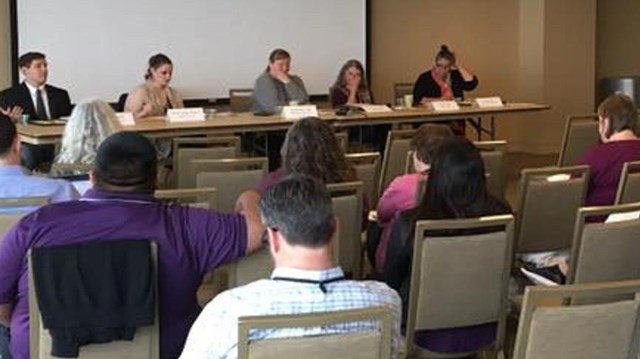
ninth meeting of the Native American Graves Protection and
Repatriation Review Committee was called to order by Ms. Tessie
Naranjo at 8:30 a.m., Thursday, February 16, 1995 at the Garden
Room A, Airport Marina Hotel, Los Angeles, California. The
following committee members, National Park Service staff, and
others were in attendance:
Members
of the committee:
Ms. Tessie Naranjo, Chair
Ms. Rachel Craig
Mr. Jonathan Haas
Mr. Dan Monroe
Mr. Martin E. Sullivan
Mr. William Tallbull
Mr. Phillip L. Walker
National
Park Service staff present:
Mr. Francis P. McManamon, Departmental Consulting
Archaeologist, Washington, DC
Mr. C. Timothy McKeown, NAGPRA Team Leader, Washington, DC
Mr. Sam Ball, NAGPRA Team, Washington, DC
The
following were in attendance during some or all of the
proceedings:
Ms. Glenda Ahhaizzy, American Indian Com., Hacienda Heights,
California
Mr. Martin Alcala, Gabrielino/Tongva Tribal Council, Venice,
California
Ms. Susan Alvarez, US Army, Fort Hunter Liggett, Jolan,
California
Mr. Roger Anyon, National Museum of Natural History,
Smithsonian Institute, Washington,
DC
Ms. Catherine Banker, California State University at Long
Beach, California
Mr. Richard M. Begay, Navajo Nation, Window Rock, Arizona
Ms. Angie Behrne, Gabrielino Tribal Council, Los Angeles,
California
Mr. Mike Burgess, Long Beach, California
Ms. Yolanda Chavez, Cultural Resource Specialist, Guidville
Indians Rancheria, Talmage,
California
Mr. Daniel Christopher, Loyola Marymount University, Los
Angeles, California
Mr. Charlie Cooke, Chumash, Acton, California
Ms. Sharon Cotrell, Gabrielino/Tongva Researcher, Long
Beach, California
Ms. Sallie Cuaresma, NACE, Gardena, California
Mr. Frank J. Diaz de Leon, Koso Native Graves Protection
Committee, Lone Pine, California
Ms. Jacqueline Dixon, Southern California Indian Center,
Carson, California
Mr. Steve Dondero, California Department of Transportation,
Sacramento, California
Mr. Robert F. Dorame, Special Projects, GTTC, Los Angeles,
California
Mr. Samuel H. Dunlap, Professional Native American Cultural
Resource Monitor, Temecula,
California
Mr. William Eckhardt, Naval Air Weapons Station, China Lake,
California
Ms. Nancy Evans, Department of Parks & Recreation and State
Office of Historical
Preservation, Newport Beach, California
Ms. Gillian Flynn, National Museum of Natural History,
Smithsonian Institute, Washington,
DC
Ms. Reba Fuller, Central Sierra Me-Wuk Cultural & Historical
Preservation Committee,
Tuolumne, California
Ms. Lynn Gamble, American Indian Studies Center, UCLA, Los
Angeles, California
Ms. D. Garcia, Sacred Sites Committee, Antelope Valley,
Covina, California
Ms. Mary Garcia, North Hollywood, California
Ms. Martha Graham, American Museum of Natural History, New
York, New York
Ms. Margaret Hardin, Natural History Museum, Los Angeles,
California
Ms. Donna Haro, Salinan Nation, Concord, California
Mr. Lawrence Hart, Cheyenne Cultural Center, Clinton,
Oklahoma
Ms. Helen Herrera Anderson, ANA, Santa Monica, California
Ms. Andrea Hunter, Smithsonian Institute Repatriation
Committee, Flagstaff, Arizona
Ms. Nancy Jackson, Gene Autry Western Heritage Museum, Los
Angeles, California
Mr. Russell Kaldenberg, Bureau of Land Management,
Sacramento, California
Mr. Tom Killion, National Museum of Natural History,
Smithsonian Institute, Washington, DC
Mr. Lamont Laird, Joint Shawnee Council, Miami, Oklahoma
Mr. Paul Little, North Dakota Intertribal Reinterment
Committee, Devils Lake, North Dakota
Ms. Cynthia Longhorn, Tribal Secretary, Absentee Shawnee,
Shawnee, Oklahoma
Mr. Edward M. Luby, Hearst Museum of Anthropology, Berkeley,
California
Ms. Stephanie Makseyn-Kelley, Smithsonian Institute
Repatriation Office, NMNH,
Washington, DC
Ms. Fern Mathias, American Indian Movement, Los Angeles,
California
Ms. Patricia Mendenhail, Southern California Indian Center,
Van Nues, California
Mr. Tim Mentz, Sr., Standing Rock Sioux Indian tribe and
North Dakota Intertribal
Reinterment Committee, Fort Yates, North Dakota
Ms. Patricia Moore, Catalina Island Museum, Avalon,
California
Mr. Bill Olsen, California Bureau of Land Management,
Sacramento, California
Ms. Judith Polanich, Hearst Museum, University of
California, Berkeley, California
Ms. Mary Ellen Powell, Los Angeles County Museum of Art, Los
Angeles, California
Mr. Charles Rhyne, Reed College Department of Art, Portland,
Oregon
Mr. David Robinson, Koso Native Graves Protection Committee,
Goleta, California
Ms. Lillian Robles, Juane±o Elder, Long Beach, California
Mr. Louis Robles, Long Beach, California
Mr. Eugene Royce, Department of Anthropology, California
State, Long Beach, California
Mr. Glenn Russell, UCLA Fowler Museum of Cultural History,
UCLA, Los Angeles,
California
Ms. Alyce Sadongei, Smithsonian Institute Natural Museum of
American Indian, Washington,
DC
Mr. Merton Sandoval, Jicarilla Apache, Dulce, New Mexico
Mr. Dan Saunders, Earth Tech, Colton, California
Mr. Leroy Seidel, UCLA American Indian Studies Center, Los
Angeles, California
Mr. Chuck Smythe, National Museum of Natural History,
Smithsonian Institute, Washington,
DC
Mr. Kenny Sonoquia, Earth Tech, Colton, California
Mr. Donald Sutherland, Bureau of Indian Affairs, Washington,
DC
Ms. Pauline Spear, California State Parks & Recreation,
Sacramento, California
Mr. Robert Steinbach, National Food Relief Inc., Malibu,
California
Mr. Fritz Stern, Hearst Museum, University of California,
Berkeley, California
Ms. Nancy Talamantes, Southern California Indian Center,
Inc., Commerce, California
Mr. Russell Thornton, Repatriation Review Committee National
Museum of Natural History,
Los Angeles, California
Mr. Paul Varela, Oakbrook Chumash People, Thousand Oaks,
California
Mr. Dan Weiner, American Museum of Natural History, New
York, New York
Ms. Terri Wessel, Earth Tech, Hesperia, California
Ms. Diana Wilson, Pitzer College, Los Angeles, California
Ms. Sonya Wolff, Smithsonian Institute Natural Museum
American Indian, Bronx, New York
Mr. Rob Wood, California State Parks & Recreation,
Sacramento, California
Ms. Lola Worthington, UCLA American Indian Studies Center,
Long Beach, California
Mr. Andy Yatsko, US Navy, Naval Air Station North Island,
San Diego, California
Ms.
Naranjo welcomed everyone to the meeting and asked the
committee members to introduce themselves. She then asked
Mr. Paul Little to provide an opening invocation.
Review
of the Agenda
Mr.
McManamon welcomed the members of the public to the meeting
and explained that the committee meetings are open to the public
with scheduled public comment periods. He then introduced
Mr. Timothy McKeown and Mr. Sam Ball of the National Park Service
(NPS). Mr. McManamon thanked the committee members for serving
on the committee and participating at this meeting. Mr. McManamon
then gave a brief review of the agenda items, including:
developing recommendations to the Secretary of the Interior
concerning regulations to implement the statute; disposition of
culturally unidentifiable human remains in existing collections;
disposition of unclaimed human remains and cultural items from
new excavations or inadvertent discoveries on Federal or tribal
lands; future applicability of the statute; and the committee's
1993-1994 Report to Congress.
Implementation
Update
Federal
Register Notices: Mr. McManamon pointed out that a
listing and copies of recent notices of inventory completion and
notices of intent to repatriate published in the Federal Register
were included in the committee binders. In addition, an updated
list of existing collection summaries for museums and Federal
agencies was included in the binders, with a total of 150 new
summaries received since the Albany meeting.
Guidance
and Outreach Activities: Mr. McManamon reported that
the NPS has participated in several training courses and meetings
on implementation of the NAGPRA statute, compliance with NAGPRA
regulations, and discussions of specific grants projects.
Grants:
A total of 52 grant proposals were received from Indian
tribes by the February 10, 1995 deadline, which was down slightly
from the previous year. The deadline for grant proposals for
museums was February 24, 1995. Due to concerns about budgetary
changes, proposal evaluations will be a one-step process with the
panel evaluating both tribal and museum proposals at one meeting.
The proposed grant budget for Fiscal Year 1996 is $2.295 million,
which is approximately the same amount as the previous two fiscal
years. The committee discussed the possibility of drafting a
letter to the House Appropriations Committee for the Department
of the Interior emphasizing the importance of the grants program,
pointing out that NAGPRA is bipartisan, and stating that this
activity should continue to be supported under a Republican
Congress as it was under a Democratic Congress.
Regulations:
Mr. McManamon reported that the final regulations
have been approved by the Office of the Solicitor and is now
ready for signature by the Assistant Secretary for Fish, Wildlife
and Parks. The Office of the Assistant Secretary for Indian
Affairs and the Bureau of Indian Affairs (BIA) have some concerns
regarding additional public review of the regulations and the
necessity for finalizing the regulations before the November 16,
1995, inventory deadline. Mr. McManamon explained that the BIA
concerns were mostly due to a several comments received from
Indian tribes or tribal representatives requesting republication
of the regulations in the Federal Register for additional public
comment. This would mean essentially starting the entire
regulatory process from the beginning. Mr. Monroe asked about the
current status of the definition of Indian tribe. Mr. McManamon
explained that the Office of the Solicitor feels that the current
definition -- including only Federally recognized Indian tribes
-
- is required by the statute.
Other
Matters: Mr. McManamon informed the committee about a
project that the NPS is undertaking with the Air Force to develop
a general guidance document concerning consultation with Indian
tribes, Native Hawaiian organizations, and lineal descendants as
part of their responsibilities under NAGPRA and the National
Historic Preservation Act requirements. The database, when
completed, will provide Air Force and other Federal and public
officials with a valuable tool to help identify the appropriate
tribal officials.
Review
of the Committee's 1993 Report to Congress
Mr.
Monroe summarized several changes and clarifications made to
the draft of the committee's Report to Congress following
discussions at the Albany committee meeting. He pointed out that
the report specifically addresses the fact that the Smithsonian
has not been brought under the provisions of NAGPRA as promised
during the initial drafting of the statute. Mr. Haas recommended
having this report encompass both 1993 and 1994 since many of the
issues discussed were applicable to both years. Mr. McKeown
agreed. Mr. Monroe agreed and pointed out that the statistics in
the current draft would need updating.
Mr.
Haas recommended that the report include a recommendation for
legislation to protect Native American graves on non-Federal
lands. The committee agreed. Mr. Tallbull added that grave goods
and other items should also be protected. Ms. Craig asked that
the regulations include a requirement of tribal consent prior to
archaeological excavations. The committee agreed.
Commenting
on the proposed reduction in the number of committee
meetings per year due to budget constraints, Mr. Monroe stated
that the committee has a great deal of difficult and demanding
issues yet to resolve and recommended a strong statement in the
Report to Congress concerning the necessity of more than two
meetings per year. The committee has a lot of work yet to do. Mr.
McManamon explained that the Department of the Interior intends
to support the committee until its activities are complete. He
fully recognizes that these activities will not be completed by
the end of the five-year terms of the initial committee members.
Mr. McManamon suggested the committee point out in the Report to
Congress that implementation of the statute is an essential
activity.
On
the final day of the meeting, Mr. Monroe read a revised draft
of the 1993-1994 Report to Congress. The revised draft included
recommendations for: increased funding for the committee to
complete final regulations in 1996; expedited review within all
departments of the draft regulations; the need to include non-
Federally recognized Indian groups as eligible for standing under
NAGPRA, such as Indian groups that have participated in treaty
negotiation and state- and city-recognized Indian groups; the
need to include the Smithsonian Institute under NAGPRA; the need
for at least $10 million in grant funding for Indian tribes and
museums in FY 1996; and the need to consider legislation to
protect Native American graves located on state or private land.
The committee approved the draft and agreed to adopt the report.
The
committee also discussed sending a letter to the Secretary of
the Smithsonian, with copies to the Director of the National
Museum of Natural History, the Director of the National Museum
of the American Indian, and the Director of the National Museum
of American History, requesting that action be taken to bring the
Smithsonian into compliance with NAGPRA and outlining specific
reasons why the committee believes that is important. The letter
would discuss the commentary received from Native Americans
nationwide concerning the noncompliance of the Smithsonian and
would address the committee's concern that the current lack of
Smithsonian summaries leaves many Indian tribes unaware of
potentially affiliated objects currently in the Smithsonian. The
letter would also outline various ways that the Smithsonian could
be brought into compliance, including policy decision by the
Secretary of the Smithsonian. The committee agreed with the
content of the letter. Ms. Naranjo and Mr. Monroe would finalize
and send the letter.
Discussion
of Committee Recommendations Regarding the Disposition
of Culturally Unidentifiable Human Remains in Museum or Federal
Agency Collections
Mr.
Monroe drafted a proposal for the committee's consideration
concerning the disposition of culturally unidentifiable human
remains. The committee would recommend to Congress that all
Indian groups that have participated in treaty negotiations with
the United States, whether ratified or not, and all Indian groups
recognized by state governments be eligible to repatriate human
remains and cultural items using NAGPRA procedures.
Mr.
Walker felt that the purpose of the legislation was to
empower Native Americans in the decision-making process regarding
ancestral human remains. This process is relatively simple when
dealing with human remains and cultural items that are clearly
cultural affiliation with a present-day Indian tribe or Native
Hawaiian organization. Problems arise when the connection
between human remains and cultural items and a present-day Indian
tribe or Native Hawaiian organization becomes blurred or when the
human remains or cultural items are affiliated with non-Federally
recognized Indian groups. The latter situation is quite common in
California where many Indian groups were disenfranchised. The
statutory definition of Indian tribe denies these historical and
cultural groups the right to decide what happens to their
ancestral human remains.
Mr.
Monroe added that a several public comments emphasize the
importance of returning human remains to the correct Indian
tribe. Museum and scientific communities generally support
tribal consensus regarding repatriation of culturally
unidentifiable human remains. This places a great responsibility
on Indian tribes to develop consensus agreements. Mr. Monroe
emphasized the importance of developing a method to address the
narrow definition of Indian tribe and the exclusion of non-
Federally recognized Indian groups in order to partially solve
the problem of culturally unidentifiable human remains.
Mr.
Tallbull wondered why all these Native American human remains
were collected in the first place. If the purpose was scientific
interest, wasn't it important to document where and from what
Indian tribe they were collected or did they just take what was
given to them? Mr. Monroe replied that museums began collecting
Native American human remains as early as 1830. The reasons were
many, both good and bad. Some collectors wanted to understand the
origins of Native people in America and their relationship to
broader human development. Others tried to categorize Native
Americans as less than human in order to justify land grabs. Most
museums simply accepted whatever human remains were offered to
them.
Mr.
Walker added that even as late as the 1970s Native American
sites and graves were not protected and were destroyed by road
construction. Well-meaning archaeologists would sometimes follow
construction equipment to salvage whatever human remains and
artifacts were revealed. These items wound up in museum
collections. The rate of destruction during this period was such
that adequate study could not keep pace with the discoveries.
Mr.
Sullivan added that he is optimistic about the positive
change in the relationship of universities, museums, Federal
agencies, and Indian tribes since NAGPRA was passed. The primary
lesson he has learned is that the recovery and reburial of human
remains is not a question of power or advantage. It is a serious,
sober, demanding, and emotionally-difficult business.
Ms.
Craig stated that she is appalled that some human remains are
still classified as culturally unidentifiable. No human remains
are culturally unidentifiable. She stated that she appreciates
the work that Mr. Haas has done on the draft and supports it.
Mr.
Haas explained that he feels the important consideration is
not whether research has been conducted on human remains, but
rather who has the responsibility and the right to make decisions
regarding their disposition. The principles behind NAGPRA
indicate that this right and responsibility rests with Native
Americans and not with museums and archaeologists. The committee
can try to help facilitate decisions regarding treatment of
culturally unidentifiable human remains, but ultimately the
Indian community needs to make that determination. Mr. Haas
suggested that the committee's recommendations not be limited by
the current statutory definition of Indian tribe, but otherwise
should stay consistent with wording in the Act. He reminded the
committee members of the precedent set in Albany when the
committee recommended the repatriation of culturally
unidentifiable human remains to a non-Federally recognized Indian
group. Mr. Haas also explained that the current draft
recommendations do not include any new mandates for museums. To
do so would hinder resolution of the issue of culturally
unidentifiable human remains. He felt, as a scientist, that the
scientific community would support the general principles
outlined in the draft. A consensus on the disposition of
culturally unidentifiable -- such as that already worked out in
southern Arizona and in North Dakota -- will prevail. Mr. Monroe
added that he has noticed a changed attitude in the museum and
scientific community toward the basic philosophy that Native
Americans should have the right to determine affiliation.
Mr.
Walker and Mr. Haas described the five categories of
culturally unidentifiable groups defined in the draft as follows:
human remains affiliated with non-Federally recognized Indian
groups who have a cultural and historical basis; human remains
identified as Native American with no further information; human
remains that come from an area with several potentially
affiliated groups; human remains that are archaic, going back
2,000 years or more; and human remains for which no information
is available. Mr. Walker also pointed out human remains could be
culturally unidentifiable based on museum error, that is, where
museum records have been misplaced or lost. The committee
discussed the possibility of reducing the number of categories to
three in order to simplify the process as follows: human remains
affiliated with non-Federally recognized Indian groups, ancient
human remains with some information, and human remains with
insufficient evidence for determination of affiliation.
Mr.
Tallbull asked the age of the oldest human remains currently
in museums. Mr. Haas replied that he was not aware of any that
were older than 10,000 years. Mr. David Robinson, with the Koso
Native Graves Protection Committee, stated that human remains
have been carbon dated as old as 30,000 years. Mr. Tallbull
stated that he was trying to relate the ancient human remains to
the geographic history of his Indian tribe.
The
committee asked how the Department of the Interior would feel
about the committee's recommendations regarding culturally
unidentifiable associated funerary objects and the inclusion of
non-Federally recognized Indian groups. Mr. McKeown responded
that the Office of the Solicitor had informally reviewed the
issue and concluded that to require repatriation of culturally
unidentifiable associated funerary objects would probably require
Congressional action. Mr. Haas suggested that the committee's
recommendations include culturally unidentifiable associated
funerary objects. Mr. McManamon responded that the committee
should feel free to recommend whatever if wants, but that the
Office of the Solicitor would advise the Secretary of the
Interior on the appropriate regulatory or legislative action.
Regarding non-Federally recognized Indian groups, he added that
committee recommendations similar to that made in regarding the
Mashpee human remains held by the Peabody Museum, Phillips
Academy, would be acceptable to the Department of the Interior.
However, these recommendations do not provide non-Federally
recognized Indian groups with the Indian tribe status. Non-
Federally recognized Indian groups must go through the same
process before the committee each time they wish to repatriate
human remains.
Ms.
Naranjo asked if it is absolutely necessity to do physical
examination of human remains in order to determine if they are
Native American given that some Indian tribes and Native Hawaiian
organizations are adamantly opposed. Mr. Walker replied that
physical examination would be necessary to determine if human
remains, for which there is no additional documentation or
associated funerary objects, are in fact Native American.
Ms. Naranjo stated that Indian tribes in the area where the human
remains were found should be able to try to make that
determination. Mr. Walker explained that, for a variety of
reasons, there are human remains in museums with no record of
where they were found. Mr. Monroe suggested that very minimal
physical examination might be sufficient to resolve this question
in cases where groups have sensitivity about physical
anthropological studies.
Mr.
Tallbull described a reburial he conducted for a culturally
unidentifiable skull found on Bureau of Land Management land. He
was glad to rebury this individual. Mr. Haas mentioned that Hui
Malama I Na Kupuna 'O Hawai'i Nei has a similar policy regarding
the reburial of culturally unidentifiable human remains in
Hawaii.
Mr.
Monroe asked how non-Federally recognized Indian groups
should be notified about human remains with which they may be
affiliated. Mr. McManamon suggested that the first step for the
committee might be to define these groups in their
recommendations. The term "Indian tribe" should not be
used
since it already defined in the statute to include only Federally
recognized Indian tribes.
The
committee continued its discussion on the disposition of
culturally unidentifiable and unclaimed human remains on the
second day of the meeting. Ms. Naranjo suggested discussing the
necessity of physical examinations of culturally unidentifiable
human remains for which no other information is available.
Mr. Sullivan recommended changing the wording from "It will
be
necessary," to "It may be appropriate," and then
adding "This
examination should be confined to nondestructive analysis."
Mr. Haas expressed a concern that if analysis was not required
that human remains would ultimately be left culturally
unidentifiable and would remain in museums and Federal agency
repositories indefinitely. Ms. Craig stated that Alaska Natives
would not be opposed to minimal physical examinations in order to
help determine affiliation. Mr. Tallbull emphasized that all
human remains need to be repatriated, regardless of affiliation.
Mr. Walker explained that this category included human remains
for which there is not sufficient evidence to even state that
they are even Native American. This should include a very small
number of remains. The physical examination would be an attempt
to determine whether or not they are Native American human
remains and thus covered by the statute. Mr. Monroe emphasized
that the position of the committee is to return all Native
American human remains, including those that are culturally
unidentifiable. He reemphasized Mr. Walker's point that the
issue is "absence of any evidence," and feels that it
is
imperative that a nonintrusive physical examination be made to
try to make a determination as to whether or not the human
remains are Native American. Mr. Monroe stated further that he
would have no problem with language limiting the extent of
physical examinations.
Mr.
Monroe suggested considering two subcategories for human
remains with no information regarding affiliation: Native
American human remains that have no additional information
regarding cultural affiliation; and human remains that have no
information as to whether they are Native American. He suggested
that Native American human remains from a particular geographic
area should be repatriated to Indian tribes in that area, with no
need for examination by a physical anthropologist. Human remains
for which there is no information should be examined by a
physical anthropologist in order to determine if they are Native
American.
Ms.
Naranjo asked if the idea of a national cemetery for
culturally unidentifiable human remains should be included in the
committee's recommendations. Mr. Haas replied that this was one
option for human remains that are obviously Native American but
for which there is no cultural affiliation or geographic
affiliation, but that this category would account for a
relatively small number of individuals. Mr. Walker pointed out
that while some of the larger museums have human remains from all
over the United States, the human remains in most smaller museums
are probably from the local vicinity. Ms. Naranjo pointed out
that a regional approach may be better, when possible, due to the
different cultural traditions of Indian tribes. Ms. Craig added
that decisions regarding the disposition of culturally
unidentifiable human remains from Alaska could be made at the
annual meeting of the Alaska Federation of Natives. Mr. Monroe
suggested having the human remains reinterred on tribal land.
Mr. Tallbull added that just about any Indian tribe with
available land would rebury those human remains. Ms. Naranjo
reminded the committee that the North Dakota Intertribal
Reinterment Committee has already expressed an interest in taking
care of culturally unidentifiable human remains.
Mr.
McManamon suggested the committee outline a course of action
for Indian tribes wishing to repatriate culturally unidentifiable
human remains. The committee members were uncomfortable with
mandating disposition of human remains, and would rather have
disposition be determined by the customs of the specific Indian
tribes and Native Hawaiian organizations that received the human
remains. Mr. Monroe suggested a simpler process where museums
and institutions could repatriate culturally unidentifiable human
remains to regional consortiums of Indian tribes for the purpose
of dealing with such human remains. This would eliminate the
need for NPS determining which groups are potentially affiliated
with culturally unidentifiable human remains. The committee
agreed with that recommendation. Mr. Walker added that the
committee should be available to help mediate any differences of
opinion. Mr. McManamon emphasized that the NPS does not wish to
make these decisions for museums and other Federal agencies. He
stressed the need for a consistent and fair method of deciding
who to notify and return the culturally unidentifiable human
remains. Mr. McManamon suggested using the US Indian Land Claims
map as a tool to help identify Indian tribes to contact regarding
return of culturally unidentifiable human remains.
Mr.
Monroe again suggested that the simplest solution would to
repatriate culturally unidentifiable human remains to regional
consortiums. Human remains with geographical affiliation should
be repatriated to the consortium from that region. Human remains
with no further identification should be repatriated to the
regional consortium close to the museum or Federal agency.
Mr. Sullivan agreed with this suggestion. He went on to question
whether there was any value in compiling the list of culturally
unidentifiable human remains as required by the statute, since
Indian tribes want all human remains returned. Very few human
remains may in fact be in the culturally unidentifiable category.
Mr. Haas disagreed, speculating that the number of culturally
unidentifiable human remains will actually be quite large.
Mr.
Monroe and Mr. Haas suggested the following steps for
repatriation of culturally unidentifiable human remains: NPS
identifies regional consortiums and Indian tribes to be
contacted; NPS notifies those regional consortiums and Indian
tribes when there are culturally unidentifiable human remains;
the first regional consortium or Indian tribe that contacts the
museum or Federal agency and requests return of the culturally
unidentifiable human remains has them returned following
publication of notice in the Federal Register. Mr. Walker
suggested that NPS, and not the committee, make the
determinations of which regional consortium or Indian tribe
should be contacted. He was concerned that once again Indian
tribes with Federal recognition would be give priority over non-
Federally recognized Indian groups.
Mr.
Sullivan described the three levels of regional affinity as
follows: affinity through a relationship of shared group
identity, without regard to BIA recognition; affinity through
aboriginal land; and affinity with earlier people. Ms. Craig and
Mr. Tallbull both stated that method would work in their areas.
Mr. McManamon stated that the proposal was worth considering but
wanted to point out potential problems concerning which groups to
include in affinity groups, especially in areas with a history of
multiple Indian tribes; difficulty in determining exactly where
Indian tribes were and when, and a potential problem of rushed
procedures after notification, if the first Indian tribe or group
would be the one to repatriate the human remains.
The
committee summarized their draft recommendations on the third
day of the meeting. Mr. Haas summarized the three categories of
culturally unidentifiable human remains, including: human remains
which are affiliated with non-Federally recognized Indian groups;
ancient human remains of Native American ancestry; and human
remains with insufficient evidence for identification. The third
category would have two subcategories; human remains with no
information on affiliation; and human remains with limited
information on affiliation, including general geographical or
tribal information. Mr. McManamon explained that while the
definition of Indian tribe cannot be changed by the committee,
the committee can recommend to Congress that the definition be
broadened. He added that the committee might make a
recommendation for dealing with culturally unidentifiable
funerary objects and other cultural items to the Secretary of the
Interior and Congress.
The
committee discussed the possibility of developing a map
showing the aboriginal territories of all Indian tribes based on
decisions of the Indian Claims Commission as well at
Congressional decisions, treaties, and information from
individual Indian tribes about their territories. Discussion
touched on the practicality of individual Indian tribes preparing
such maps, the accurateness of the Land Claims Commission map,
and the questionable clarity of any one map incorporating all of
the above-mentioned sources.
After
further discussion, the committee agreed to have Mr. Haas
prepare a draft containing the various ideas that were mentioned
to then be distributed to the public for comment. The committee
later reviewed the draft recommendations as prepared by Mr. Haas
and recommended several minor changes for clarification and
consistency with the statute.
Public
Comment Concerning the Disposition of Culturally
Unidentifiable Human Remains
Mr.
Paul Little, North Dakota Intertribal Reinterment Committee,
agreed that Indian tribes need to set up regional burial sites to
take care of ancient and culturally unidentifiable human remains.
Indian tribes know how to identify these human remains and want
them taken care of immediately.
Mr.
Dan Saunders, Project Manager for Cultural Resources for
Earth Tech, suggested replacing the phrase, "It may be necessary.
. ." with "It is recommended and may be appropriate to
have the
individuals examined by a qualified physical anthropologist or
forensics expert." He also recommended including "The
necessity
for this examination must be weighed on an individual basis and
take under consideration individual Native American tribal
beliefs, practices, and customs." He agreed with Mr. Little's
idea of the establishment of a national sacred park for
culturally unidentifiable human remains.
Mr.
Tim Mentz, Standing Rock Sioux Indian tribe and North Dakota
Intertribal Reinterment Committee, agreed with Ms. Naranjo
regarding the use of "may" instead of "will"
for physical
examinations. He personally would only support visual examination
of human remains. He recommended the committee take a position
that all ancient human remains are Native American human remains
regardless of the amount of information associated with them. He
emphasized that Native Americans should determine the disposition
of all Native American human remains, even culturally
unidentifiable human remains, and added that Native Americans are
compassionate enough to rebury human remains determined to be
non-Native American.
Mr.
Haas asked what Mr. Mentz recommended with regard to human
remains that are culturally unidentifiable and probably not
Native American. Mr. Mentz replied that all human remains have
the right to be buried and put back respectfully in the ground.
If these human remains can be determined to be from a non-Native
American group, then that group should be contacted to determine
disposition. Mr. Mentz expressed a further concern about funding
for physical examinations since many museums do not have these
resources readily available. He suggested the committee take the
position that whenever there is a reasonable doubt about the
identity of human remains a determination should be made that the
human remains are Native American.
Mr.
Donald Sutherland, Chief Archaeologist for the Bureau of
Indian Affairs, asked what the usual procedure would be for the
treatment of unidentified human remains. Do museums have
established policies regarding the disposition of such a "John
Doe?" Mr. Haas explained that the disposition of "John
Doe"
human remains depends on state law, but that many museums do hold
numerous human remains from cultures that feel museum curation is
an appropriate treatment. Mr. Haas explained that such cultural
differences make identification especially important. Some
cultures would have spiritual problems if non-Native human
remains were repatriated by Indian tribes, or Native American
human remains were repatriated to other groups.
Mr.
Monroe, Mr. Walker, and Mr. Haas discussed the possible costs
involved in physical examination of cultural unidentifiable human
remains. Costs would vary with each individual depending on the
location and the number of human remains. Mr. Monroe agreed with
Mr. Mentz that the economical realities of the examination were
a
very important factor.
Mr.
Steve Dondaro, Archaeologist with the California Department
of Transportation, described research taking place at the
University of California at Davis called the Ancient DNA Project
in which bone samples are examined in an attempt to establish
genetic fingerprints for specific ancient populations. At least
one tribal group in Northern California has submitted samples to
the project for testing in an effort to document the connection
between their Indian tribe and ancient populations. He urged the
committee not to preclude the use of DNA testing with regards to
addressing this issue. Mr. Walker added that he is aware of
other Native Californians who are interested in this type of
analysis and have donated DNA samples. Many people are excited
about this kind of research and do not see an ethical problem in
doing analysis that results in some loss of skeletal material.
Mr. Haas added that the recommendations do not preclude such
testing. He agreed that it should be the decision of Native
Americans. Mr. Walker and Mr. Dondaro discussed the fact that
this type of testing is very expensive.
Ms.
Yolanda Chavez, Cultural Resource Specialist for Guidville
Band of Pomo Indians and Vice Chairwoman of the Mendocina County
Archaeological Commission, pointed out that in California, and
perhaps other areas as well, non-Native Americans sometimes
became members of the local Indian tribe. Non-Native American
human remains may in fact have been respected members of local
Indian tribe at the time of their death.
Mr.
Glenn Russell, Curator of Archaeology for the Fowler Museum
of Cultural History at UCLA, asked the committee to consider what
will happen when, even after physical examination it can not be
determined if particular human remains are Native American.
Mr. Walker responded that may very well be the outcome in most
cases.
Ms.
Pauline Spear, California State Parks, described three cases
of culturally unidentifiable human remains from her department,
and pointed out how museums or Federal agencies could interpret
lack of information as meaning non-Native American human remains
and leave those human remains out of their inventories. She
stated that her department reported all human remains in their
collection, even non-Native American.
Discussion
with Members of the Smithsonian Repatriation Review
Committee
Mr.
McManamon thanked the members of the Smithsonian Repatriation
Committee and staff for attending the meeting and updating the
NAGPRA Review Committee about the activities of the Smithsonian.
He expressed appreciation for the cooperative and professional
relationship exhibited between the NAGPRA Review Committee and
the Smithsonian Repatriation Committee. Mr. McManamon explained
the recommendation of the NAGPRA Review Committee, as discussed
previously at this meeting, that the Smithsonian Institution,
specifically the National Museum of Natural History (NMNH), be
brought under the provisions of NAGPRA by a Congressional
amendment to NAGPRA. A number of the Smithsonian's activities
already comply with the spirit of NAGPRA. In an attempt to fully
understand what activities the Smithsonian is undertaking, the
Committee is interested in having representatives from the
Smithsonian summarize these activities.
Mr.
Tom Killion, Program Manager of the Repatriation Office at
the NMNH, presented the committee with a summary of activities,
guidelines, and statistics relevant to repatriations completed to
date and explained the museum's ongoing repatriation practices.
NMNH must comply with the National Museum of the American Indian
Act (NMAIA), which requires them to deal with documentation and
repatriation of human remains and funerary objects. There is no
language in the NMAIA covering sacred objects and objects of
cultural patrimony. However, NMNH policy requires documentation,
consultation, and return of sensitive objects as well. Mr. Chuck
Smythe is in charge of the object summary operation. Summaries
have been completed and consultations begun with groups about the
return and identification of these sensitive objects.
Mr.
Monroe and Mr. Haas expressed their appreciation of the
efforts that the Smithsonian has made regarding repatriation
issues, particularly NMNH's attempts to adhere to the provisions
of NAGPRA by policy. However, they were concerned that promises
made by Congress to bring the Smithsonian under the provisions of
NAGPRA have not been fulfilled. Mr. Monroe asked if NMNH had
provide summaries of its collections to Indian tribes and Native
Hawaiian organizations. Mr. Killion replied that NMNH is
responding to individual tribal requests with complete object
inventories. He explained that rather than give a general
description to all Indian tribes about the objects at NMNH, the
museum developed guidelines on providing complete inventories to
requesting Indian tribes. Mr. Monroe expressed concern that this
would exclude Indian tribes not aware of affiliated objects at
the Smithsonian and, therefore, not requesting complete
summaries. Mr. Monroe added that it is essential that the
summaries provide Indian tribes with some very simple,
straightforward information about the Smithsonian's holdings.
Mr. Monroe recommended that the Smithsonian complete their
summaries and distribute them, at which time the Smithsonian
could continue with its present course of action. Mr. Killion
respectfully recommended that Mr. Monroe make that recommendation
to the Secretary of the Smithsonian. Mr. Haas further explained
that the reasoning behind requesting summaries from the
institutions rather than inventories was to provide Indian tribes
with a general idea of where potentially affiliated objects were
located, in order to help the Indian tribes develop a plan of
action regarding repatriation.
Mr.
Sullivan asked Mr. Killion what experiences the Smithsonian
has had regarding non-Federally recognized Indian groups.
Mr. Killion explained the NMNH philosophy of trying to meet with
groups that are culturally affiliated, whether they are Federally
recognized or not, including state-recognized Indian groups. He
reported that most cases to date have involved Federally
recognized Indian tribes, but NMNH continues the difficult
process of consultation with non-Federally recognized Indian
groups. He added that one of the reasons the Smithsonian
Repatriation Office staff was attending this committee meeting
was to find out how the committee was dealing with culturally
unidentifiable human remains and non-Federally recognized Indian
groups. Mr. Killion added that in the case of state recognition,
the Smithsonian also looks at other factors, such as recognition
criteria for each state, the agencies within each state that
recognize Indian tribes, the kinds of services provided to the
Indian tribes by these agencies, and historic information about
the standing of those Indian tribes. Mr. Killion emphasized that
state recognition on its own is not a blanket acceptance. Each
situation needs to be considered on a case-by-case basis.
Mr.
Walker asked if the Smithsonian had situations involving a
combination of Indian tribes and non-Federally recognized Indian
groups. Has the Smithsonian established a hierarchy to deal with
those situations? Mr. Killion stated that type of situation has
thus far not arisen. Possible conflicts have generally developed
between two Federally recognized Indian tribes or several
individuals within a single Federally recognized Indian tribe.
Mr.
Russell Thornton, Chair of the Repatriation Review Committee
for NMNH, stated that the main concern of his committee is to
find ways to speed up the repatriation process. Most Indian
tribes feel that priority needs to be put on repatriation of
human remains. Mr. Haas pointed out that many other Indian
tribes have made repatriation of sacred objects and objects of
cultural patrimony their highest priority. The priorities need to
be set by the Indian tribes and Native Hawaiian organizations and
not by the Smithsonian. Mr. Thornton responded that NMNH was
doing what was required by Congress, repatriate human remains and
funerary objects as quickly as possible.
Review
of Requests for Recommendations Regarding the Disposition
of Culturally Unidentifiable Human Remains
The
Commonwealth of Virginia: Mr. McKeown summarized the details
of a request made by the Commonwealth of Virginia regarding
approximately sixty human remains excavated on two different
occasions from the Great Neck Site in Virginia Beach, Virginia.
The human remains have been determined to be from the Chesapeake
tribe, an identifiable earlier group within the context of this
law. The Commonwealth of Virginia, based on archeological and
historical evidence, believes that there are no present-day
descendants of the Chesapeake tribe. However, historical reports
indicate that the Chesapeake were allied with the Nansemond tribe
in the early 17th Century and that some remnants of the
Chesapeake may have been absorbed by the Nansemond tribe. The
Nansemond Indian tribe received was chartered by the Commonwealth
of Virginia in 1984 and recognized as a tribe in 1985. Oliver
Perry, the Chief Emeritus of the Nansemond Indian tribe, stressed
in a phone conversation to Mr. McKeown the documented alliance
between the Nansemonds and the Chesapeake and requested the
repatriation of the Chesapeake human remains, which will be
reburied at the Great Neck site. The Commonwealth of Virginia
has indicated its willingness to comply with this request.
Mr.
Haas wondered if all other Indian groups recognized by the
Commonwealth of Virginia were consulted about the proposed
disposition of these human remains. Mr. McKeown asked was type
of documentation the committee would like to see to fulfill the
consultation requirement. Mr. McManamon suggested written
documentation from all potentially affiliated non-Federally
recognized Indian groups in Virginia.
Mr.
Monroe suggested that the committee make a recommendation
that the Commonwealth of Virginia work with the Nansemond Indian
tribe and contact other non-Federally recognized Indian groups.
Absent any competing claims or disputes regarding disposition,
the committee would approve repatriation of these human remains
to the Nansemond Indian tribe. Ms. Craig and Mr. Tallbull agreed
that the Commonwealth of Virginia should proceed with the
repatriation. After further discussion, the committee decided to
recommend that the Commonwealth of Virginia should consult with
other state-recognized Indian groups and other potential groups,
and then provide documentation that the consultation has occurred
and what attempts have been made to identify the other groups. If
there is no conflict or dispute, the matter does not have to come
back before the committee and repatriation can occur.
Fort
Hunter Liggett, U.S. Army: Ms. Susan Alvarez, Contract
Cultural Resources manager for the U.S. Army at Fort Hunter
Liggett, summarized the history of Fort Hunter Liggett. The
installation consists of approximately 165,000 acres of land
purchased in the 1940s from William Randolf Hearst, who acquired
the area in 1800s. Prior to Hearst, the area was occupied by
Salinan people for approximately 10,000 years. The fort's
Historic Preservation Plan includes an interim burial protection
policy developed between the Army, the State Historic
Preservation Office, the Advisory Council on Historic
Preservation, and the Salinan Tribal Council and other Salinan
individuals. Ms. Donna Haro, Council Chair of the Salinan
Nation, added that Army possession of the Salinan homeland has
been both positive and negative: the area has been protected from
private development but Salinan access to burials, villages
sites, and caves is limited. The Salinan people have established
a good rapport with the Army. Mrs. Alvarez stated that the Army
and the Salinan Indian tribe are asking for the
committee's concurrence with their repatriation agreement. There
are no contesting groups.
Mr.
Walker wanted reassurance that consultation occurred with all
potentially affiliated Indian groups. Ms. Alvarez explained that
a copy of the inventory was sent to all people who attended the
Historic Preservation Plan hearings, including the one member of
the Salinan group. Ms. Haro explained that the Salinan Nation
formed the Salinan Indian Tribal Council as part of the process
to receive Federal recognition. The Salinan Nation Cultural
Preservation Association is a nonprofit organization, with the
same membership as the Salinan Nation, established to deal with
repatriation issues.
Mr.
Haas asked what sources could be utilized to ensure full
consultation with potentially affiliated Indian groups.
Ms. Alvarez volunteered to work closely with the California
Native American Heritage Commission, through Native Californian
newspapers, as well as word of mouth. Ms. Haro described the
process by which Salinan people become members of the Salinan
Nation, which requires proof of Salinan heritage.
Mr.
Monroe recommended that the Army repatriate these human
remains to the Salinan Nation. He was satisfied there were no
other groups that should be notified. The committee agreed, and
Mr. Haas requested that notice of the proposed repatriation be
published in the California Indian media as well as the Federal
Register. Mr. McManamon summarized the committee's
recommendation. A letter would be sent to the Army describing
the committee's recommendation that the human remains be
repatriated to the Salinan Indian Tribal Council. In addition to
the normal publication in the Federal Register, notice should be
placed in local and regional newspapers in order to alert the
Indian and museum community about this planned repatriation.
Discussion
of Future Applicability
The
committee held a brief, general discussion of the topic of
future applicability of the statute. The main issue discussed
was how often should institutions that hold collections should
update their summary and/or inventory information. Mr. Sullivan
pointed out that although most museums and Federal agencies are
no longer actively seeking objects that might be covered under
the statute, such items might still be acquired as gifts.
Mr. Walker added that the University of California-Santa Barbara
has actually acquired objects with the intention of then going
through the NAGPRA process for repatriation rather than seeing
the objects remain in the private sector. Mr. Haas stated that
when institutions acquire objects that have previously been
included on summaries, they do not need to send out further
summaries of the new objects unless there have been specific
inquiries regarding the objects. In the latter case, those
Indian tribes and Native Hawaiian organizations could be provided
the additional information. If new objects are received, an
updated summary would have to be provided. In the case of
inventories, any additional human remains or objects received
would have to be included in an additional inventory.
Discussion
of the Committee's Future Activities
Upcoming
Meetings: Mr. McManamon explained that due to budgetary
and time constraints, the earliest the next committee meeting
could be held would be in October, 1995. The committee discussed
the possibility of individual committee members fulfilling their
consultative duties at related meetings, such as meetings for the
Bureau of Indian Affairs, the American Association of Physical
Anthropology, the Society for American Archeology, the American
Association of Museums, the Keepers of the Treasures, plus
meetings with individual tribal groups. After discussion, the
committee decided to pursue a meeting in Anchorage, Alaska, in
October to coincide with the annual meeting of the Alaska
Federation of Natives.
Public
Comment
Mr.
Martin Alcala, Chairperson for the Gabrielino-Tongva Indian
tribe, thanked the committee for its great concern on these
difficult issues and asked the committee to please honor his
departed chief, Fred Sparkemer Ellis. He stated that it will be
necessary to change the very narrow definition of Indian tribe
that the BIA imposes in order to continue with this work.
Mr. Alcala agreed with Mr. Tallbull's actions in reburying an
culturally unidentifiable skull and stated that all human remains
need to be given proper spiritual ceremony, regardless of
nationality or affiliation. He explained that he is recognized
by the Native American Heritage Commission as the most likely
descendant of his Indian tribe, which is both city and state
recognized. He encouraged non-Federally recognized Indian groups
to get involved in the recognition process on city, state, and
Federal levels. Mr. Alcala explained that Indians will set aside
differences and come together in order to conduct the proper
ceremonies and repatriate human remains.
Mr.
Roger Anyon, Director of Zuni Heritage and Historic
Preservation, stated that in the case of human remains that have
generic location identification, such as in New Mexico, the
decision should be made by Indian tribes as to cultural
affiliation, and that the land claims commission's maps were not
made for determining cultural affiliation and should not be used
for that purpose. Regarding the belief that all human remains
should come out of museums, he stated individual Indian tribes
should make that decision. For example, Zuni do not want human
remains from their reservation returned at this time. He added
that although the repatriation process needs to be expedient,
enough time needs to be given so Indian tribes can fully consider
all issues and the ramifications of their decisions.
Mr.
Richard Begay, Navajo Nation, explained that he has completed
two repatriation requests and agrees with Mr. Sullivan that the
information provided by Indian tribes is very basic. His main
concern is about the extent of testing needed for culturally
unidentifiable human remains. Mr. Begay asked what type of
analysis would be used in this determination and asked if the use
of only nondestructive techniques would be possible. Mr. Walker
replied that the most useful information in determining whether
human remains are Native American is the context of the
discovery. Is there an archaeological site nearby? What is the
condition of the discovery? If that information is not
available, physical examination is usually sufficient, consisting
of visual examination and perhaps some measurements. If the
human remains are fragmentary, then it may be necessary to do
radiocarbon testing or DNA testing. These are destructive tests.
Mr. Begay recommended adding language limiting examination to
"simple visual examination" or "nondestructive analysis."
Ms.
Yolanda Chavez, Cultural Resource Specialist with the
Guidville Band of Pomo Indians and Vice Chairwoman of the
Mendocina County Archaeological Committee, stated that her Indian
tribe has a history of cremation, so their main concern is with
the return of artifacts. She stated that her tribal council is
concerned about revealing the sensitive purpose or use of these
objects. She wondered if it would be possible to repatriate
these items by just identifying what objects are theirs and not
having to explain what the objects were used for. She assured
the committee that her Indian tribe does not want to take
advantage of this in order to acquire objects that belong to
others and that the tribal elders would be extremely careful in
identifying objects. Ms. Naranjo stated that Indian tribes do
not have to disclose any religious or sacred information.
Ms.
Chavez asked why it was necessary to classify objects as
either cultural patrimony or sacred objects. Mr. Monroe
explained that those distinctions had to be made in order for the
statute to pass through Congress. To claim a sacred object, a
lineal descendant, Indian tribe, or Native Hawaiian organization
needs to provide information to show how the item fits the
statutory definition. Only Indian tribes and Native Hawaiian
organizations may claim objects of cultural patrimony, but those
claims must also provide information to show how the item fits
the statutory definition. Ms. Chavez was concerned about the
availability of the sensitive information used to claim sacred
objects or objects of cultural patrimony. Mr. Sullivan explained
that some information is included in the Federal Register, but
the information is very basic.
Ms.
Chavez also asked for clarification of the time of European
contact. While European contact is usually dated to 1492, some
Indian tribes did not experience contact until the 1800s.
Ms. Naranjo stated that for the Southwest, contact occurred in
the mid 1500s. Mr. Walker stated that contact in California
dates to 1542. Mr. Haas explained that the term "contact"
was
not used to establish dates but rather to serve as guidelines for
determining when human remains were without doubt Native
American.
Mr.
Charlie Cooke, a California Indian, explained that due to the
various Spanish-Mexican-American genocides and mission
dispersions he can be identified with four Indian groups, none of
which are Federally recognized. He stated that steps need to be
taken in order for repatriation to occur to non-Federally
recognized Indian groups and added that he would like to see all
human remains reburied as close as possible to where they came
from, preferably on public land.
Mr.
Frank Diaz de Leon, Co-chairman of the Koso Native Graves
Protection Committee representing four Federally recognized
Indian tribes and four non-Federally recognized Indian groups,
stated his committee is currently establishing an agreement
between their Indian tribes to determine aboriginal boundaries.
These maps will be forwarded to the NAGPRA Review Committee as
soon as the agreements are made. Mr. Diaz de Leon explained that
all aboriginal areas in California have overlapping boundaries,
which makes these agreements very important. Eventually, the
California Indian tribes will have full agreement on aboriginal
boundaries. He added that some groups with overlapping
boundaries have very diverse cultures.
Ms.
Reba Fuller, NAGPRA Project Director for the Central Sierra
Me-Wuk Cultural and Historic Preservation Committee, stated that
her committee was founded in by several Indian tribes and non-
Federally recognized Indian groups February 1991 to provide a
mechanism for the non-Federally recognized Indian groups to
repatriate human remains and cultural items. Ms. Fuller concurred
with Mr. Begay's comments regarding nondestructive physical
examination of culturally unidentifiable human remains. She
explained that 105 of the 550 Federally recognized Indian tribes
are in California, accounting for 243,000 of the 1,283,000
enrolled members in the United States. In addition, there 80,000
to 120,000 self-defined "Native Americans" in the state.
Mr. Monroe stated that the committee was aware of the problems of
non-Federally recognized Indian groups and tried unsuccessfully
to change the definition of Indian tribe in NAGPRA.
Ms.
Lynn Gamble, American Indian Study Center at UCLA, agreed
with Mr. Walker that the situation in California, with the high
number of non-Federally recognized Indian groups, makes the use
of maps complicated. She suggested the Handbook of North
American Indians by the Smithsonian as one source to help show
current ethnographic boundaries. She also recommended that
individuals interested in learning more about the situation in
California attend the California Indian Conference to be held in
the fall of 1995.
Ms.
D. Garcia, Gabrielino-Tongva and Serrano from Southern
California, stated that her Indian group is recognized by the
state of California and has participated in treaty negotiations.
She asked the committee what steps would be necessary for her
Indian tribe to be included in the NAGPRA process. Mr. Walker
explained that the categories of unratified treaty Indian groups
and state-recognized Indian groups were under discussion as
possible categories to include in determining affiliation for
culturally unidentifiable human remains. Mr. Monroe added that a
letter to the committee would not accomplish anything for her
Indian group since the committee has no authority to grant status
for NAGPRA participation. However, such letters could be used as
backup documentation for this issue. The definition of Indian
tribe is a problem that is inherent in the statute. Mr. Monroe
added that the committee is looking for ways to expand the
definition of Indian tribe to include as many Indian groups as
possible. No specific method has yet been developed. Mr. McKeown
explained the process utilized by Peabody Museum, Phillips
Academy, regarding human remains culturally affiliated with the
Mashpee, a non-Federally recognized Indian group. Mr. Haas
recommended that Ms. Garcia contact the members of the Mashpee
that were involved in that case. He encouraged her to continue
working toward accomplishing the repatriation goals of her Indian
group.
Ms.
Donna Haro, Council Chair of the Salinan Nation, stated that
she agrees with the committee's discussion of the definition of
Indian tribe. It would probably be necessary to call in a
coroner to determine if culturally unidentifiable human remains
are Native American. There is a spiritual issue involved in
reburying culturally unidentifiable human remains in the wrong
tradition. Ms. Haro explained that she is personally recognized
by the state of California on as a most likely descendant. The
Salinan Nation is not state recognized. She emphasized that the
Salinan Nation would help the committee to resolve the issue of
non-Federally recognized Indian groups.
Ms.
Cynthia Longhorn, Tribal Secretary for the Absentee-Shawnee
Indian Tribe and Chair for the Joint Shawnee Council, suggested
Oklahoma as a location for the next committee meeting. She
stressed the need to hear from as many Indian people as possible
regarding repatriation issues. While Indian tribes have been
using the statute to take care of ancestors, they also must
coordinate their activities with other Indian tribes. There are
no standard repatriation procedures that will work within the
context of the variety of tribal practices. That is why
consultation is critical. The repatriation process will take a
long time. She felt that the 30 day time limit to respond to
Federal Register notices was not sufficient.
Mr.
Tim Mentz, member of the Standing Rock Sioux Indian tribe of
North Dakota and the North Dakota Intertribal Reinterment
Committee, welcomed the committee members and stated that he
appreciated their efforts to protect tribal rights. He stressed
the importance of protecting Native American culture and
spirituality when interpreting man-made law and described how the
sacred nature of burials has existed since time immemorial. He
explained that the North Dakota Intertribal Reinterment Committee
does not believe any test can conclusively determine whether or
not human remains are Native American. The committee feels that
there are no culturally unidentifiable human remains. Regarding
the draft recommendations, Mr. Mentz stated that he also is
against destructive analysis, but he agrees with the other points
in the draft.
Mr.
Mentz stated that the Sacred Hoop was broken when human
remains and objects were taken. They need to be returned in
order to mend the Sacred Hoop. He urged the committee to
treasure their responsibility and use it wisely. Regarding the
committee's recommendations on culturally unidentifiable human
remains, Mr. Mentz commended the committee for their viewpoint
that all ancient human remains and objects are Native American
and that all decisions about what happens to the human remains of
Native American individuals and associated funerary objects from
anywhere in the United States should rest in the hands of Indian
tribes. He made several suggestions concerning the draft
recommendations regarding clarification of funding for committee
activities, funding requirements of Indian tribes, consistency of
the definition of ancient human remains, and the premise that all
ancient human remains are Native American.
Mr.
David Robinson, Co-Chairman of the Koso Native Graves
Protection Committee, emphasized the importance of including all
Native Americans in repatriation issues and explained the
formation of the Koso Native Graves Protection Committee as an
effort to include all lineal descendants. By organizing Indian
tribes, Federal recognition is no longer an issue in dealing with
NAGPRA and repatriation issues. Mr. Robinson explained his
Indian tribe's 30,000-year plan for retain their land, culture,
and language long into the future.
Ms.
Lillian Valenzuela Robles, a Juane±o elder, described
problems her Indian tribe has had in receiving inventory
information from Long Beach State University. She asked for the
committee's help. She also described actions taken by the Board
of Supervisors of Orange County allowing development on a sacred
site called Bolsa Chica. She described how restrictions at the
site made proper mourning for repatriated human remains
impossible. Ms. Robles complained about the BIA's lack of
interest which has made her attempts to prove her genealogy and
gain Federal recognition difficult. Mr. Haas stated that Long
Beach State is required to submit an inventory by November of
1995. Ms. Robles inquired about a lawsuit between Long Beach
State and the Department of Interior. Mr. McManamon explained
that the lawsuit was filed by Long Beach State against the
Department for not having regulations in place that clearly
describe what the University has to do to comply with the
statute. The University is asking for clarification in light of
both NAGPRA and the existing policy of the State of California
regarding repatriation of human remains. Ms. Robles explained
that her Indian tribe was aware of 22 bodies that were recovered,
including some Acagahemen human remains now at the University.
Ms.
Pauline Spear, Coordinator for the Repatriation Program of
the California State Parks, stated that after NAGPRA was passed,
California Assemblyman Katz promoted a bill that made it the
policy of the State of California to repatriate Native American
human remains and funerary objects. Her department has
interpreted the state policy to require the repatriation of all
Native American human remains and associated funerary objects to
the most appropriate Indian group. She supports a process where
each repatriation is based on its own merits and does not
determine future repatriations or other actions. Ms. Spear asked
what would happen where both Indian tribes and non-Federally
recognized Indian groups request repatriation of human remains.
Mr. Walker explained that situation has already arisen between
the Santa Ynez Chumas and various non-Federally recognized
Chumash groups. The Federally recognized Indian tribe has
standing to claim the human remains if they choose. Mr. McManamon
mentioned a second situation in which the Federally recognized
Gayhead Wampanoag Indian tribe agreed to let the Hood Museum
repatriate culturally affiliated human remains to the non-
Federally recognized Mashpee Wampanoag Indian tribe.
Mr.
Donald Sutherland, BIA, stressed the importance of
consultation regarding this statute and, more specifically, the
issue of culturally unidentifiable human remains and the
possibility of different Indian tribes proving affiliation.
Mr.
Dan Weiner, outside counsel to the American Museum of Natural
History in New York City, reminded the committee of their
requirement to consult with Native Hawaiians, Native Americans,
scientific groups and museums in formulating these
recommendations. He suggested that the committee publish or
circulate these recommendations public comment in order to
facilitate the required consultation. He also reminded the
committee that only human remains are considered "culturally
unidentifiable" in the statute. Recommendations that go beyond
the statute will ultimately end up being rejected and will be
very frustrating. One solution would be for people to testify to
the importance of inclusion of these objects in the statute at
the upcoming oversight hearings.
Mr.
Weiner cautioned the committee against recommending a policy
for returning all human remains to regional groups in light of
testimony given by the Zuni and other Indian tribes regarding
their desire to leave human remains in museums. He added that
not all Indian tribes want non-Federally recognized Indian groups
to be included under NAGPRA. Mr. Weiner suggested that the
committee their decision not to make appropriate recommendations
or requirements with regard to the disposition of human remains
and objects more consideration, because not all repatriated items
have been treated with proper respect. He added that the
committee is required in the statute to make recommendations
regarding the future care of repatriated cultural items. Not all
Indian tribes are opposed to scientific testing of human remains.
There is a great diversity and divergence of views. Therefore,
broad statements about what all Native Americans want regarding
physical testing might be a disservice.
Regarding
the categories of culturally unidentifiable human
remains previously discussed by the committee, Mr. Weiner agrees
with the committee's recommendations for culturally
unidentifiable human remains that are affiliated with a non-
Federally recognized Indian group. He believes the approach
taken with the Mashpee is solid. He suggests that the same
approach be used for those "Native American" human remains
that
lack sufficient evidence to the preponderance of evidence
requirement. Indian tribes could ask for repatriation of these
human remains in a similar manner as the Mashpee. Mr. Weiner
respectfully disagreed with the statement that all ancient human
remains should be returned to Indian tribes lacking any shared
group identity. He described museums as "Keepers of the
Stories," preserving culture and traditions. He stated that
reburial of these human remains could result in a loss of
information for future generations.
Mr.
Monroe responded that many in the museum community do not
agree with Mr. Weiner's statement of retaining ancient human
remains that have no affiliation with any present group.
Mr. Haas pointed out that the statute actually charges the
committee with making recommendations regarding future care of
cultural items which are to be repatriate, "if appropriate."
He
personally feels it is not appropriate for the committee to make
recommendations regarding disposition of human remains. Mr. Haas
thanked Mr. Weiner for his comments, particularly concerning
consultation, and added that although the committee members may
disagree in some areas, Mr. Weiner's remarks are important for
the committee to consider.
Mr.
Andy Yatsko, Naval Air Station North Island in San Diego,
described the frustration of not being able to repatriate human
remains to a non-Federally recognized Indian group. He explained
that the North Island area is clearly affiliated with the
Gabrielino, a non-Federally recognized Indian group. He described
his frustration in not being able to deal formally with these
legitimate Native Americans. Mr. Yatsko expressed his desire
that the committee continue to try to develop a mechanism to deal
with all non-Federally recognized Indian groups, and he agreed
with the concept of consensual understanding between Native
American groups. He asked for guidance in dealing with non-
Federally recognized Indian groups to reach a consensus on how to
treat numerous human remains in a way that is sensitive to the
needs of the indigenous people of his area. Mr. Haas asked
Mr. Yatsko and others about the possibility of using state
recognition or treaty negotiation, either approved or not, as a
qualification to NAGPRA participation. Mr. Monroe then asked if
Mr. Yatsko would be able to use the process, utilized by the
Mashpee, of unrecognized groups requesting repatriation through
the committee process. Mr. Yatsko replied that it would be
possible, but that he is concerned that the situation would be
shelved by the agency because of the lengthy and complicated
processes involved.
Closing
Ms.
Naranjo expressed her appreciation to the audience for
attending the meeting. Mr. McManamon thanked the members of the
committee for their time and effort, the University of Loyola for
the use of their facilities, and to the members of the public for
attending the meeting. Mr. Paul Little gave the closing
blessing. The meeting was adjourned at 5:11 p.m. on Saturday,
February 18, 1995.
Approved:
/S/ Tessie Naranjo October 24, 1997
Tessie Naranjo, Chair Date
Native American Graves Protection
and Repatriation Committee
|
|