Introductory title image for the National Park Service, U.S. Department of Interior and the National Center for Cultural Resources to include the official arrowhead of the National Park ServiceImage of the official National Park Service arrowhead and a link to ParkNet The National NAGPRA title image on a green background with an historic image of native baskets next to water and reed-type river grass - image by Edward S. Curtis, courtesy of NPS Resources for navigation image bar including tribes, museums, agencies, public and press linksimage for tribes linkimage for museums linkimage for agencies linkimage for public linkimage for press link

Native American Graves Protection and

Repatriation Review Committee

Report to the Congress

For 2002, 2003, and 2004


November 2005

Introduction

Passage of the Native American Graves Protection and Repatriation Act of 1990 (NAGPRA) marked a watershed in the long and often troubled relationship between Native Americans and many of this country's educational institutions, museums, and public agencies. NAGPRA provides for the disposition of Native American cultural items - human remains, funerary objects, sacred objects, and objects of cultural patrimony - removed from Federal or tribal lands to lineal descendants or Indian tribes or Native Hawaiian organizations based on geographic or cultural affiliation. NAGPRA also prohibits trafficking of Native American cultural items. Lastly, NAGPRA provides for the repatriation of Native American cultural items in museum and Federal agency collections to lineal descendants or culturally affiliated Indian tribes or Native Hawaiian organizations.

NAGPRA directs the Secretary of the Interior to establish and maintain the Native American Graves Protection and Repatriation Review Committee to monitor and review the summary, inventory, and repatriation requirements of the Act. The Review Committee operates in accordance with the Federal Advisory Committee Act and a charter issued by the Secretary of the Interior. The Review Committee's actions and findings are advisory, although they may be admissible in court proceedings.

This report is prepared and submitted to Congress, as required by NAGPRA, to identify progress made and barriers encountered in implementing the summary, inventory, and repatriation requirements of the Act.

Review Committee Activities

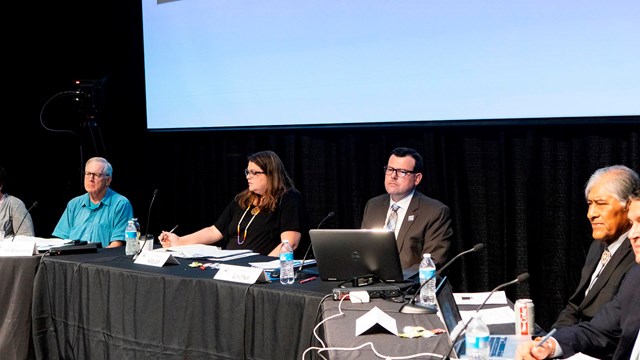
This report summarizes the Review Committee's activities for calendar years 2002, 2003 and 2004. The Review Committee convened six times during the reporting period -

•  May 31-June 2, 2002, in Tulsa, OK
•  November 8-10, 2002, in Seattle, WA
•  May 9-10, 2003, in St. Paul, MN
•  July 19, 2004, by teleconference
•  September 17-18, 2004, in Washington, DC
•  November 2, 2004, by teleconference.

Review Committee membership remained the same for calendar years 2002 and 2003. Members appointed from nominations received from Indian tribes, Native Hawaiian organizations, or traditional religious leaders were Lawrence Hart, Armand Minthorn, and Rosita Worl. Members appointed from nominations received from national museum organizations and scientific organizations were Garrick Bailey, James Bradley, and John O'Shea. The seventh member, appointed from a list of persons developed and consented to by all of the other members of the Review Committee was Vera Metcalf. Armand Minthorn served as Review Committee chair for calendar years 2002 and 2003.

Review Committee membership changed in calendar year 2004. Members appointed from nominations received from Indian tribes, Native Hawaiian organizations, and traditional religious leaders were Willie Jones, Lee Staples, and Rosita Worl. Members appointed from nominations received from national museum organizations and scientific organizations were Garrick Bailey, Dan Monroe, and Vincas Steponaitis. Vera Metcalf's term as the seventh member of the Review Committee expired in June 2004, but she agreed to serve until the position is filled. Rosita Worl was elected chair in July 2004.

The Review Committee's activities are prescribed by the Review Committee's charter and the Act. During calendar years 2002, 2003, and 2004, the Review Committee -

•  Monitored the inventory and identification process conducted by museums and Federal    agencies.
•  Facilitated the resolution of a dispute between the Western Apache and the Denver Art Museum.
•  Made recommendations on a request of the Bishop Museum for clarification regarding an item    held by Native Hawaiian organizations. This recommendation was subsequently held in    abeyance pending rehearing by the Review Committee.
•  Monitored the completion of the inventory of culturally unidentifiable human remains.
•  Consulted with Indian tribes, Native Hawaiian organizations, museums, and Federal agencies    on inventory, identification, and repatriation activities; and
•  Consulted with representatives of the Secretary of the Interior on draft proposed regulations for    the disposition of culturally unidentifiable human remains (43 CFR 10.11) and the future    applicability of the summary and inventory provisions (43 CFR 10.13).

Progress Made

Most museums and Federal agencies appear to have carried out the provisions of NAGPRA in good faith.

Section 5 of the Act requires all museums and Federal agencies that have possession or control over Native American human remains and associated funerary objects to compile inventories of such items in consultation with Indian tribes and Native Hawaiian organizations. As of December 31, 2004, inventories had been completed by 528 museums and 259 Federal agencies.

Section 6 of the Act requires all museums and Federal agencies that have possession or control over collections that may contain unassociated funerary objects, sacred objects, or objects of cultural patrimony to complete summaries of such collections. As of December 31, 2004, summaries had been completed by 767 museums and 287 Federal agencies.

Section 7 of the Act requires all museums and Federal agencies to repatriate human remains, funerary objects, sacred objects, and objects of cultural patrimony upon the request of known lineal descendants or culturally affiliated Indian tribes or Native Hawaiian organizations. While the number of actual repatriations is not monitored, notices published in the Federal Register provide a measure of museums and Federal agencies that have agreed to repatriate cultural items. As of December 31, 2004, museums and Federal agencies had published 812 notices of inventory completion accounting for the remains of 30,261 individuals and 581,679 associated funerary objects. Museums and Federal agencies had also published 300 notices of intent to repatriate accounting for 92,298 unassociated funerary objects, 1,222 sacred objects, 275 objects of cultural patrimony, and 657 cultural items that fit both the sacred and cultural patrimony categories.

Barriers Encountered

The National NAGPRA Program was established in 2000 to carry out some of the Secretary of the Interior's responsibilities for implementation of the Act. The program prepares regulations, reviews museum appeals for extension to the inventory deadline, publishes notices in the Federal Register, provides administrative and staff support to the Review Committee, administers grants to assist Indian tribes, Native Hawaiian organizations, and museums in implementing the Act, and provides technical assistance to Indian tribes, Native Hawaiian organizations, museums, and Federal agencies. It has also been responsible for implementation of the civil penalties portion of the law for those museums failing to comply. In 2003, this function was transferred from National NAGPRA to the Chief Curator, where it remains. There have been no program funds to support investigation of civil penalties cases. The Department of the Interior has never assessed a civil penalty.

Due in part to inadequate funding, the National NAGPRA Program staff has been unable to travel to provide technical assistance and to hold statutorily mandated consultation on 43 CFR 10.7, disposition of unclaimed human remains and cultural items. The program continues to have a backlog of approximately 200 unpublished Federal Register notices. The number of grants to Indian tribes, Native Hawaiian organizations, and museums has continued to be reduced as grant funds are diverted to cover administrative costs. The Review Committee is also concerned that the National NAGPRA Program has failed to take steps to ensure that museums and Federal agencies have fully complied with provisions of the Act. Many of the pending submissions of summaries and inventories have never been fully evaluated.

Separate from the costs of administration, but of equal concern to the Review Committee, are the costs of compliance. These costs include documentation, consultation, travel, and the transfer of cultural items. Most of these costs are borne by museums, Federal agencies, and tribes. The National NAGPRA Program administers a competitive grant program to assist in funding some of these activities. The National NAGPRA Program awarded grants in FY2002, FY2003, and FY2004 totaling $2,245,820, $2,201,000, and $2,182,000 respectively. These amounts are only half of what the applicants requested each year. The Review Committee strongly endorses the effectiveness of NAGPRA grants. Also, the Review Committee continues to be concerned that annual shortfalls in overall program funding are made up at the expense of grant awards. With the advent of the culturally unidentifiable database placing information in the inventories on-line and accessible to tribes, it is anticipated that there will be a resurgence of consultation activity on a large scale, putting additional pressure on the grants program.

The Review Committee remains extremely concerned that overall Federal agency compliance with NAGPRA has been excessively slow. This issue was highlighted in the Review Committee's 1999-2001 report to the Congress and has been discussed at every meeting since. Agency compliance varies widely, and while several agencies have made important internal changes in order to meet their NAGPRA responsibilities, others have made only minimal efforts. The Review Committee feels strongly that the failure by some Federal agencies to meet the standard for compliance set by nonfederal institutions is inexcusable.

The Review Committee has also heard considerable testimony reflecting concerns that information provided by Indian tribes and Native Hawaiian organizations to Federal agencies, museums, and the Review Committee in the course of repatriating cultural items can be accessed or made available to the general public via the Freedom of Information Act (FOIA). There is a genuine fear that sensitive cultural information could easily be misused, and this fear has caused some to hesitate coming forward to make rightful claims. Information relating to the location of archeological sites is exempt from FOIA requirements due to a compelling public interest in protecting sites from looting and destruction. It would seem reasonable to extend similar protections to particularly sensitive cultural information relating to confidential religious or ritual information that is presented solely for the purpose of making a claim under NAGPRA.

Recommendations

Authorized by the Native American Graves Protection and Repatriation Act [25 U.S.C. 3006], the Native American Graves Protection and Repatriation Review Committee has served since 1992 to monitor and review implementation of the Act. At its November 16-17, 2005, meeting, the Review Committee made the following recommendations:

1. Costs to Comply with NAGPRA. The Review Committee recommends that Congress      appropriate the following amounts for FY2007 to ensure continued implementation of the Act:

      •  At least $5 million in grants to Indian tribes, Native Hawaiian organizations, and museums;

      •  The amounts requested by the administration that is targeted for each Federal agency's          compliance efforts.

      The Review Committee also recommends that the President request the same amounts listed       above in the FY2008 budget proposal.

2. Definition of Native American. The Review Committee recommends strongly that      Congress amend the definition of "Native American" at 25 U.S.C. 3001 (9) by adding the words      "or was" so that it reads: "'Native American' means of, or relating to, a tribe, people, or culture      that is, or was indigenous to the United States."

The Review Committee respectfully submits these recommendations with the full and unanimous support of all members.


Native American Graves Protection and Repatriation Review Committee Members

Garrick Bailey
term 2001-2006
nominated by American Anthropological Association  

James Bradley
term 1997-2003
nominated by American Association of Museums

Rachel Craig
traditional religious leader
term 1992-1997
nominated by Treasures for Our Children, Northwest Arctic Borough, Fairbanks Native Association chair 1992  

Jonathan Haas
term 1992-1997
nominated by concurrence of other committee members  

Lawrence Hart
traditional religious leader
term 1996-2001
nominated by the Cheyenne and Arapaho Tribes and Forest County Potawatomi Community  

Willie Jones
traditional religious leader
term 2004-2008
nominated by Lummi Tribe of the Lummi Reservation, Washington

Colin Kippen
term 2005-2009
nominated by concurrence of other committee members  

Vera Metcalf
term 1998-2005
nominated by concurrence of other committee members  

Armand Minthorn
traditional religious leader
term 1997-2003
nominated by Confederated Tribes of the Umatilla Indian Reservation
chair 2000-2003
 

Dan Monroe
term 1992-1997
nominated by American Association of Museums and Museum Trustees Association
term 2004-2008
nominated by American Association of Museums

Tessie Naranjo
term 1992-1997
nominated by Santa Clara Indian Pueblo
term 1997-2000
nominated by Pueblo of Acoma and Hui Malama I Na Kupuna O Hawaii Nei
chair 1993-1999

John O'Shea
term 1997-2003
nominated by Society for American Archaeology  

Lee Staples
traditional religious leader
term 2003-2007
nominated by Mille Lacs Band of Minnesota Chippewa Tribe, Minnesota  

Martin Sullivan
term 1992-1997
nominated by American Association of Museums and Museum Trustees Association
term 1997-2000
nominated by American Association of Museums and Hui Malama I Na Kupuna O Hawaii Nei
chair 1999-2000  

Vincas Steponaitis
term 2004-2008
nominated by Society for American Archaeology  

William Tallbull
traditional religious leader
term 1992-1996
nominated by Northern Cheyenne Tribe  

Phillip Walker
term 1992-1997
nominated by Society for American Archaeology, American Association of Museums, and American Anthropological Association  

Rosita Worl
term 2001-2006
nominated by Huna Heritage Foundation
chair 2004-present


This report was prepared by the Native American Graves Protection and Repatriation Review Committee and edited and produced by the National Park Service's National NAGPRA Program.

National NAGPRA carries out certain responsibilities for the Secretary of the Interior and Assistant Secretary for Fish and Wildlife and Parks related to implementation of NAGPRA. One of these duties is to provide administrative and staff support to the Review Committee.

Statements, views, and recommendations in this report are those of the Review Committee and should not be interpreted as representing the opinions of the U.S. Government.

Send inquiries about this report to:

C. Timothy McKeown, Ph.D.
Designated Federal Officer to the
Native American Graves Protection and Repatriation Review Committee
National NAGPRA Program
1849 C Street NW (2253)
Washington, DC 20240
Tel: (202) 354-2206
Fax: (202) 371-5197

November 2005


Home
Frequently Asked Questions
Law and Regulations
Online Databases
Grants
Training
Notices
Documents and Publications
Review Committee
Special Topics
Contact National NAGPRA
navigation bar image with links to ParkNet, Links to the Past, FOIA, Privacy, Disclaimer and FirstGov Image link to ParkNet, the National Park Service websiteimage link to Links to the Past, the National Park Service's Cultural Resources websiteImage link to the National Park Service's Freedom of Information Act Image link to the National Park Service's Privacy PolicyImage link to the National Park Service's Disclaimer, Liability and Ownership notice Image link to the U.S. Government's FirstGov official web portalImage link for First GovImage link for NPS Search EngineImage link for ParknetImage link for Links to the PastImage link for FOIA PrivacyImage link for Disclaimer

PMM