Introductory title image for the National Park Service, U.S. Department of Interior and the National Center for Cultural Resources to include the official arrowhead of the National Park ServiceImage of the official National Park Service arrowhead and a link to ParkNet The National NAGPRA title image on a green background with an historic image of native baskets next to water and reed-type river grass - image by Edward S. Curtis, courtesy of NPS Resources for navigation image bar including tribes, museums, agencies, public and press linksimage for tribes linkimage for museums linkimage for agencies linkimage for public linkimage for press link

Native American Graves Protection and

Repatriation Review Committee

Report to the Congress

For 1999, 2000, and 2001


May 2003

This report was prepared by the Native American Graves Protection an Repatriation Review Committee, an edited and produced by the National Park Service's National NAGPRA program.

National NAGPRA is a program of the National Center for Cultural Resources, which is part of the National Park Service's Washington, DC, headquarters. In addition to other responsibilities for national implementation of NAGPRA, National NAGPRA provides administrative and staff support for the Review Committee.

Statements, views, and recommendations in this report are those of the Native American Graves Protection an Repatriation Review Committee and should not be interpreted as representing the opinions or policies of the U.S. Government.

Send inquiries about this report, including requests for copies, to -

Native American Graves Protection an Repatriation Review Committee
c/o National NAGPRA
1849 C Street NW (2253)
Washington, DC 20240

or to nagpra_info@nps.gov.

Native American Graves Protection and Repatriation Review Committee

Report to the Congress for 1999,2000,and 2001

May 2003

Contents

A. Introduction 2
B. Review Committee Activities 3
C. Implementation 7
D. Recommendations 10
E. Conclusion 11
F. Appendices 12
I. Native American Graves Protection and Repatriation Act 12
II. Review Committee charter 22
III. Review Committee roster 25
IV. Federal agency presentations and submissions at Review Committee meetings during the 1999 -2001 reporting period 26
V. Culturally unidentifiable Native American human remains 28
i. Recommendations Regarding the Disposition of Culturally Unidentifiable Native American Human Remains 28
ii. Summary of requests to the Review Committee for disposition of culturally unidentifiable Native American human remains 31
VI. Disputes 34
i. Dispute assistance requests to the Review Committee 34
ii. Dispute findings and recommendations: Hopi Tribe and U.S. Department of the Interior, National Park Service, Chaco Culture National Historical Park 37
iii. Dispute findings and recommendations: Fallon Paiute-Shoshone Tribe and U.S. Department of the Interior, Bureau of Land Management, Nevada State Office 39

[Page 2]


A. Introduction

Passage of the Native American Graves Protection and Repatriation Act of 1990 (NAGPRA) marked a watershed in the long an often troubled relationship between Native Americans and many of this country's educational institutions, museums, and public agencies. NAGPRA provides for the repatriation of Native American cultural items-human remains, funerary objects, sacred objects, and cultural patrimony-in museum and Federal agency collections, and cultural items that may be found on Federal or Indian land in the future, to lineal descendants and culturally affiliated Indian tribes, and to Native Hawaiian organizations. NAGPRA also provides greater protection for Native American graves located on Federal and tribal lands. Lastly, NAGPRA amends Chapter 53 of title 18 of the United States Code to prohibit trafficking in Native American human remains and, in certain situations, funerary objects, sacred objects, and cultural patrimony. NAGPRA affects all museums that have received Federal funds and all Federal agencies.

The Native American Graves Protection an Repatriation Review Committee was established under NAGPRA. The Review Committee has several statutory responsibilities, and operates in accordance with the Federal Advisory Committee Act and the Review Committee's charter. The Review Committee's actions and findings are advisory. Per NAGPRA, records and findings of the Review Committee relating to the identity or cultural affiliation of cultural items and the return of cultural items may be admissible in any action brought under Section 15 of NAGPRA.

Additional information about NAGPRA and the Review Committee is available on the
Web-www.cr.nps.gov/nagpra.

This report is prepared and submitted as required by NAGPRA: "The [Review]
Committee established under subsection (a) of this section shall submit an annual report to the Congress on the progress made, and any barriers encountered, in implementing this section during the previous year."

[Page 3]

B. Review Committee Activities

This report summarizes the Review Committee's activities for this reporting period-
calendar years 1999 through 2001. Several important changes occurred during the
reporting period, both in the Review Committee and in the National Park Service's administration of NAGPRA.

Per NAGPRA, "The [Review] Committee established under subsection (a) of this section shall be composed of 7 members, (A) 3 of whom shall be appointed by the Secretary from nominations submitted by Indian tribes, Native Hawaiian organizations, and traditional Native American religious leaders with at least 2 of such persons being traditional Indian religious leaders; (B) 3 of whom shall be appointed by the Secretary from nominations submitted by national museum organizations and scientific organizations; and (C) 1 who shall be appointed by the Secretary from a list of persons developed and consented to by all of the members appointed pursuant to subparagraphs (A) and (B)."

The roster of Review Committee members during the reporting period is included in this report as Appendix III.

The four members appointed to begin 6-year terms in 1998-Mr. James Bradley, Ms. Vera Metcalf, Mr. Arman Minthorn, and Mr. John O'Shea-served throughout the reporting period, as did Mr. Lawrence Hart.(Although Mr. Hart's term expired in September 2001,Mr.Hart agreed to continue to serve on the Review Committee until the vacancy is filled, as provided in the Review Committee's charter.)In 2000, the terms of the last two original Review Committee members, Ms. Tessie Naranjo and Mr. Martin Sullivan, expired. These members were replaced by Mr. Garrick Bailey and Ms. Rosita Worl, each appointed for a 6-year term.

Significant changes also occurred during the reporting period in the National Park Service's administration of some of the Secretary of the Interior's responsibilities under NAGPRA. In Fall 1999,in response to input by the Review Committee, the Congress, and the NAGPRA community, the Department of the Interior directed the National Park Service to separate the oversight of NAGPRA implementation within the National Park System from the administration of NAGPRA outside of the National Park System. The National Park Service proceeded immediately to separate "Park NAGPRA" from "National NAGPRA." The Archeology an Ethnography program of the National Park Service's National Center for Cultural Resources continues to administer Park NAGPRA. National NAGPRA was established as a separate program in the National Center for Cultural Resources under the National Park Service's Assistant Director, Cultural Resources.

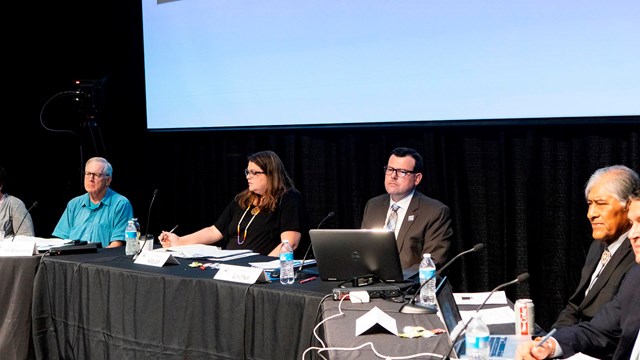
Six Review Committee meetings were convened during the reporting period -

May 3 - 5,1999 Silver Spring, MD
November 18 -20, 1999 Salt Lake City, UT
April 2 - 4, 2000 Juneau, AK
December 11 -13, 2000 Nashville, TN
May 31 -June 2, 2001 Kelseyville, CA
November 17 -19, 2001 Cambridge, MA

At each meeting, the Review Committee heard from a broad range of tribal officials and members, museum an scientific institution officials, Federal agency representatives,

[Page 4]

and members of the public on NAGPRA and its implementation. Review Committee meeting minutes are available online.

Four topics dominated Review Committee meetings during the reporting period -

1 .The need for clear and consistent administrative policy and management
At every meeting, the Review Committee heard expressions of concern on the importance of NAGPRA, the need for implementation to be balanced and fair, delays in
Implementation, and the need for National Park Service and Department of the Interior leadership in national implementation. Specifics on this topic are discussed under Implementation Issues, below.

2 . Compliance by museums and Federal agencies
Most museums and many Federal agencies appear to have carried out the provisions of NAGPRA in good faith. As of December 31, 2001, inventories of human remains an associated funerary objects, or statements of no collections, had been received from 883 museums and Federal agencies, and summaries of unassociated funerary objects, sacred objects, and objects of cultural patrimony, or statements of no collections, had been received from 1,059 museums and Federal agencies.

In May 1999,the Assistant Secretary for Fish and Wildlife and Parks denied an extension of time to complete NAGPRA inventories to six museums with particularly large collections. All six were given a specific period during which the Secretary of the Interior would forbear pursuing civil penalties. All six museums completed their inventories within the forbearance period.

NAGPRA compliance by Federal agencies appears to be more variable than NAGPRA compliance by museums. This aspect of NAGPRA implementation is discussed further under Implementation Issues, below.

3. Recommendations on the disposition of culturally unidentifiable human remains Perhaps the most pressing challenge that faced the Review Committee during the reporting period was fulfilling the statutory requirement to advise the Secretary of the Interior concerning the disposition of culturally unidentifiable Native American human remains. On June 20, 1995, and August 20, 1996, the Review Committee published in the Federal Register draft recommendations for public comment, but these recommendations failed to receive the broad support from tribes, museums, and Federal agencies necessary for their adoption as a fair and credible basis for drafting regulations. At the June 1998 Review Committee meeting in Portland, OR, the Review Committee approved "Draft Principles of Agreement Regarding the Disposition of Culturally Unidentifiable Native American Human Remains," which were published in the Federal Register on July 29, 1999. Response to the draft principles generally was favorable. The Review Committee proceeded to refine the draft principles into draft recommendations.

Mindful of the lack of support for prior recommendations regarding the disposition of culturally unidentifiable human remains, yet acutely aware of the pressing need for final regulations, the Review Committee was determined to produce a consensus document that would be both workable an command broad support. The Review Committee took as its starting point its consideration of special requests proposed to

[Page 5]

the Review Committee for the repatriation of human remains classified as culturally unidentifiable. Beginning with these examples, the Review Committee distilled the various reasons that human remains might be classified as culturally unidentifiable and then determined appropriate dispositions. Through this process the Review Committee developed draft principles of agreement that all Review Committee members, representing both Native American and scientific interests could support.

The final version of the principles of agreement was drafted and approved during the April 2000 Review Committee meeting in Juneau, AK. The final version -
"Recommendations Regarding the Disposition of Culturally Unidentifiable Native
American Human Remains "-was published in the Federal Register on June 8, 2000. The Federal Register version of the recommendations is included in this report as
Appendix V.i.

With the completion of these recommendations, the task of developing formal regulations for the disposition of culturally unidentifiable human remains passed to the National NAGPRA program and the Department of the Interior. The Review Committee will monitor the development of the regulations, and hopes that this project will proceed expeditiously.

During the reporting period, the Review Committee considered 13 requests for the repatriation of human remains that were classified as culturally unidentifiable.
Appendix V.ii summarizes Review Committee action on each of these requests. Many of the requests were submitted jointly by representatives of tribes and museums or
Federal agencies; for all of the requests, tribes and museums or Federal agencies agreed on the proposed disposition.

4 . Dispute resolution
NAGPRA specifies that the Review Committee "shall be responsible for -(3) upon the request of any affected party, reviewing an making findings related to -(A) the identity or cultural affiliation of cultural items, or (B) the return of such items; (4) facilitating the resolution of any disputes among Indian tribes, Native Hawaiian organizations, or lineal descendants and Federal agencies or museums relating to the return of such items including convening the parties to the dispute if deemed desirable." The Review Committee's roles range from mediating between parties to hearing disputes, with the disputing parties 'presenting evidence and the Review Committee's issuing findings and recommendations. The Review Committee seeks to reach consensus decisions on disputes. Appendix VI.i summarizes the dispute resolution requests to the Review Committee.

During the reporting period, the Review Committee considered two disputes at
Review Committee meetings. The first dispute involved the Hopi Tribe and the U.S.
Department of the Interior, National Park Service, Chaco Culture National Historical
Park. The second dispute involved the Fallon Paiute-Shoshone Tribe and the U.S. Department of the Interior, Bureau of Land Management, Nevada State Office. The
Review Committee findings and recommendations for these two disputes are included in this report as Appendices VI.ii and iii.

Both disputes raised points of great significance to the ongoing implementation of NAGPRA. The Hopi Tribe/Chaco Culture National Historical Park dispute raised issues concerning the nature of tribal consultation and the adequacy of collective, as

[Page 6]

opposed to one-to-one, consultation between tribes and Federal agencies. This dispute also raised questions of what constitutes adequate presentation and weighing of evidence in making determinations of cultural affiliation.

The issue of weighing various kinds of traditional and scientific evidence also was central to the dispute between the Fallon Paiute-Shoshone Tribe and the Bureau of Land Management, Nevada State Office, as was the question of what constitutes good-faith consultation. In this dispute, the Review Committee was asked to determine what constitutes sufficient evidence to demonstrate cultural affiliation between a present-day tribe and human remains from the very distant past. The dispute was unusual in that the Bureau of Land Management, Nevada State Office provided written information only and did not participate in person in presenting the dispute to the Review Committee. The Fallon Paiute-Shoshone/Bureau of Land Management, Nevada State Office dispute also was the first instance that the Review Committee did not reach a consensus decision.

Beyond immediate issues considered in these two disputes, more general issues were raised regarding the Review Committee's role in dispute resolution. In the case of the Hopi Tribe/Chaco Culture National Historical Park dispute, the director of the National Park Service's Intermountain Region, which includes Chaco Culture National Historical Park, responded to the Review Committee and declined to follow the Review Committee's recommendations the park withdraw its published notice of inventory completion and reassess its determination of cultural affiliation. While the Review Committee's recommendations are advisory, the Review Committee was disappointed by the park's and the regional office's rejection of its recommendations. When recommendations are summarily dismissed within the Review Committee's home agency, what is the likelihood that other agencies or other departments will be responsive to Review Committee requests and recommendations?

Many Native Americans look to the Review Committee as the sole recourse, short of the courts, for advice on actions by museums and Federal agencies that are perceive as improper or unfair. This is an important role that the Review Committee plays in maintaining the integrity and credibility of NAGPRA. Disregard of Review Committee recommendations by Federal agencies calls into question the viability of the Review Committee's statutory role in dispute resolution.

[Page 7]

C. Implementation

1 . Reporting and assessment
The problem of accurately assessing the progress made an barriers encountered in implementing NAGPRA is compounded by variability in reporting by museums an
Federal agencies and records management by the National NAGPRA program. The
Review Committee will work with the National NAGPRA program to develop better ways to monitor compliance so that the Review Committee can, in turn, report more comprehensively an accurately to the Congress.

2 . Costs of administering NAGPRA
Publishing Federal Register notices is a critical step in the NAGPRA repatriation process. Per NAGPRA regulations, repatriation of cultural items under NAGPRA may proceed only following publication in the Federal Register of notices of inventory completion (for human remains and associated funerary objects) or notices of intent to repatriate (for unassociated funerary objects, sacred objects, and objects of cultural patrimony) The National Park Service assists museums and Federal agencies in preparing notices, and publishes the notices on behalf of museums an Federal agencies.

The Review Committee recognizes that inadequate staffing resulting from inadequate funding has been the determining factor for the slow rate of publishing notices and the resulting backlog of unpublished notices. In the Review Committee's 1998 report to the Congress and among Review Committee recommendations to the Secretary of the
Interior in 2000, the Review Committee strongly endorsed funding sufficient to support program needs. In the FY2001 appropriation, National NAGPRA received a $400,000 funding increase for operations, including staffing. The Review Committee strongly endorses the increase, and recommends maintaining this level of funding, plus annual increases to cover normal personnel an business expense increases.

3 . Costs of NAGPRA compliance
Separate from the costs of administration, but of equal concern to the Review
Committee, are the costs of compliance. These costs include documentation, consultation, travel, and the transfer of cultural items. Most of these costs are borne by museums, Federal agencies, and tribes. National NAGPRA administers a competitive grant program to assist in funding some of these activities. In FY1999, National NAGPRA awarded 43 grants totaling $2,336,060; in FY2000, 45 grants totaling $2,245,000; in FY2001, 44 grants totaling $2,438,000. Although impressive, these amounts are only half of what the applicants requested each year. The Review Committee strongly endorses the effectiveness of NAGPRA grants. Also, the Review Committee continues to be concerned that annual shortfalls in overall program funding are made up at the expense of grant awards.

4 . Federal agency compliance
The Review Committee remains extremely concerned that overall Federal agency compliance with NAGPRA has been excessively slow. This issue was highlighted in the
Review Committee 's 1998 report to the Congress and has been discussed at every meeting since.

Agency compliance varies widely, and while several agencies have made important internal changes in order to meet their NAGPRA responsibilities, others have made only minimal efforts. The Review Committee feels strongly that the failure by some

[Page 8]

Federal agencies to meet the standard for compliance set by nonfederal institutions is inexcusable.

Based on agency testimony before the Review Committee as well as public comment, four common problems are apparent -
a. NAGPRA compliance is not an agency priority.
b. Headquarters policy directives on NAGPRA are disregarded or reinterpreted at the regional level.
c. Agency perception that consultation with tribes on a government-to-government basis is not part of NAGPRA process or not required for compliance.
d. NAGPRA does not provide for civil penalties for noncompliance by Federal agencies, unlike museums.

5 . Need for regulations on the disposition of culturally unidentifiable Native American human remains
Backed by strong public encouragement to provide the Secretary of the Interior with recommendations regarding the disposition of culturally unidentifiable human remains, this task was a top priority for the Review Committee during the reporting period. Final "Recommendations Regarding the Disposition of Culturally Unidentifiable Native American Human Remains "were adopted in April 2000 at the Review Committee meeting in Juneau, AK, forwarded to the Secretary of the Interior as recommendations for regulations, and published in the Federal Register. While the Review Committee has met its responsibility under NAGPRA to develop its recommendations, the Review Committee is concerned that promulgation of this section of the regulations does not appear to be the National NAGPRA program's highest priority.

6 . Collections contamination
Throughout the 19th and early 20th centuries, museums and collectors often
treated cultural items and storage cabinets and facilities with poisonous compounds
as preventive conservation measures to guard collections against deterioration.
These compounds bin with the component organic materials of the cultural items, rendering the objects themselves poisonous. When contaminated objects are repatriated, they may pose a health hazard for those who receive, use, and care for the objects. Pesticide contamination is an unforeseen complication in the repatriation process. Although the full extent and severity of this problem are not yet determined, pesticide treatment is known to be sufficiently widespread to present significant public health an NAGPRA implementation concerns. Research and education are essential towards fulfilling museums' and Federal agencies' responsibilities under NAGPRA 19 and addressing ongoing health and safety concerns. The National NAGPRA program is participating in current discussions on contaminated collections, and reports regularly to the Review Committee on this topic.

7 . Reorganizing the NAGPRA program
In its 1998 report to the Congress, the Review Committee expressed great concern that inadequate staffing was delaying the repatriation of human remains and other cultural items. In the following years, the location of NAGPRA within the National Park Service was perceived as a conflict of interest. The resulting political pressure to relocate NAGPRA within the Department of the Interior also contributed to delays in NAGPRA implementation. Concerns about program location grew stronger during

[Page 9]

1999 as staff numbers decreased and the backlog of unpublished notices increased. At the April 2000 NAGPRA Review Committee meeting in Juneau, AK, frustrations regarding the location of NAGPRA, staffing, and the notices backlog resulted in a Review Committee recommendation that the Secretary of the Interior "place the NAGPRA administrative structure within the Secretariat … rather than retaining it in the NPS." Subsequent changes in funding and staffing have improved program performance. The Review Committee, however, remains deeply concerned that the agency that assists the Secretary of the Interior with the Secretary 's NAGPRA responsibilities should demonstrate strong commitment to full and expeditious implementation.

8. Examples of NAGPRA implementation problems within two Federal agencies
a. National Park Service response to the Review Committee's findings and recommendations in a dispute involving a national park: As described above, in February 2000, the Review Committee received a letter from the director of the National Park
Service's Intermountain Region, stating that "Agency administrative processes are
not subject to [Review ]Committee findings and recommendations as defined in
NAGPRA and in the 'Dispute Resolution Procedures of the NAGPRA Committee'." Since the Review Committee members are appointed by the Secretary of the Interior and the Review Committee is associated administratively with the National Park
Service as the lead agency for implementing the statute, the Review Committee asked for clarification on this matter. The situation has one little to build confidence
in the commitment of the National Park Service to NAGPRA and has produced considerable uncertainty as to the role of the Review Committee.

b. Reburial on Federal land: The ability to rebury as close to the original interment site as possible is an issue of great importance to many Native Americans. Since many of the human remains subject to NAGPRA originate from burials on Federal lands, agencies' reburial policies often determine whether a repatriation can be fully satisfactory. Unfortunately, there is no uniform Federal policy on reburial. The Review Committee recommends that a uniform reburial policy on Federal lands be developed in consultation between agencies and tribes, and adopted. Some Department of the Interior agencies, such as the National Park Service, have permitted and have even encouraged reburial on land within their jurisdiction. Other land management agencies, such as the Bureau of Land Management, have prohibited reburial. This lack of a consistent Federal reburial policy has caused confusion and frustration for many Native Americans.

9 . Status of nonfederally recognized tribes, especially regarding the disposition of culturally unidentifiable human remains
At several meetings, notably the Silver Spring, MD, in 1999 and the Kelseyville, CA,
and Cambridge, MA, meetings in 2001, the Review Committee heard from tribes who are not federally recognized and therefore frequently are excluded from repatriation consultations and decisions. The issue of NAGPRA participation by nonfederally recognized tribes is complex and differs significantly in various parts of the country.
While the Review Committee is not yet prepared to make a general recommendation
on this issue, the Review Committee urges the development of mechanisms to include all legitimate claimants in the NAGPRA process.

[Page 10]

D. Recommendations

The Review Committee submits the following recommendations to the Congress in response to its experiences during the reporting period -
1. Increase funding for NAGPRA administration.
2. Increase funding for the NAGPRA grants program.
3. Encourage NAGPRA compliance by linking progress towards compliance with
Federal agencies' annual funding allocations.
4. Amend the statute.
During the reporting period, the Review Committee discussed two recommended amendments:
a. Protect Native American graves on State or private lands from unauthorized excavation and other forms of destruction, and
b. Provide that any monies received from civil penalties be used to further enforce NAGPRA.

5 . Reburial on Federal lands.
Develop Department of the Interior policy and procedures that permit reburial of cultural items repatriated under NAGPRA at secure, protected burial sites on Federal lands. Such a policy and procedures should be a model for all Federal agencies.

[Page 11]

E. Conclusion

NAGPRA has helped to rectify some of the injustices suffered by Native Americans resulting from the removal of ancestral human remains and other cultural items without permission from relatives or Indian tribes. The NAGPRA process has provided opportunities for tribes, museums, and Federal agencies to communicate with each other and to begin building new relationships based on mutual trust and respect.

Compliance with NAGPRA has increased the knowledge and understanding of
Native American concerns within most museums and some Federal agencies, and changed the ways in which Native Americans and their diverse cultures are presented to an viewed by the American public. With this increase in knowledge and understanding, NAGPRA has helped Native Americans to regain dignity and respect, which contributes to mitigating the corrosive and tragic loss of land, sovereignty, and traditional lifeways. For this progress to continue, the Congress needs to reaffirm its support for NAGPRA through appropriations that will permit full national implementation and oversight of Federal agency compliance.

The members of the Review Committee submit this report to the Congress with full and unanimous approval.

On behalf of the Review Committee -

/S/ Armand Minthorn, Chair

Appendix I: Native American Graves Protection and Repatriation Act

Appendix II: Native American Graves Protection and Repatriation Review Committee Charter

Appendix III: Review Committee roster (meeting by meeting participation)
(See PDF, or contact National NAGPRA to obtain a copy of this table)

Appendix IV: Federal agency presentations and submissions at Review Committee meetings during the 1999 - 2000 reporting period
(See PDF, or contact National NAGPRA to obtain a copy of this table)

Appendix V.i: Recommendations Regarding the Disposition of Culturally Unidentifiable Humah Remains

Appendix V.ii: Summary of requests to the Review Committee for disposition of culturally unidentifiable human remains
(See PDF, or contact National NAGPRA to obtain a copy of this table)

Appendix VI.i: Dispute requests to the Review Committee
(See PDF, or contact National NAGPRA to obtain a copy of this table)

Appendix VI.ii: Dispute findings and recommendations
NAGPRA Review Committee Advisory Findings and Recommendations Regarding Human Remains and Associated Funerary Objects in the Control of Chaco Culture National Historical Park [Feb. 10, 2000]
and
Native American Graves Protection and Repatriation Review Committee Findings and Recommendations Regarding Human Remains and Associated Funerary Objects from Spirit Cave in Nevada [Apr. 10, 2002]


Home
Frequently Asked Questions
Law and Regulations
Online Databases
Grants
Training
Notices
Documents and Publications
Review Committee
Special Topics
Contact National NAGPRA
navigation bar image with links to ParkNet, Links to the Past, FOIA, Privacy, Disclaimer and FirstGov Image link to ParkNet, the National Park Service websiteimage link to Links to the Past, the National Park Service's Cultural Resources websiteImage link to the National Park Service's Freedom of Information Act Image link to the National Park Service's Privacy PolicyImage link to the National Park Service's Disclaimer, Liability and Ownership notice Image link to the U.S. Government's FirstGov official web portalImage link for First GovImage link for NPS Search EngineImage link for ParknetImage link for Links to the PastImage link for FOIA PrivacyImage link for Disclaimer

PMM