Preservation Tech Notes, Historic Glass Number 1, Repair and Reproduction of Prismatic Glass Transoms
TPS graphic header with link to ParkNet

historic prismatic transoms
Prismatic glass transoms are an important feature of many historic storefronts.


PRESERVATION
Tech Notes


HISTORIC GLASS
NUMBER 1

Repair and Reproduction
of Prismatic Glass Transoms


Chad Randl


Hamm Building
St. Paul, Minnesota

Introduced in the 1890s, prismatic glass transoms were a popular and practical means of directing daylight into building interiors. With origins in sidewalk vault lights and glass panels used on ship decks, prismatic tiles had ridges or other raised patterns on their inside surface that refracted sunlight toward the rear of a building. The pressed tiles were usually joined together with zinc or lead in a process similar to that used to create stained glass windows. An alternative, less common approach was to bond the tiles to copper strips during immersion in an electrolytic bath, a process known as electroglazing. At the peak of popularity, over a dozen manufacturers offered varying tile patterns - each "scientifically designed" to increase natural light levels and thereby reduce reliance upon light wells and artificial light sources. Prismatic glass tiles were used both in new construction and to update existing storefronts, until changing tastes and the dominance of electricity led to their functional obsolescence by the 1930s.

drawing of prismatic glass panel and storefront transom
A typical prismatic tile with zinc came is shown on the left. Tiles on the Hamm Building had a pattern of raised circles on the inside surface. The drawing on the right illustrates a storefront with prismatic transoms.

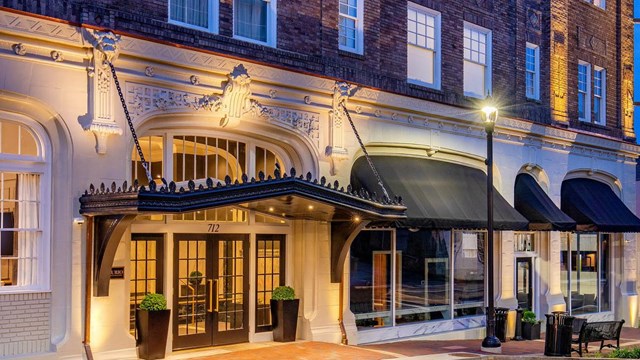
   Although prismatic transoms were seen most frequently above the display windows and doorways of modest main street buildings, they were also used in larger commercial structures. An example is the Hamm Building in St. Paul, Minnesota. This six-story structure, with shops on the ground floor, offices above, and a theatre on one side, was completed in 1920. The exterior of the building was especially admired for its cream-colored terra cotta with Classical and Renaissance Revival ornamentation.    Another important feature of the Hamm Building exterior was the large band of prismatic glass located just above the storefront awnings. Divided into groups of three and four panels separated by terra cotta pilasters, their placement mirrored the fenestration pattern on the rest of the facade. Each of the fifty-six panels was approximately 4-1/2' tall by 5' wide and contained 224 tiles, each measuring 4" high by 4" wide by ¼" thick. The tiles were made by the Manufacturers Glass Company, one of several prismatic glass producers based in Chicago. Two types of tiles were used in each Hamm Building panel. Most featured uniform rows of raised circles resembling bubbles on both sides of the tile. The other tile pattern had bubbles on the interior face only, with the manufacturer's trademark logo on the exterior side. (Both differed from a more common prism tile of the time that featured horizontal ribs on the inside surface).
exterior photo of Hamm Building
The Hamm Building featured fifty-six prismatic panels set directly above the awnings. Each panel contained over two hundred individual tiles. Photo shows completed project.

   In the Hamm Building transoms, the trademark tiles were arranged in a square border along the edge of each panel. The prisms were glazed with zinc came and set within a copper frame. A small pivoting ventilator was located in the center of each panel.

   Like many historic transoms today, a large number of the Hamm Building panels were covered over during a mid-twentieth century renovation. Only partially intact when the building was rehabilitated in the 1990s, the prisms were uncovered, removed, cleaned and reglazed. New glass that approximated the historic prisms was used to replicate several missing panels. With modifications that improved their structural strength, the transoms continue to contribute to the visual interest of the exterior and natural light levels in the interior.


Problem and Solution

Problem and Solution


Site Map


Print Version (42k)


Home |  Search |  E-mail |  Technical Preservation Services |  NPS History & Culture

Technical Preservation Services Home National Park Service Home