![]() |
PRESERVATION EXTERIOR WOODWORK Log
Crown Repair and Selective Replacement Using Epoxy and Fiberglass
Reinforcing Rebars Harrison Goodall |
||
LAMAR
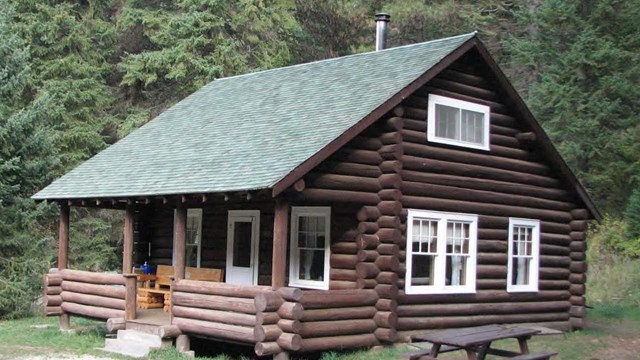
BARN In the 1930s, Yellowstone National Park set out to revive the wild buffalo herd. To meet this important goal, the park set up a buffalo ranch on the northern edge of the Lamar Valley. The project saved the buffalo, but all that remains of the Lamar Buffalo Ranch are two residences, a bunk-house (home of the Yellowstone Institute), and a horse barn. Built in 1936, the horse barn is like thousands of other log structures constructed in the rustic style between the late teens and World War II. The two-story barn is made of Lodgepole Pine logs, daubed with mortar on the out-side, chinked with wood on the inside, and set on a stone and concrete foundation. Typical of this type of building, the intersecting log wall crowns extend 12" to 28" from the corners of the building. The log rafters and purlins originally extended about 8" beyond the roof eaves and rakes, but were cut back years ago. Magnificent in its massive scale and bulky appearance, this simple barn presented a major preservation problem because of its distinctive design. Problem An inspection of the Lamar Barn revealed few surprises. Wood protected by the roof was in good condition; portions of the logs directly exposed to the weather were deteriorated. The culprit in every case was moisture. It was easy to predict where to find the greatest pockets of decay. Log crowns extending beyond the drip edge of the roof were in the worst condition. Sill logs, particularly on the north side of the building, were also badly deteriorated. The amount and depth of decay in both instances followed a pattern: the further out from the roof they extended, the greater the deterioration (see figure 1). After about sixty years, decay had taken its toll. More than half of the extending crowns were so rotten that it was possible to pull large chunks of the heartwood out of the exposed ends. In some cases, the log crowns were almost totally gone. In others, the shells of the crowns had given way and the soft mulch-like interior had fallen out. In the most severe cases, the decay had penetrated beyond the notch where the logs intersected and had traveled into the log as much as ten to twelve inches. This impacted both the visual and the structural integrity of the walls and their appearance. Logs should be repaired rather than replaced in log structures whenever possible to preserve the historic structure's integrity and character. Options for Repair There are only a few ways to treat this type of deterioration: 1) replace the deteriorated logs; 2) stabilize or repair the deteriorated portion of the crowns; 3) remove the deteriorated crowns; or 4) saw off the deteriorated portion and leave as is. In the past, the most expedient treatment was chosen. In an attempt to stop the rot, the decayed rafters and purlins were simply sawed off. It did not work. Unfortunately, this is the most frequently chosen treatment in such situations. The greatest problem with this technique is that it irreparably alters the architectural character of this type of building, which derives much of its appearance from these extending roof and corner elements. Their removal flattens the surface and dilutes the rustic qualities of the barn. For this reason, Option #4 was immediately rejected. Option #1, replacement, was not a viable choice either. More than half of the logs in the building were deteriorated to some degree. Such extensive replacement would have raised serious questions about the physical integrity of the historic building. Intervention on this scale would also have created other problems. It would have required dismantling many features connected to the exterior log walls. These included interior stalls and walls, windows, doors, frames and jambs. The exterior appearance of the building afterwards, and the notching in particular, would have looked entirely different because it would not have been possible to obtain logs with minimal taper like the original logs. Finally, replacing most of the logs in the building would have been costly as well as harmful to the historic character of the barn.
Then Option #2, patching, was also rejected. Repairing or patching decay in wood is possible only when there is enough sound wood on which to bond repair material. A good case in point is when the shell of a log is still intact. The decayed wood can be stabilized with an epoxy patch material to make the repair. In the Lamar Barn, however, there was not enough sound wood for an epoxy patch in the extending crowns. Option #3 involved cutting off the deteriorated log crowns at the area of greatest decay (the intersecting notches), and splicing on replacement crowns of the same size, configuration, and texture. This approach had several advantages:
For these reasons, Option #3 was chosen over the other alternatives. Home | Search | E-mail | Technical Preservation Services | NPS History & Culture
|
|||