TPS graphic header with link to ParkNet

WINDOWS 10


Project Evaluation
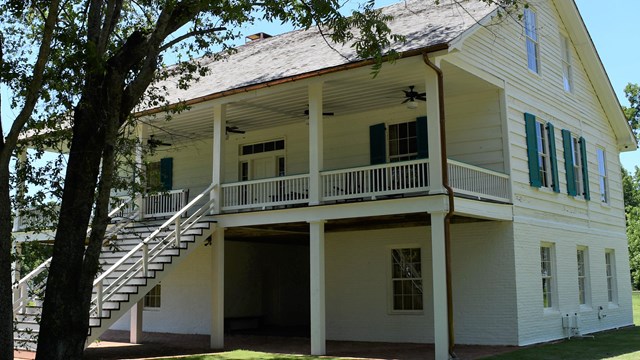
Worthington House with louvers installed
Figure 6. The window louvers installed in the Worthington House have proven effective over the past two years in providing the necessary ventilation for the building. Photo: Tom Vitanza.
The window louvers installed in the Worthington House have proven effective over the past two years in providing the necessary ventilation for the building (see figure 6). Neither fungal attack nor condensation damage has recurred, and the interior air lacks even the typically humid, musty odor typically found in many older buildings. The louvers provide for good air movement within the building and a greater equilibrium between interior and exterior humidity levels and air temperatures, thus helping to protect the historic plaster and the significant interior finishes. The installation of the louver system in conjunction with the other sash work, and the overall exterior stabilization work has stimulated an interest in finding a use for the structure. As a temporary solution to a complex set of problems, the louver vents in the Worthington House have resolved a variety of issues. When used together with additional weatherproofing measures, this venting solution can be adopted for use in other buildings being mothballed.
PROJECT DATA

Building: Worthington House
Monocacy National Battlefield
Frederick County, Maryland

Owner: National Park Service
Antietam National Battlefield
Sharpsburg, Maryland

Project Date: January-lune 1983

Project Staff:
Williamsport Preservation Training Center National Park Service Williamsport, Maryland
Douglas C. Hicks, Project Supervisor Supervisory Exhibit Specialist
Thomas A. Vitanza, Project Leader Historical Architect Trainee
William Hose, Exhibit Specialist Trainee
Bruce Martin, Woodworking Specialist


Project Cost: Material and labor for construction of the 17 full size, 7 basement and 3 attic louvers was approximately $1,800. The material and labor cost for reconstruction of the sash, including glazing, painting, sizing and installation was around $5,200 (roughly $100 per sash unit), involving 21 pairs of double-hung sash and 7 basement and 3 attic windows. All other related work for the 31 openings, including sizing and installation of the louvers, repair to window openings (repair/replacement of sills and jambs and related masonry work), painting, and installation of screening and blocking cost between $1 ,000 and $2,000. Total window costs for complete sash and the louvers as well as installation and finish work was between $8,000 and $9,000.
 
This PRESERVATION TECH NOTE was prepared by the National Park Service. Charles E, Fisher, Preservation Assistance Division, National Park Service serves as Technical Coordinator for the PRESERVATION TECH NOTES . Special thanks go to James S. Askins, Branch Chief . Williamsport Preservation Training Center, for his time and generous assistance in providing information concerning the ventilation problems of mothballed historic buildings. Thanks also go to Doug Hicks, Project Supervisor, Williamsport Preservation Training Center, for his contributions to this Tech Note. The following Preservation Assistance Division staff contributed to the production of this Tech Note: Michael J. Auer, Brenda Johnson, Christine Henry, Janet L. Thomas , Theresa Robinson, and Alicia Hardison. Cover Photo: Tom Vitanza.

This and many of the PRESERVATION TECH NOTES on windows are included in ''The Window Handbook: Successful Strategies for Rehabilitating Windows in Historic building's a joint publication of the Preservation Assistance Division, National Park Service, and the Center for Architectural Conservation, Georgia Institute of Technology. For information write to The Center for Architectural Conservation, P.O. Box 93402, Atlanta, Georgia 30377.

PRESERVATION TECH NOTES are designed to provide practical information on practices and innovative techniques for successfully maintaining and preserving cultural resources. Al1 techniques and practices described herein conform to established National Park Service policies, procedures, and standards. This Tech Note was prepared pursuant to the National Historic Preservation Act Amendments of 1980 which directs the Secretary of the Interior to develop and make available to government agencies and individuals information concerning professional methods and techniques for the preservation of historic properties.

ISSN:0741 -9023 PTN- l I August l 985


Introduction

Introduction


Contents


Print Version (42k)


Home |  Search |  E-mail |  Technical Preservation Services |  NPS History & Culture

Technical Preservation Services Home National Park Service Home