Identify, Retain and Preserve

Identifying, retaining, and preserving entrances
and porches--and their functional and decorative features--that
are important in defining the overall historic character
of the building such as doors, fanlights, sidelights,
pilaster, entablatures, columns, balustrades, and stairs.
 |
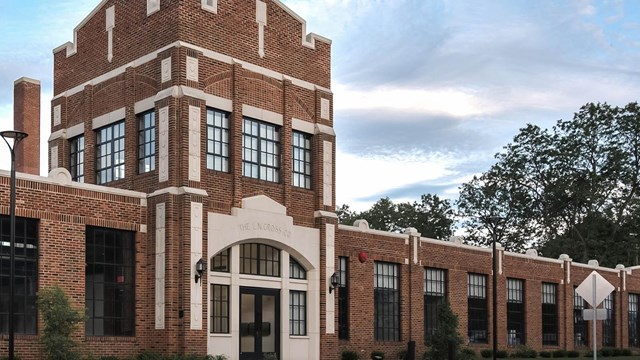
Entrances and porches are quite often the focus
of historic buildings, particularly on primary
elevations, such as this dramatic brick archway
on an early 20th century building. Photo: NPS
files.
|
Removing or radically changing entrances and porches
which are important in defining the overall historic
character of the building so that, as a result, the
character is diminished.
Stripping entrances and porches of historic material
such as wood, cast iron, terra cotta tile, and brick.
Removing an entrance or porch because the building
has been re-oriented to accommodate a new use.
Cutting new entrances on a primary elevation.Altering
utilitarian or service entrances so they appear to be
formal entrances by adding panelled doors, fanlights,
and sidelights.
Altering utilitarian or service entrances so they appear
to be formal entrances by adding panelled doors, fanlights,
and sidelights.

Protect and Maintain

Protecting and maintaining the masonry, wood, and
architectural metals that comprise entrances and porches
through appropriate surface treatments such as cleaning,
rust removal, limited paint removal, and re-application
of protective coating systems.

Failing to provide adequate protection to materials
on a cyclical basis so that deterioration of entrances
and porches results.
Failing to undertake adequate measures to assure the
protection of historic entrances and porches.

Repair
Repairing entrances and porches by reinforcing
the historic materials. Repair will also generally include
the limited replacement in kind--or with compatible
substitute material--of those extensively deteriorated
or missing parts of repeated features where there are
surviving prototypes such as balustrades, cornices,
entablatures, columns, sidelights, and stairs.
 |
 |
In Rehabilitation, deteriorated features should
be repaired, whenever possible, and replaced when
the severity of the damage makes it necessary.
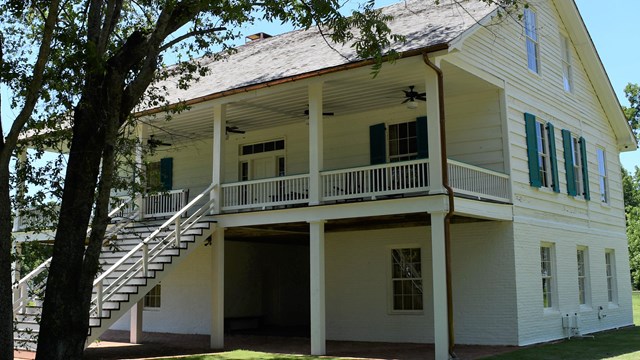
Here, a two-story porch is seen prior to treatment
(before). The floor boards are rotted out and
the columns are structurally unsound. Other components
are in varying stages of decay. Appropriate work
on the historic porch (after) included repairs
to the porch rails; and total replacement of the
extensively deteriorated columns and floor boards.
Some dismantling of the porch was necessary. Photos: NPS files.
|

Replacing an entire entrance or porch when the repair
of materials and limited replacement of parts are appropriate.
Using a substitute material for the replacement parts
that does not convey the visual appearance of the surviving
parts of the entrance and porch or that is physically
or chemically incompatible.

Replace

Replacing in kind an entire entrance or porch that
is too deteriorated to repair--if the form and detailing
are still evident--using the physical evidence as a
model to reproduce the feature. If using the same kind
of material is not technically or economically feasible,
then a compatible substitute material may be considered.

Removing an entrance or porch that is unrepairable and
not replacing it; or replacing it with a new entrance
or porch that does not convey the same visual appearance.
The following work
is highlighted to indicate that it represents
the particularly complex technical or design aspects
of Rehabilitation projects and should only be
considered after the preservation concerns listed
above have been addressed.
Design for the Replacement of Missing Historic
Features

Designing and constructing a new entrance or
porch when the historic entrance or porch is completely
missing. It may be a restoration based on historical,
pictorial, and physical documentation; or be a
new design that is compatible with the historic
character building.

Creating a false historical appearance becausethe
replaced entrance or porch is based on insufficient
historical, pictorial, and physical documentation.
Introducing a new entrance or porch that is incompatible
in size, scale, material, and color.

The following work is
highlighted to indicate that it represents the
particularly complex technical or design aspects
of Rehabilitation projects and should only be
considered after the preservation concerns listed
above have been addressed.
Alterations/Additions for the New Use

Designing enclosures for historic porches
on secondary elevations when required by the new
use in a manner that preserves the historic character
of the building. This can include using large
sheets of glass and recessing the enclosure wall
behind existing scrollwork, posts, and balustrades.
Designing and installing additional entrances
or porches on secondary elevations when required
for the new use in a manner that preserves the
historic character of the buildings, i.e., limiting
such alteration to non-character-defining elevations.

Enclosing porches in a manner that results in
a diminution or loss of historic character by
using materials such as wood, stucco, or masonry.
 |
 |
 |
As part of a rehabilitation project, a late-19th century
produce distribution center (top
left) with a utilitarian loading dock (top
right) was removed and replaced with a monumental entrance featuring
massive formal columns (left). The new
addition is incompatible with the
simple, industrial character of the building.
Photos: NPS files.
|
Installing secondary service entrances and porches
that are incompatible in size and scale with the
historic building or obscure, damage, or destroy
character-defining features.
|
|
 |

|