Building Exterior

Reconstructing a non-surviving building to depict
the documented historic appearance. Although traditional
building materials such as masonry, wood, and architectural
metals are preferable, substitute materials may be used
as long as they re-create the historical appearance.
Re-creating the documented design of exterior features
such as the roof shape and coverings; architectural
detailing; windows; entrances and porches; steps and
doors; and their historic spatial relationships and
proportions.
Reproducing the appearance of historic paint colors
and finishes based on physical and documentary evidence.
Using signs to identify the building as a contemporary
re-creation.
 |
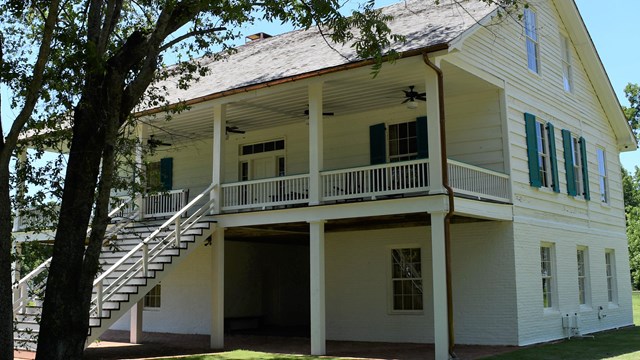
The 1778 Kershaw House, which served as British
Headquarters during the Revolutionary War, was
burned by Union troops in 1865. In the early 1970s,
the house was reconstructed as part of Camden
Battlefield, Camden, South Carolina. Built expressly
for interpretive purposes, it serves as an illustrative
reminder of a past event of national significance.
The Standards for Reconstruction call for any
re-created building to be clearly identified as
a contemporary depiction. This is most often done
by means of an exterior sign or plaque, or through
an explanatory brochure or exhibit. A guide may
inform visitors as well. Photo: NPS files.
|
Reconstructing features that cannot be documented historically
or for which inadequate documentation exists.
Using substitute materials that do not convey the appearance
of the historic building.
Omitting a documented exterior feature; or re-building
a feature, but altering its historic design.
Using inappropriate designs or materials that do not
convey the historic appearance, such as aluminum storm
and screen window combinations.
Using paint colors that cannot be documented through
research and investigation to be appropriate to the
building or using other undocumented finishes.
Failing to explain that the building is a reconstruction,
thus confusing the public understanding.
|