Identify, Retain and Preserve

Identifying, retaining, and preserving wood features
that are important in defining the overall historic
character of the building such as siding, cornices,
brackets, window architraves, and doorway pediments;
and their paints, finishes, and colors.
 |
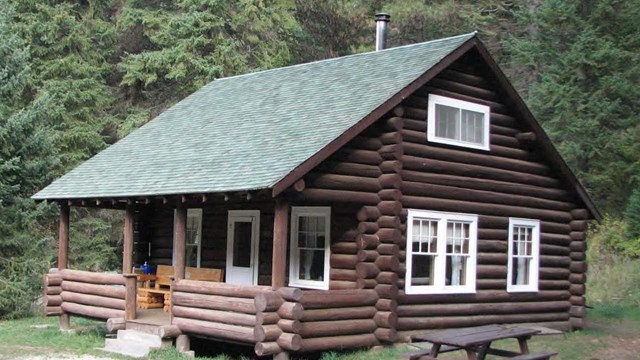
Whether it is used for exterior cladding,
roofing, interior finishes, decorative features, or structural members,
wood is frequently an essential component of historic
and older buildings which should be retained and
preserved. Photo: NPS files.
|
Altering wood features which are important in defining
the overall historic character of the building so that,
as a result, the character is diminished.
Replacing historic wood features instead of repairing
or replacing only the deteriorated wood.
Changing the type of paint or finish and its color.

Stabilize

Stabilizing deteriorated or damaged wood as a preliminary
measure, when necessary, prior to undertaking appropriate
preservation work.

Failing to stabilize deteriorated or damaged wood until
additional work is undertaken, thus allowing further
damage to occur to the historic building.

Protect and Maintain

Protecting and maintaining wood features by providing
proper drainage so that water is not allowed to stand
on flat, horizontal surfaces or accumulate in decorative
features.
Applying chemical preservatives to wood features
such as beam ends or outriggers that are exposed to
decay hazards and are traditionally unpainted.
Retaining coatings such as paint that help protect
the wood from moisture and ultraviolet light. Paint
removal should be considered only where there is paint
surface deterioration and as part of an overall maintenance
program which involves repainting or applying other
appropriate protective coatings.
Inspecting painted wood surfaces to determine whether
repainting is necessary or if cleaning is all that is
required.
 |
 |
Maximizing retention of historic materials and
features is the primary goal of Preservation, as
demonstrated here in these "before" and "after"
photographs. Aside from some minor repairs and
limited replacement of deteriorated material,
work on this house consisted primarily of repainting
the wood exterior. Photos: Historic Charleston
Foundation.
|
Removing damaged or deteriorated paint to the next
sound layer using the gentlest method possible (handscraping
and handsanding), then repainting.
Using with care electric hot-air guns on decorative
wood features and electric heat plates on flat wood
surfaces when paint is so deteriorated that total removal
is necessary prior to repainting.
Using chemical strippers primarily to supplement
other methods such as handscraping, handsanding and
the above-recommended thermal devices. Detachable wooden
elements such as shutters, doors, and columns may--with
the proper safeguards--be chemically dip-stripped.
Applying compatible paint coating systems following
proper surface preparation.
Repainting with colors that are appropriate to the
historic building and district.
Evaluating the existing condition of the wood to
determine whether more than protection and maintenance
are required, that is, if repairs to wood features will
be necessary.

Failing to identify, evaluate, and treat the causes
of wood deterioration, including faulty flashing, leaking
gutters, cracks and holes in siding, deteriorated caulking
in joints and seams, plant material growing too close
to wood surfaces, or insect or fungus infestation.
Using chemical preservatives such as creosote which,
unless they were used historically, can change the appearance
of wood features.
 |
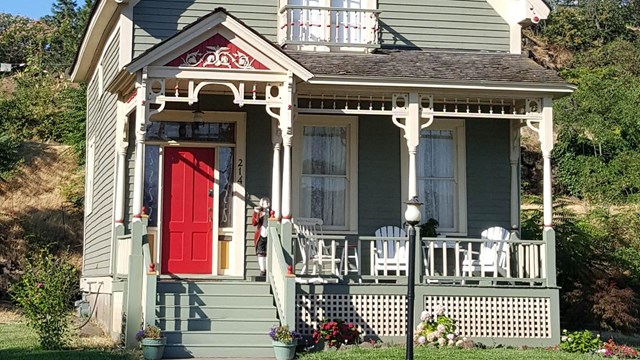
As shown, the paint on this house is failing in isolated spots, while most of it is in good condition. On
older buildings heavy paint buildup is common.
The thick paint film traps moisture in the wood.
As the moisture escapes from the wood it pushes
the paint off the wall, leaving spots of bare
wood. Photo: © John Leeke.
|
Stripping paint or other coatings to reveal bare wood,
thus exposing historically coated surfaces to the effects
of accelerated weathering.
Removing paint that is firmly adhering to, and thus,
protecting wood surfaces.
Using destructive paint removal methods such as propane
or butane torches, sandblasting or waterblasting. These
methods can irreversibly damage historic woodwork.
Using thermal devices improperly so that the historic
woodwork is scorched.
Failing to neutralize the wood thoroughly after using
chemicals so that new paint does not adhere.
Allowing detachable wood features to soak too long
in a caustic solution so that the wood grain is raised
and the surface roughened.
Failing to follow manufacturers' product and application
instructions when repainting exterior woodwork.Using
new colors that are inappropriate to the historic building
or district.
Failing to undertake adequate measures to assure the
protection of wood features.

Repair

Repairing, stabilizing, and conserving fragile wood
using well-tested consolidants, when appropriate. Repairs
should be physically and visually compatible and identifiable
upon close inspection for future research.
Repairing wood features by patching, piecing-in,
or otherwise reinforcing the wood using recognized preservation
methods. The new work should be unobtrusively dated
to guide future research and treatment.

Removing wood that could be stabilized and conserved;
or using untested consolidants and untrained personnel,
thus causing further damage to fragile historic materials.
Removing wood that could be repaired, using improper
repair techniques, or failing to document the new work.
The following work
is highlighted to indicate that it represents
the greatest degree of intervention generally
recommended within the treatment Preservation,
and should only be considered after protection,
stabilization, and repair concerns have been addressed.
Limited Replacement in Kind

Replacing in kind extensively deteriorated or
missing parts of wood features when there are
surviving prototypes such as brackets, molding,
or sections of siding. New work should match the
old in material, design, color, and texture; and
be unobtrusively dated to guide future research
and treatment.
 |
An example of "limited replacement in
kind" points out an appropriate scope of
work within the treatment, Preservation.
Targeted repairs to deteriorated wood cornice
elements (fascia board and modillions) meant
that most of the historic materials were
retained in the work. Photo: NPS files.
|

Replacing an entire wood feature such as a column
or stairway when limited replacement of deteriorated
and missing parts is appropriate.
Using replacement material that does not match
the historic wood feature; or failing to properly
document the new work.
|
|